

Key Takeaways
- SaaS companies should not choose marketing channels because they are popular.
- The right channel depends on your product, audience, ACV, sales cycle, and growth stage.
- SEO, content, email, and referrals can lower customer acquisition costs over time.
- PPC, LinkedIn Ads, and ABM work better when your messaging and ICP are already clear.
- Strong SaaS teams build a channel mix that supports acquisition, activation, retention, and expansion.
SaaS growth rarely comes from being everywhere. It comes from being in the right places, with the right message, in front of the right buyers.
That is where many SaaS companies make mistakes. They see a competitor growing through LinkedIn Ads, so they launch ads. They hear SEO has strong ROI, so they publish blog posts. They notice another company growing through PLG, so they add a free trial without fixing onboarding.
The channel is not the strategy. A channel only works when it matches the product, market, buyer journey, price point, and revenue model.
HubSpot can win with a massive content engine because it has authority, a broad market, and a large product ecosystem. A new SaaS startup may need direct outreach, niche SEO, and founder-led sales before it invests heavily in scale channels.
LinkedIn Ads can help an enterprise SaaS company reach CFOs, IT leaders, and operations teams. But for a low-ACV SaaS product, the cost can become difficult to justify. SEO can reduce CAC over time, but it needs patience, expertise, and consistent publishing.
This guide breaks down the best SaaS marketing channels for 2026. It also explains how to choose the right channels based on business model, growth stage, buyer behavior, ACV, and revenue impact.
What Are SaaS Marketing Channels?
SaaS marketing channels are the platforms, systems, and strategies software companies use to attract, convert, activate, retain, and grow subscribers.
They help SaaS companies create demand, generate qualified pipelines, increase product adoption, and protect recurring revenue.
For SaaS companies, marketing does not end when someone books a demo or starts a free trial. That moment is only the beginning.
The real goal is to bring in the right customers, help them see value quickly, keep them engaged, and grow their account over time. Most SaaS channels fall into three main groups.
Acquisition to Retention Funnel
Graph showing Acquisition → Activation → Retention → Expansion.
| Channel Type | Main Purpose |
|---|---|
| Acquisition | Bring qualified prospects into the funnel |
| Activation | Help users experience product value faster |
| Retention | Improve renewals, loyalty, and expansion revenue |
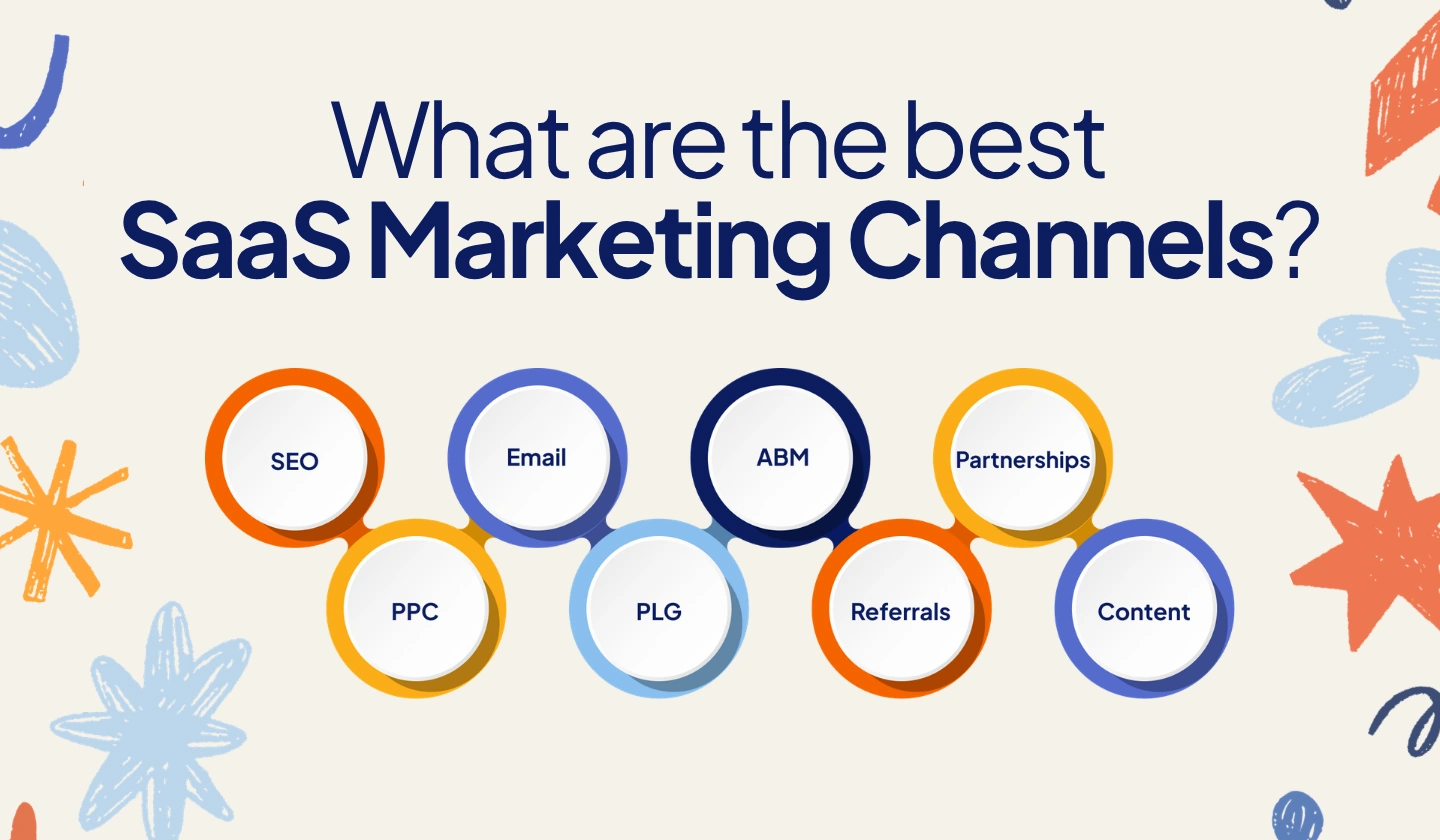
Acquisition channels include SEO, PPC, LinkedIn Ads, webinars, referrals, partnerships, and ABM.
Activation channels include onboarding emails, in-app messaging, product education, templates, free trials, and PLG loops.
Retention channels include lifecycle email, customer marketing, communities, renewal campaigns, product updates, and expansion offers.
A good SaaS marketing strategy connects all three. It does not only create traffic. It helps move people from first touch to product value, and from product value to long-term revenue.
Why SaaS Companies Need a Different Channel Strategy
SaaS companies grow differently from traditional businesses.
A traditional company may focus on one-time purchases. A SaaS company depends on recurring revenue, renewals, upgrades, retention, and customer success.
That changes how marketing should be measured.
A demo request or trial signup matters, but it does not tell the full story. SaaS teams need to know whether a channel brings users who activate, convert, stay, and expand.
That means tracking metrics like CAC, LTV, payback period, activation rate, retention, pipeline quality, and expansion revenue.
| Traditional Business | SaaS Business |
|---|---|
| One-time sale | Recurring revenue |
| Short customer relationship | Long customer lifecycle |
| Immediate ROI focus | Longer CAC payback |
| Transaction-based marketing | Lifecycle-based marketing |
| Campaign reporting | Revenue attribution reporting |
SaaS buyers also need more confidence before they convert.
They compare features, pricing, integrations, onboarding, security, reviews, support, and business impact. In B2B SaaS, several people may influence the final decision.
A marketing manager may like the product. Finance may question the cost. IT may review security. Leadership may ask about ROI.
That is why SaaS marketing needs education, proof, positioning, product experience, and nurturing.
Product-led growth also changes the channel mix. For companies like Notion, Canva, and Slack, the product itself helps drive adoption. Their channels support sharing, collaboration, templates, onboarding, and repeat usage.
Traditional marketing often focuses on awareness and conversion. SaaS marketing must support the full customer journey.
The Best SaaS Marketing Channels in 2026
There is no single best SaaS marketing channel.
The best channel for your company depends on your market, growth stage, ACV, product maturity, sales cycle, budget, and team capability.
Before investing heavily in any channel, review these factors.
| Factor | What to Evaluate |
|---|---|
| Speed | How quickly can the channel create demand? |
| CAC | How expensive is customer acquisition? |
| Scalability | Can the channel grow without costs rising too fast? |
| Revenue Impact | Can it influence trials, demos, pipeline, or ARR? |
| Attribution | Can you connect activity to revenue outcomes? |
| Fit | Does it match your ICP, ACV, and sales cycle? |
A healthy SaaS channel mix balances short-term pipeline with long-term efficiency.
Paid channels can create faster demand. Organic channels can reduce CAC over time. Product-led channels can scale when users reach value quickly.
The goal is not to use every channel. The goal is to choose the few that can create meaningful revenue for your SaaS model.
SEO
SEO is one of the strongest long-term marketing channels for SaaS companies.
It helps your brand appear when buyers are already searching for problems, solutions, comparisons, pricing, integrations, alternatives, and product categories.
That makes SEO especially useful for B2B SaaS, PLG SaaS, vertical SaaS, and category-led software companies.
| Metric | Evaluation |
|---|---|
| CAC | Low over time |
| Speed | Slow |
| Scalability | High |
| Long-Term ROI | Strong |
Strong SaaS SEO usually includes use case pages, comparison pages, alternative pages, integration pages, feature pages, pricing-related content, and bottom-funnel guides.
For example, Zapier uses integration-led pages to capture users searching for specific workflow solutions. Ahrefs and Semrush use educational content to earn trust from people who already care about SEO and marketing.
A payroll SaaS could use SEO to target searches around payroll compliance, tax forms, HR integrations, and payroll automation. These keywords may not always create instant demos, but they attract buyers who are already researching the problem.
The biggest challenge with SEO is time.
It does not usually create a pipeline in a few weeks. It needs technical health, strong internal linking, topical authority, useful content, and consistent publishing. But when SEO works, it becomes a long-term revenue asset.
Content Marketing
Content marketing helps SaaS companies educate buyers before they are ready to speak with sales.
It builds trust, answers objections, supports SEO, and gives sales teams better material for follow-up conversations.
Good SaaS content is not random blogging. It should match the buyer’s journey.
Some content should help readers understand the problem. Some should compare solution options. Some should help buyers justify the investment. Some should help customers get more value after they purchase.
Useful SaaS content can include blog posts, buyer guides, templates, reports, case studies, product tutorials, comparison guides, industry benchmarks, and thought leadership articles.
Content works best when the buyer needs education before making a decision.
HubSpot built authority by teaching marketers and sales teams. Notion supports adoption through templates and workflows. Ahrefs earns trust by showing practical SEO examples.
A project management SaaS selling to agencies could publish content on client approval workflows, team utilization, project profitability, and deadline management. That type of content speaks to real operational problems, not just broad productivity topics.
The benefit is long-term trust and lower acquisition cost. The challenge is quality.
Generic content does not build authority. Thin content does not create a pipeline. The best SaaS content helps the reader before it asks for anything in return.
AI Search Optimization
AI search optimization helps SaaS brands appear in AI-generated answers.
Buyers now use ChatGPT, Google AI Overviews, Perplexity, and other answer engines to compare tools, understand categories, and shortlist vendors.
That means SaaS visibility is no longer limited to traditional search results.
AI search optimization is about making your brand easy to understand, easy to compare, and easy to reference.
Important actions include:
- Writing clear answer-first sections
- Adding comparison tables
- Defining your category clearly
- Building detailed author profiles
- Using structured data where helpful
- Creating pages for use cases and alternatives
- Keeping product positioning consistent across the web
- Earning credible third-party mentions
- Adding original examples, frameworks, and insights
- Answering specific buyer questions directly
This matters because a buyer may ask:
“What is the best CRM for a small SaaS company?”
Or:
“What are the best project management tools for agencies?”
If your product, positioning, audience, use cases, and proof points are unclear, AI systems may not understand when to include your brand.
A customer support SaaS should not only publish a generic page about customer support software. It should also explain who the product is best for, which integrations it supports, how it compares with alternatives, and what type of support teams use it.
The challenge is measurement.
AI visibility is still harder to track than SEO, PPC, or email, but it can influence awareness, consideration, and vendor shortlisting.
For SaaS companies, AI search optimization should work with SEO, content, digital PR, and brand authority building.
PPC
PPC helps SaaS companies create demand faster.
It works best when buyers already understand the problem and are actively searching for a solution, competitor, pricing page, integration, or alternative.
Google Search Ads can support demo requests, trial signups, competitor campaigns, pricing campaigns, comparison landing pages, integration campaigns, and high-intent keyword campaigns.
PPC is useful when you need a pipeline while SEO is still building. It can also help test messaging, offers, and landing pages before investing heavily in organic content.
| Metric | Evaluation |
|---|---|
| CAC | Medium to high |
| Speed | Fast |
| Scalability | Strong with control |
| Risk | High without tracking |
The biggest risk is wasted spending.
SaaS clicks can be expensive. If the landing page is weak, the offer is unclear, or the sales follow-up is slow, PPC can drain the budget quickly.
PPC should not be judged by clicks alone.
Track cost per lead, demo rate, trial quality, SQL rate, CAC, payback period, pipeline created, and revenue influenced.
Good PPC is not about buying traffic.
It is about buying the right demand at a cost your business can afford.
LinkedIn Ads
LinkedIn Ads are useful for B2B SaaS companies that need to reach specific roles, industries, companies, and buying committees.
This channel becomes valuable when your SaaS product sells to a clearly defined audience. If you know the job titles, company sizes, industries, and pain points you want to reach, LinkedIn can help you get in front of them.
Strong LinkedIn campaigns often promote reports, webinars, expert content, customer stories, thought leadership, problem-aware content, and account-based campaigns.
LinkedIn Ads usually work better for higher-ACV products.
For low-ticket SaaS products, the cost can become difficult to justify unless the funnel is highly optimized.
A construction SaaS company could use LinkedIn Ads to reach operations directors, project managers, and executives at mid-sized construction firms. Instead of sending them directly to a demo page, it could promote a report on project delays, cost overruns, and field productivity first.
The benefit is precise B2B targeting.
The downside is expensive clicks, creative fatigue, and longer attribution cycles.
Cold demo ads often perform poorly on LinkedIn. A better approach is to educate the audience first, then retarget engaged users with stronger conversion offers.
Email Marketing
Email marketing is one of the most useful lifecycle channels for SaaS.
It helps with lead nurturing, onboarding, activation, retention, upgrades, renewals, and win-back campaigns.
For SaaS teams, email should do more than send newsletters. It should guide people toward the next useful step.
Email can support demo follow-up, trial onboarding, product education, renewal reminders, feature announcements, upgrade campaigns, customer activation, abandoned trial recovery, and lead nurturing sequences.
The best SaaS emails are based on behavior.
A trial user who has not activated needs one message. A product-qualified lead needs another. A customer near renewal needs something different again.
The benefits are clear.
Email is affordable, fast to launch, easy to personalize, and useful across the full customer journey.
The risks are poor segmentation, weak deliverability, list fatigue, and generic messaging.
Email works when it feels timely and helpful.
It fails when it feels like noise.
Product-Led Growth
Product-led growth means the product plays a major role in acquisition, activation, and expansion. PLG works when users can experience value before speaking with sales.
Companies like Slack, Canva, and Notion show how product usage can create adoption, sharing, and growth.
Common PLG motions include free trials, freemium plans, templates, invite loops, collaboration features, product sharing, in-app onboarding, and usage-based upgrade prompts.
PLG can reduce CAC because users see value before a sales conversation. It can also create product-qualified leads for sales teams. These leads are often warmer because they have already used the product.
But PLG depends heavily on product experience. If onboarding is confusing, value is unclear, or activation is slow, PLG will struggle.
This channel works best for collaborative, self-serve, usage-driven, or template-based SaaS products.
Referral Marketing
Referral marketing turns happy customers into a growth channel. It works through user invites, rewards, credits, partner incentives, and sharing loops. This channel performs best when the product naturally gives people a reason to share it.
That often happens with productivity tools, creative platforms, project management tools, communication software, collaboration products, and team-based SaaS tools.
Referrals can convert well because they come with trust. A recommendation from a friend, colleague, or teammate often feels more credible than an ad. The downside is that referrals are harder to force.
Customers need to like the product first. The referral offer must also be simple, clear, and worth sharing.
The best referral programs feel natural. They reward users without making the experience feel awkward.
Partner Marketing
Partner marketing helps SaaS companies grow through relationships with other businesses. These partners may include agencies, consultants, affiliates, implementation firms, integration partners, marketplaces, and technology ecosystems.
This channel works well when your product fits into a larger workflow.
For example, CRM, analytics, finance, HR, automation, and operations tools often benefit from partner ecosystems.
Partners can help with referrals, co-marketing, implementation, customer success, integration adoption, shared pipeline, and retention support.
The main advantage is trust. A good partner already has access to the audience you want to reach. The challenge is management.
Partnerships need enablement, incentives, shared goals, clear ownership, and pipeline accountability. Partner marketing works best when both sides clearly benefit from the relationship.
Community Marketing
Community marketing builds trust through shared learning and peer conversations.
SaaS discovery often happens inside Slack groups, Discord servers, Reddit threads, LinkedIn groups, private communities, and industry networks.
This channel works well when buyers care about peer recommendations.
It is especially useful for developer tools, PLG SaaS, creative software, technical products, niche B2B SaaS, and productivity platforms.
Community is not usually a direct sales channel. It works through education, trust, advocacy, feedback, and long-term engagement.
The benefits include loyalty, user insights, organic advocacy, and stronger customer relationships. The drawbacks include slow growth, moderation work, and difficult attribution.
The best SaaS communities do not push the product all the time. They help people solve real problems.
Webinar Marketing
Webinars help SaaS companies educate buyers and create a warmer pipeline. They work well for complex products, technical solutions, high-consideration purchases, and longer sales cycles.
A strong SaaS webinar can explain the problem, common mistakes, industry trends, useful frameworks, solution options, implementation steps, product use cases, and business outcomes.
Webinars are useful because they show buying intent. Someone who attends a detailed webinar is usually more engaged than someone who only clicks an ad.
The benefits include strong engagement signals, reusable content, sales enablement, and warmer follow-up. The downsides are planning time, production effort, attendance drop-off, and follow-up dependency.
A webinar should not feel like a long product pitch. Teach something useful first, then show the product only where it naturally supports the lesson.
Influencer Marketing
Influencer marketing helps SaaS companies build trust through credible industry voices. For B2B SaaS, influencers are often LinkedIn creators, consultants, newsletter writers, podcast hosts, analysts, operators, or niche experts.
This channel works when the creator already speaks to your ideal customers.
A strong SaaS influencer campaign can support brand awareness, expert validation, product education, audience trust, content distribution, and category authority.
The benefit is credibility. The right creator can make your product easier to trust because the audience already trusts them.
The risks include poor creator fit, weak attribution, and inconsistent performance. SaaS influencer marketing should not feel like a random sponsorship.
It works best when the creator connects your product to real problems, real workflows, and real buyer needs.
Podcast Marketing
Podcast marketing helps SaaS companies reach professional audiences through deeper conversations. A SaaS company can start its own podcast, sponsor relevant shows, or appear as a guest on industry podcasts.
This channel works well for founder visibility, executive authority, category education, enterprise trust, expert conversations, and brand awareness.
Podcasts are usually better for trust than direct conversion. They help your brand stay part of the conversations your buyers already care about. The benefits include depth, relationship building, audience connection, and authority. The drawbacks include slow growth, consistency requirements, and difficult attribution.
Podcast marketing works best when the topics are specific and useful. A general podcast is easy to ignore. A focused one can build real authority.
YouTube Marketing
YouTube helps SaaS companies build trust through visual education. Many buyers want to see how a product works before they speak with sales. That makes video a strong channel for tutorials, comparisons, demos, and product-led education.
YouTube can support product demos, tutorials, comparison videos, use case explainers, integration walkthroughs, customer stories, category education, and problem-solving content.
Ahrefs and Semrush use video well because they teach practical topics while showing product value naturally.
YouTube also supports search visibility. Videos can rank on both YouTube and Google. The benefits include long shelf life, visual depth, product clarity, and search discovery.
The challenges are production quality, consistency, and time. YouTube works best when videos answer real questions from buyers and users. It should not only be used for brand awareness.
Account-Based Marketing
Account-Based Marketing focuses on high-value target accounts instead of broad lead generation.
ABM works best for enterprise SaaS, high-ACV B2B products, and complex buying committees.
Instead of trying to attract everyone, ABM helps sales and marketing focus on the accounts most likely to create meaningful revenue.
ABM can include target account lists, personalized campaigns, executive outreach, custom landing pages, LinkedIn Ads, sales enablement, intent data, direct mail, and account-specific content.
The benefits include better pipeline quality, stronger personalization, and closer sales alignment.
The drawbacks include more planning, higher effort, expensive tools, and longer sales cycles.
ABM needs a clear ICP, reliable account data, sales alignment, and strong attribution.
It is not the right fit for every SaaS company, but for high-value deals, it can be one of the most powerful revenue channels.
SaaS Marketing Channels by Growth Stage
SaaS companies should choose channels based on the growth stage.
A pre-PMF startup should not copy the marketing mix of a scale-up. Each stage has different needs, risks, and priorities.
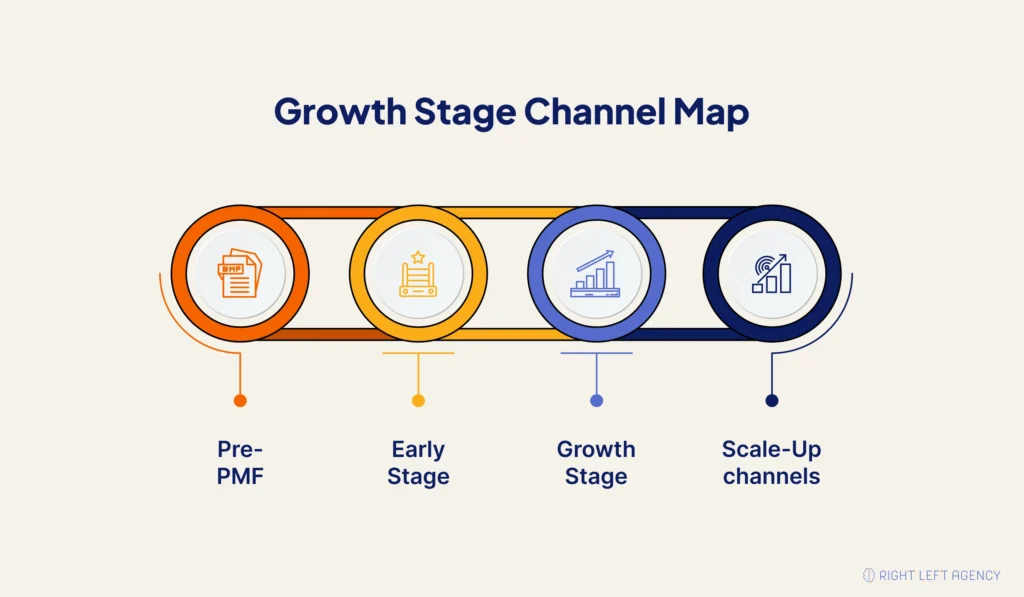
| Growth Stage | Best Channels |
|---|---|
| Pre-PMF | Founder-led outreach, communities, partnerships |
| Early Stage | SEO, content, email, referrals |
| Growth Stage | PPC, LinkedIn Ads, webinars, demand generation |
| Scale-Up | ABM, brand, partner ecosystems, lifecycle marketing |
Pre-PMF SaaS
Pre-PMF SaaS teams need learning before scale. At this stage, the goal is not traffic or lead volume. The goal is to understand the customer.
Founder-led outreach, direct sales, communities, and partnerships work well because they create real conversations. These conversations help validate pain points, ICP, pricing, messaging, buyer urgency, and product direction.
Paid acquisition is risky before product-market fit. It may create traffic, but it often does not create useful learning or sustainable growth.
Pre-PMF teams should focus on conversations before campaigns.
Early-Stage SaaS
Early-stage SaaS companies need repeatable acquisition foundations. SEO, content, email, and referrals work well because they build long-term assets without requiring massive budgets.
At this stage, focus matters. A small team should not try to run every channel at once. It should choose a few channels and execute them well.
Good priorities include core landing pages, bottom-funnel content, comparison content, customer stories, onboarding emails, simple referral loops, and sales-support content.
The goal is to educate buyers, support sales, and build early category authority.
Growth-Stage SaaS
Growth-stage SaaS companies need a more predictable pipeline. At this stage, the company usually has a clearer ICP, stronger positioning, better sales feedback, and more reliable conversion data.
That makes paid channels less risky. Growth-stage teams can invest more in PPC, LinkedIn Ads, webinars, demand generation, retargeting, lifecycle email, sales enablement, and conversion optimization.
The focus should be pipeline quality, not lead volume alone. Teams should track CAC, SQL rate, payback period, trial activation, pipeline velocity, and revenue influence.
Scale-Up SaaS
Scale-up SaaS companies need a broader channel portfolio. At this stage, growth often depends on brand strength, partner ecosystems, account expansion, customer marketing, and enterprise pipeline.
Scale-up teams often invest in ABM, brand campaigns, partner marketing, customer marketing, lifecycle automation, executive thought leadership, product expansion campaigns, and enterprise sales enablement.
A scale-up SaaS company should not depend on one acquisition channel. Costs can rise. Competitors can enter. Algorithms can change. Demand can slow.
The goal is to build a balanced, revenue-driven channel portfolio.
SaaS Marketing Channels by Business Model
SaaS channel selection also depends on the business model.
B2B SaaS, PLG SaaS, enterprise SaaS, and vertical SaaS companies each need a different mix.
| Business Model | Recommended Channels |
|---|---|
| B2B SaaS | SEO, LinkedIn Ads, ABM, webinars, email |
| PLG SaaS | SEO, product virality, community, referrals |
| Enterprise SaaS | ABM, events, executive thought leadership, LinkedIn |
| Vertical SaaS | Niche SEO, partnerships, trade publications, webinars |
B2B SaaS
B2B SaaS companies usually need education, trust, and stakeholder alignment.
SEO captures buyers who are already searching. LinkedIn helps reach specific roles. ABM supports high-value accounts. Webinars and email help nurture long buying journeys.
This mix works because B2B SaaS buyers rarely make quick decisions. They need clarity, proof, and internal confidence before they move forward.
Product-Led Growth SaaS
PLG SaaS companies need channels that support adoption. The product must help users reach value quickly.
SEO, community, referrals, templates, and product sharing work well because they bring users closer to the product experience.
For PLG, activation matters as much as acquisition. A signup alone is not enough. The user needs to reach value, keep using the product, and ideally invite others.
Enterprise SaaS
Enterprise SaaS companies sell into complex buying committees. These buyers need trust, proof, security, ROI clarity, and internal alignment.
ABM, executive thought leadership, events, webinars, and LinkedIn campaigns often work well. These channels help influence decision-makers across long sales cycles.
Enterprise SaaS marketing should support sales conversations, not just generate leads.
Vertical SaaS
Vertical SaaS companies serve specific industries. That makes industry trust more important than broad reach.
Trade publications, industry partnerships, niche SEO, webinars, and communities often work well.
Vertical buyers want to feel understood. They want to know that your product fits their workflow, language, regulations, and daily challenges.
Broad messaging usually performs poorly here. Specificity wins.
Which SaaS Marketing Channels Have the Lowest CAC?
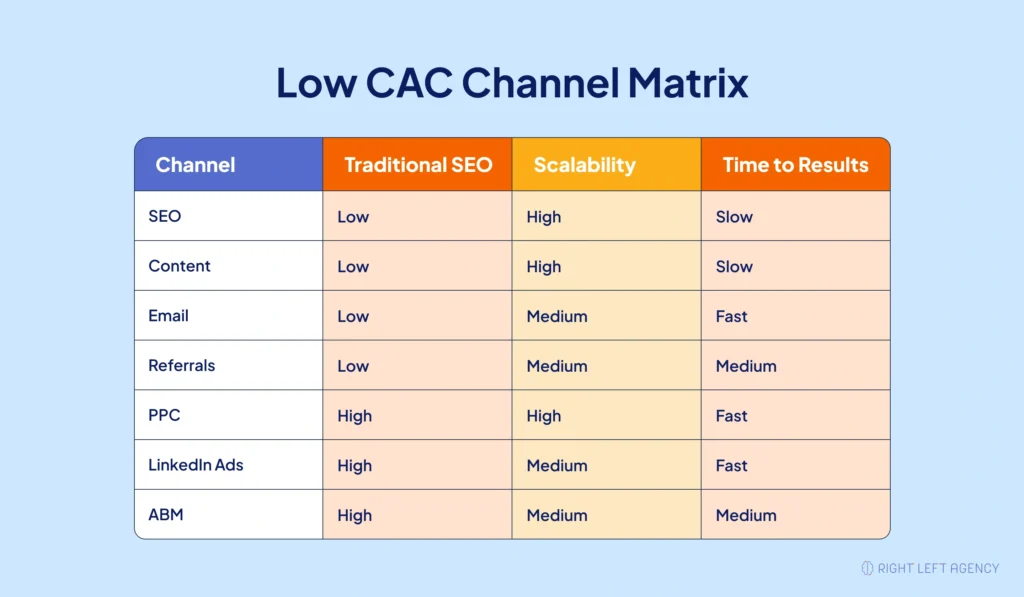
SEO, content marketing, email, and referrals usually have the lowest CAC potential over time. These channels reduce dependence on paid acquisition and create compounding value.
But low-CAC channels are not effortless. They still require strategy, consistency, and strong execution.
| Channel | CAC Potential | Scalability | Time to Results |
|---|---|---|---|
| SEO | Low | High | Slow |
| Content | Low | High | Slow |
| Low | Medium | Fast | |
| Referrals | Low | Medium | Medium |
| PPC | High | High | Fast |
| LinkedIn Ads | High | Medium | Fast |
| ABM | High | Medium | Medium |
The cheapest channel is not always the best channel.
A higher CAC can still make sense when ACV and LTV are strong. For example, ABM may be expensive, but it can be profitable for enterprise SaaS deals.
For low-ACV SaaS products, expensive paid acquisition can quickly hurt margins. SaaS teams should judge channels by payback, revenue quality, and scalability.
SaaS Marketing Channels Ranked by Revenue Impact
Some channels influence revenue more directly than others.
The table below is a directional view. The scores should change based on ACV, sales cycle, product maturity, market demand, and execution quality.
| Rank | Channel | Revenue Impact Score |
|---|---|---|
| 1 | SEO | 9.5/10 |
| 2 | Product-Led Growth | 9/10 |
| 3 | ABM | 8.5/10 |
| 4 | Content Marketing | 8.5/10 |
| 5 | PPC | 8/10 |
| 6 | LinkedIn Ads | 7.5/10 |
SEO ranks high because it captures active demand.
PLG ranks high because product usage can drive conversion, retention, expansion, and referrals.
ABM can create a strong revenue impact for high-value accounts.
Content marketing supports the full funnel and improves sales conversations.
PPC and LinkedIn Ads can create a faster pipeline, but they need strong targeting, messaging, landing pages, and attribution.
How to Prioritize SaaS Marketing Channels
SaaS companies should choose channels based on fit, not popularity. The CHANNEL FIT Framework can help teams make better decisions.
CHANNEL FIT Framework
Evaluate every marketing channel against these ten factors before making investment decisions.
Customer Fit
Determine whether your ideal customer profile (ICP) actively searches, researches, or engages on the channel. The best-performing channels are those where your target audience already spends time.
High Intent
Assess whether the channel attracts buyers actively looking for a solution. High-intent channels generally produce higher-quality leads and better conversion rates.
Acquisition Cost
Estimate the expected customer acquisition cost (CAC) and compare it with your customer lifetime value (LTV) and target payback period to ensure profitable growth.
Need
Evaluate whether the channel aligns with your buyers’ level of urgency. Some channels capture immediate demand, while others help create future demand.
Nurture
Consider whether the channel can educate, engage, and build trust throughout longer buying journeys, especially for B2B SaaS and enterprise sales.
Execution
Review your team’s skills, available resources, and budget. Even a high-potential channel may underperform without the expertise to execute it effectively.
Lifecycle
Determine whether the channel supports more than acquisition. The strongest channels also improve activation, retention, expansion, and customer loyalty.
Business Fit
Ensure the channel matches your SaaS business model, average contract value (ACV), pricing, growth stage, and go-to-market strategy.
Impact
Measure the channel’s potential to generate qualified pipeline, increase revenue, and improve overall marketing ROI rather than focusing only on traffic or leads.
Timing
Understand how quickly the channel can deliver results. Balance fast-growth channels like PPC with long-term investments such as SEO and content marketing to create sustainable growth.
Use this decision matrix before scaling channels.
| Situation | Best Channel Priority |
|---|---|
| Long horizon and limited budget | SEO and content |
| High ACV and long sales cycle | ABM and LinkedIn |
| Strong product virality | PLG and referrals |
| Need fast pipeline | PPC and webinars |
| Niche industry | Vertical SEO and partnerships |
| Large customer base | Email and lifecycle marketing |
Most SaaS companies should start with one or two focused channels. Once those channels show traction, the team can expand. Focus creates learning, and learning makes scaling safer.
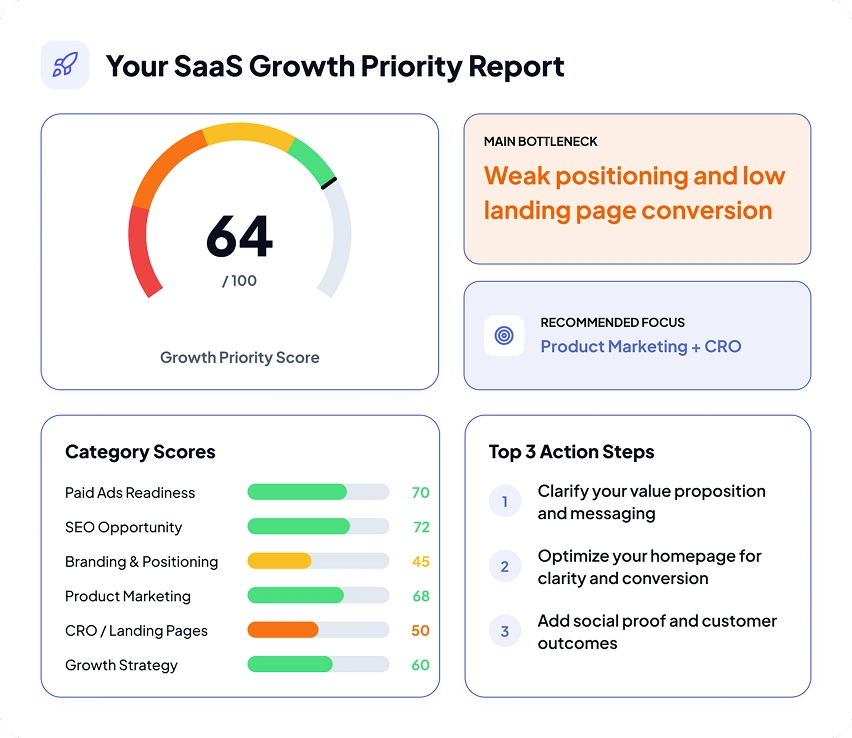
Free 3-Minute Diagnostic
What Should Your SaaS Prioritize Next?
Not sure whether to focus on SEO, paid ads, CRO, positioning, or another growth area? Get a personalized recommendation based on your SaaS and current growth challenges.
Real SaaS Marketing Channel Examples
Real SaaS growth rarely comes from one channel.
Strong SaaS companies build channel systems around their product, market, and customer behavior.
| Company | Primary Channel | Result |
|---|---|---|
| HubSpot | SEO and content | Category authority and inbound demand |
| Ahrefs | SEO and YouTube | Trust through expert education |
| Notion | Community and PLG | User-led adoption and loyalty |
| Canva | PLG and referrals | Scalable product-led growth |
| Zapier | SEO and integrations | High-intent organic acquisition |
HubSpot
HubSpot built authority through SEO, content, and education. Its content helps people understand marketing, sales, CRM, automation, and customer growth. That education builds trust before the buyer is ready to purchase. Trust turns into a pipeline.
Ahrefs
Ahrefs uses SEO and YouTube to educate marketers. Its content shows real workflows, examples, and product use cases. This approach builds trust because the content helps people solve real problems. The product becomes part of the learning experience.
Notion
Notion grew through community, templates, and product-led adoption. Users share pages, systems, workflows, and templates with others. That sharing creates organic discovery. The product itself becomes part of the distribution engine.
Canva
Canva uses product-led growth, templates, and sharing loops. Users create value quickly and often share their designs. That sharing brings more people back to the product. Canva grows because the product creates both value and visibility.
Zapier
Zapier captures workflow-based search demand through SEO and integration pages. Its pages are tied to specific tools, automations, and use cases. That creates a clear connection between search intent and product value. Zapier does not only rank for broad keywords. It ranks for the exact problems users want to solve.
Common SaaS Marketing Channel Mistakes
Using Too Many Channels Too Early
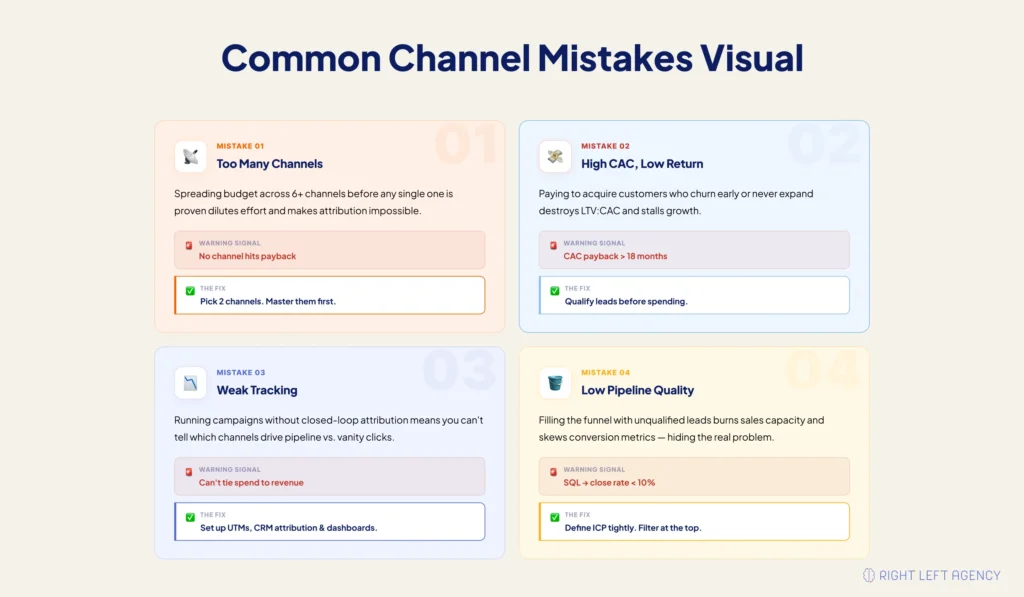
Small SaaS teams often try to do everything at once. They launch SEO, PPC, LinkedIn, webinars, email, and partnerships before any one channel is working properly. That usually leads to shallow execution. Start with fewer channels and do them well.
Copying Competitors Without Context
A competitor’s channel may not fit your business. Their ACV, budget, team size, brand strength, product maturity, and sales cycle may be completely different. Do not copy the channel blindly. Understand why it works for them first.
Ignoring CAC and Payback Periods
Lead volume does not mean much if acquisition costs are too high. SaaS teams should track CAC, payback period, lead quality, trial quality, SQL rate, and revenue outcomes. A channel that creates cheap leads but no customers is not a growth channel. It is a distraction.
Tracking Attribution Too Narrowly
SaaS buyers rarely convert after one touchpoint. They read articles, compare vendors, attend webinars, check reviews, ask peers, visit the website again, and maybe return through retargeting. Single-touch attribution hides that journey. Use attribution as a guide, not the full truth.
Scaling Paid Channels Too Early
Paid media magnifies what already exists. If positioning is weak, ads will expose it faster. If the landing page is unclear, paid traffic will waste the budget. Before scaling paid channels, validate your audience, message, offer, landing page, and follow-up process.
Neglecting Organic Growth
Organic channels take longer, but they improve long-term efficiency. SEO, content, referrals, community, and PLG loops can reduce dependence on paid acquisition. Ignoring organic growth can make a SaaS company too dependent on rising ad costs.
Confusing Traffic With Pipeline
Traffic is not the final goal. Qualified pipeline is. A SaaS company can get thousands of visitors and still miss revenue targets if those visitors are not the right buyers. Measure channels by business impact, not vanity metrics.
Signs Your SaaS Needs a Multi-Channel Strategy
A SaaS company needs a multi-channel strategy when growth depends too heavily on one source. Channel concentration is risky. CAC can rise. Competitors can spend more. Algorithms can change. Demand can slow.
You may need a broader channel mix if:
- Your main acquisition channel is getting more expensive
- Your pipeline is becoming less predictable
- Your paid campaigns depend on a small keyword set
- Your organic traffic is growing, but conversions are weak
- Your sales team needs better educational content
- Most of your revenue comes from one channel
- Competitors are becoming more aggressive in your strongest channel
- Your buying committee needs more touchpoints
- Your expansion revenue needs stronger lifecycle marketing
A multi-channel strategy does not mean doing everything. It means building a balanced channel portfolio that supports revenue growth.
When to Hire a SaaS Marketing Agency
A SaaS company should hire a marketing agency when internal execution starts limiting growth. This often happens when paid acquisition becomes expensive, SEO stops growing, content does not create pipeline, or the team lacks channel expertise.
You may also need agency support if CAC keeps rising, content is not converting, sales and marketing are misaligned, or the team is unsure which channels deserve more investment.
A strong SaaS agency can help with channel strategy, positioning, SEO, content systems, PPC, LinkedIn Ads, lifecycle marketing, ABM, attribution, and conversion optimization.
However, a SaaS company should not hire an agency just to run random campaigns. The best agency partnerships happen when leadership is clear on ICP, revenue goals, CAC targets, sales process, and growth priorities.
If your team is investing in channels without knowing which ones actually drive the pipeline, start with a channel audit. It can show where your budget is working, where CAC is rising, and which channels deserve the next investment.
RLA can ensure all of your concerns.
Conclusion
There is no universal best SaaS marketing channel.
The right channel depends on your growth stage, business model, ACV, budget, sales cycle, buyer behavior, and revenue goals.
SEO is strong for long-term acquisition. PPC can create faster pipelines. ABM works well for high-value enterprise deals. PLG helps products grow through usage and adoption. Email supports activation, retention, and expansion.
Partnerships, referrals, communities, webinars, and YouTube can strengthen trust and reduce channel risk.
The best SaaS companies do not chase every channel. They build a channel portfolio that matches their customer acquisition economics, product maturity, and revenue targets.
That creates a stronger pipeline, lower CAC pressure, and more sustainable growth.
Frequently Asked Questions
What are SaaS marketing channels?
SaaS marketing channels are the platforms and strategies software companies use to attract, activate, retain, and expand customers. Common channels include SEO, content marketing, PPC, LinkedIn Ads, email, PLG, ABM, referrals, partnerships, webinars, communities, and lifecycle marketing.
Which SaaS marketing channel has the highest ROI?
SEO often delivers the strongest long-term ROI because it captures high-intent demand and reduces dependence on paid acquisition. PLG, referrals, and email can also produce strong ROI when they match the product and audience.
What channels work best for B2B SaaS?
B2B SaaS companies usually perform best with SEO, LinkedIn Ads, ABM, webinars, email, and content marketing. These channels support longer buying cycles, multiple stakeholders, education, trust-building, and pipeline creation.
How many marketing channels should a SaaS company use?
Most SaaS companies should start with two or three focused channels. Early-stage teams need focus, while scale-up teams need broader channel portfolios. The right number depends on budget, team size, ACV, sales cycle, and attribution maturity.
Should SaaS companies invest in SEO or PPC first?
SaaS companies with limited budgets and longer timelines should usually start with SEO. PPC works better when messaging, landing pages, and conversion paths are already tested. Many SaaS teams use SEO for long-term CAC efficiency and PPC for faster pipeline.