

Key Takeaways
- Construction tech marketing is not generic SaaS marketing. It needs proof-first messaging, longer nurture cycles, and buyer-specific content.
- ConTech buyers include owners, operations leaders, project managers, CFOs, IT leaders, and field teams. Each one needs a different message.
- Trust-building content like case studies, ROI calculators, and implementation guides directly affects demo requests and deal velocity.
- SEO, LinkedIn, ABM, and sales enablement all work together in a winning ConTech go-to-market strategy.
- AI search optimization is no longer optional. ConTech brands need structured, entity-rich content to show up in AI-generated answers.
Most ConTech companies have a solid product. The technology works and the use case is real, but the pipeline stays dry, demos are hard to book, and deals take forever to close.
That is not always a product problem. More often, it is a marketing problem.
Construction technology buyers are not like typical SaaS buyers. They are practical, skeptical, and risk-aware. They have watched software roll out on a job site only to get abandoned by the field crew two weeks later. They have sat through demos that promised the world and delivered confusion. When they consider a new platform, they need more than a feature list. They need proof, clarity, and confidence that the tool will actually hold up in their environment.
Construction tech marketing works best when it connects software capabilities to real construction outcomes. Fewer delays. Better cost visibility. Less rework. Stronger field-to-office communication.
But here is the part most ConTech brands miss: construction buyers operate in one of the least digitally mature industries in the world. Many general contractors still run projects on spreadsheets, email chains, and phone calls. Subcontractors do not always have IT departments. Field crews rarely had a say in the last three software rollouts that failed. That context changes everything about how you market to them.
When your marketing speaks the language of the job site, buyers pay attention. When it sounds like a generic SaaS pitch, they scroll past it.
This guide covers what ConTech founders, marketers, and growth teams need to attract, educate, and convert more construction buyers.
What Is Construction Tech Marketing?
Construction tech marketing is the process of promoting software, platforms, tools, and digital solutions that help construction companies improve productivity, communication, cost control, safety, scheduling, reporting, and project delivery.
It covers everything from how a ConTech brand positions its product to how it generates qualified leads, supports the sales team, and converts buyers at each stage of a complex buying journey.
Construction tech marketing helps brands:
- Explain complex technology in simple, job-site-friendly language
- Reach the right construction decision-makers at the right time
- Build trust through proof, education, and credibility
- Generate qualified leads and demo requests
- Support sales teams with content that moves deals forward
The tools being marketed span a wide range: project management software, BIM platforms, estimating software, field reporting tools, scheduling software, ERP systems, safety software, and construction-specific CRM solutions.
Why ConTech Marketing Is Different from Traditional SaaS Marketing
General SaaS marketing tactics do not always translate to construction. Many ConTech brands borrow playbooks from generic B2B SaaS and then wonder why the results are weak.
The difference comes down to the buyer and the environment they work in. A SaaS marketer selling project management software to a tech startup is talking to someone who already lives in tools like Jira, Notion, or Slack. A ConTech marketer selling scheduling software to a mid-size general contractor is often talking to someone who has never used a SaaS product at work. They manage a $20M job with a whiteboard and a shared Google Drive folder. Convincing them to change is a completely different challenge.
Construction buyers also carry more project risk than most SaaS buyers. A bad software decision does not just cost a subscription fee. It can delay a subcontractor, misalign a change order, or create a compliance gap on a live job site. That risk awareness is why they move slowly, ask more questions, and need far more proof before they commit.
They want to see that your tool works in the field. They want to know how long implementation takes. And they want to understand what happens when something breaks on a job site at 6 AM and no one from your support team is online.
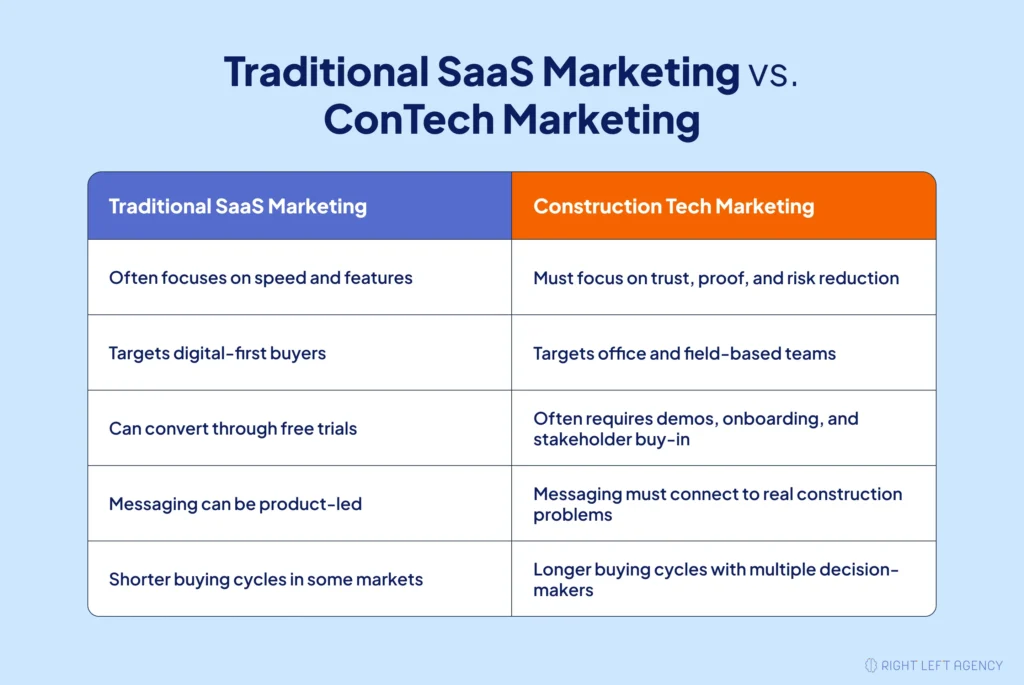
Here is how ConTech marketing compares to traditional SaaS marketing:
| Traditional SaaS Marketing | Construction Tech Marketing |
| Often focuses on speed and features | Must focus on trust, proof, and risk reduction |
| Targets digital-first buyers | Targets office and field-based teams |
| Can convert through free trials | Often requires demos, onboarding, and stakeholder buy-in |
| Messaging can be product-led | Messaging must connect to real construction problems |
| Shorter buying cycles in some markets | Longer buying cycles with multiple decision-makers |
Understanding this gap is the foundation of every effective construction SaaS marketing strategy.
Who Are Construction Technology Buyers?
ConTech buying decisions rarely come from one person. A project manager might champion your tool but have no authority to sign the contract. A CFO might approve the budget but have zero interest in daily usability. A field supervisor might reject the software before it ever gets implemented.
Effective construction tech marketing means mapping your message to every person in that buying committee.
| Buyer Type | What They Care About | Marketing Message That Works |
| Owner / Founder | Growth, margins, operational control | “Scale projects without adding more manual work.” |
| Operations Leader | Efficiency, standardization, visibility | “Improve project visibility across teams and sites.” |
| Project Manager | Usability, communication, fewer delays | “Keep teams aligned without extra admin work.” |
| CFO / Finance Leader | ROI, cost savings, risk reduction | “Reduce waste, rework, and budget overruns.” |
| IT / Technology Leader | Security, integration, implementation | “Connect with existing systems and protect company data.” |
| Field Teams | Ease of use, speed, less paperwork | “Simple tools your team can actually use on-site.” |
When your content speaks to only one of these buyers, you create friction everywhere else. Strong ConTech marketing addresses the full committee.
What Construction Buyers Need Before They Trust a ConTech Brand
Construction buyers move slowly for a reason. Picking the wrong software costs time, money, and team trust. Before they book a demo or sign a contract, they usually need a few things in place.
Clear problem framing. They need to see that you understand their specific pain. Not generic productivity challenges, but the real ones: rework from miscommunication, project delays from poor scheduling, and cost overruns from lack of visibility.
Proof from similar companies. If your case studies come from retail or healthcare SaaS, they will not land. Construction buyers want to see contractors, subcontractors, and project teams who faced the same challenges and made it work with your product.
Measurable outcomes. Vague success stories do not move construction buyers. Specific numbers do. Time saved. Rework reduced. Projects delivered on budget. According to the State of Digital Adoption in the Construction Industry 2024 report from Autodesk and Deloitte, each additional technology a construction business implements leads to a 1.4 percentage point increase in revenue growth per year. That kind of data gives buyers the confidence to act.
Implementation clarity. Nothing stalls a ConTech deal faster than fear of a painful rollout. Buyers want to know exactly what onboarding looks like, how long it takes, and what support they get during the process.
Integration details. Most construction companies already run a mix of tools. They need to know your platform connects with their existing accounting software, ERP, or scheduling systems.
Security and compliance information. IT leaders and operations teams need to know their project data stays protected and that your platform meets relevant compliance standards.
Testimonials from credible users. A quote from a general contractor who used your software on a $50M project carries far more weight than a generic five-star review.
What makes a strong ConTech case study? Most ConTech case studies are too vague to be useful. They say things like “improved efficiency” or “saved time on reporting” without any specifics. Construction buyers see through that.
A strong ConTech case study names the contractor type, the project size, the specific problem, and the measurable result. The metrics that move construction buyers include:
- Rework reduction (for example, 30% fewer punch list items after switching to digital field reports)
- Faster RFI response times (cut from 4 days to under 24 hours)
- Improved labor productivity (field crews spending 40 fewer minutes per day on paperwork)
- Reduced project delays (projects completing on schedule increased from 60% to 85%)
- Better budget adherence (cost overruns reduced by 18% across active projects)
When your case study includes numbers like those tied to a recognizable company type, it becomes one of your strongest sales tools.
Pro Tip: Build a dedicated “Why Us” page that answers the most common buyer concerns before they even have to ask. Cover implementation timelines, integration support, onboarding steps, and data security in one place. That single page can remove weeks of friction from your sales cycle.
Core Construction Tech Marketing Strategies That Win More Buyers
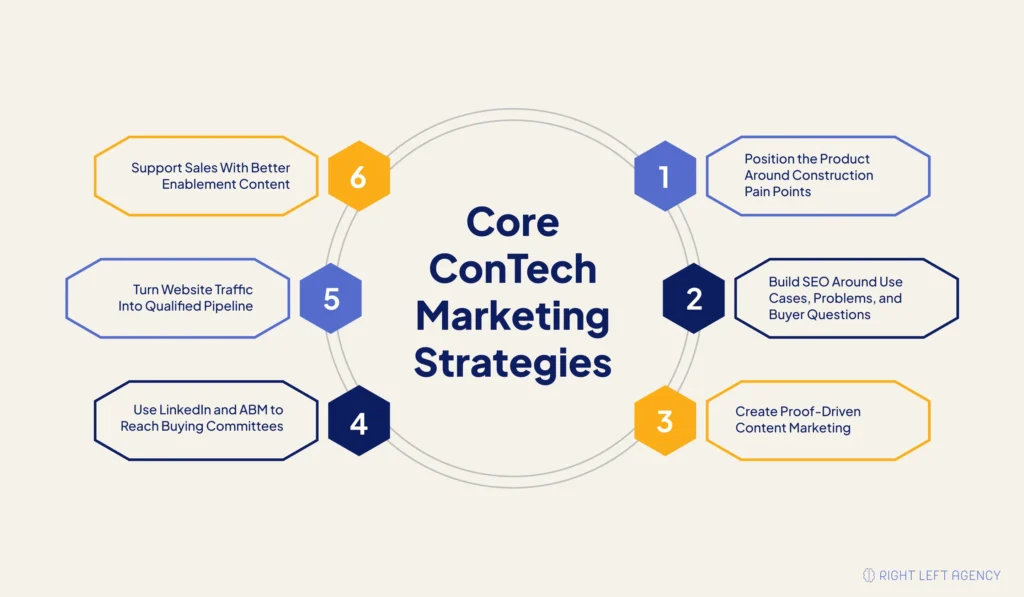
1. Position the Product Around Construction Pain Points
Most ConTech brands lead with features. That is the wrong starting point.
Construction buyers do not wake up thinking about AI dashboards or cloud-based collaboration tools. They wake up thinking about the three tasks that are behind schedule, the change order dispute that could blow the budget, and the project manager who quit last month. Your positioning needs to start there.
Instead of saying “AI-powered project dashboard,” say “See project risks earlier so teams can reduce delays and costly rework.” Instead of “cloud-based document management,” say “Keep every team member working from the latest version, whether they are in the office or on the job site.”
Lead with the pain the buyer already feels. Then show how your product fixes it. The feature becomes proof, not the pitch.
This is especially important in B2B SaaS marketing for industries like construction, where buyers are outcome-driven, not feature-driven.
2. Build SEO Around Use Cases, Problems, and Buyer Questions
Construction buyers search the way they think. They type real problems into Google, not product category names.
Your SaaS SEO strategy needs to target how they actually search. That means building content around use cases, problems, and comparisons, not just broad category terms.
Here are the high-intent keyword clusters worth targeting for ConTech brands:
Software comparisons and alternatives
- Procore alternatives for small contractors
- Autodesk vs Procore for commercial construction
- Best Procore alternatives for subcontractors
- Construction ERP comparison
Project management and scheduling
- Best construction project management software
- Construction scheduling software for subcontractors
- Field reporting software for general contractors
- How to reduce construction rework
ERP and accounting integrations
- Construction software that integrates with QuickBooks
- Construction ERP for mid-size general contractors
- Best accounting integration for construction project management
BIM and digital design tools
- BIM software for general contractors
- BIM adoption for small construction firms
- Best BIM tools for subcontractors
Construction AI and emerging tech
- AI tools for construction scheduling
- Construction AI software 2026
- How AI is used on construction job sites
Safety and compliance software
- Construction safety management software
- Digital safety inspection tools for contractors
- OSHA compliance software for construction
Field management
- Field management software for subcontractors
- Mobile construction management apps
- Digital daily reports for construction teams
Each of these clusters reflects buyers at different stages of their journey. Problem-aware content pulls in early-stage buyers. Comparison pages and use-case landing pages attract buyers who are close to a decision.
Building topical authority across these clusters helps both search engines and AI tools recognize your brand as the go-to resource in construction technology marketing.
3. Create Proof-Driven Content Marketing
ConTech content only works when it shows practical outcomes, not just thought leadership. Construction buyers do not need another blog post about the future of the industry. They need to see proof that your product works in the field.
The most effective content types for ConTech brands include:
- Case studies that show real before-and-after results from construction teams
- ROI calculators that let buyers estimate the cost of project delays or rework
- Buyer guides that help early-stage buyers understand how to evaluate tools
- Implementation guides that take the fear out of onboarding and rollout
- Product comparison pages that honestly address how you stack up against alternatives
- Jobsite workflow guides that show your product working in real construction scenarios
- Webinars where buyers hear directly from contractors who use your software
This kind of content marketing for SaaS works because it meets buyers where they are and removes the uncertainty that slows down construction buying decisions.
Pro Tip: One well-written case study with specific numbers, project type, and contractor size will outperform ten general blog posts. Write case studies that feel like a story, not a press release.
4. Use LinkedIn and ABM to Reach Buying Committees
Most construction technology buyers are not ready to convert the first time they see your brand. LinkedIn and account-based marketing (ABM) help you stay visible to the right accounts while they work through their buying process.
The buying committee in construction looks very different depending on who your target customer is. That matters a lot when you plan your ABM campaigns.
General contractors typically involve an operations director or VP of Construction, a project manager or superintendent, a CFO or controller, and sometimes an IT manager in larger firms. The operations leader usually drives the evaluation. The PM validates usability. The CFO approves the spend.
Specialty and subcontractors often have a flatter structure. The owner or principal makes most decisions. Field supervisors and estimators have real influence. IT is rarely involved. Messages that feel enterprise-level will not land here. Keep them practical and direct.
Developers and owners care most about project visibility, cost control, and delivery timelines. They are not managing day-to-day operations. They want to know if your software gives them better reporting and fewer surprises. Content that leads with ROI and budget adherence works best for this audience.
Construction management firms evaluate software across client projects. They care about scalability, reporting flexibility, and how easy it is to onboard new project teams. They respond well to implementation case studies and integration depth.
On LinkedIn, you can target each of these groups by job title, company size, industry segment, and geography. A campaign targeting operations leaders at mid-size general contractors in the Southeast looks completely different from one targeting IT directors at ENR 400 firms. Build separate message tracks for each.
ABM goes further. Instead of casting a wide net, you identify your top target accounts and run coordinated campaigns around them. You serve content that matches their exact stage in the buying journey, then pass warm accounts to sales when signals indicate they are ready to talk.
This approach works because construction buying cycles can run six to eighteen months for larger contracts. You need to stay visible to the right people consistently. A strong demand generation program combines LinkedIn visibility with email sequences, retargeting, and content to keep your brand top of mind from the first touchpoint to the signed contract.
5. Turn Website Traffic Into Qualified Pipeline
Traffic alone does not fill your pipeline. Your website has to convert visitors into leads, demo requests, and sales conversations.
Many ConTech websites fall short here. They have a single generic “Request a Demo” button and hope for the best. Buyers who are not yet ready for a demo leave without any next step.
A better approach includes:
- Clear demo CTAs for buyers who are ready to talk
- Industry-specific landing pages for different buyer types and use cases
- Case study CTAs that let buyers self-select based on their company type
- ROI calculator CTAs for buyers who need to build an internal business case
- Lead magnets like buyer guides and checklists for early-stage visitors
- Retargeting campaigns to bring back visitors who did not convert the first time
- CRM tracking so sales knows exactly where every lead came from
This is what separates a ConTech website that looks good from one that actually builds pipeline. For more on turning clicks into leads, see our guide on SaaS lead generation strategies.
6. Support Sales With Better Enablement Content
Marketing does not stop when a lead enters the CRM. The ConTech sales process is long, and buyers raise objections at every stage. Marketing can help sales move those deals forward.
Sales enablement content for ConTech includes:
- Sales decks tailored to different buyer roles
- One-pagers that explain the product in plain language for each stakeholder
- Comparison sheets that address how you differ from Procore, Autodesk, or other competitors
- Objection-handling guides that give reps clear answers to common pushbacks
- ROI documents that help buyers make the internal case for your product
- Implementation explainers that take the fear out of the rollout process
When marketing and sales are aligned, deals close faster. When they are not, buyers fall through the cracks between a strong demo and a signed contract.
Are You Creating Demand or Capturing It?
This is one of the most important questions in ConTech marketing, and most brands never ask it.
Some construction technology categories are established. General contractors already know what project management software is. They have already seen Procore. They have probably tried Autodesk. When you market in an established category, your job is to capture existing demand. Buyers are already searching. You compete on differentiation, proof, and pricing.
But many ConTech companies operate in emerging categories. Digital twins. Construction robotics. AI-powered scheduling. Autonomous site monitoring. Construction buyers do not yet have a name for what you do, which means they are not searching for it yet.
Marketing an emerging ConTech category requires a different approach:
For established categories (demand capture):
- Invest heavily in comparison content, category keywords, and G2 or Capterra presence.
- Use case studies from recognizable contractor types to reinforce trust.
- Focus messaging on why your product beats the incumbent or replaces the spreadsheet.
- Win on proof, implementation speed, and customer support.
For emerging categories (demand creation):
- Lead with the problem, not the product. Construction buyers will not search for “digital twin software” if they do not know what a digital twin is.
- Publish content that names the problem first: “Why your field reporting process is costing you more than you think.”
- Use LinkedIn and ABM to reach buyers before they start searching, not after.
- Educate through webinars, job site workflow guides, and industry events.
- Partner with ERP providers, associations like AGC or ABC, and implementation consultants who can introduce your category to their audiences.
The brands that win in emerging ConTech categories are the ones that teach buyers what to want before the category becomes competitive.
Best Content Ideas for ConTech Brands
| Content Type | Purpose | Example Topic |
| Use-case page | Capture problem-aware traffic | Construction software for project visibility |
| Case study | Build trust with proof | How a contractor cut reporting time by 60% |
| Comparison page | Capture decision-stage buyers | Procore alternative for subcontractors |
| ROI calculator | Support conversion | Calculate the true cost of project delays |
| Buyer guide | Educate early-stage buyers | How to choose construction management software |
| Checklist | Generate leads | Construction software evaluation checklist |
| Webinar | Build authority | How contractors can improve field-to-office communication |
| Integration page | Reduce technical concerns | Construction software that connects with QuickBooks and Sage |
How to Position Against the Real Competition
Most ConTech companies think their biggest competitor is another SaaS vendor. In reality, it is usually one of three things: a spreadsheet, the existing software stack, or internal resistance to change.
Competing against spreadsheets and manual processes
A large portion of construction companies still manage scheduling, RFIs, field reports, and cost tracking through some combination of Excel, email, and shared drives. When this is your real competition, do not talk about features.
Talk about what manual processes cost. How many hours does a project manager spend chasing down daily reports? How much does a missed change order cost on a $5M project? What is the average cost of a two-week project delay? When you put a number on the status quo, buying your software becomes the obvious financial decision.
Competing against the existing software stack
Many ConTech buyers already have something. It might be an older ERP, a legacy scheduling tool, or a platform their parent company mandated. The question is not whether they will buy software. It is whether they will replace what they have. Positioning here is about showing the cost of staying. Show integration depth, migration support, and case studies from companies that switched from a named competitor. Make the transition feel manageable, not risky.
Competing against internal resistance
Field adoption is one of the biggest barriers in construction software. A project manager might love your product, but if the superintendents on the job site will not use it, the contract will not be renewed.
Address adoption directly in your marketing. Show how other field crews adopted the tool. Mention mobile-first design, offline functionality, and training support. Construction buyers who have survived a failed software rollout will ask adoption questions before they ask about pricing.
When your positioning accounts for all three of these competitors, your messaging becomes more specific, more credible, and much harder to ignore.
Partner and Ecosystem Marketing for ConTech Brands
There is an acquisition channel most ConTech companies ignore: the people construction buyers already trust.
Construction buyers rarely make software decisions in a vacuum. Many of them consult their ERP provider, their industry association, their accounting firm, or an implementation consultant before they talk to a vendor. When your brand shows up in those conversations, you reach buyers at exactly the right moment.
ERP and software integrations
If your platform integrates with Sage, Viewpoint, Foundation, Procore, or QuickBooks, you have a partnership opportunity. ERP providers talk to construction companies every day. When they recommend a tool that connects cleanly with their system, buyers listen. Build co-marketing content, integration landing pages, and joint webinars around these partnerships. A page that says “Best construction field management software for Sage 300 users” captures high-intent buyers and reinforces your ecosystem credibility.
Industry associations
Groups like the Associated General Contractors (AGC), Associated Builders and Contractors (ABC), and the Construction Financial Management Association (CFMA) have deep trust with their members. Sponsoring their events, contributing to their publications, or presenting at their conferences puts your brand in front of exactly the right buyers with a credibility layer that paid ads cannot replicate.
Implementation consultants and VARs
Many construction companies hire third-party consultants to help them evaluate and implement new software. These consultants carry enormous influence. A recommendation from a trusted advisor can shorten a six-month sales cycle by half. Identify the consultants and value-added resellers (VARs) in your category and build relationships with them. Give them case studies, co-sell support, and the tools they need to recommend your product confidently.
Trade media and industry publications
Earning coverage in publications like Engineering News-Record (ENR), Construction Dive, or ForConstructionPros puts your brand in front of buyers who read industry news as part of their job. A contributed article or a data study gives you credibility that a blog post on your own site cannot match. This type of coverage also strengthens your AI search visibility, since AI tools pull from authoritative industry sources when generating answers about construction technology.
Common Construction Tech Marketing Mistakes to Avoid
Many ConTech brands repeat the same mistakes. Knowing them helps you avoid wasted time and budget.
- Using too much technical jargon. If a project manager on a job site cannot understand your homepage in ten seconds, your messaging needs work.
- Focusing on features instead of outcomes. Buyers do not buy features. They buy fewer delays, less rework, and better margins.
- Ignoring field users. If field teams do not adopt the software, the deal falls apart regardless of what the executive signed.
- Creating generic SaaS content. Blog posts about “digital transformation” and “the future of construction” do not convert buyers. Specific, practical content does.
- Not showing proof or case studies. Construction buyers need to see that other contractors have succeeded with your product before they trust it.
- Sending all traffic to one generic demo page. Different buyers need different conversion paths. One CTA does not fit everyone.
- Not aligning marketing with sales. When marketing generates leads that sales cannot close, the pipeline looks full but revenue stays flat.
- Not explaining implementation clearly. Fear of a painful rollout is one of the biggest reasons ConTech deals stall or die.
- Targeting only executives and ignoring influencers. The project manager or field supervisor who rejects the tool has as much power as the CFO who approved the budget.
How to Measure Construction Tech Marketing Performance
You cannot improve what you do not measure. These are the metrics that matter most for ConTech marketing.
| Metric | Why It Matters |
|---|---|
| Organic traffic by intent | Shows whether SEO attracts the right audience |
| Demo requests | Measures conversion interest from qualified buyers |
| Qualified leads | Shows lead quality beyond raw volume |
| Sales-qualified pipeline | Connects marketing activity to revenue |
| Cost per lead | Measures channel efficiency |
| Customer acquisition cost | Shows growth sustainability |
| Conversion rate | Measures landing page and funnel performance |
| Deal velocity | Shows whether marketing helps shorten the sales cycle |
| Content-assisted revenue | Shows how content supports closed deals |
Connect these metrics to your CRM and attribution model so you can see which channels, content types, and campaigns actually drive pipeline and revenue. For more on tracking what matters, see our guide on B2B SaaS lead generation challenges.
What Pipeline Quality Looks Like for ConTech Brands
Raw lead volume is a starting point, not a success metric. For ConTech SaaS companies, pipeline quality often matters more than pipeline quantity.
These indicators tell you whether your marketing is attracting the right buyers, not just any buyers:
Demo-to-opportunity rate. If a large percentage of demos do not progress to a qualified opportunity, something is off. Either the wrong buyers are booking demos, or the demo experience is not landing. Marketing and sales need to align on ICP fit before a demo gets scheduled.
Opportunity-to-close rate. A low close rate on opportunities usually points to one of two problems: positioning that attracts browsers instead of buyers, or a sales process that lacks the right enablement content at key decision stages.
Pipeline by ICP fit. Not every lead is worth the same. Track what percentage of your pipeline matches your ideal customer profile. A general contractor with 50 to 200 employees managing $10M to $100M in annual project volume looks very different as a prospect than a one-person subcontractor evaluating your enterprise tier.
Revenue influenced by content. Which blog posts, case studies, comparison pages, or calculators show up in the deals that close? Content attribution does not have to be perfect to be useful. Even a rough view of which assets appear in closed-won accounts tells you a lot about what is actually moving buyers through the funnel.
These metrics connect marketing to business outcomes, not just activity. They are the ones that matter in a ConTech SaaS lead generation conversation with your board or leadership team.
AI Search Optimization for Construction Tech Brands
AI search is changing how construction buyers discover software. When a project manager types a question into ChatGPT, Google AI Overviews, or Perplexity, the answer they see comes from content that AI systems can read, trust, and summarize. If your content is not built for this, your competitors get cited instead of you.
According to the 2025 U.S. Houzz State of AI in Construction and Design Report, more than one in three construction professionals already use AI in their businesses. As AI tools become part of how buyers research software, showing up in AI-generated answers matters just as much as ranking on page one of Google.
Include ConTech-specific entities in your content
AI tools build topical relevance from the entities in your content. For construction technology brands, that means consistently using specific terminology that AI systems associate with the construction industry and the software ecosystem around it.
Use these entity categories throughout your content:
- Buyer roles: general contractor, subcontractor, specialty contractor, project owner, construction manager, superintendent, project manager, estimator, field crew
- Job types and workflows: RFI management, submittal tracking, change order processing, daily field reports, punch lists, BIM coordination, job costing, labor productivity
- Software ecosystem: Procore, Autodesk Construction Cloud, Sage 300 CRE, Viewpoint Vista, Foundation Software, QuickBooks, PlanGrid, Bluebeam, Trimble
- Industry associations and publications: AGC, ABC, CFMA, ENR, Construction Dive, ForConstructionPros, JBKnowledge ConTech Report
- Compliance and standards: OSHA, LEED, AIA contract documents, prevailing wage, certified payroll
- Technology categories: construction ERP, BIM software, field management software, digital twin, AI scheduling, drone inspection, construction robotics, autonomous equipment
When your content uses these terms naturally and accurately, AI tools recognize it as a credible, authoritative source on construction technology and are more likely to cite it in generated answers.
Structural tips for AI-visible ConTech content
- Use clear definitions near the top of each page. AI tools favor concise, authoritative answers.
- Write short answer-style paragraphs under key headings so AI can extract clean summaries.
- Include comparison tables. AI systems reproduce these well in structured answers.
- Add FAQ sections that mirror the exact questions construction buyers ask.
- Use schema markup for FAQ, Article, Organization, and Service where applicable.
- Build topical authority across the full cluster of ConTech topics over time.
- Include original data, specific examples, and ConTech-specific insights. Generic statements do not get cited.
For a deeper look at building AI-visible content for construction brands, see our guide on AI search optimization for construction SaaS.
Pro Tip: Write every section as if it might be the only part an AI tool reads. When each section stands alone as a useful answer, your content performs better in both traditional search and AI-generated results.
Construction Tech Marketing Is Not a Template. It Is a Strategy.
Construction is a relationship-driven industry built on trust, proof, and reputation. The companies that win long-term contracts do not win them by being the loudest. They win them by being the most credible, the most prepared, and the most consistent.
Marketing construction technology works the same way.
The ConTech brands that generate real pipeline are not the ones with the biggest ad budget. They are the ones that understand their buyers across every role from the CFO to the field crew, speak to each buyer’s specific pain, show proof through real construction outcomes, and stay visible throughout a buying cycle that often takes months to complete.
That combination of trust, proof, buyer alignment, and construction-specific expertise is what separates a ConTech marketing strategy that converts from one that just looks good in a slide deck.
If your current marketing is not generating the quality pipeline your product deserves, the issue is almost never the product. It is the strategy.
Ready to turn construction buyers into qualified pipelines? Book a strategy call with our team.
FAQ: Construction Tech Marketing
What is construction tech marketing?
Construction tech marketing is the process of promoting software, platforms, and digital tools that help construction companies improve productivity, communication, safety, cost control, and project delivery. It covers positioning, SEO, content, lead generation, ABM, sales enablement, and conversion strategy.
How do ConTech companies generate leads?
ConTech companies generate leads through SEO targeting buyer-specific search terms, LinkedIn campaigns aimed at buying committee members, ABM programs focused on target accounts, content marketing with gated assets like buyer guides and ROI calculators, and retargeting campaigns that bring back visitors who did not convert the first time.
What marketing channels work best for construction technology companies?
The most effective channels are organic search through SEO, LinkedIn Ads for reaching decision-makers, content marketing built around proof and education, ABM for high-value accounts, and email nurturing for buyers in longer sales cycles.
Why is construction technology hard to market?
Construction technology is hard to market because buyers are risk-aware and proof-driven, buying decisions involve multiple stakeholders with different priorities, sales cycles are long, field adoption is a real concern, and generic SaaS messaging does not resonate with construction professionals.
How do you sell software to construction companies?
Selling software to construction companies requires strong proof through case studies and ROI data, clear implementation messaging, buyer-specific content for each stakeholder, and a sales process backed by enablement materials that address common objections. Demos should be tailored to the buyer’s specific role and project type.
What content works best for ConTech buyers?
Case studies with specific outcomes, ROI calculators, implementation guides, comparison pages, use-case landing pages, and buyer guides work best for ConTech buyers. These formats address the proof, clarity, and confidence buyers need before they commit to a decision.
How can ConTech brands build trust with construction buyers?
ConTech brands build trust by showing proof from similar construction companies, being transparent about implementation, clearly explaining integrations and security, using plain language instead of jargon, and making it easy for buyers to find answers to their biggest concerns before they ever talk to sales.
What is the difference between SaaS marketing and ConTech marketing?
SaaS marketing often focuses on product-led growth, speed, and feature differentiation. ConTech marketing must focus on trust, proof, risk reduction, field adoption, and longer buying cycles involving multiple decision-makers across executive leadership and field teams.