

Key Takeaways
- Construction SaaS is cloud-based software that helps construction companies manage projects, teams, documents, costs, and communication through a subscription model.
- The market includes platforms for project management, estimating, field management, safety, scheduling, job costing, and more — each serving different parts of the construction workflow.
- Common examples of Construction SaaS companies include Procore, Autodesk Construction Cloud, Buildertrend, Fieldwire, PlanGrid, and ServiceTitan.
- Growing a ConTech SaaS company requires segment-specific positioning, SEO built around buyer intent, strong website conversion, and a sales enablement system that supports long, complex sales cycles.
- The right metrics to track include demo requests, qualified pipeline, CAC, ARR, churn rate, and sales cycle length — not vanity metrics like page views or follower counts.
Construction projects have always been complex, but managing them through disconnected spreadsheets, email chains, and paper-based processes makes everything harder than it needs to be.
That’s changing. Construction companies are now moving to cloud-based software that connects project teams, tracks costs, manages documents, and gives everyone, from the office to the job site, a single place to work.
The Construction SaaS market grew from $13.42 billion in 2024 to $14.91 billion in 2025, at an 11.1% CAGR, and is projected to reach $50.36 billion by 2036. That growth means more buyers are ready to adopt cloud-based software than ever before. It also means more vendors are entering the market to compete for them.
In this guide, we cover what Construction SaaS is, how it works, which companies are leading the space, and how ConTech companies can grow in a market that’s competitive, niche, and full of opportunity.
What Is Construction SaaS?
Construction SaaS is cloud-based software built specifically for construction companies. Instead of installing software on a single machine, users access it through a browser or mobile app on a subscription basis.
These platforms help construction teams manage:
- Projects, tasks, and schedules
- Estimates, bids, and proposals
- Documents, drawings, and revisions
- Budgets, change orders, and job costs
- Field reports, safety logs, and daily updates
- Team communication and client collaboration
The subscription model means companies pay monthly or annually for access. The software updates automatically without any IT intervention.
How Construction SaaS Works
Most Construction SaaS platforms work through a web app and a mobile app. Office teams and field teams log in from wherever they are and access the same project data in real time.
Here’s what a typical day looks like in practice:
- A project manager updates a schedule from the office
- A field supervisor logs a daily report from the job site on their phone
- A subcontractor submits an RFI through the platform
- The finance team tracks budget changes and approves a change order
- The owner sees a live project status dashboard without calling anyone
Common platform features include:
- Project dashboards and task tracking
- Document storage and version control
- Mobile field updates and photo uploads
- Notifications and approval workflows
- Integrations with accounting, CRM, and ERP tools
- User roles and permission settings
- Reporting and analytics
The result is better coordination between office teams and job sites, fewer missed updates, and more consistent project data across the board.
Why Construction Companies Use SaaS
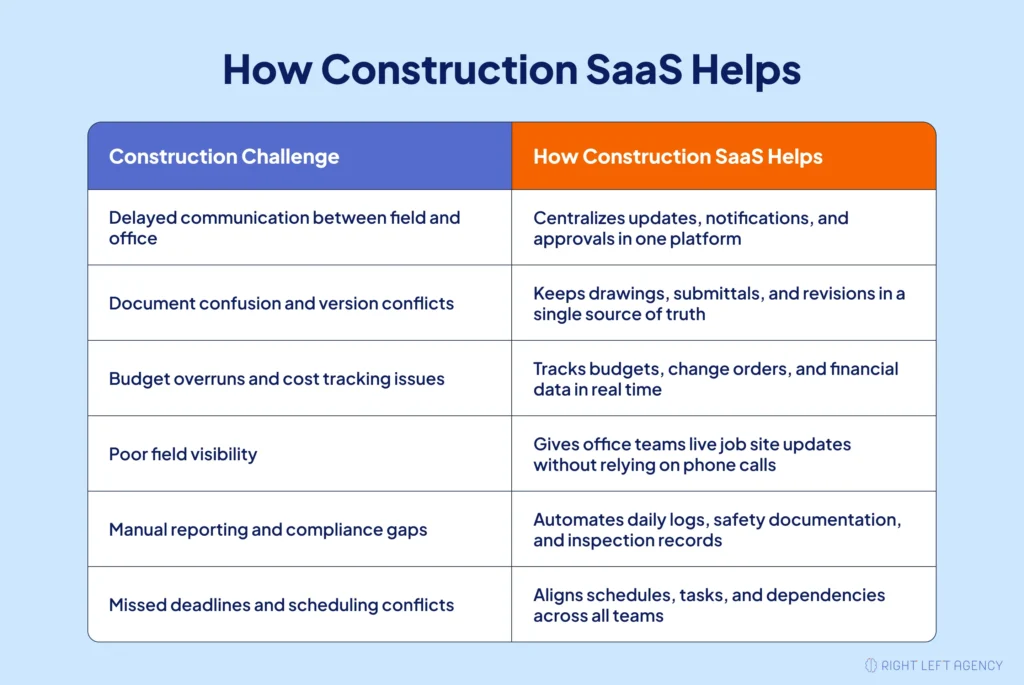
Construction has always struggled with communication gaps, budget overruns, and document chaos. SaaS platforms are built to address these problems directly.
| Construction Challenge | How Construction SaaS Helps |
| Delayed communication between field and office | Centralizes updates, notifications, and approvals in one platform |
| Document confusion and version conflicts | Keeps drawings, submittals, and revisions in a single source of truth |
| Budget overruns and cost tracking issues | Tracks budgets, change orders, and financial data in real time |
| Poor field visibility | Gives office teams live job site updates without relying on phone calls |
| Manual reporting and compliance gaps | Automates daily logs, safety documentation, and inspection records |
| Missed deadlines and scheduling conflicts | Aligns schedules, tasks, and dependencies across all teams |
These aren’t small problems. A single missed change order or a miscommunicated RFI can cost a contractor tens of thousands of dollars. Construction SaaS reduces that risk by keeping all project information in one place and accessible to everyone who needs it.
Main Categories of Construction SaaS
Construction SaaS is not one-size-fits-all. Different platforms focus on different parts of the construction workflow.
| Category | What It Manages | Example Use Case |
| Project management | Tasks, schedules, documents, communication | Managing a commercial building project end to end |
| Estimating and bidding | Quotes, bids, proposals, cost estimates | Preparing bids for subcontractor work |
| Field management | Daily logs, photos, site updates | Sending field reports from a mobile app on-site |
| Document management | Drawings, specifications, submittals, RFIs | Tracking drawing revisions across trades |
| Safety management | Inspections, incidents, compliance records | Logging daily safety checks and certifications |
| Scheduling | Timelines, resource allocation, dependencies | Planning crew schedules across multiple active jobs |
| Equipment management | Asset tracking, maintenance, utilization | Monitoring equipment location and service history |
| Financial and job costing | Budgets, invoices, job cost reporting | Tracking labor and material costs against the original budget |
| CRM for contractors | Leads, proposals, client communication | Managing the sales pipeline for a specialty contractor |
| Workforce management | Time tracking, crew management, payroll data | Tracking field hours and labor productivity |
Some platforms cover multiple categories in one system. Others specialize in one area and integrate with tools that handle the rest.
Examples of Construction SaaS Companies
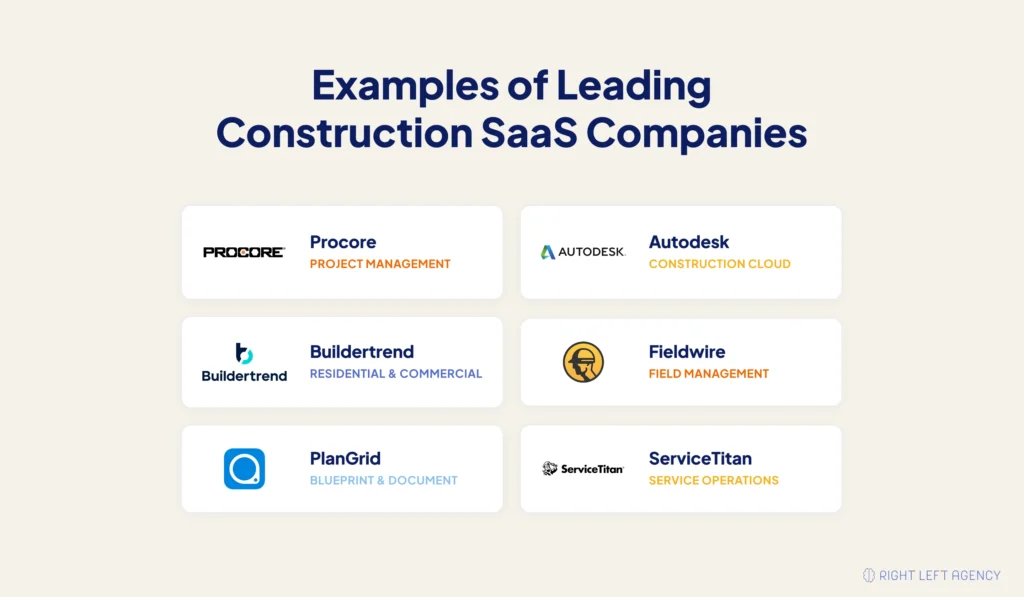
Several well-known platforms have built strong positions in the Construction SaaS market. Here’s a quick breakdown of the most recognized names:
| Company | Main Category | Who It Serves | What It Helps With |
| Procore | Construction management | General contractors, owners, subcontractors | Project management, financials, document control |
| Autodesk Construction Cloud | BIM and project management | General contractors, architects, project owners | Design coordination, project execution, field collaboration |
| Buildertrend | Residential construction software | Home builders and remodelers | Scheduling, client communication, project management |
| Fieldwire | Field management | Contractors and field teams | Task management, plans, job site coordination |
| PlanGrid | Document management | Field teams and project managers | Drawing management and field productivity |
| ServiceTitan | Service and contractor CRM | Specialty trades and service contractors | Scheduling, dispatching, invoicing, sales |
These companies come up constantly when construction firms evaluate what software to adopt. This is the competitive landscape your SaaS ConTech is positioning against.
Construction SaaS vs Traditional Construction Software
Older construction software was typically installed on a single workstation or server. That worked in a world where projects were managed from one office. It doesn’t work well for modern construction teams spread across multiple job sites.
Cloud-based solutions now account for around 82% of the construction project management software market. The shift to cloud-based software is no longer a trend. It’s the default.
| Feature | Traditional Construction Software | Construction SaaS |
| Access | Installed on specific devices | Accessed through a browser or mobile app from anywhere |
| Pricing | Often a large upfront license fee | Subscription-based, monthly or annual |
| Updates | Manual updates, often delayed | Automatic updates pushed through the cloud |
| Collaboration | Limited to local users | Real-time access for office and field teams |
| Mobile use | Minimal or unavailable | Built-in mobile apps for field teams |
| Scalability | Difficult to scale across teams | Scales easily as teams grow |
| Integrations | Limited API connectivity | Connects with accounting, ERP, and CRM tools |
| Maintenance | Requires IT support | Managed by the software vendor |
Traditional software still exists, and some companies stick with it. But cloud-based construction software gives modern construction teams more flexibility, better collaboration, and a lower upfront cost. That’s why the market has shifted.
Who Buys Construction SaaS?
Understanding the buying committee matters for both positioning and messaging. Construction SaaS doesn’t have a single buyer. Multiple stakeholders are usually involved in the decision.
| Buyer Type | What They Care About | Messaging Angle |
| CEOs and Founders | Growth, profitability, risk reduction | Better project visibility and stronger margins |
| General Contractors | Project delivery, coordination, compliance | One platform connecting office and field |
| Subcontractors | Clear communication, RFIs, schedule access | Less back-and-forth, faster issue resolution |
| Project Managers | Scheduling, tasks, document control | Everything in one place, fewer missed updates |
| Finance and Accounting Teams | Budget tracking, change orders, job costing | Real-time cost data without manual entry |
| IT Leaders | Security, integrations, compliance | Enterprise-grade platform with strong vendor support |
| Operations Leaders | Efficiency, resource planning, reporting | Fewer bottlenecks across active projects |
Each of these buyers needs different messaging. A CEO cares about margin and growth, while a project manager cares about whether the platform is easy to use on a busy job site. An effective ConTech marketing strategy speaks to all of them.
Common Growth Challenges for Construction SaaS Companies
Growing a Construction SaaS company is not the same as growing a general B2B SaaS product. The construction market has its own dynamics, and each one requires a specific response.
Long and complex sales cycles. Construction companies take time to evaluate software. Multiple stakeholders need sign-off. A deal that looks close can take months to close.
Hard-to-convince buyers. Many contractors are skeptical of new technology. They’ve seen software fail to deliver before. Trust takes time to build in this market.
Feature-heavy messaging. Construction SaaS companies often lead with features instead of outcomes. Buyers don’t care how many integrations you have. They care whether you’ll help them win more bids and stay on budget.
Weak website conversion. Many ConTech websites get traffic but fail to convert it. Vague CTAs, unclear positioning, and no social proof all hurt conversion rates.
Poor SEO visibility. Competitors with stronger content libraries dominate search results for high-intent construction software keywords. Without SaaS SEO investment, the organic pipeline stays weak.
Unclear positioning by segment. A platform that tries to serve every contractor type often resonates with none of them. Generic messaging loses to focused messaging every time.
Limited sales enablement. Sales reps often lack the content they need to handle objections, compare against competitors, or justify ROI to a skeptical CFO.
Why Construction SaaS Marketing Is Different
Most B2B SaaS companies operate in markets where buyers are comfortable with software, sales cycles are predictable, and category awareness already exists. Construction SaaS operates under completely different conditions.
The buyer is not a tech buyer. A general contractor, a project manager, or a field supervisor evaluates software differently from a SaaS-native buyer at a tech company. They want to know if it works on a job site, not whether it has 200 integrations. Marketing language that works in general B2B SaaS often falls flat in construction.
The sales cycle involves the whole company. A single Construction SaaS purchase can involve the CEO, the CFO, IT leadership, project managers, and field supervisors. Each person has a different concern. Your marketing has to speak to all of them, often through different content formats and channels.
Trust is built through the industry, not around it. Construction buyers trust other contractors, trade associations, and industry peers more than they trust vendor websites. Social proof, case studies, and referrals from within the industry carry more weight here than they do in most SaaS categories.
The language has to be construction-first. Generic SaaS messaging about “workflow automation” and “cloud collaboration” does not land with a contractor who talks about submittals, RFIs, change orders, and punch lists every day. Marketing that uses construction terminology and speaks to real job site problems earns attention. Generic messaging gets ignored.
The market is fragmented by segment. General contractors, residential builders, subcontractors, specialty trades, and owners all have different workflows, different buying criteria, and different pain points. A message built for one segment rarely works for another. Construction SaaS companies that try to speak to everyone typically connect with no one.
This is also why working with a ConTech marketing partner that understands both SaaS growth and the construction industry matters.
When we worked with PermitFlow, a ConTech startup automating preconstruction workflows, we applied exactly this approach: full-funnel paid media built around construction buyer intent, landing pages optimized for the right audience, and a creative strategy rooted in the specific language and concerns of construction businesses. The result was a 44% increase in lead volume and a 52% increase in Meta leads within a single month.
Growth Strategies for Construction SaaS Companies
Sharpen Positioning by Buyer Segment
The most effective Construction SaaS companies don’t market to “contractors.” They market to general contractors in the commercial space, or residential builders, or specialty trade subcontractors.
The more specific the positioning, the stronger the messaging. A home builder and a highway contractor have completely different problems, workflows, and buying criteria. Trying to speak to both with the same message weakens both conversations.
Start by identifying the segment where you win most often. Build your messaging around that segment first. Then expand.
Build SEO Around High-Intent Construction Software Keywords
Organic search is one of the strongest demand channels for Construction SaaS. Buyers actively search for tools when they’re ready to switch systems.
An effective SaaS SEO strategy for ConTech includes:
- Category pages targeting keywords like “construction project management software” or “construction estimating software”
- Comparison pages for searches like “Procore alternatives” or “best construction management software”
- Use-case pages built around specific workflows like “RFI management software” or “construction daily reporting tool”
- Industry pages targeting specific buyer segments like “software for subcontractors” or “construction software for home builders”
- Problem-led blog content that answers questions buyers search for before they’re ready to buy
Each of these page types targets a different stage of the buyer journey and builds the kind of content library that generates a consistent organic pipeline.
Create Case Studies by Construction Role or Segment
Buyers trust proof from people like them. A general contractor in the commercial space wants to see results from another general contractor, not a vague customer success story.
Effective case studies for Construction SaaS:
- Name the segment clearly (residential builder, specialty subcontractor, general contractor)
- Lead with the outcome, not the background story
- Include specific metrics like time saved, cost reduction, or number of projects completed
- Use real quotes from real people with real job titles
Case studies built this way work in sales conversations, on the website, in paid ads, and in email sequences.
Use Paid Search for High-Intent Demand
Paid media for SaaS puts you in front of buyers who are actively searching for solutions. For Construction SaaS, the most valuable paid search campaigns target:
- Bottom-funnel keywords like “construction management software pricing” or “Procore alternative”
- Competitor brand terms from buyers already evaluating similar tools
- Demo-intent searches like “request demo construction software” or “book a call construction project management”
Paid search doesn’t build brand awareness. It captures demand that already exists. Pair it with strong landing pages and clear CTAs to get the most out of each click.
Improve Website Conversion Paths
Most Construction SaaS websites are built to inform, not to convert. That’s a missed opportunity. Conversion rate optimization for SaaS starts with the website.
A higher-converting ConTech website includes:
- A clear, segment-specific value proposition above the fold
- Demo CTAs that are visible and easy to act on
- Customer logos and case studies from recognizable construction companies
- ROI framing that ties the product to cost savings or revenue impact
- Clear product messaging that explains what you do in one sentence
Small improvements here compound quickly across all your demand channels.
Build Sales Enablement Assets
Your sales team needs content that helps them move deals forward. That includes:
- One-pagers tailored to specific buyer types
- ROI calculators or value justification guides
- Comparison guides positioning you against top competitors
- Objection-handling content for common pushback
- Buyer guides that help an internal champion sell the platform to the rest of the team
Without this content, reps rely on product demos and follow-up emails alone. That’s not enough in a long sales cycle with a skeptical buying committee.
Develop Partner and Ecosystem Marketing
Construction companies trust recommendations from people in their network. That’s why partner marketing is often an underused growth channel for ConTech companies.
High-value partnership opportunities include:
- Construction associations and trade groups
- Industry consultants and technology advisors
- Integration partners like accounting software or ERP vendors
- General contractors who can refer subcontractor users
- Construction training programs and certification bodies
A strong partner channel builds pipeline through trusted relationships rather than cold outreach.
SEO Strategy for Construction SaaS Companies
SEO is not just a traffic strategy for Construction SaaS. It’s a pipeline strategy. Buyers who find you through organic search are often further along in their decision process than those who see a paid ad.
A strong SaaS content marketing and SEO program for Construction SaaS includes:
- Category pages that target how buyers describe the software category, not just your product name
- Comparison and alternative pages that capture buyers evaluating your competitors
- Use-case pages built around specific construction workflows and problems
- Industry and segment pages targeting specific contractor types and project categories
- Integration pages that rank for searches combining your tool with accounting, ERP, or CRM software
- Bottom-funnel blog content that answers buying-stage questions
- Internal linking that connects related pages and distributes authority across the site
- Technical SEO to make sure the site loads fast, indexes correctly, and has no structural issues
- Demo and conversion pages optimized for keywords that signal purchase intent
The goal isn’t just traffic. It’s qualified traffic that turns into demo requests and pipeline.
Construction SaaS Topic Cluster Ideas
If you’re building a SaaS content marketing strategy around Construction SaaS, these topic ideas can support the main pillar page and drive additional organic traffic.
| Cluster Topic | Search Intent | Funnel Stage |
| Best construction project management software | Commercial investigation | BOFU |
| What is construction management software? | Informational | TOFU |
| Procore alternatives | Commercial investigation | BOFU |
| Construction software for general contractors | Commercial investigation | MOFU |
| Construction software for subcontractors | Commercial investigation | MOFU |
| Construction CRM software | Informational / Commercial | MOFU |
| Construction estimating software | Commercial investigation | BOFU |
| How to generate leads for construction software | Informational | TOFU |
| Construction SaaS marketing strategy | Informational | TOFU/MOFU |
| ConTech trends | Informational | TOFU |
| Construction software buyer’s guide | Commercial investigation | MOFU/BOFU |
Build content across all funnel stages. TOFU content builds awareness and topical authority. BOFU content converts. Both matter for a healthy organic pipeline.
How to Measure Construction SaaS Growth
Tracking the right metrics keeps your B2B SaaS lead generation strategy honest. These are the KPIs that matter most for Construction SaaS companies.
| Metric | What It Shows |
| Demo requests | Whether demand generation is working |
| Qualified pipeline | Whether marketing is attracting the right buyers |
| Trial signups | Whether top-of-funnel conversion is working |
| CAC (Customer Acquisition Cost) | How efficiently you’re acquiring customers |
| LTV (Lifetime Value) | How much a customer is worth over time |
| ARR (Annual Recurring Revenue) | Total subscription revenue growth |
| Churn rate | Whether customers are staying after they sign up |
| Activation rate | Whether new users are getting value from the product |
| Sales cycle length | Whether deals are moving forward faster over time |
| Conversion rate by channel | Which demand channels produce the best-qualified leads |
| Customer acquisition source | Which channels are driving the most pipeline |
Don’t try to track everything at once. Start with demo requests, qualified pipeline, CAC, and ARR. Add more as your reporting infrastructure matures.
How Three Construction SaaS Leaders Grew Their Market Position
Understanding how established platforms scaled helps put the earlier growth strategies into context. These three companies took different paths, but each one reflects principles that work specifically in the construction market.
Procore: Deep Vertical Focus and a Land-and-Expand Model
Procore built its position by staying relentlessly focused on the construction industry and refusing to be a generic project management tool. The company found early product-market fit by narrowing its focus to custom home builders serving high-net-worth individuals, then expanded from serving the project manager to serving multiple stakeholders across multiple products and geographies over its first decade.
One of Procore’s most instructive growth moves was in sales hiring. Rather than hiring people directly from construction to do sales, which typically failed, Procore found success doing the opposite: hiring strong salespeople and teaching them construction, bringing domain experts in as sales engineers instead. That distinction matters for any ConTech company trying to build a sales team.
The revenue model centers on land-and-expand. Procore’s primary revenue stream is the subscription, and its growth engine is cross-selling an expanding product suite. The company achieved a net revenue retention rate of 106% for the full year 2024, with large-scale customer accounts growing 18% year-over-year in Q3 2024. Those numbers show what happens when you combine strong positioning, segment-specific messaging, and a product that continues to expand value for existing customers.
Key growth insight: Procore won by going deep on one industry, speaking the language of construction buyers, and expanding within accounts rather than constantly chasing new logos.
ServiceTitan: Segment Ownership and Community-Led Growth
ServiceTitan took a different approach. Rather than building a broad construction platform, it focused on a specific underserved segment: specialty trades contractors in HVAC, plumbing, and electrical. By going narrow and owning that segment completely, it built the trust and proof that eventually let it expand.
ServiceTitan’s implied ARR reached $772 million in 2024, growing 24% year-over-year, and is on track to surpass $1 billion in 2025. That growth was built on a few deliberate strategies. The company invested heavily in the community, creating a peer network where contractors shared ideas, strategies, and results with each other. That community became one of the company’s strongest marketing channels because contractors trust other contractors far more than they trust software vendors.
ServiceTitan’s ROI calculator offered a fast, personalized estimate of platform impact, enabling the sales team to quantify potential gains in efficiency, revenue, and profitability in under 30 seconds. That kind of sales enablement shortens the evaluation cycle and gives buyers the financial justification they need to move forward with a skeptical CFO.
Key growth insight: ServiceTitan proved that owning one segment deeply is more powerful than trying to serve the whole market. The community-led approach and ROI-focused sales enablement both accelerated trust and conversion in a market where trust is everything.
Buildertrend: Niche Dominance in Residential Construction
Buildertrend chose a clear lane early: residential builders and remodelers. Instead of competing directly with enterprise-focused platforms like Procore, it built a product and a brand specifically for home builders and remodelers who needed something more accessible than the enterprise tools and more powerful than a spreadsheet.
Buildertrend has served the residential construction market since 2006 and generated $171.6 million in revenue, positioning itself as the leading construction management software for home builders and remodelers. Its growth came from deep segment focus, strong product-market fit for its specific buyer, and a platform designed around the residential workflow rather than adapted from a commercial one.
The marketing lesson is simple but often ignored: being the best option for one specific segment beats being a decent option for everyone. Buildertrend’s success came from clarity of positioning, not breadth of features.
Key growth insight: Segment ownership drives category leadership. Buildertrend didn’t try to compete with Procore on enterprise accounts. It built a brand that residential builders trusted, and that trust created durable market share.
Final Thoughts on Construction SaaS
Construction SaaS has moved from a niche category to a core part of how modern construction companies operate. Contractors who use cloud-based software manage projects more efficiently, reduce costly errors, and give their teams better tools to do the work.
For the companies building these platforms, growth depends on more than a good product. It takes clear positioning, consistent demand generation, SaaS SEO built around buyer intent, and a SaaS website design that converts the traffic you earn. If your Construction SaaS company is ready to build a marketing system that drives a qualified pipeline, consider working with a SaaS marketing agency that understands the complexity of selling software in niche B2B markets.
FAQs About Construction SaaS
What is Construction SaaS?
Construction SaaS is cloud-based software built for construction companies to manage projects, teams, documents, schedules, costs, and communication through a subscription model. It replaces installed software with platforms accessible from any device, anywhere, in real time.
What are examples of Construction SaaS companies?
Well-known Construction SaaS companies include Procore, Autodesk Construction Cloud, Buildertrend, Fieldwire, PlanGrid, and ServiceTitan. Each serves a different part of the construction market, from commercial general contractors to residential builders and specialty trades.
How does Construction SaaS help contractors?
Construction SaaS helps contractors by connecting office teams and field teams, centralizing project documents, tracking budgets and change orders, automating reporting, and improving visibility across all active projects. The result is fewer errors, better communication, and more control over project outcomes.
Is Construction SaaS the same as ConTech?
Not exactly. ConTech (construction technology) is a broader category that includes all technology used in construction, from hardware and drones to robotics and software. Construction SaaS is a specific subset of ConTech that refers to cloud-based software delivered through a subscription model.
What is the difference between Construction SaaS and construction management software?
Construction management software is a category of tools that helps teams manage projects, schedules, and documents. Construction SaaS is the delivery model. Most modern construction management software is delivered as SaaS, meaning it’s cloud-based, subscription-priced, and accessible through a browser or app.
How do Construction SaaS companies make money?
Construction SaaS companies earn recurring revenue through monthly or annual subscriptions. Pricing is usually based on the number of users, projects, or seats. Many platforms also generate revenue through implementation fees, premium support tiers, and add-on modules.
How can Construction SaaS companies grow?
Construction SaaS companies grow by sharpening their positioning by buyer segment, investing in SEO and SaaS content marketing, running paid search campaigns targeting high-intent keywords, improving website conversion, building strong sales enablement assets, and developing partner and ecosystem relationships across the construction industry.
Who buys Construction SaaS products?
The buying committee for Construction SaaS typically includes CEOs, general contractors, project managers, finance teams, operations leaders, and IT teams. Each stakeholder has different priorities, so effective messaging speaks to each role separately rather than trying to appeal to everyone with a single message.