


Key Takeaways
- SaaS content marketing is a full-funnel system that supports awareness, demand generation, demos, trials, onboarding, retention, and expansion.
- BOFU content, such as comparison pages, alternative pages, use-case pages, and case studies, often drives faster conversion impact than broad awareness content.
- Every content asset should map to a funnel stage, a search intent, an ICP pain point, and a conversion goal.
- SaaS content performance should be measured by pipeline influence, demo requests, trial signups, activation, and retention, not traffic alone.
Your SaaS team has been publishing blog posts every week for six months. Traffic is climbing, demo requests are flat, trial signups are thin, and the sales team still has nothing useful to share with prospects. The content looks good. So why is it not working?
This is one of the most common problems SaaS companies run into. Publishing is not the same as marketing. The real challenge is building a content system that moves the right people from search to signup, and from curiosity to confidence.
SaaS content marketing is a strategic approach to creating and distributing content that helps software companies attract, educate, convert, and retain customers. It focuses on content that supports the full SaaS customer journey, from awareness and product education to demos, trials, onboarding, and expansion.
This guide walks through strategy, content types, funnel-stage examples, distribution, metrics, common mistakes, and a practical checklist you can start using today.
What Is SaaS Content Marketing?
SaaS content marketing is the practice of creating and distributing content that supports the entire customer lifecycle of a software product. It helps potential customers understand their problem, discover your product as a solution, and feel confident enough to sign up, book a demo, or become a paying user.
Unlike a general content strategy, SaaS content marketing has to go further. It needs to support product education, address long sales cycles, handle buying committees, and keep existing customers engaged long after they sign up.
For example, a project management SaaS might use educational blog posts to attract teams struggling with missed deadlines, use-case pages to show how agencies manage client projects, comparison pages to capture buyers evaluating alternatives, and onboarding guides to help new customers adopt key features. Each piece of content does a specific job at a specific stage of the journey.
SaaS content marketing helps companies with:
- Building awareness among their ideal customer profile
- Educating potential buyers on their problems and the right solution
- Explaining product use cases and how the tool fits into a real workflow
- Generating demo requests and free trial signups
- Supporting sales conversations with relevant, helpful assets
- Improving onboarding so new users see value faster
- Reducing churn through ongoing customer education
Why SaaS Content Marketing Is Different
Most B2B software purchases are not simple decisions. A buyer rarely discovers your tool on Monday and buys it on Tuesday. There are research phases, internal discussions, competing priorities, and budget approvals.
B2B SaaS buying decisions also involve multiple stakeholders. A product manager may discover your tool. A VP of Engineering may evaluate integrations and scalability. A security or IT team may review compliance. A CFO may want the ROI case. Each stakeholder needs different content before the deal can move forward.
SaaS content marketing needs to address:
- Long sales cycles that require nurturing over weeks or months
- Multiple decision-makers with different priorities and concerns
- Technical product questions about security, integrations, and scalability
- Use-case education that shows the product solving real workflows
- Competitor comparisons for buyers who are already shopping for alternatives
- Customer onboarding to help new users activate and find value faster
- Retention and expansion to reduce churn and grow account value
- Revenue attribution so teams can connect content to pipeline and ARR
Content in SaaS is not a campaign. It is an ongoing system.
Why SaaS Companies Need Content Marketing
Paid ads can generate demos quickly, but the moment you stop spending, the leads stop coming. Content marketing builds compounding assets. A well-optimized article, comparison page, or use-case guide can generate qualified traffic for years without extra spend.
First Page Sage’s SEO ROI benchmarks report lists B2B SaaS SEO at a 702% three-year average ROI, with an estimated seven-month break-even period. Organic search also accounts for nearly 45% of all B2B revenue, making it the single largest revenue channel for most software companies. Treat these as benchmarks, not guarantees. Actual ROI depends on content quality, competition, conversion paths, and attribution.
Content marketing also helps bring down CAC over time by creating a more efficient acquisition channel. It supports retention, which directly protects ARR and LTV.
SaaS content marketing can help companies:
- Attract qualified organic traffic from buyers who are actively searching for solutions
- Build trust with problem-aware buyers before they ever talk to sales
- Generate product-qualified leads who already understand what the product does
- Support demo and trial conversions through content that answers last-mile questions
- Enable sales teams with comparison pages, case studies, ROI explainers, and objection-handling guides
- Improve customer onboarding through tutorials, guides, and knowledge base content
- Reduce churn by educating customers on features they have not yet adopted
- Increase expansion revenue by surfacing higher-tier features to existing users
The earlier you build this content system, the more time it has to compound.
SaaS Content Marketing Strategy: Step-by-Step Framework
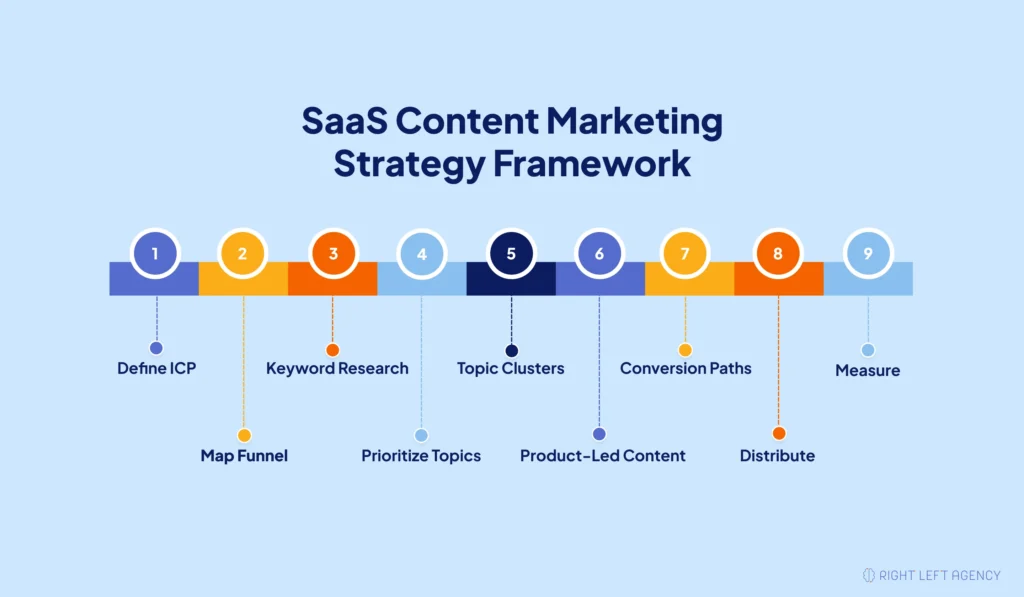
A SaaS content strategy is only as good as the system behind it. Here is the framework we recommend.
1. Define Your ICP and Buyer Personas
Before you write a single word, you need to know exactly who you are writing for. Start with your ideal customer profile (ICP). What industry are they in? What is their company size? What job roles are involved in the buying decision? What pain points are they trying to solve, and what triggers them to start looking for a solution?
Buyer personas help you translate the ICP into content decisions. The content a solo founder needs looks nothing like what a VP of Marketing at a 200-person company wants to read. Get this clarity first.
💡Pro Tip: Talk to your five best customers before you brief a single article. Ask them what they Googled before finding your product, what made them hesitate, and what finally convinced them. Their exact language will surface your best keyword and content ideas faster than any tool.
2. Map Content to the SaaS Funnel
Not all content serves the same purpose. We map everything to three stages of the funnel:
TOFU (top of funnel): Awareness content for people who have a problem but are not yet looking for your product. Think educational guides, industry trend pieces, and problem-framing articles.
MOFU (middle of funnel): Solution content for buyers who know they need a tool and are evaluating options. Think use-case pages, product category guides, templates, and webinars.
BOFU (bottom of funnel): Decision content for buyers who are close to a purchase. Think comparison pages, alternative pages, case studies, demo landing pages, and pricing explainers.
Each stage needs different content with a different CTA. Mapping this out before you produce anything prevents the most common mistake in SaaS content: a calendar full of top-of-funnel posts with nothing that actually converts.
3. Conduct SaaS Keyword Research
SaaS keyword research goes beyond finding high-volume terms. You need keywords across four levels of buyer awareness:
- Problem-aware keywords: “how to reduce customer churn,” “why is my team not adopting new software.”
- Solution-aware keywords: “best project management tools for agencies,” “CRM for startups.”
- Product-aware keywords: “[Your Product] features,” “[Your Product] pricing”
- Competitor-aware keywords: “[Competitor] alternative,” “[Competitor] vs [Your Product]”
A keyword with 50,000 monthly searches is still a poor target if it attracts the wrong audience. A low-volume keyword with strong buying intent will generate more demo requests than a high-traffic informational article.
4. Prioritize Content by Business Impact
After keyword research, resist the urge to start with the biggest topics. Score each content opportunity by buying intent, ICP fit, product relevance, ranking difficulty, and conversion potential.
For early-stage SaaS companies, do not start with a huge topic cluster around broad educational terms. Start with one commercial cluster. For example, a customer success platform could build a pillar page around “customer success software,” then support it with “customer success software for SaaS,” “[Competitor] alternatives,” “customer health score template,” “customer onboarding checklist,” and “how to reduce SaaS churn.” This gives the cluster both SEO depth and conversion value.
Use this simple scoring table. Score each factor from 1 to 5, where 1 means low value, and 5 means high value. Prioritize topics with the highest total score, especially those that combine strong buying intent with strong product relevance.
| Factor | Score (1–5) |
|---|---|
| ICP fit | |
| Buying intent | |
| Product relevance | |
| Ranking opportunity | |
| Conversion potential | |
| Sales usefulness |
Create the highest-scoring content first. This keeps your calendar focused on content that converts, not just content that ranks.
5. Build Topic Clusters
Topic clusters help you build topical authority in your niche. One comprehensive pillar page covers a broad topic, and a set of supporting articles covers related subtopics in depth.
A pillar page on “project management software” might link to supporting articles on agile workflows, sprint planning templates, resource management, and remote team collaboration. Internal links connect everything, and search engines recognize the depth of your coverage.
6. Create Product-Led Content
Product-led content shows how your product solves real problems without reading like a sales pitch. This means weaving product examples naturally into educational content. If you are writing a guide on “how to automate client reporting,” you show how your product handles that workflow without making the article feel like an ad.
💡Pro Tip: The easiest way to write product-led content is to walk through your own product while writing the article. Screenshot what you are doing. Show the actual steps. Readers trust tutorials that look lived-in.
7. Add Conversion Paths
Every piece of content needs a clear next step. The right CTA depends on the funnel stage.
TOFU content might link to a newsletter, a downloadable template, or a related guide. MOFU content might link to a webinar or a product feature page. BOFU content should point directly to a demo or free trial.
Every page is an opportunity to move someone forward. Missing CTAs is one of the most expensive content mistakes a SaaS team can make.
8. Distribute and Repurpose Content
Publishing is only half the job. Share new articles on LinkedIn, include them in email newsletters, send them to the sales team for prospect conversations, and post in relevant communities.
A long-form guide can become a LinkedIn carousel, a webinar outline, a short email sequence, or a sales enablement one-pager. Distribution multiplies the return on every piece of content you produce.
9. Measure Performance
Track content performance across the full funnel. Rankings and organic traffic tell you if content is getting found. Demo requests, trial signups, and content-assisted conversions tell you if it is driving pipeline. Retention and activation data tell you if onboarding content is doing its job.
Best Content Types for SaaS Companies
Different stages of the buyer journey need different content formats. A first-time visitor who found you through Google needs something completely different from a prospect who is already comparing you to a competitor. The table below maps each content type to where it does its best work.
| Content Type | Funnel Stage | Purpose | Example |
|---|---|---|---|
| Educational blog posts | TOFU | Build awareness, drive organic traffic | “How to reduce software onboarding time.” |
| Use-case pages | MOFU | Show product fit for specific roles or industries | “Project management software for marketing teams” |
| Comparison pages | BOFU | Help buyers evaluate your product vs. competitors | “[Your Product] vs [Competitor]” |
| Alternative pages | BOFU | Capture competitor traffic | “Best [Competitor] alternatives for [use case]” |
| Case studies | BOFU | Build trust with social proof | “How [Customer] reduced churn by 40%” |
| Product tutorials | MOFU / Retention | Drive activation and feature adoption | “How to set up automated reports in [Product]” |
| Templates and checklists | MOFU | Generate leads, demonstrate expertise | “Content calendar template for SaaS teams” |
| Webinars | MOFU | Educate and capture qualified leads | “How to build a B2B SaaS content strategy” |
| Integration pages | BOFU | Support technical buyers and SEO | “[Your Product] + [Integration] integration” |
| Help center content | Retention | Reduce support tickets, improve adoption | “How to invite team members to [Product]” |
| Customer onboarding content | Retention | Speed up time to value | “Getting started with [Product]: 5-day guide” |
SaaS Content Marketing Examples by Funnel Stage
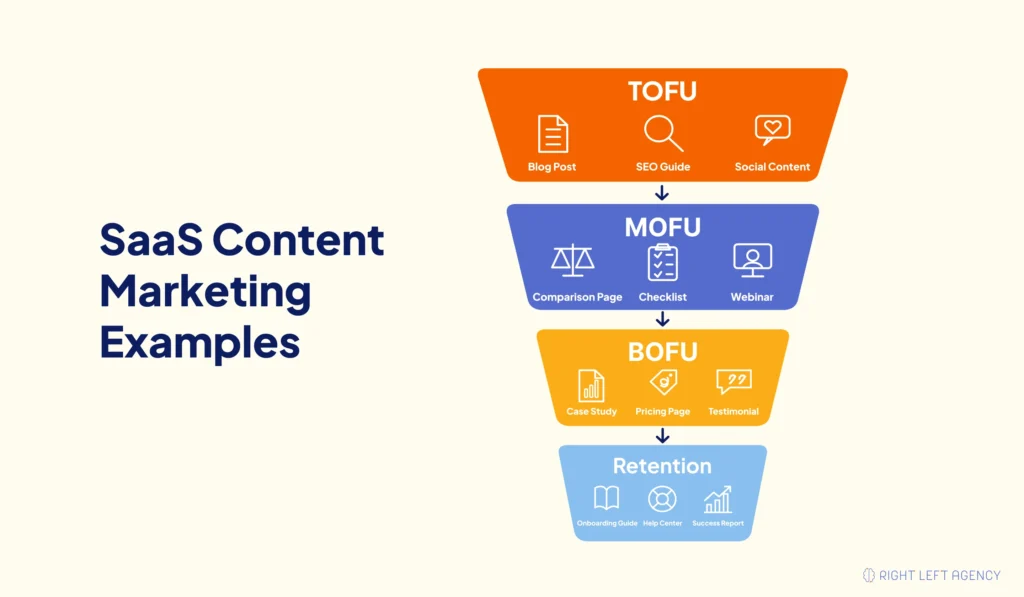
Here is how this plays out at each stage, including the right CTA for each content type.
Top-of-Funnel SaaS Content
TOFU content targets buyers who have a problem but are not yet shopping for a tool. The goal is to earn their attention and build trust before they are ready to evaluate solutions.
- Educational guides: A CRM company publishing “How to build a sales pipeline from scratch” targets problem-aware buyers without pitching the product
- Problem-framing articles: “Why your customer onboarding is costing you revenue” speaks directly to ICP pain without being promotional
- Industry trend posts: “How B2B buying behavior is changing in 2025” attract decision-makers who want to stay ahead in their space
- Beginner resources: “What is ARR and why does it matter for SaaS companies” draws early-stage founders who might eventually need financial tools
TOFU CTAs: Download a checklist, subscribe to the newsletter, or read a related guide.
Middle-of-Funnel SaaS Content
MOFU content serves buyers who know they need a solution and are actively evaluating their options.
- Templates and frameworks: “Free SaaS onboarding checklist” generates leads while demonstrating product expertise
- Use-case content: “How marketing agencies use [Product] to manage client campaigns” helps specific buyer segments see themselves in the product
- Product category guides: “The 10 best customer success platforms compared” positions your product within a competitive landscape
- Webinars: Live sessions on “Reducing churn with better onboarding” attract engaged buyers and give the sales team warm follow-up opportunities
MOFU CTAs: Watch a webinar, download a template, or visit a use-case page.
Bottom-of-Funnel SaaS Content
BOFU content targets buyers who are close to a decision. These pages drive the highest conversion rates because the reader already knows what they want.
- Comparison pages: “HubSpot vs Salesforce: Which CRM is right for your team?” captures high-intent search traffic from buyers already evaluating options
- Alternative pages: “Best HubSpot alternatives for small businesses” directly intercepts competitor searches
- Case studies: Social proof from real customers addresses objections and builds the final layer of confidence a buyer needs
- Integration pages: “[Product] + Zapier integration” captures technical buyers searching for specific compatibility before committing
- Pricing explainers: Content that contextualizes pricing helps buyers justify the investment internally and move the deal forward
BOFU CTAs: Book a demo, start a free trial, or compare pricing.
Retention and Expansion Content
Content does not stop working after the sale. This is where a lot of SaaS teams leave money on the table.
- Onboarding guides help new users reach their first meaningful win quickly, which directly reduces early churn
- Product tutorials drive feature adoption and help customers get more value from what they already pay for
- Feature update posts keep existing users aware of capabilities they may not have found on their own
- Customer education content supports your customer success team and cuts inbound support volume
Retention CTAs: Try a new feature, join a training session, or contact customer success.
💡Pro Tip: Your customer success team is sitting on some of your best content ideas. Ask them what questions new users ask in the first 30 days. Those are your highest-priority onboarding content topics.
How to Create a SaaS Content Calendar
A SaaS content calendar is not just a list of topics and publish dates. It keeps your team aligned on intent, ownership, and business outcomes. Without this structure, content production becomes reactive, and it gets very hard to know which articles are actually moving the needle.
| Field | What to Include |
|---|---|
| Topic | The specific article or page title |
| Primary keyword | The main search term you are targeting |
| Funnel stage | TOFU, MOFU, or BOFU |
| Search intent | Informational, navigational, or transactional |
| Content type | Blog post, comparison page, case study, etc. |
| CTA | Demo, trial, newsletter, template download |
| Owner | Writer, editor, or content manager responsible |
| Publish date | Target live date |
| Update date | Date for next scheduled content refresh |
| Target KPI | Rankings, demo requests, trial signups, traffic |
| Distribution channel | SEO, LinkedIn, newsletter, sales sequence, paid retargeting, community, webinar |
| Sales/CS use case | How sales or customer success can use this asset in conversations |
A filled-in calendar keeps production tied to business goals, not just publishing velocity.
SaaS Content Distribution Strategy
Publishing is where most SaaS content programs stop. Distribution is where they start working.
A strong distribution system helps each asset reach buyers across multiple channels: search, email, LinkedIn, sales conversations, communities, paid retargeting, and customer onboarding.
Think of a BOFU comparison page as more than a blog post. It can support SEO, become a sales follow-up link, fuel LinkedIn posts, and run in retargeting campaigns for visitors who viewed your pricing or demo pages.
Here are the main distribution channels to build into your workflow:
- Organic search: Publish and optimize for target keywords, then build internal links from existing pages to support new content
- LinkedIn: Turn key points from long-form articles into carousels, short posts, or short-form videos
- Email newsletter: Share new articles with your subscriber list and segment by funnel stage where possible
- Sales enablement: Send relevant comparison pages, use-case pages, and case studies to the sales team for use in prospect conversations
- Paid retargeting: Use high-intent BOFU content in retargeting campaigns targeting visitors who viewed your pricing or demo pages
- Communities: Share educational content in Slack groups, Reddit communities, and LinkedIn groups where your ICP spends time
- Webinars: Repurpose long-form guides into webinar outlines and use recordings to feed future content
- Customer onboarding emails: Include help articles, tutorials, and feature guides in onboarding sequences to drive activation
- Partner and co-marketing channels: Share content with integration partners, resellers, or industry publications that reach your ICP
As a rule of thumb, plan distribution before publishing. For high-value assets, distribution should be treated as part of the production process, not an afterthought.
How to Measure SaaS Content Marketing Success
Many SaaS teams still struggle to connect content performance to revenue, which makes it harder to know what is working and what is wasting budget. SaaS content needs to be measured across the full funnel, from first click to closed revenue.
| Metric | What It Shows | Why It Matters |
|---|---|---|
| Keyword rankings | Visibility in search | Shows if content is being found by the right audience |
| Organic traffic | Volume of search visitors | Indicates channel growth and content reach |
| Click-through rate | Search result engagement | Shows if titles and meta descriptions are compelling |
| Engaged sessions | Quality of on-page experience | Reveals if content is actually being read |
| Content-assisted conversions | Multi-touch attribution | Shows content’s role in the full buyer journey |
| Demo requests | Sales pipeline input | Direct measure of BOFU content performance |
| Trial signups | Product-qualified leads | Shows acquisition efficiency from content |
| MQLs | Marketing-qualified leads | Tracks lead quality from content efforts |
| SQLs | Sales-accepted leads | Measures hand-off quality from marketing to sales |
| Pipeline influenced | Revenue opportunity | Connects content to deals in progress |
| CAC | Cost to acquire a customer | Shows efficiency improvements over time |
| Activation rate | Onboarding success | Measures how well product education drives early value |
| Retention | Customer staying power | Shows the impact of customer-stage content |
| Churn | Revenue loss prevention | Helps identify content gaps in onboarding or adoption |
| Expansion revenue | Growth from existing accounts | Tracks upsell content effectiveness |
Do not evaluate metrics in isolation. High traffic with low demo requests usually means the topic is too top-of-funnel or the CTA is weak. Low traffic with strong SQL influence usually means the page is valuable BOFU content that should be expanded, not deprioritized. High rankings with low CTR usually mean the title and meta description are not matching what the searcher expects. Strong activation but weak trial signups usually mean onboarding content is working, but acquisition content needs improvement.
Connect your content data from Google Search Console and GA4 to your CRM so you can trace the full path from organic click to closed deal.
Common SaaS Content Marketing Mistakes
Most SaaS content programs fail not because the writing is bad, but because the strategy is incomplete. Here are the mistakes we see most often, and how to fix each one.
- Writing only top-of-funnel content. TOFU content alone rarely converts. Fix: Add MOFU and BOFU content to your calendar every month.
- Ignoring BOFU keywords. Low-volume keywords like “[Competitor] alternative” or “best [category] software for [use case]” often carry the highest buying intent. Fix: Run a BOFU keyword audit and prioritize those pages before publishing another awareness post.
- Creating content without ICP research. Writing for everyone means converting no one. Fix: Interview your best customers and build content around the exact language they use to describe their problems.
- Targeting only high-volume keywords. A keyword with 50,000 monthly searches is still a poor target if it attracts the wrong audience. Fix: Prioritize keyword intent over keyword volume.
- Not connecting content to product use cases. Generic educational content builds traffic but rarely drives signups. Fix: Weave product examples into every relevant article naturally.
- Weak or missing CTAs. Publishing content without a clear next step wastes the traffic you worked to earn. Fix: Every page needs a contextually appropriate CTA based on the funnel stage.
- No internal linking strategy. Unlinked content is harder for search engines to discover and harder for readers to navigate. Fix: Add internal links to and from every new article as part of your publishing checklist.
- No content refresh process. Rankings decay. Information goes stale. Fix: Schedule quarterly reviews of your top 20 pages and update them with fresh data, better examples, and sharper targeting.
- Measuring only traffic, not the pipeline. Set up content-assisted conversion tracking in GA4 and connect it to your CRM.
- Publishing without distribution. Even great content gets ignored if nobody sees it. Fix: Build a distribution checklist that runs automatically after every publish.
SaaS Content Marketing Best Practices
These expert-level principles separate content programs that grow revenue from those that just grow page counts.
- Build BOFU clusters before scaling TOFU traffic. Comparison pages, alternative pages, and use-case pages convert faster. Build those first, then expand into awareness content.
- Use sales call objections to create comparison and alternative pages. Your sales team hears the same objections every week. Those objections are BOFU content briefs. Write pages that answer them directly.
- Add product screenshots to educational content where relevant. Showing the product in context inside a guide connects the problem to the solution in one reading session.
- Give every article a primary and a secondary CTA. The primary CTA pushes toward the next logical step (demo, trial, or template). The secondary CTA catches readers who are not ready yet (newsletter, related article).
- Refresh pages ranking in positions 4 to 20 before creating more new content. Updating existing content is often the highest-ROI move. A page close to the top needs less work to move up than a brand-new article needs to rank at all.
- Use CRM data to identify which content actually influences opportunities. Do not rely only on last-click attribution. A BOFU page that rarely gets traffic but appears in 40% of closed deals is one of your most valuable assets.
- Create customer education content for features with low adoption. If a feature has a strong retention impact but low usage, a tutorial or guide can fix that.
- Align content briefs with product positioning. Every article should reflect how your product is positioned, not just what the keyword says.
- Include original data, customer insights, and first-hand examples. First-hand experience can strengthen trust and make content more useful, especially when readers need practical advice rather than generic tips.
- Align content with both sales and customer success teams. Sales knows what stops a deal. Customer success knows what causes churn. Use both to fill content gaps across the funnel.
SaaS Content Marketing Checklist
Whether you are auditing an existing program or building one from scratch, this checklist keeps you on track. Work through it in order, and you will have a solid foundation for a content program that drives revenue, not just traffic.
Define your ICP by industry, company size, role, pain point, and buying trigger
Map content to TOFU, MOFU, BOFU, retention, and expansion
Research keywords by problem-aware, solution-aware, product-aware, and competitor-aware intent
Prioritize BOFU and product-led opportunities first
Build topic clusters around high-value product categories
Add clear CTAs based on funnel stage to every page
Link content to product, use-case, comparison, and demo pages
Create a distribution workflow for every asset before publishing
Track demos, trials, assisted conversions, pipeline, activation, and retention
Refresh high-value content quarterly
Share every new asset with the sales team before or at publication
Collect customer language from interviews, support tickets, and reviews to sharpen every content brief
When Should SaaS Companies Hire a Content Marketing Agency?
In-house content is often the better choice when your team has strong product knowledge, clear positioning, access to customer insights, and enough time to manage strategy, writing, editing, publishing, and measurement. If those conditions are in place, building internally gives you speed and brand consistency that is hard to outsource.
An agency becomes more useful when the team needs outside SaaS SEO strategy, scalable production, or a faster path to BOFU content.
It might be time to consider outside help when:
- Your team lacks SaaS SEO expertise. Content without a strong keyword strategy and technical SEO rarely earns sustainable organic traffic. An experienced agency brings frameworks that take years to develop internally.
- Content is not generating a pipeline. If you are driving traffic but not demos or trials, the strategy has a conversion problem. A B2B SaaS content marketing agency can identify and fix it faster than a generalist team.
- You need to scale production without losing quality. Hiring, onboarding, and managing an in-house content team takes time you may not have. An agency gives you a ready-made system.
- You need BOFU content urgently. Comparison pages, alternative pages, and product-led content require a specific skill set. An agency can build those faster than most internal hires.
- You want strategy, execution, and measurement working together. Many in-house teams have good writers but lack the strategic layer that connects content to revenue. An agency built around SaaS growth brings all three.
The right choice depends on your resources, growth stage, and available time. Some companies do best with a hybrid model: in-house content lead generation supported by an agency for strategy and production.
Conclusion
SaaS content marketing is not about publishing as much as possible and hoping something sticks. It is about building a full-funnel content system that attracts the right people, educates them at every stage of the buyer journey, and gives them every reason to sign up, book a demo, or become a long-term customer.
The companies that do this well have a clear strategy, a funnel-aware content plan, consistent distribution, and a measurement system that connects content to revenue.
If your SaaS content is getting traffic but not enough demos, trials, or pipeline, a content audit and roadmap can help you identify the gaps, prioritize high-impact opportunities, and build a full-funnel content system that supports growth. We are here to help you get started.
FAQs
What is SaaS content marketing?
SaaS content marketing is a strategic approach to creating and distributing content that helps software companies attract, educate, convert, and retain customers. It supports the full customer journey, from awareness and product education through to demos, trials, onboarding, and expansion.
Why is content marketing important for SaaS companies?
Content marketing helps SaaS companies attract qualified organic traffic, build buyer trust, generate demo and trial requests, support sales conversations, and improve retention. It creates compounding assets that reduce customer acquisition cost over time and keep delivering returns long after publication.
How is SaaS content marketing different from regular content marketing?
SaaS content marketing has to support long sales cycles, multiple decision-makers, complex product education, and recurring revenue goals. It also needs to address customer retention and expansion, not just acquisition. Generic content marketing rarely accounts for any of this.
What are the best content types for SaaS?
The most effective content types include educational blog posts, use-case pages, comparison pages, alternative pages, case studies, product tutorials, templates, webinars, integration pages, and onboarding guides. The right mix depends on your SaaS marketing funnel priorities and where your biggest gaps are.
How long does SaaS content marketing take to work?
SEO-led content typically takes three to six months to gain meaningful traction in search. BOFU content like comparison pages and competitor alternatives can generate results faster because they target buyers with high intent. Distribution-led content through email or LinkedIn can drive results within days of publishing.
How do you measure SaaS content marketing ROI?
Measure ROI using demo requests, trial signups, content-assisted conversions, pipeline impact, CAC, LTV, and customer retention rates. Connect content data from Google Search Console and GA4 to your CRM to get a full picture of how content contributes to revenue.
Should SaaS companies create content in-house or hire an agency?It depends on resources, expertise, speed, and B2B growth goals. In-house teams bring stronger product context and brand knowledge. Agencies bring faster execution and deeper SaaS SEO expertise. Many companies find that a hybrid model works best.