

Key Takeaways
- B2B SaaS marketing should focus on qualified demos, pipeline, retention, and recurring revenue.
- SaaS buyers follow a nonlinear journey, so content must support every buying stage.
- Strong SaaS marketing needs both demand creation and demand capture to grow sustainably.
- The best channel mix depends on ICP, deal size, buyer behavior, and sales motion.
- Marketing success should be measured by CAC, LTV, churn, pipeline, and revenue impact, not traffic alone.
What Is B2B SaaS Marketing?
B2B SaaS marketing is the practice of promoting subscription software to business buyers in a way that produces qualified demos and recurring revenue, not just brand awareness.
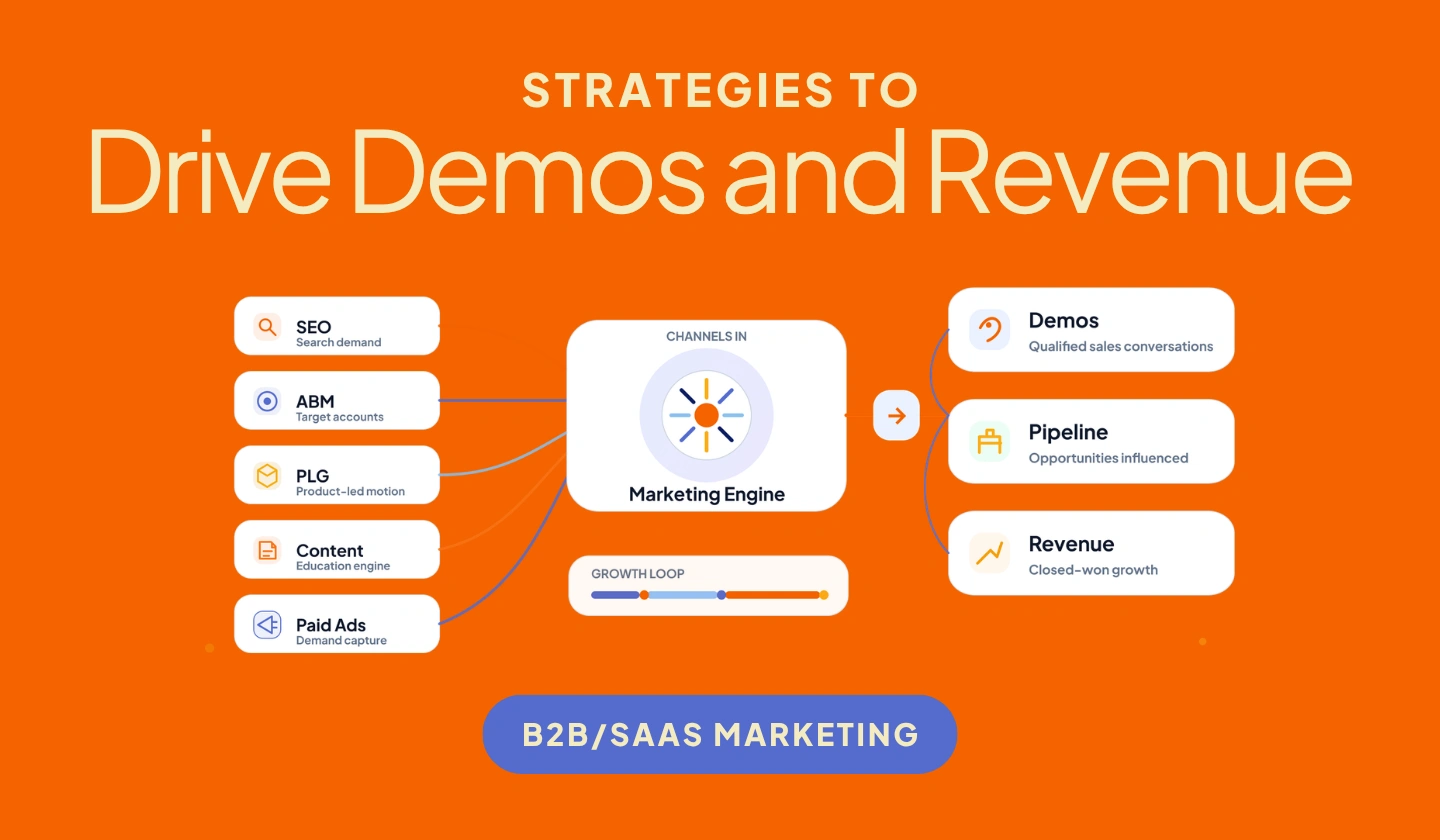
A real strategy blends positioning, SEO, content, and paid media with lifecycle campaigns, product-led experiences, and sales enablement, because the customer relationship doesn’t end at the signature, it continues through onboarding and renewal.
CRM platforms, analytics tools, cybersecurity software, HR platforms, project management tools, and marketing automation suites all fall into this category, and each one needs marketing that connects acquisition, activation, retention, and expansion into a single motion rather than four disconnected functions.
What Are the Winning Criteria of a SaaS Marketing Strategy?
A winning SaaS marketing strategy needs more than active channel execution. It needs clear alignment across buyers, messaging, campaigns, metrics, and revenue goals.
- Clear ICP Definition: Identify which accounts deserve your budget, content, and sales focus.
- Strong Positioning and Messaging: Explain why buyers should choose your software over competing alternatives.
- Full-Funnel Content Coverage: Support buyers as they understand, compare, decide, onboard, and expand.
- Demand Creation and Demand Capture: Build future demand while converting active buyers into sales opportunities.
- Bottom-Funnel SEO Strategy: Capture buyers comparing tools, integrations, alternatives, and solution options.
- Conversion-Focused Landing Pages: Turn qualified visitors into demos, trials, and sales conversations.
- Sales and Marketing Alignment: Use sales feedback to improve campaigns, messaging, content, and follow-ups.
- Product and Customer Success Alignment: Use product insights to improve onboarding, activation, retention, and expansion.
- Lifecycle Nurturing: Move leads, trials, and customers toward the next meaningful action.
- Revenue Attribution and Reporting: Track which channels influence pipeline, closed deals, retention, and expansion.
Why B2B SaaS Marketing Looks Different From Other Marketing
The short answer is that B2B buying is messy, and SaaS buying is messier still. Gartner’s research on B2B purchasing identifies six distinct “buying jobs” that committees work through — problem identification, solution exploration, requirements building, supplier selection, validation, and consensus creation — and crucially, buyers don’t move through them in order.
Roughly 90% of buyers loop back to revisit at least one job before they finalize a purchase, and the typical buying group spans six to ten stakeholders, each with a different stake in the outcome. A CFO is weighing cost, risk, and payback period. An end user just wants something that fits their existing workflow without a steep learning curve. Marketing has to speak to both without diluting the message.
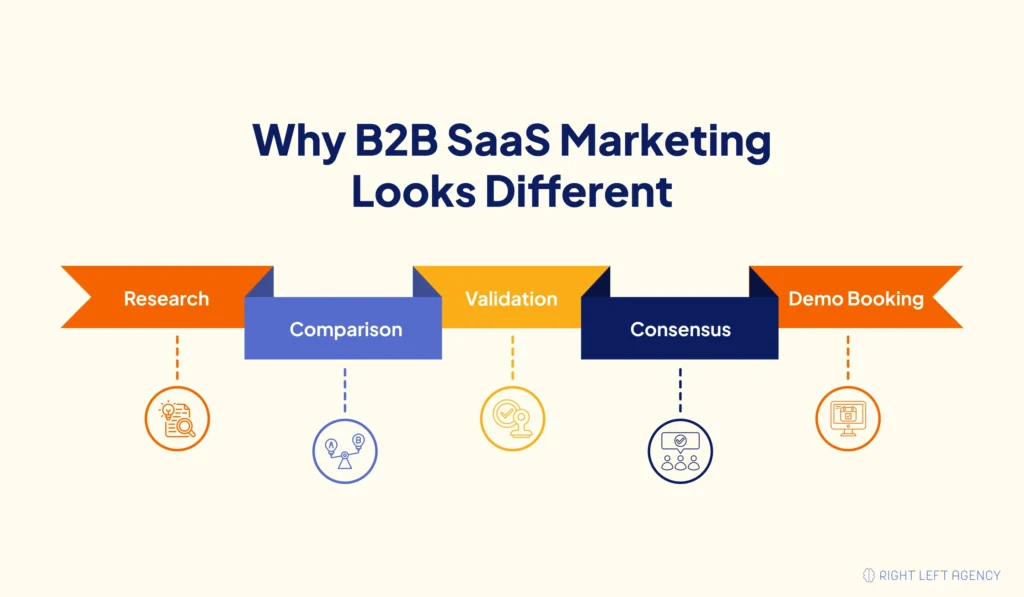
On top of that, SaaS revenue is recurring, not transactional, so the job doesn’t stop once a lead converts. The strongest teams pair demand generation — building awareness with buyers who aren’t ready to evaluate yet — with demand capture, which converts the smaller pool of active, in-market buyers into demos and opportunities. Both motions matter, and leaning too hard into one at the expense of the other tends to show up later as a pipeline that’s either too thin or too unqualified.
How to Build a B2B SaaS Marketing Strategy
A strategy that actually drives revenue starts before anyone picks a channel.
Get specific about who you’re selling to. Define your ideal customer profile using real signals — industries, company size, use cases, the events that trigger a buying decision — rather than a vague aspirational persona. The clearer this is, the easier everything downstream becomes.
Map the journey, not just the funnel. Buyers need different messages before they’ve booked a demo, while they’re evaluating, and after they’ve signed. Borrowing from Gartner’s buying-jobs framework, the goal is to have something useful for problem-identification searches, comparison-stage evaluation, and post-purchase validation, since buyers will revisit all three more than once.
Nail positioning before picking channels. Your message should make it obvious who buys, why now, and why you, and it should lead with the business outcome, not the feature list. Channels amplify positioning; they don’t fix weak positioning.
Choose channels based on deal size and buyer behavior, not what’s trendy. SEO tends to win for active, high-intent solution-seekers. ABM earns its cost for enterprise accounts with larger contracts. Paid media is the fastest way to test a new message or audience before committing a budget elsewhere.
Build real feedback loops with sales and customer success. Sales hears the objections firsthand. Customer success sees where adoption breaks down. Both should be feeding directly into content, campaigns, and lifecycle messaging, not just reporting up a chain that never reaches marketing.
Core B2B SaaS Marketing Channels and Tactics
Content Marketing for Education and Demand Creation
Most B2B SaaS buyers need to understand a problem before they’ll book a demo to evaluate the solution. Blog posts, guides, templates, webinars, and customer stories all do this work, but they need to map to different stages.
Early content should name a painful problem the buyer already feels, middle content should compare approaches and categories, and late-stage content should knock down objections that are standing between a prospect and a signed contract.
SaaS SEO for Bottom-Funnel Demand
The highest-leverage SEO for SaaS companies usually isn’t the broad, informational keyword — it’s the comparison page, the alternative page, the integration page, and the problem-solution article that catches someone who already knows they have a budget and a deadline. These searchers convert at a different rate than someone reading a general “what is X” post, because intent is already established before they land on the page.
Paid Advertising for Fast Pipeline Testing
Paid media earns its place when you need to test a message, an audience, or an offer faster than organic content allows. Google Search Ads capture commercial-intent keywords; LinkedIn Ads reach specific roles and account segments; retargeting re-engages visitors who already looked at pricing.
The trap to avoid is judging any of this by cost-per-click instead of by the pipeline it actually produces. A cheap lead that never becomes a qualified opportunity isn’t actually cheap.
Account-Based Marketing for High-Value Deals
ABM makes the most sense once your average deal size justifies a more manual, coordinated motion. It starts with a target account list, then aligns marketing and sales around personalized pages, executive content, and role-specific assets that help each stakeholder evaluate risk and ROI on their own terms. Done well, it reduces wasted spend by concentrating effort on the accounts most likely to close and expand.
Email Marketing and Lifecycle Nurturing
Most buyers won’t book a demo on their first visit, which is exactly what nurture sequences are for. Demo follow-ups, trial onboarding flows, re-engagement campaigns for inactive leads, and product update emails for existing customers all keep your product visible without forcing a premature ask. The best sequences match content to where the buyer actually is, rather than pushing every lead toward a demo on the same fixed timeline.
Product-Led Growth and Free Trial Conversion
PLG turns the product itself into the growth engine, using free trials, freemium tiers, and in-app prompts to drive discovery and upgrades. It’s worth setting expectations honestly here: industry benchmarks from OpenView Partners put median freemium-to-paid conversion in the low single digits, typically somewhere between 2% and 5%, which is exactly why activation and onboarding deserve as much attention as signups do.
Marketing, product, and customer success need shared activation milestones, and upgrade prompts should appear only after a user has actually experienced something valuable — not on a generic timer.
Customer Marketing for Retention and Expansion
Growth doesn’t stop at the first sale. Existing customers drive upsells, cross-sells, and referrals when they’re given the right education, case studies, and advocacy opportunities. Retention campaigns that help users realize value before a renewal conversation tend to protect both churn and lifetime value, and they make sales’ job easier when it’s time to talk about expansion.
Not sure which of these channels is actually producing pipeline for your business right now? A strategy review can usually surface where demos and revenue opportunities are quietly disappearing.
Metrics That Tie B2B SaaS Marketing to Revenue
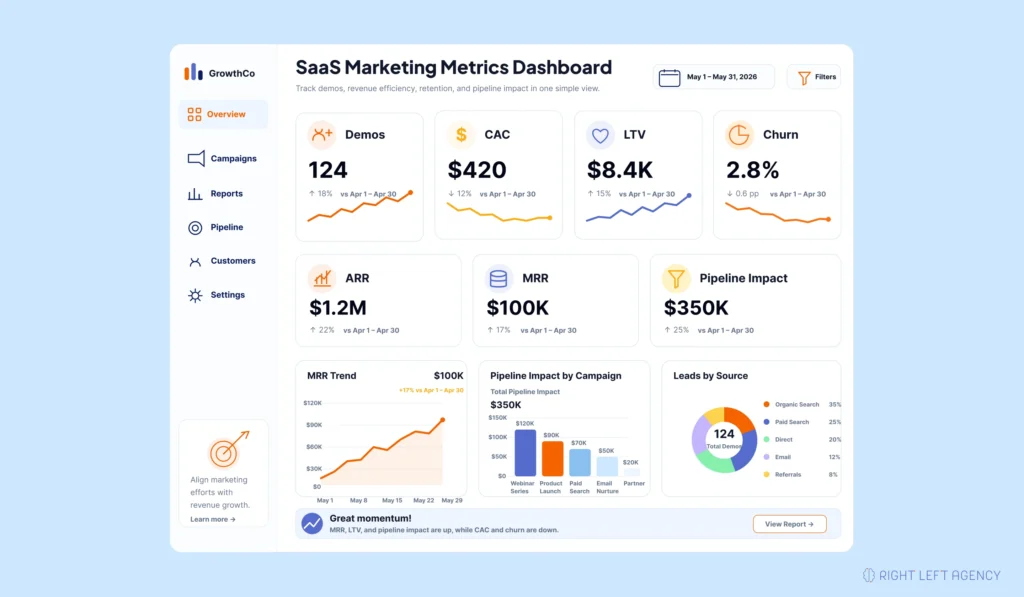
Critical B2B SaaS Marketing Metrics to Track
SaaS marketing should be measured by pipeline, revenue, and retention. These metrics show whether campaigns create real business growth.
| Metric | What It Shows | What It Helps Measure |
|---|---|---|
| Website Traffic | How many people visit your site from all channels. | Reach, visibility, and audience growth. |
| Conversion Rate | How many visitors take a desired action. | Landing page, CTA, and offer effectiveness. |
| Demo Requests | How many prospects ask to speak with sales. | Bottom-funnel intent and sales readiness. |
| Trial Signups | How many users start a free trial or freemium plan. | Product-led acquisition and signup interest. |
| Activation Rate | How many users reach key product milestones. | Onboarding quality and early product value. |
| MQLs | Leads that match your marketing qualification criteria. | Lead quality before sales review. |
| SQLs | Leads accepted by sales as real opportunities. | Sales fit and buyer readiness. |
| MQL-to-SQL Conversion Rate | How many marketing leads become sales-qualified leads. | Campaign quality and sales alignment. |
| Pipeline Value | Potential revenue from open sales opportunities. | Marketing’s contribution to future revenue. |
| Customer Acquisition Cost | How much it costs to acquire one customer. | Acquisition efficiency and budget health. |
| Customer Lifetime Value | Expected revenue from each customer relationship. | Retention value and long-term profitability. |
| LTV-to-CAC Ratio | Whether customer value outweighs acquisition cost. | Financial sustainability of growth. |
| MRR | Predictable subscription revenue generated each month. | Short-term recurring revenue growth. |
| ARR | Predictable subscription revenue generated each year. | Long-term revenue scale and stability. |
| Churn Rate | How many customers or how much revenue you lose. | Retention, satisfaction, and customer fit. |
| Expansion Revenue | Revenue from upsells, cross-sells, and upgrades. | Customer growth after the first sale. |
| Revenue Attribution | Which channels influence leads, pipeline, and deals. | Highest-performing marketing activities. |
Common B2B SaaS Marketing Mistakes to Avoid
Most SaaS marketing mistakes come from weak strategy, not weak effort. These mistakes can reduce demo quality, pipeline efficiency, and retention.
- Targeting Everyone: Trying to sell to too many customer types weakens your message. It also wastes the budget on accounts that are unlikely to convert.
- Chasing Traffic Instead of Revenue: Traffic looks good, but it means little without a qualified pipeline. The real goal is demos, opportunities, customers, and recurring revenue.
- Weak Positioning: Weak positioning fails to explain who the product helps and why. Buyers should understand your value before reading several full paragraphs.
- Ignoring Bottom-Funnel SEO: Many teams publish educational content but ignore high-intent keywords. Competitors then capture buyers comparing tools, alternatives, and integrations.
- Over-Relying on Paid Ads: Paid ads can create quick demand, but costs can rise fast. Without organic demand, pipelines become expensive and harder to sustain.
- Using One Message for Every Stakeholder: SaaS buying committees include finance, IT, leaders, and end users. Each group needs messaging that answers its specific concerns.
- Forcing Demos Too Early: Some buyers need education before they are ready for sales. Pushing demos too soon can reduce trust and conversion quality.
- Ignoring Lifecycle Nurturing: Many buyers do not convert after one visit or trial. Nurture campaigns keep your brand visible until buyers are ready.
- Treating PLG as Signup Growth Only: Free users do not automatically become active or paid customers. Teams must measure activation, adoption, upgrade paths, and retention.
- Ignoring Retention After Acquisition: Strong acquisition cannot fix poor retention or high churn. SaaS marketing should support adoption, renewal, expansion, and customer education.
- Poor Attribution Tracking: Without attribution, teams cannot see which channels influence revenue. Leaders may invest based on opinion instead of performance evidence.
- Sales and Marketing Silos: Disconnected teams create weak messaging, poor follow-up, and missed objections. Sales feedback should shape campaigns, content, and nurture sequences.
- No Conversion Rate Optimization: Traffic loses value when landing pages fail to convert visitors. CRO helps turn qualified visitors into demos, trials, and leads.
- Only Targeting Active Buyers: Most buyers are not ready to purchase immediately. SaaS teams must build trust before future buyers enter the market.
Examples of B2B SaaS Marketing in Action
Right Left Agency, also known as RLA, is a growth marketing agency. We help B2B and SaaS companies turn marketing into measurable revenue. Our work focuses on SEO, paid media, content, CRO, and pipeline growth.
Privva: Cybersecurity SaaS and Vendor Risk Management
Privva is a cloud-based vendor risk management platform. RLA found challenges around lead quality, awareness, and channel reach.
The strategy combined Google Ads, SEO, long-form content, and email marketing. RLA also tested LinkedIn Ads and PR to expand lead generation. After the campaign, Privva saw an 81% increase in site traffic.
This example shows the value of connected SaaS marketing execution. Paid ads captured active demand, while content and SEO built trust.
OneTouchPoint: Brand Management Software Growth
OneTouchPoint provides brand management software for distributed marketing teams. RLA strengthened its growth foundation with SEO, CRO, landing pages, and ads.
The strategy also included Google Search campaigns and tighter keyword targeting. As a result, OneTouchPoint gained 80% more leads and reduced CPL by 32%.
This example shows how SaaS campaigns improve when traffic and conversion align. Better keywords attracted stronger visitors, while landing pages improved lead quality.
Billd: B2B FinTech Growth With SaaS-Style Pipeline Lessons
Billd provides capital solutions for commercial construction businesses. RLA analyzed lead sources, shifted budget, and optimized conversion assets.
The strategy included media mix improvements, form optimization, and ad copy testing. Within six months, Billd achieved 125% growth in qualified lead volume.
Although Billd is not pure SaaS, the pipeline lesson still applies. B2B growth improves when the budget follows qualified leads and conversion data.
When Should You Hire a B2B SaaS Marketing Agency?
Outside help tends to make sense once a few warning signs stack up: traffic is healthy, but demo requests aren’t, paid campaigns generate leads that never turn into real pipeline, positioning doesn’t clearly explain the value or urgency, content misses the bottom-funnel keywords buyers actually search, or sales and marketing are quietly working from different assumptions about the buyer.
A good SaaS-focused agency should understand buying journeys, ICP development, demand generation, SEO, and ABM well enough to diagnose which of these is the actual bottleneck — and should be willing to measure its own success by demos, pipeline, and revenue rather than by deliverables shipped.
Final thoughts
The strongest B2B SaaS marketing strategies follow the buyer rather than a generic playbook, adjusting for ICP, sales motion, and product maturity along the way. SEO, content, paid media, ABM, PLG, and lifecycle campaigns all earn their place when they’re tied to revenue data instead of running as separate, disconnected efforts.
The goal was never a longer spreadsheet of leads — it’s qualified demos, healthy pipeline, and the retention and expansion that turn a single sale into years of recurring revenue.
Ready to turn your SaaS marketing into something more predictable? Book a strategy call to find out where your biggest growth opportunities are hiding.
FAQs
How is B2B SaaS marketing different from regular B2B marketing?
The biggest difference is that SaaS sells recurring access, not a one-time transaction, so marketing’s job continues well past the initial sale. Onboarding, adoption, renewal, and expansion all become marketing’s concern alongside acquisition, which is why SaaS marketing teams tend to work much more closely with product and customer success than traditional B2B marketers do.
What is the best B2B SaaS marketing strategy?
There isn’t a single universal answer — it depends on your ICP, average contract value, sales cycle length, and how mature your category is. Most SaaS companies end up combining SEO, content, paid media, and lifecycle campaigns, with the mix shifting based on deal size and buyer behavior. Tight alignment with sales tends to matter more than any single channel choice.
What is the 95/5 rule in B2B marketing?
It’s the idea, originally from researcher John Dawes and popularized by LinkedIn’s B2B Institute, that only about 5% of potential buyers are actively shopping at any given moment, while the remaining 95% aren’t yet ready to evaluate. The practical takeaway is that demand capture alone isn’t enough — brands also need to build awareness with the much larger group of future buyers who aren’t in-market yet.
How long does it take to see results from B2B SaaS marketing?
Bottom-funnel tactics like paid search and retargeting can show pipeline impact within weeks, since they target buyers who are already evaluating. SEO and content marketing usually take longer — often several months — to build the authority and rankings needed to capture that same intent organically. Brand and demand-generation work pays off on an even longer horizon, since it’s aimed at buyers who won’t be ready to purchase for a while yet.
When should a SaaS company hire a marketing agency?
Agency support tends to make sense once execution isn’t translating into revenue — common signs include weak positioning, poor attribution, or a steady stream of leads that never become qualified pipeline. The right partner should be able to point to specific gaps in strategy, SEO, or paid acquisition, and should measure their own work against demos and revenue rather than vanity metrics.