


Software as a Service (SaaS) is a software delivery and business model where a provider hosts the application in the cloud and customers access it over the internet. Instead of one-time licenses, revenue comes from recurring subscriptions or usage-based fees.
The vendor handles hosting, updates, security, and support; customers sign in via a browser or app. This matters because the economics of SaaS revolve around retention and expansion, metrics like MRR, ARR, churn, and LTV/CAC determine growth.
For entrepreneurs and product teams, the SaaS business model offers a way to build recurring revenue and scale globally, but it also requires new disciplines around customer acquisition, retention and service quality.
We will examine how the SaaS business model works, explore common pricing strategies, analyze key metrics and look at the trends shaping the industry in 2026. By the end you will have a clear understanding of the business model, the opportunities it presents, and the challenges you must overcome.
The Evolution of Software Delivery

In the early days of computing, companies purchased software licences and installed the programs on their own servers or desktops. Maintenance, upgrades, and security were the customer’s responsibility. By the late 1990s, cloud computing emerged and pioneers like Amazon, Salesforce, and Concur began offering applications as online services.
These pioneers recognized that renting infrastructure (infrastructure‑as‑a‑service or IaaS) and platforms (platform‑as‑a‑service or PaaS) could make it possible to deliver software to many customers at scale. When email services such as Gmail launched in 2004, mainstream consumers experienced the convenience of running applications in a browser.
By the late 2010s, SaaS had become a leading approach to delivering business applications, and by the early 2020s it was widely adopted across industries.
Get 20 profitable micro SaaS ideas to start a business within a complicated approach.
This shift brought more than new technology; it created a new way to think about value creation. Software no longer had to be sold once. Instead, the SaaS model emphasized continuous service.
The provider maintained one version of the software on its own infrastructure and gave all customers access through a web application. Because the application resided in the cloud, updates could be rolled out to everyone almost instantly. The relationship between provider and customer thus became ongoing and the health of the SaaS business depended on both acquiring and retaining users. Understanding this continuous relationship is central to mastering the business model.
Defining the SaaS Business Model
At its core SaaS is a cloud computing service model in which the provider hosts the application and all supporting infrastructure, making it available to customers over the internet. Customers access the service through a web browser or app, and they do not need to install, maintain, or update the software themselves.
Learn: 14 Proven SaaS Lead Generation Strategies for B2B Growth
Unlike traditional software, there is typically only one version of the application, and all customers share the same multi‑tenant architecture. This shared architecture delivers economies of scale and allows providers to offer features such as rapid scaling, automatic backups, and seamless updates.
A defining feature of the SaaS business model is how revenue is generated. Whereas perpetual licences offer a one‑time payment, SaaS providers rely on subscription and usage‑based fees. In practice, this means customers pay a recurring fee monthly, quarterly, or annually for continued access to the software.
Some providers complement subscriptions with freemium tiers, advertising, or transaction fees. Because the provider controls the infrastructure and application, it also bears responsibility for security, uptime, and customer support. The ease with which customers can cancel a subscription places pressure on the provider to deliver value continuously.
SaaS vs. On-Prem vs. PaaS/IaaS
| Model | Where it runs | Who manages infra | How you pay | Typical pros | Typical cons |
|---|---|---|---|---|---|
| SaaS | Vendor cloud | Vendor | Subscription or usage | Fast onboarding, continuous updates, lower upfront cost | Less control, vendor dependency, data residency constraints |
| On-prem | Your servers | You | License + maintenance | Maximum control, local data residency | High capex/opex, slower upgrades, internal security burden |
| PaaS/IaaS | Public cloud building blocks | Shared (vendor + you) | Pay-as-you-use | Flexibility, scale on demand, build custom apps | Requires engineering ops, cost sprawl risk, more security/compliance ownership |
Revenue Models in SaaS

Choosing the right revenue model is one of the most important decisions when building a SaaS business. Your pricing determines how customers perceive value, how predictable your revenue will be, and how efficiently you can scale. Below we outline the common models and highlight their advantages and trade‑offs.
Subscription Model
The most prevalent approach is the subscription model. Customers pay a recurring fee, usually monthly or annually, for access to the software. Providers often offer tier‑level pricing per person or per group, or flat‑rate plans that include unlimited access. Subscriptions create predictable, renewable revenue, but they are vulnerable to cancellation; if too many customers churn, the business can be jeopardized. On the other hand, the recurring nature of subscriptions tends to attract investors because it shows ongoing cash flow.
Usage‑Based Pricing
Usage‑based pricing charges customers based on the volume of transactions, number of seats, amount of storage, or other metrics. This model appeals to customers who are light users because they pay only for what they consume. It also enables providers to reach occasional users who might not buy a subscription. The trade‑off is that revenue can become unpredictable for the provider and billing complexity increases.
Freemium and Advertising‑Supported Models
A freemium approach gives away basic functionality for free while charging for premium features. It helps capture market share and displace rivals, even if only a small percentage of users convert to paying customers.
However, hosting costs grow with every free user and the provider must fund those costs until conversions occur. Some SaaS businesses also rely on advertising or affiliate marketing to support free tiers.
In advertising‑supported models, customers do not pay directly; instead, advertisers fund the service, which can work well for consumer products with large audiences. The challenge is balancing user experience with ads and ensuring that ad revenue covers infrastructure and development costs.
Hybrid Pricing
Many successful SaaS businesses combine the models above. They might offer a limited free tier, a per‑user subscription for small teams, and a usage‑based plan for enterprises. Hybrid pricing allows you to meet diverse customer needs and optimize revenue across segments. When designing hybrid plans, it’s important to keep the structure clear so customers understand what they are paying for and can upgrade easily.
Vertical SaaS Business Model Examples and Opportunities
While horizontal platforms such as Salesforce or Slack grab headlines, the fastest-growing software as a service business model gains today are being made in vertical niches. Vertical SaaS business model examples include Veeva (life-sciences CRM), Procore (construction management), and Clio (legal practice software). Each of these companies took a single industry, embedded regulatory workflows, and packaged the result as a cloud subscription.
Founders looking to replicate this success should start with a SaaS business model template that maps industry pain points to feature sets, then validate assumptions with a rapid MVP built by reputable SaaS development services. Because vertical solutions command higher ARPU and lower churn, they are ideal candidates for micro-SaaS experiments before expanding into adjacencies.
Do you need a SaaS marketing agency for your company? We also compiled a list of top 12 SaaS marketing agencies with sustainability in mind.
Challenges of Running a SaaS Business
Despite its many advantages, a SaaS business also comes with unique challenges. Understanding these hurdles will help you design strategies to mitigate risk and sustain growth.
- Customer churn and subscription cancellations: In a subscription‑based business, the risk of cancellations is ever‑present. The ease of switching providers gives customers significant leverage. If a substantial number of users cancel their subscriptions, the viability of your business can be threatened. Churn not only reduces revenue, but also wastes the money and effort spent on acquiring those customers.
- High customer acquisition cost (CAC): If CAC trends up faster than lifetime value, growth stalls. Diagnose the drivers such as traffic mix, sales cycle length, and conversion rates. Experiment with pricing, packaging, onboarding, and channels to restore a sustainable LTV to CAC ratio.
- Security and compliance concerns: Because SaaS data resides in the provider’s environment, security is a top concern for potential customers. Providers must implement strong access controls, encryption, and compliance measures. They also have to manage latency and performance issues since all data must travel over the internet. Building and maintaining trust through transparency and adherence to regulations is vital.
- Demand forecasting and infrastructure management: This applies mainly to infrastructure-heavy or consumption-priced products. If unit costs spike at peak times, plan capacity, set usage based pricing tiers, and use rate limiting or queuing to smooth bursts. Avoid paying for idle capacity.
From Idea to Launch: Technical Foundations
Tie every technical decision back to the software as a service business model. The goal is durable recurring revenue and fast iteration.
Start with a short discovery sprint that maps the problem, target users, and must-have outcomes. Translate that into a testable plan that covers subscription logic, multi-tenant architecture, usage metering, compliance, billing, and lifecycle events like upgrades and downgrades.
Ship a minimal, usable slice to validate problem–solution fit quickly. Measure activation, time to value, and retention from day one.
Choose a stack that supports CI/CD, autoscaling, observability, and secure APIs. Instrument analytics so MRR, ARR, churn, NRR, ARPU, LTV, and CAC land in your dashboards as soon as users onboard.
SaaS Business Model Template (Quick Start)
- Customer segments
- Core jobs and problems
- Value proposition and differentiators
- Pricing and packaging (subscription or usage)
- Onboarding and activation plan
- Retention and expansion motions
- Success metrics: MRR, churn, LTV, CAC, payback
- Risks and assumptions to test next
SaaS Business Model Examples (Quick Hits)
- Horizontal collaboration app for small teams: low-touch funnel, freemium entry, paid tiers by seats.
- Vertical practice management for clinics: high-trust onboarding, per-location pricing, premium support.
- Developer API for analytics: usage-based pricing by events, strong docs, self-serve with sales assist.
- Finance back office tool for small businesses: annual contracts, role-based permissions, integrations with accounting.
Working with SaaS Development Services
- When to use a vendor: you lack specialist skills or must hit a fixed date.
- What to evaluate: multi-tenant experience, security compliance, billing and metering expertise, SLAs, code ownership, handoff plan, total cost.
- How to work: define a thin slice, set acceptance criteria, require observability and metrics, keep IP and repositories under your organization.
Read more: Best Practices for SaaS Marketing
Key Metrics for SaaS Success
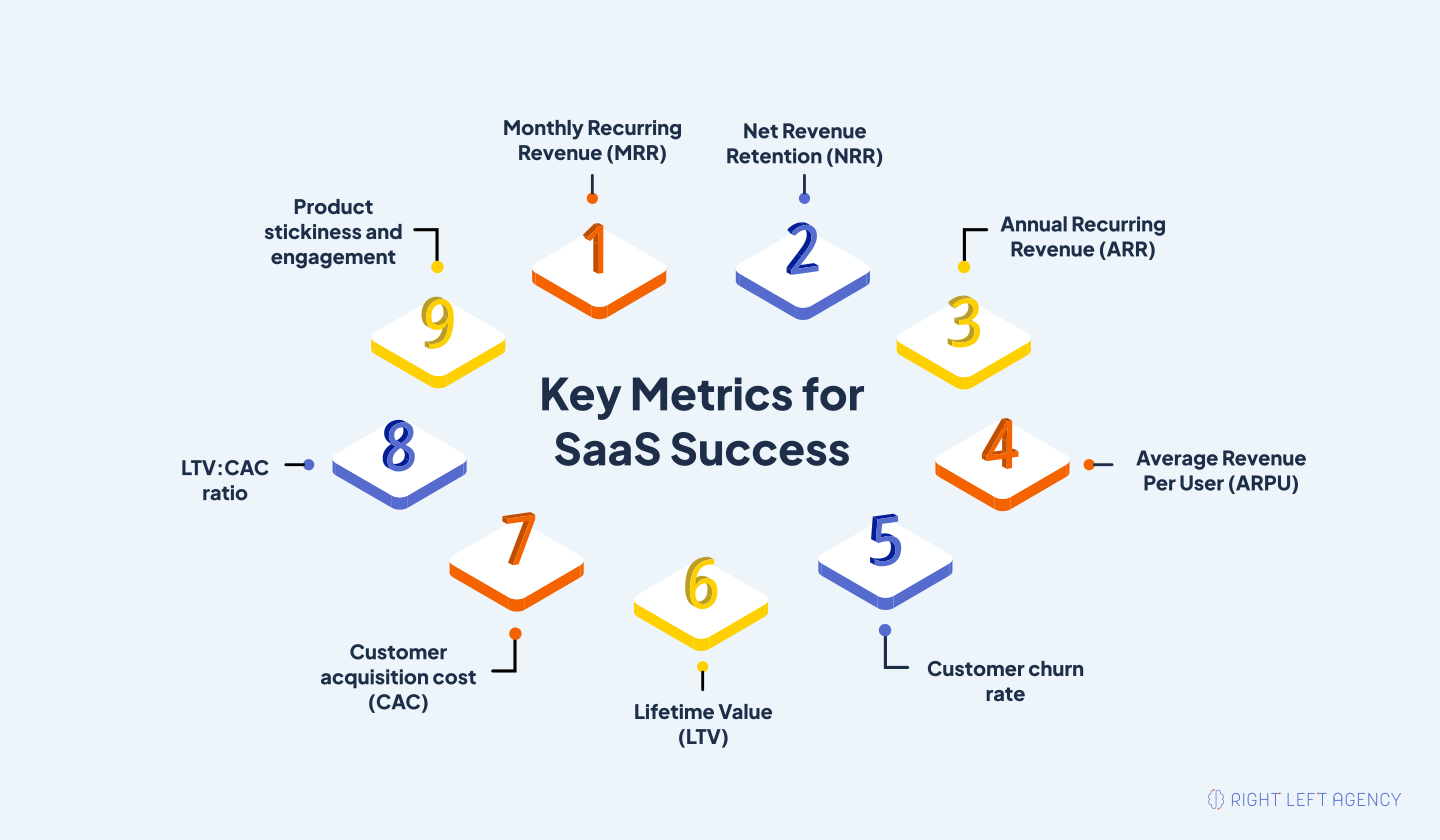
To steer a SaaS business effectively, you must track metrics that reflect revenue growth, customer health, and operational efficiency. Here are the most important metrics and how to calculate them.
- Monthly Recurring Revenue (MRR): MRR measures predictable income from subscriptions. It is calculated by multiplying the average monthly revenue per customer by the number of paying customers. Tracking MRR helps you assess growth trends and forecast future revenue.
- Net Revenue Retention (NRR): NRR measures how much revenue is retained and expanded from the current customer base after accounting for churn and downgrades. A strong SaaS business typically aims for NRR above 100%, meaning expansions offset losses. For example, if existing customers upgrade to higher tiers or add more users, NRR increases, indicating a healthy, growing customer base.
- Annual Recurring Revenue (ARR): ARR is simply MRR multiplied by 12. It provides an annualized view of your recurring revenue stream and is often used by investors to evaluate the size and health of a SaaS model.
- Average Revenue Per User (ARPU): ARPU indicates the average revenue generated per customer in a given period. Higher ARPU reflects your ability to upsell features, adjust pricing, or serve larger customers. Improving ARPU is one of the most direct ways to increase lifetime value.
- Customer churn rate: Churn rate is the percentage of subscribers who cancel during a specific period. For example, if you start a month with 200 subscribers and 10 cancellations, your churn rate is 5 percent. A high churn rate erodes revenue and lowers the lifetime value of each customer. Monitoring churn helps you identify retention issues early and test solutions.
- Lifetime Value (LTV): LTV is the total revenue you expect to generate from a customer over the course of their relationship. A simple way to estimate LTV in a subscription model is: LTV = ARPU ÷ monthly churn rate. Example: if ARPU is $50 per month and monthly churn is 5% (0.05), expected lifetime ≈ 1 ÷ 0.05 = 20 months, so LTV ≈ $50 × 20 = $1,000. If you instead know the average lifetime, use LTV = ARPU × average lifetime. Use one method consistently.
- Customer acquisition cost (CAC): CAC measures how much you spend to acquire a new customer. To calculate it, divide your total sales and marketing expenses by the number of new customers acquired during that period. For example, if you spent $20,000 on marketing and gained 500 customers, your CAC is $40. Understanding CAC helps you allocate marketing budgets and evaluate which channels deliver the best return on investment.
- LTV:CAC ratio: The LTV:CAC ratio compares the revenue from a customer to the cost of acquiring them. A popular benchmark for a healthy SaaS business is above 3:1 but below 5:1. This means that for every dollar spent on acquisition, you should earn at least three dollars in lifetime revenue. Ratios below 3 indicate that your customer acquisition is too expensive relative to the value generated. Ratios above 5 suggest you may be under‑investing in growth and leaving opportunities on the table.
- Product stickiness and engagement: Beyond financial metrics, it is important to measure how frequently and consistently customers use your product. Metrics like daily active users (DAU), feature adoption, and time‑to‑value indicate whether your service is meeting customer needs. High product stickiness often leads to higher retention and LTV.
Monitoring these metrics regularly allows you to detect problems early and refine your SaaS model. You can segment metrics by customer cohort (e.g., new users vs. long‑term users) to understand which segments are thriving and which need attention. A data‑driven approach will help you make informed product, marketing, and pricing decisions.
Marketing and Growth Strategies for SaaS
Growing a SaaS business requires more than a great product. You must reach the right audience, communicate value effectively, and nurture relationships over time. Marketing for SaaS differs from traditional product marketing because of recurring revenue and long sales cycles. Below are strategies to accelerate growth in 2026.
- Focus on long‑term engagement: SaaS purchases often involve multiple stakeholders and longer evaluation cycles. Map the journey by role, provide interactive demos and sandboxes, and offer guides that reduce risk at each step. Nurture with education and clear next steps instead of one off campaigns.
- Balance CAC with growth: Managing customer acquisition cost while scaling is another major challenge. To optimize CAC, use data to identify marketing channels that deliver high‑quality leads at a reasonable cost. Paid search, social advertising and partner referrals can all be effective, but they must be measured against lifetime value. Combine acquisition and retention tactics so the same channels that bring users in also help expand and retain them. For example, content marketing and email campaigns can nurture existing customers and encourage upgrades, improving LTV and reducing churn.
- AI and automation: Use AI for go-to-market activities such as audience segmentation, ad creative testing, intent scoring, lead routing, and content operations like summaries and briefs. In campaigns and on your site, apply dynamic personalization to improve conversion and reduce CAC. Keep model use explainable and privacy safe.
- Content marketing and SEO: High quality content is a cornerstone of efficient growth. Publish practitioner grade playbooks, teardown style case studies, and problem led guides that answer the questions users have before they buy. Use internal links to guide users to pricing, docs, and onboarding. Structure pages with clear headings and schema where relevant, and keep content fresh with regular updates tied to product changes.
- Community and customer success: Building a community around your product fosters loyalty and organic growth. Forums, user groups, and events encourage customers to share best practices and support each other. A robust customer success program ensures that users achieve their desired outcomes, which increases satisfaction and reduces churn. Activities such as onboarding sessions, training webinars, and proactive outreach show customers you are invested in their success. Over time, this personal touch turns users into advocates who refer new customers and defend your brand.
- Leverage partnerships and integrations: Many SaaS products become more valuable when they integrate with other tools. Strategic partnerships allow you to tap into existing customer bases and expand your reach. For example, integrating with a popular CRM can make your product indispensable to sales teams. Joint marketing campaigns with complementary products can also generate qualified leads. Evaluate your partner ecosystem and look for ways to build win–win relationships.
- Embrace product‑led growth (PLG): Product‑led growth is a strategy where the product itself is the primary driver of acquisition, expansion, and retention. Free trials, freemium tiers, and self-serve onboarding allow users to experience value before committing to a purchase. PLG relies on a seamless user experience, clear in‑product messaging, and data‑driven experimentation. When executed well, it lowers CAC and accelerates organic growth because satisfied users become advocates.
Product Development and Innovation in SaaS
Delivering ongoing value is at the heart of the SaaS business model. Innovation should be continuous, guided by customer feedback and market trends. Here are some considerations for product teams in 2026.
- Vertical and micro‑SaaS opportunities: As the market matures, opportunities arise in specialized niches. Vertical SaaS targets specific industries—healthcare, real estate, legal services—offering features tailored to industry workflows. Micro‑SaaS businesses focus on solving a very narrow problem for a niche audience. These targeted solutions can achieve high margins because they meet unmet needs that larger platforms overlook. If you choose a vertical or micro‑niche, immerse yourself in the customers’ environment and build deep domain expertise.
- AI and machine learning: Build AI into the product with contextual in-app assistance, anomaly detection, predictive churn and upsell models, and smart defaults based on usage patterns. Deliver value inside core workflows so AI improves time to value, not just marketing.
- User experience and design: SaaS success depends not just on functionality, but also on usability. Invest in user research, design testing, and accessibility. Simplify onboarding so new users reach their “aha” moment quickly. Provide contextual help and make the interface intuitive. A delightful user experience reduces friction, encourages adoption, and decreases support costs.
- Security and compliance by design: Data breaches and regulatory fines can destroy customer trust. Build security and compliance into your development process from the start. Implement role‑based access, encryption at rest and in transit, and regular penetration testing. Stay current with regulations such as GDPR, CCPA, and industry‑specific standards. Communicate your commitment to privacy clearly so customers feel safe adopting your product.
Customer Retention and Churn Management
Because recurring revenue depends on retention, managing churn is as important as acquiring new customers. The following strategies will help you keep more customers for longer.
- Offer excellent onboarding and education: Customers need to see value quickly. Design an onboarding process that guides them through key features and shows them how your product solves their specific problem. Provide in‑app tutorials, documentation, and video walkthroughs. Follow up after sign‑up to answer questions and offer additional training. A smooth onboarding experience reduces early cancellations and lays the foundation for long‑term success.
- Collect and act on feedback: Regularly solicit feedback through surveys, interviews, and usage analytics. Identify friction points and fix them quickly. Use feedback to prioritize feature development and demonstrate that you listen to customers. Even a simple note saying “we built this because of your request” can strengthen loyalty.
- Proactive customer success: Don’t wait for users to raise issues. Monitor engagement metrics and intervene when usage drops. For example, if a customer’s activity declines, reach out to understand the reason and offer help. Encourage customers to adopt new features and provide resources for advanced use cases. Proactive outreach shows you care and helps prevent silent churn.
- Loyalty programs and community: Reward customers for sticking around. Offer loyalty discounts, early access to new features or exclusive content. Create opportunities for customers to connect with each other through forums, events, or user groups. A strong community fosters peer support and creates a sense of belonging that reduces churn.
- Reduce friction in cancellation and re‑engagement: Sometimes customers will still leave. Make the cancellation process simple and collect feedback on why they are leaving. Use this information to improve. Keep re‑engagement offers ready, such as discounted plans or new features, to win back churned customers. Remember that retention is an ongoing process that requires continuous effort.
Scaling and Funding: Navigating Growth Stages

As your SaaS business matures, you will move through different growth stages, from early product–market fit to rapid scaling and eventually to steady-state optimisation. Each stage requires a different emphasis.
- Early stage – finding product–market fit: In the early days, you must verify that your solution solves a real problem and that customers are willing to pay. Keep development cycles short and focus on a minimum viable product. Use feedback to iterate quickly. At this stage, your metrics will be more qualitative than quantitative, but you should still track MRR, churn, and user engagement to assess traction. Fundraising often comes from seed investors who look for a compelling vision and early adoption.
- Growth stage – accelerating acquisition: Once you have product–market fit, the focus shifts to scaling. Invest in marketing channels that yield the best LTV:CAC ratio and build a repeatable sales process. Expand your team to include specialists in marketing, sales, customer success, and engineering. Use data to identify which segments produce the highest lifetime value and double down on those. Venture capital funding may become necessary to accelerate growth and outpace competitors.
- Expansion stage – optimising retention and profitability: As you grow, efficiency becomes vital. Streamline operations, reduce churn, and optimize pricing. Expand into new markets or verticals by adapting your product and messaging. Pay attention to unit economics to ensure that incremental revenue exceeds incremental costs. Consider upsell and cross‑sell opportunities within your customer base. When your SaaS model achieves sustainable profitability, you can explore exits such as acquisitions or initial public offerings.
Future Trends Shaping SaaS in 2026 and Beyond
Looking ahead, several macro trends are poised to influence the SaaS business landscape. Being aware of these trends allows you to plan and innovate.
- AI‑driven personalisation: Generative AI and advanced machine learning will continue to transform SaaS products and marketing. Expect more tools that personalize user experiences, automate decision‑making, and offer predictive insights. Companies that leverage AI responsibly will differentiate themselves by delivering smarter, more intuitive solutions.
- Increased focus on vertical solutions: The demand for industry‑specific software will grow. Vertical SaaS businesses understand the regulatory, workflow, and data needs of niche markets and can command higher prices. Healthcare compliance, construction project management, and legal case management are examples of vertical opportunities.
- Data privacy and ethical considerations: Consumers and regulators are demanding greater transparency and control over data. Providers must prioritise privacy by design, invest in compliance, and communicate their practices clearly. Those who fail to build trust may see customers choose competitors with stronger privacy credentials.
- Hybrid and offline functionality: Although SaaS relies on internet connectivity, some customers need offline capabilities or hybrid deployment options for latency‑sensitive tasks. Future SaaS applications may offer local caching or edge computing to maintain performance when networks are unreliable. Balancing cloud convenience with offline resilience will be an important differentiator.
- Subscription fatigue and value orientation: As more products adopt subscription pricing, some customers experience fatigue. They question the cumulative cost of multiple subscriptions. To stand out, you must continuously demonstrate value and consider flexible pricing options. Bundling services, offering pay‑as‑you‑go features, or providing loyalty discounts can alleviate subscription fatigue.
Conclusion
The SaaS business model has revolutionized how software is built, sold, and consumed. It turns software into a service, creating recurring revenue streams and lowering barriers to adoption.
Yet the same characteristics that make SaaS attractive—subscription pricing, rapid iteration, and low switching costs—also introduce challenges around customer retention, security, and demand forecasting. By understanding the revenue models, mastering key metrics like churn and LTV, implementing effective marketing strategies, and embracing continuous innovation, you can build a resilient SaaS business.
The road ahead will be shaped by AI, vertical specialization, and increasing demands for privacy, but the fundamentals remain the same: deliver value, nurture relationships, and adapt to change. Whether you are launching your first product or scaling to global markets, this guide equips you with the knowledge to navigate the dynamic landscape of SaaS in 2026.
Frequently Asked Questions (FAQs)
Is Uber SaaS or PaaS?
Uber is neither SaaS nor PaaS. It’s a marketplace platform that connects riders and drivers, not subscription-based software or developer infrastructure.
Is Netflix SaaS?
Yes, under a broad definition, it’s a B2C SaaS (software delivered as an online subscription). It’s not B2B, but the delivery and monetization model matches SaaS.
What is the 3-3-2-2 rule of SaaS?
It’s a growth benchmark suggesting SaaS companies should triple revenue in years 1–3, then double revenue in years 4–5. The shorthand helps investors gauge healthy SaaS scaling.
Is SaaS product or service?
It’s both: the software is the product, but it’s delivered as a subscription service with hosting, updates, and support handled by the vendor.
What is not an example of SaaS?
Installed desktop software like Microsoft Office 2016 or licensed on-prem ERP systems are not SaaS because they run locally and require customer maintenance.