
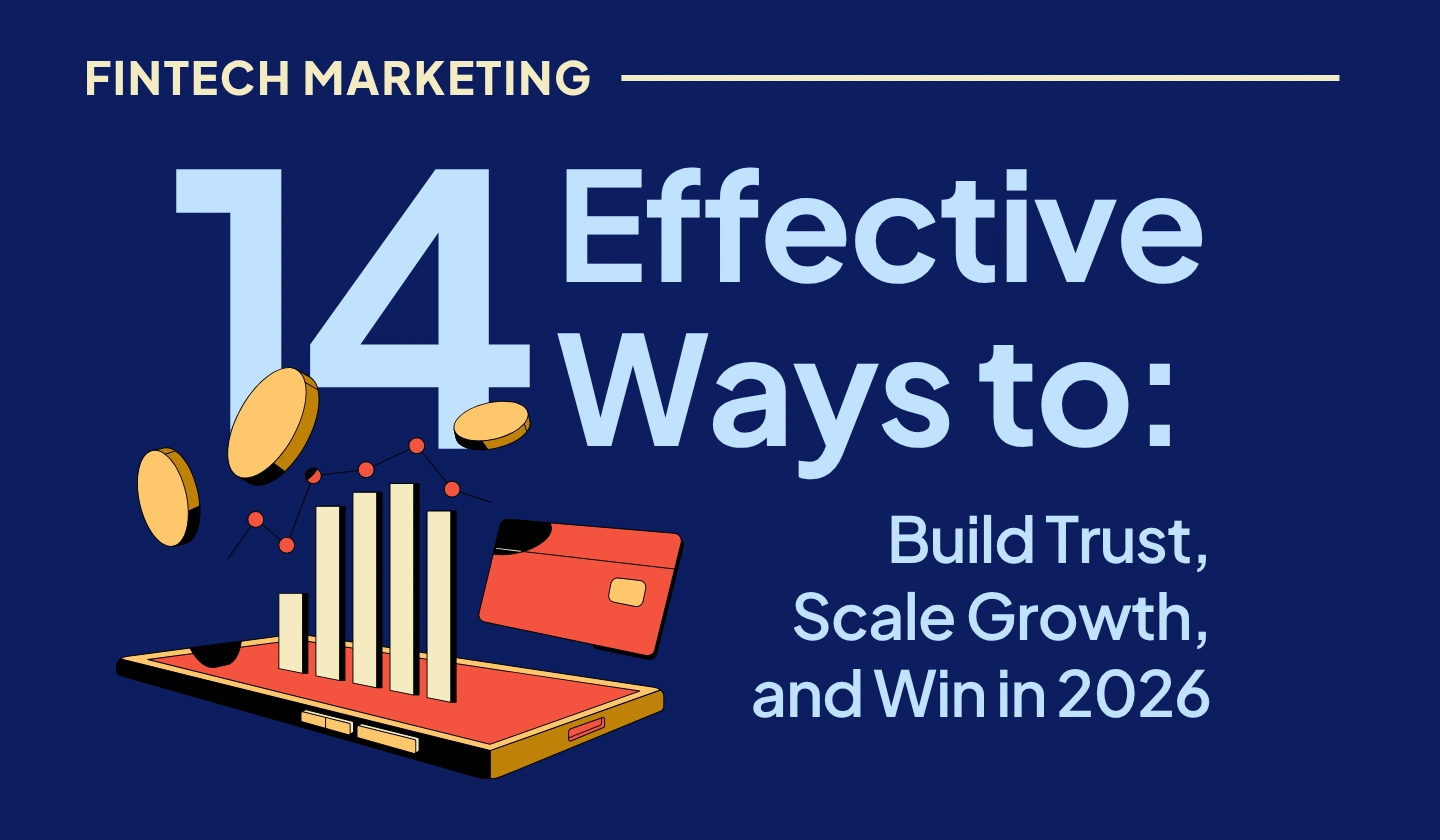
Fintech is one of the fastest-growing industries, but also one of the hardest to market. More so than e-commerce or SaaS, fintech products depend on trust. If people don’t believe their money is safe, no campaign will convince them to join.
Successful fintech companies don’t grow because of technology alone. They become household names through smart marketing strategies that build confidence and create loyal communities.
This article explores 14 valid fintech marketing strategies that have worked in the real world. Each one is backed by lessons from industry leaders and can help you scale faster, stand out, and build trust in 2026 and beyond.
What Is a Fintech Marketing Strategy?
A fintech marketing strategy is a focused plan that helps financial technology companies connect with people, earn trust, and drive adoption. It blends digital marketing with trust-building tactics like transparency, security signals, education, and community.
At its core, fintech marketing combines traditional growth channels like SEO, paid ads, and content marketing with special trust-building methods unique to finance. This includes being transparent about fees, showing strong security measures, complying with regulations, educating users about complex topics, and building a community that reinforces credibility.
Why Marketing Is Different in Fintech
Marketing a fintech product isn’t the same as marketing clothing, electronics, or even regular software. When money is involved, people think and behave differently. That changes the rules of the game.
Key Challenges
| Challenge | Why It Matters |
|---|---|
| Trust is harder to earn | Money is personal. Even a small doubt can stop someone from signing up or making a transaction. |
| Regulation shapes every message | Compliance rules limit what you can say in campaigns. Marketing must balance clarity with legal accuracy. |
| Advertising is expensive | Finance is one of the most competitive ad categories. Click costs on Google, LinkedIn, and Facebook are among the highest. |
| Switching behavior takes time | Changing banks, wallets, or accounting systems involves habit change, risk, and sometimes multiple approvals. |
Because of these challenges, fintech marketing can’t focus only on visibility or clicks. It has to go deeper. The real goal is to build trust at scale while keeping customer acquisition costs under control.
14 Fintech Marketing Strategies to Build Trust and Scale Growth
1. Radical Transparency as a Trust Weapon
In finance, most people assume there are hidden costs. Traditional providers reinforce this by burying fees in the fine print or disguising them in exchange rates. That doubt alone can stop a potential customer from moving forward.

Smart fintech companies realized this early and made transparency the foundation of their marketing. Instead of hiding costs, they showcase them openly:
- Building fee calculators that break down exactly what a customer pays and receives.
- Comparing their rates side by side with traditional providers.
- Running bold campaigns that dramatize the problem of hidden fees and position transparency as a movement, not just a feature.
This shift changes the conversation. Instead of customers asking, “What’s the catch?” they begin to say, “Finally, someone honest.” That perception alone is a massive trust advantage.
2. Paid Advertising that Converts (SEM + Paid Social)
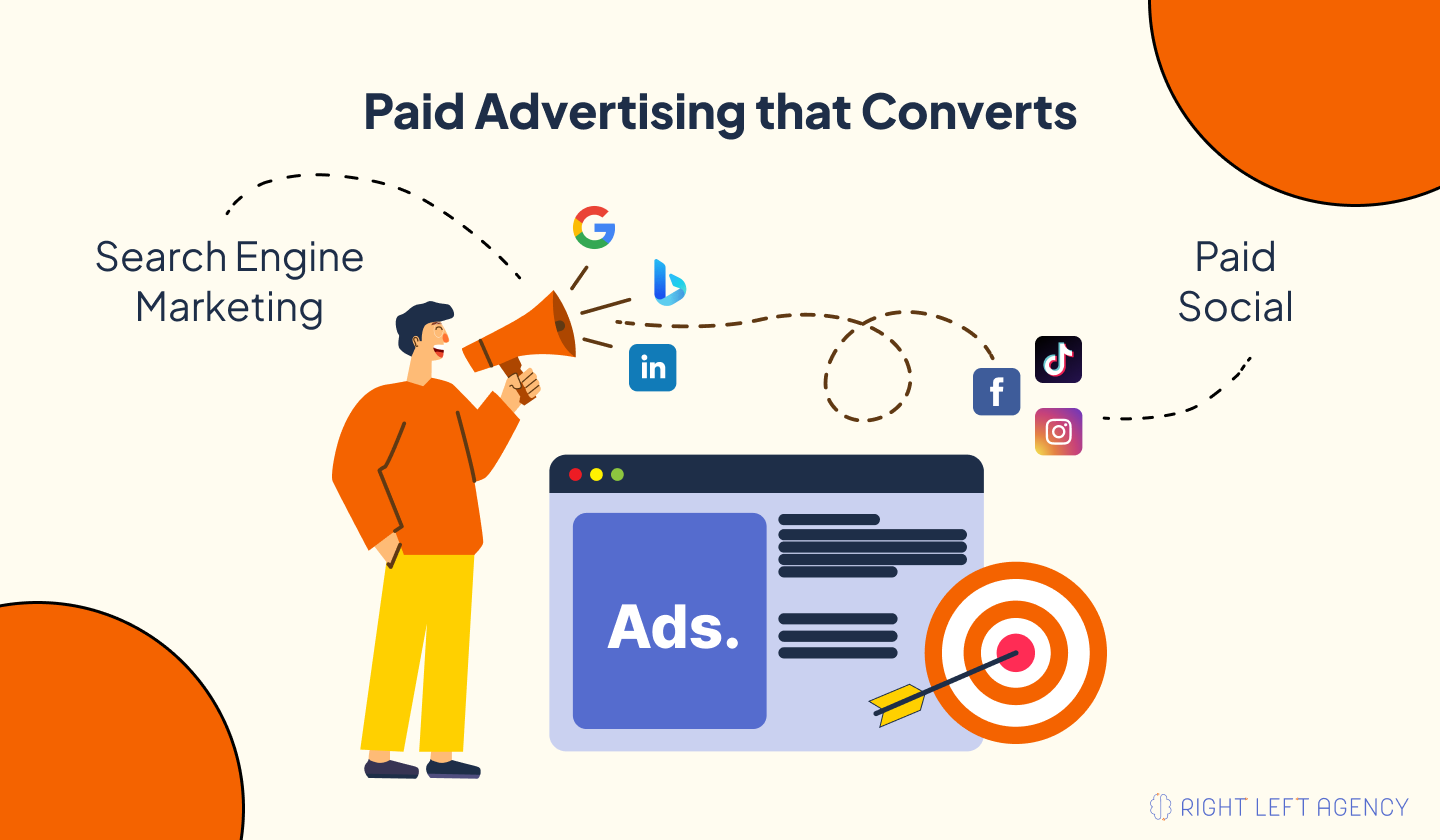
In fintech, paid media works when it mirrors real intent and lands people on pages that keep the same promise. Use search to capture corridor and use-case queries on Google and Bing.
Then send clicks to the exact calculator or corridor page that repeats the fee, delivery time, and final amount the recipient gets.
On LinkedIn, Instagram, Facebook, and TikTok, lead with short, plain-English education and outcome stories rather than product features; show how a user moves money faster, pays less, or reconciles in fewer steps.
Keep message congruence between ad and landing page, avoid generic homepages, and optimize to cost per activated user instead of cost per signup. Add compliance disclosures and visible license info on the destination page. Prove incrementality with geo holdouts or time-boxed tests so you know which channels lower CAC and shorten time to first successful transaction.
In the era of AI, fintech advertisers now rely on intelligent systems to run more effective campaigns. AI-driven tools handle smarter bidding, dynamic creatives, and real-time audience adjustments that no manual campaign can match. Beyond Google, AI-powered platforms like ChatGPT and Perplexity are where people now search for financial solutions. Fintech brands that show up there will have a clear edge.
Learn: Digital Marketing vs. Social Media Marketing
3. Content Marketing That Drives Activation
Content marketing helps you explain money topics in simple language and earn trust. It builds authority in search and makes customers confident about choosing you. Show proof with real numbers and clear examples.
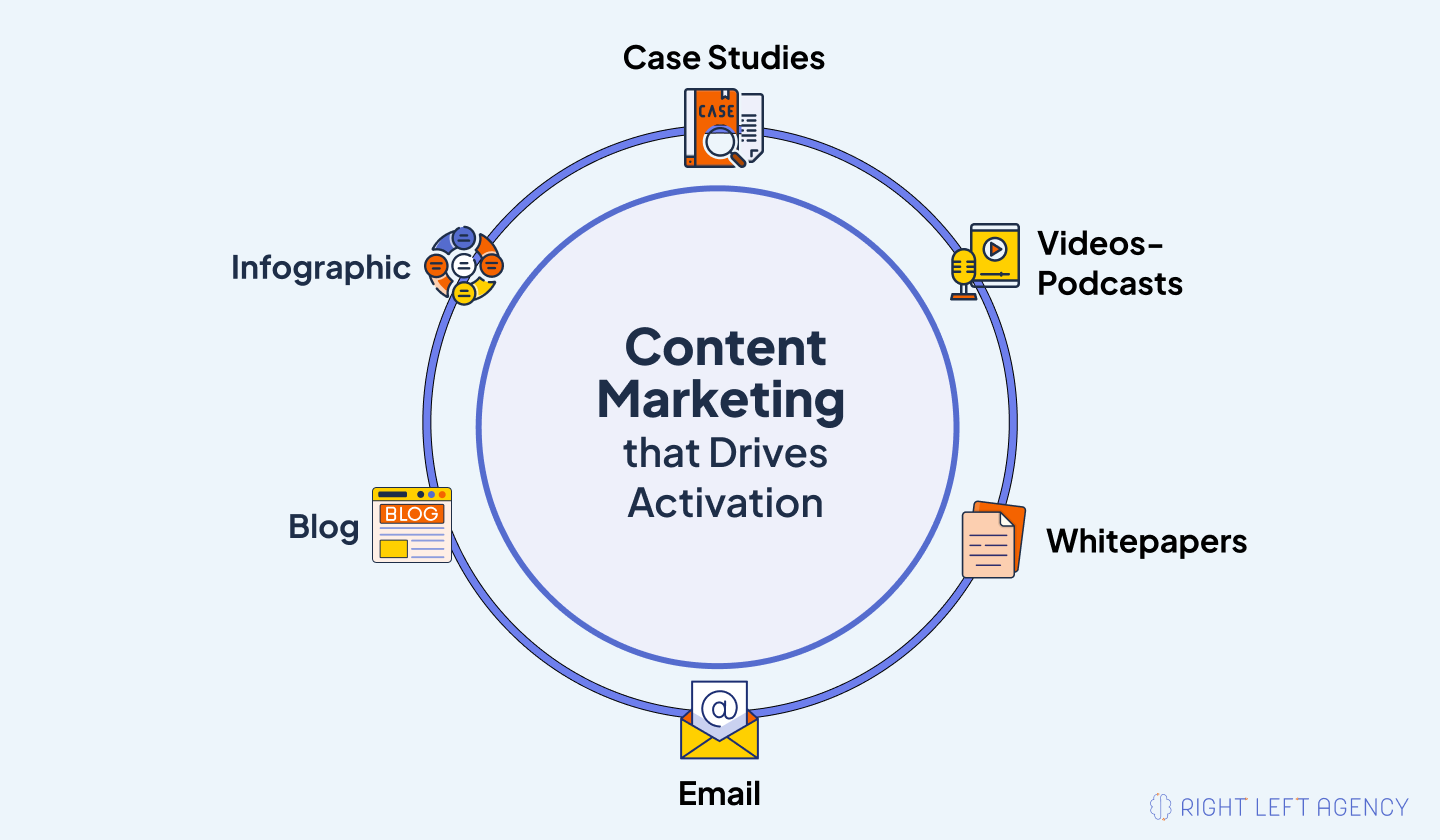
What you can include as content:
- Blog posts and corridor explainers.
- Visual guides and infographics.
- Original data reports and case studies.
- Short product walkthrough videos (Reels, TikToks, YouTube Shorts).
- AI-powered calculators and chatbots (fees, delivery time, savings).
- Downloadable checklists and templates.
- Whitepapers and eBooks.
- Digital PR and thought-leadership pitches.
- Webinars and email mini-courses.
- In-app tips and mobile feature tours.
Short-form video is performing exceptionally well right now. Fintech brands investing in 60-second reels consistently outperform traditional brand content. Pair that with an embedded AI tool, and your content becomes a conversion engine, not just a reading experience.
4. Referral Loops That Create Virality
Money spreads through trust networks: friends, family, and colleagues. That’s why referrals have always been powerful in finance.
A well-structured referral system allows each new customer to become a mini-marketer. Instead of spending heavily on ads, fintech companies can encourage users to invite others with simple, tangible rewards.
Examples include:
- Cash or credit bonuses for both the referrer and the referee.
- Discounted transaction fees for every successful referral.
- Limited-time perks, such as premium feature access create urgency and excitement.
For referrals to work, they must follow three principles:
- Keep it simple: “Invite a friend, you both earn $10” works better than complicated point systems.
- Deliver fast: Rewards should be instant or tied to a clear milestone, like completing a first payment.
- Make it fair: Both sides should benefit equally, which keeps the program trustworthy.
Actionable takeaway: Referrals aren’t just about user acquisition. In fintech, they’re about multiplying credibility. Every satisfied customer has the potential to bring in another at a fraction of the cost of paid advertising.
5. Programmatic SEO to Own High-Intent Searches

When people look for financial solutions online, their searches are usually very specific. They’re not typing vague queries like “money app.” Instead, they search for things like:
- “Send money from the UK to India.”
- “Best low-fee wallet in Canada”
- “How to reconcile payments in accounting software”
These are high-intent searches, meaning the user is already close to making a decision. Fintech companies that capture these searches often acquire customers at a much lower cost than through ads.
The most effective way to do this is through programmatic SEO. That means creating thousands of structured landing pages at scale, each designed for a specific corridor, location, or use case. A strong page doesn’t just stuff keywords. Instead, it answers the exact questions people have.
Actionable takeaway: Map out every journey your customer takes, from fees to locations to use cases. Build pages that directly address those needs. Programmatic SEO isn’t about scale for the sake of scale. It’s about scale with relevance.
6. Marketing Trust Signals, Not Just Security
Every financial product says it’s “secure.” But to a customer, that phrase means very little. Security is expected, it’s not a differentiator. What builds confidence is when security is turned into clear, visible trust signals.
Examples include:
- Guarantees showing how disputes or chargebacks are handled.
- Compliance badges highlighting regulatory licenses or certifications.
- Insurance coverage that reassures customers their money is protected even if something goes wrong.
- Social proof through verified reviews and customer satisfaction scores.
In 2026, proactive security communication is a growth lever, not just a legal requirement. These aren’t just legal requirements; they’re conversion drivers. When someone sees that their funds are protected, or that a company is licensed in multiple markets, it reduces friction and increases the chance they’ll sign up.
7. Embedded Partnerships and Ecosystem Growth
Direct marketing: ads, social, and email can bring results, but it often has limits. Growth multiplies when a fintech product becomes part of an existing ecosystem. Instead of convincing every customer one by one, the product rides on the trust and scale of platforms people already use.
Examples include:
- A payment service integrated directly into accounting software.
- A digital wallet is offered at checkout on a popular marketplace.
These embedded partnerships do more than distribute the product; they validate it. Customers feel reassured when a familiar platform they trust offers a fintech service as part of its workflow.
Actionable takeaway: Don’t just chase customers. Chase the platforms they already trust. An integration with one ecosystem can be more powerful than a year of direct campaigns.
8. Cause Marketing and Bold PR Stunts
Finance is serious, but serious doesn’t have to mean boring. The most memorable fintech campaigns turn numbers into stories and sometimes into movements.
One approach is cause marketing: picking a clear enemy, like hidden fees, outdated banks, or financial exclusion, and positioning your product as the solution. By taking a stand, you give people a reason to care that goes beyond features.
Another approach is bold stunts. Some companies stage attention-grabbing campaigns to dramatize the problems in the industry. Others lean into community-driven narratives, like making financial independence a social movement.
Actionable takeaway: Identify the bigger problem you’re fighting. Then find creative ways to turn it into a headline. People rally behind movements, not features.
9. Influencer Marketing for Credibility, Not Just Reach
In finance, people trust informed humans more than polished logos, so choose creators who teach clearly and already serve your audience.
For consumer fintech, co-create short explainers and authentic switching stories with personal finance educators; for B2B, collaborate with operators and analysts on LinkedIn and YouTube for walkthroughs, live demos, and Q&As that address compliance and procurement concerns.
Give creators real product access so demonstrations are truthful, use proper disclosures, and whitelist high-performing posts so you can amplify them from the creator’s handle without losing authenticity.
Send traffic to calculators, corridor pages, or a low-risk “test with a small amount” flow rather than a generic homepage, and judge success by view-to-click, calculator engagement, first successful transaction, cohort retention, and cost per activated user, not vanity impressions.
10. Education as a Conversion Funnel
Finance can feel overwhelming. Terms like FX spread, APR, or blockchain often scare people away before they even try a product. That’s why education isn’t just content marketing in fintech, it’s a growth engine.
Effective education as a funnel includes:
- Guides and explainers that break down complex concepts in simple language.
- Interactive tutorials that let users try the product in a safe, risk-free way.
- Webinars and workshops that solve real customer pain points while showcasing the product.
- Incentivized learning modules where users unlock credits, discounts, or trial features by completing lessons.
Education builds confidence. When people feel they understand what they’re doing, they are far more likely to take the next step, whether that’s opening an account, making a first transaction, or upgrading to a premium plan.
11. Simple Pricing and Clear Communication
Pricing in fintech is more than a number, it’s a trust signal. Many traditional providers still hide fees in fine print, spread costs across multiple steps, or use vague language that confuses users. That complexity creates doubt.
The companies that win are the ones that turn pricing into a marketing advantage. They do this by:
- Showing one clear fee instead of a list of hidden charges.
- Explaining exactly how much money goes in and how much comes out.
- Repeating the same pricing message consistently across ads, landing pages, and in-app flows.
- Avoiding jargon and speaking in plain, relatable language.
Actionable takeaway: Simplify your pricing until it can be explained in a single sentence. The easier it is to understand, the stronger it becomes as a marketing message.
12. Time-Boxed Incentives and Airdrops
Incentives are a proven way to get people to try something new, but in fintech, they work best when they are focused and time-limited. If they’re too generous or permanent, customers may only stick around for the reward and disappear afterward.
Examples include:
- Cash or credit bonuses for completing a first transaction.
- Referral rewards that benefit both sides but stop after a milestone.
- Airdrops or token rewards to spark early adoption.
- Limited-time offers that create urgency.
Actionable takeaway: Use bonuses when entering a new market or launching a product, but keep them short-term. Incentives should be the spark, not the fuel.
13. Sell Outcomes, Not Features
Many fintech companies make the mistake of marketing their technology instead of the results it delivers. Features like APIs, dashboards, or integrations sound impressive, but customers care more about the outcomes.
Examples of outcome-driven marketing include:
- Saving time through faster payments or automated workflows.
- Protecting money with stronger compliance or guaranteed dispute handling.
- Increasing revenue with higher checkout conversions or lower processing costs.
Actionable takeaway: Translate every feature into a result. Instead of saying, “Our platform has instant settlement,” say, “You get paid in minutes instead of days.” Customers don’t buy tools, they buy outcomes.
14. Hyper-Personalization Powered by AI
Generic marketing is losing its edge fast. In 2026, customers expect their fintech product to feel like it was built specifically for them. AI now makes that possible at scale by processing behavioral signals like spending patterns, transaction history, and in-app actions to deliver the right message at the right moment.
What this looks like in practice: personalized onboarding flows, dynamic emails triggered by user behavior, real-time product nudges, and AI chatbots that respond with context, not scripts. AI-driven personalization improves click-through rates by 15 to 40% on average compared to generic campaigns.
Actionable takeaway: Start with your highest drop-off point, like post-signup, and build one personalized flow around it. Prove the lift, then scale from there.
Fintech Marketing Agency That Builds Trust and Growth
Your fintech brand needs more than just standard marketing campaigns. A fintech marketing agency like Right Left Agency can help financial technology companies step out of the box. How? With our tested strategies focused on trust, compliance, and measurable growth.
Right Left specializes in crafting fintech marketing strategies, combining content marketing, SEO, performance campaigns, and brand storytelling into one cohesive plan. Our team understands how to turn complex financial topics into simple, relatable stories that build credibility and drive adoption.
With experience across fintech and SaaS, we don’t just run ads or write content. We create growth systems that reduce acquisition costs, increase conversions, and strengthen customer loyalty. If you’re launching a new product or scaling an established platform, Right Left Agency gives you the clarity, creativity, and expertise to market your fintech brand with confidence.