

Key Takeaways
- SaaS sales outsourcing helps B2B SaaS companies outsource sales tasks such as prospecting, lead qualification, appointment setting, demo booking, and outbound campaign execution.
- Outsourcing works best when the company already has a clear ICP, proven offer, sales messaging, CRM process, and internal follow-up system.
- The biggest benefits are faster ramp-up, reduced hiring pressure, access to experienced SDR talent, and more consistent outbound activity.
- The biggest risks are poor targeting, generic messaging, low-quality meetings, weak CRM visibility, and poor handoff between outsourced and internal teams.
- SaaS companies should measure outsourced sales by qualified pipeline, show rates, opportunities, and closed-won revenue — not just meetings booked.
What Is SaaS Sales Outsourcing?
SaaS sales outsourcing means working with an external sales partner to handle specific parts of your sales process, such as prospecting, lead qualification, appointment setting, demo booking, or outbound campaign execution. This partner could be an outsourced SDR team, an outside appointment-setting team, a lead-generation team, an outbound sales team, or even a full-cycle sales team.
For some SaaS companies, outsourcing means hiring an external SDR team to find prospects, qualify leads, and book meetings for the internal sales team. For other SaaS startups, it involves delegating more of the revenue process, including prospecting, lead qualification, setting up demos, and so forth.
In simple terms, outsourcing gives a SaaS company extra sales execution without hiring every role internally. Such a model would be beneficial to those companies that require a pipeline but cannot afford to allocate the necessary budget, time, or organizational framework for creating an entire sales force.
Nonetheless, outsourced SaaS sales involve much more than simply making additional emails or phone calls. The ideal partner should have thorough knowledge of your ICP, sales cycle, pain points of buyers, positioning of products, CRM process, and revenues.
Outsourcing done right complements your overall go-to-market approach. When outsourcing is done poorly, it can create noise, generate poor-fit meetings, and damage your brand reputation.
How SaaS Sales Outsourcing Works
SaaS sales outsourcing typically involves a strategy preceding the execution of tasks. The best firms don’t begin their process by sending any outreach that could be applied generally. Instead, they learn about your customers and the reasons behind their purchases.
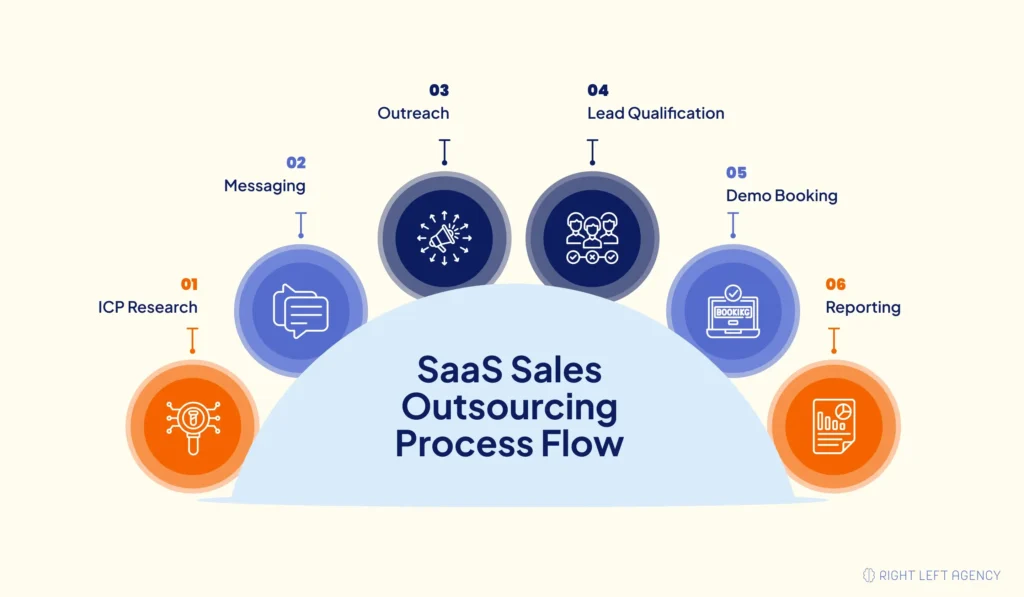
Below is what goes into a sales outsourcing project:
- ICP and buyer persona development
Your outsource partner studies your existing customers, target segments, industries, company size, job roles, and buying triggers to avoid general targeting and generating low-quality leads.
- Messaging and sales positioning
The partner advises you on crafting outbound messaging that addresses customer challenges rather than the features of your software solution. Messaging describes the business issue, the cost of inaction, and the desired outcome.
- Prospect list development
Your target companies and contacts are collected based on your ICP using firmographics, job roles, technical stack, fundraising stage, hiring activity, or intent-based data points.
- Outreach campaign creation
Depending on the strategy, outreach may include cold email, LinkedIn outreach, phone calls, retargeting, or multi-touch sales sequences. The goal is not to send generic messages at scale, but to start relevant conversations with buyers who match the ICP. - Lead qualification
Not all leads must be sales-ready. The outsourcing team must qualify leads based on fit, pain points, needs, authority, timeline, and deal size.
- Meeting or demo setup
Once qualified, leads must then be handed over to your in-house sales team or account executives for a demo, discovery call, or sales call.
- CRM tracking & reporting
All activities must be logged inside a CRM system such as HubSpot or Salesforce. Reports must include lead quality, number of meetings set up, demo show rate, deal pipeline creation, and next steps.
- Campaign testing & optimization
Campaigns should continue to get better over time. Messaging, target audiences, email subject lines, call scripts, lead qualification process, and follow-up sequences must be tested.
The main point: outsourced SaaS sales should be a structured growth system, not random outbound activity.
What SaaS Sales Tasks Can Be Outsourced?
SaaS companies do not always need to outsource the entire sales process. In many cases, it makes more sense to outsource the parts that are slowing growth.
| Sales Task | What It Includes |
|---|---|
| Outsourced SDR work | Prospecting, outreach, qualification, and demo booking |
| Lead generation | Finding and engaging potential buyers that match the ICP |
| Appointment setting | Booking qualified calls for internal sales reps |
| Cold email outreach | Writing, launching, testing, and managing email sequences |
| LinkedIn outreach | Connecting with target buyers and starting conversations |
| Sales research | Building account lists, contact lists, and buyer profiles |
| Demo booking | Moving qualified prospects from interest to scheduled sales calls |
| Full-cycle sales | Managing outreach, discovery, demo, follow-up, and closing |
| Market expansion | Testing new industries, regions, or buyer segments |
| Customer reactivation | Re-engaging old leads, lost opportunities, or inactive accounts |
For most B2B SaaS marketing agencies, the most common starting point is outsourced SDR or appointment-setting support. This keeps the closing process in-house while giving the internal team more qualified conversations.
A more mature SaaS company may outsource market testing or outbound campaigns while keeping enterprise sales, demos, and negotiations internal.
The right model depends on your sales cycle, deal size, team capacity, and how much control you want over the buyer experience.
When Should a SaaS Company Consider Sales Outsourcing?
SaaS sales outsourcing makes the most sense when your company has a real growth bottleneck that an external team can help solve. If your team cannot clearly explain who buys, why they buy, what pain point they have, and what next step sales should take, outsourcing will likely amplify confusion instead of fixing it.
You may want to consider outsourcing sales if:
- Your founder is still handling most sales conversations manually.
- Your internal team needs more qualified demos.
- You have product-market fit, but not enough pipeline.
- Hiring SDRs or BDRs is taking too long.
- Your sales team is spending too much time prospecting instead of closing.
- You want to test outbound sales before building a full internal team.
- You are entering a new market, vertical, or region.
- Your marketing generates leads, but sales needs help qualifying and following up.
- You need more consistent outbound activity, but do not have the internal bandwidth.
Outsourcing is especially useful for SaaS companies that already know who they sell to and why those buyers convert. If your ICP, pricing, positioning, or offer is still unclear, an outsourced sales team may struggle to create a quality pipeline. Without those pieces, outsourcing may expose the gaps in your go-to-market strategy instead of solving them.
Benefits of SaaS Sales Outsourcing
The value of SaaS sales outsourcing depends on how well it supports your revenue strategy. The goal is not simply more activity. The goal is a more qualified pipeline with less internal hiring pressure.
Faster sales ramp-up
Getting new sales reps onboard in-house takes several months of recruiting, interviewing, onboarding, training, management, and performance monitoring. An outsourcing partner may have an advantage in being able to start quicker due to pre-existing staff, software, and processes. This is useful when you need to create sales activity quickly but do not have time to recruit, hire, and train an internal SDR team.
Lower costs of hiring and training
An in-house sales organization entails costs of salaries, technology, management, training, and sales enablement. If the new hire is not the right fit, then costs become even greater. Outsourcing will help cut back some of those internal expenses. Your internal team can focus on discovery calls, demos, proposals, and closing while the outsourced team supports prospecting and qualification.
Exposure to experienced sales professionals
An experienced outsourcing partner may bring knowledge from similar verticals, sales motions, and outbound campaigns. This can help founder-led SaaS companies improve prospecting, qualification, CRM tracking, and campaign optimization faster.
Greater consistency in outbound activities
Most SaaS businesses understand that they need to perform outbound operations, but find it difficult to maintain consistency. They often put off prospecting until their time allows them to focus on product development, customer support, fundraising, or closing deals. An outsourced team will ensure that the outbound campaigns continue to happen consistently each week. Consistency becomes important since you cannot build a pipeline out of just one interaction.
Ease of testing markets
SaaS outsourcing can allow businesses to test new markets, regions, and personas through campaigns, without having to hire an entire team for every experiment. For instance, a SaaS company might wish to test which industry or market reacts more positively to its offer of healthcare, fintech, or construction software. Such experiments become much easier with outsourcing.
Freed-up internal team time
With prospecting, list-building, and initial outreach left to the external team, your in-house team will be able to concentrate fully on discovery calls, demonstrations, proposals, relationship-building, and closing. Such a greater focus becomes even more productive when the external team sends qualified prospects rather than raw leads.
Lower operational complexity
An outsourced partner may already have outreach tools, data sources, SDR processes, reporting templates, and campaign workflows in place. This can reduce the operational burden for SaaS teams that do not yet have mature revenue operations.
Risks and Challenges of SaaS Sales Outsourcing
SaaS sales outsourcing can work well, but it can also fail quickly when expectations, targeting, and communication are weak.
The most common risks include:
- Poor product understanding: The outsourced team does not fully understand the SaaS product, use cases, or buyer pain points.
- Weak ICP targeting: Campaigns target too broadly and attract poor-fit prospects.
- Generic messaging: Outreach sounds like every other cold email in the buyer’s inbox.
- Low-quality leads: Meetings are booked, but the prospects do not match the company’s real sales criteria.
- Lack of transparency: The company cannot see what is happening inside campaigns.
- Poor CRM reporting: Activity is tracked, but pipeline quality and revenue impact are unclear.
- Sales handoff issues: The outsourced team books calls, but internal sales does not have enough context to continue the conversation.
- Brand reputation risk: Bad outreach can make the company look careless or spammy.
- Overdependence on the external team: If the outsourced partner owns all messaging, outreach data, and buyer insights, the SaaS company may fail to build internal sales knowledge.
The best way to reduce these risks is to treat onboarding seriously. Give the partner access to your ICP research, sales calls, customer objections, case studies, product positioning, CRM definitions, and approved messaging.
Also, agree on KPIs before the campaign starts. Do not measure only emails sent or meetings booked. Track qualified opportunities, show rate, pipeline value, and closed-won revenue.
💡Pro Tip: Review early call quality before scaling outreach volume. Ten well-qualified conversations will teach you more than 500 generic emails sent to the wrong audience.
SaaS Sales Outsourcing vs In-House Sales Team
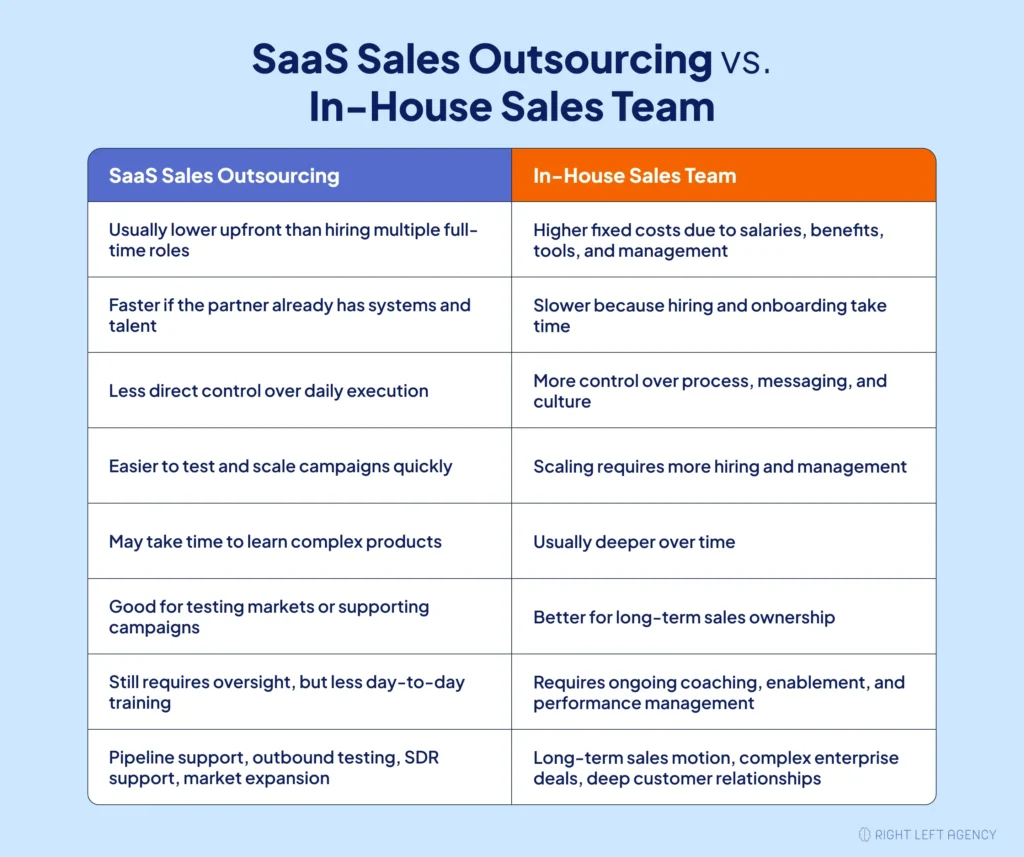
Many SaaS leaders compare outsourcing against hiring an internal SDR or sales team. The right choice depends on speed, budget, control, and long-term revenue goals.
| Factor | SaaS Sales Outsourcing | In-House Sales Team |
|---|---|---|
| Cost | Usually lower upfront than hiring multiple full-time roles | Higher fixed costs due to salaries, benefits, tools, and management |
| Ramp-up time | Faster if the partner already has systems and talent | Slower because hiring and onboarding take time |
| Control | Less direct control over daily execution | More control over process, messaging, and culture |
| Scalability | Easier to test and scale campaigns quickly | Scaling requires more hiring and management |
| Product knowledge | May take time to learn complex products | Usually deeper over time |
| Flexibility | Good for testing markets or supporting campaigns | Better for long-term sales ownership |
| Management effort | Still requires oversight, but less day-to-day training | Requires ongoing coaching, enablement, and performance management |
| Best use case | Pipeline support, outbound testing, SDR support, market expansion | Long-term sales motion, complex enterprise deals, deep customer relationships |
Outsourcing is often better when speed, testing, and pipeline support are the priority. In-house sales are often better when the company needs deep product expertise, long-term relationship building, and complete control over the sales process.
For many SaaS companies, the best approach is not one or the other. It is a hybrid model. The outsourced team handles prospecting and qualification, while the internal team owns demos, proposals, and closing.
How Much Does SaaS Sales Outsourcing Cost?
SaaS sales outsourcing costs vary based on the scope of work, sales complexity, target market, outreach volume, and level of experience required.
Most providers use one of these pricing models:
Monthly retainer
The company pays a fixed monthly fee for a defined scope of work. This may include strategy, list building, outreach, reporting, and campaign optimization. This model is common for outsourced SDR and lead generation programs.
Pay-per-meeting
The company pays based on booked meetings or qualified appointments. This can look attractive, but it depends heavily on how “qualified meeting” is defined. If the qualification standard is weak, the company may pay for meetings that never become real opportunities.
Warning: A pay-per-meeting model can work, but only if the definition of a qualified meeting is strict. Otherwise, the provider may be rewarded for volume rather than fit.
Commission-based
The outsourced team earns a percentage of revenue from deals they help close. This model is more common when the partner is involved more deeply in the sales process. It can align incentives, but it may not work well for long sales cycles or complex enterprise SaaS deals.
Hybrid pricing
Some providers use a lower monthly retainer plus performance-based compensation. This can balance stability for the partner with performance incentives for the client.
Dedicated team pricing
Larger SaaS companies may pay for a dedicated outsourced team that includes SDRs, sales managers, campaign strategists, and reporting support. The cost usually increases when the partner handles more strategy, more channels, or more parts of the sales cycle.
Factors that affect SaaS sales outsourcing cost include:
- Target market
- Deal size
- Sales cycle length
- Number of buyer personas
- Outreach channels
- CRM setup
- Sales assets needed
- Geographic market
- Level of reporting
- Whether the partner handles SDR-only or full-cycle sales
The cheapest option is not always the best option. Low-cost outsourcing can become expensive if it creates poor-fit meetings, weak data, and wasted sales time.
Before comparing providers, define what a qualified meeting means for your company. Otherwise, pricing comparisons can become misleading.
How to Choose the Right SaaS Sales Outsourcing Partner
Choosing the right partner is one of the most important parts of the process. A good partner can help you build a pipeline and learn faster. A bad partner can damage your brand and waste your sales team’s time.
Use this checklist before hiring a SaaS sales outsourcing company:
- Do they have B2B SaaS experience?
SaaS sales have unique challenges, including long buying cycles, subscription revenue, product education, and multiple decision-makers. - Do they understand your ICP?
A partner should ask detailed questions about your best customers, poor-fit customers, buyer roles, pain points, and sales triggers. - Can they show relevant case studies?
Look for proof that they have worked with similar SaaS companies, markets, or deal sizes. - How do they build prospect lists?
Ask whether they use firmographics, job titles, buying signals, technology data, funding signals, or intent data. - What outreach channels do they use?
Cold email alone may not be enough. Depending on your market, LinkedIn, calls, remarketing, or email nurture may support the process. - How do they qualify leads?
Make sure they define the qualification clearly. A booked meeting is not always a qualified opportunity. - What CRM and reporting process do they follow?
You should be able to see activity, responses, meetings, lead status, pipeline value, and outcomes. - Who owns the messaging?
Messaging should be approved by your team. The partner can help write and test it, but it should still match your brand voice. - How often do they report results?
Weekly reporting is usually helpful during early campaigns. It keeps both teams aligned and allows fast adjustments. - What KPIs do they measure?
Avoid partners that only talk about email volume. Focus on qualified meetings, show rate, SQLs, opportunities, and pipeline generated. - How do they handle compliance and deliverability?
Cold email and outbound campaigns can damage the domain’s reputation if they are poorly managed. Ask about email deliverability, opt-out handling, data sources, GDPR/CAN-SPAM awareness where relevant, and message approval.
The best SaaS sales outsourcing partner should feel like an extension of your revenue team. They should bring process and execution, but they should also listen, test, report, and improve.
SaaS Sales Outsourcing KPIs to Track
Outsourced sales should be evaluated based on the results achieved for the business and not just activity.
Key performance indicators include:
- Qualified leads generated
- Meetings booked
- Meeting show rate
- Demo-to-opportunity conversion rate
- MQL-to-SQL conversion rate
- SQL-to-opportunity conversion rate
- Pipeline value created
- Cost per qualified meeting
- Sales cycle length
- Closed-won revenue
- CAC by channel or campaign
- CRM data quality
Activity metrics such as emails sent, LinkedIn connection requests, and calls made can show effort, but they do not automatically prove success. As a SaaS company, the relevant metric is not “how many people did we reach?” but rather, “did this campaign generate a qualified pipeline that will turn into revenue?”
This distinction matters because one campaign may generate fewer meetings but produce better-fit opportunities, while another may fill the calendar with prospects that never convert.
How SaaS Sales Outsourcing Supports a Pipeline-Focused Growth Strategy
SaaS sales outsourcing should not sit in a silo. The insights from outbound campaigns can improve landing pages, paid ads, SEO content, sales enablement, and ICP targeting.
For example, an outsourced sales team may identify that a specific buyer persona responds strongly to one pain point. That insight can improve landing page copy, paid ad messaging, email nurture sequences, and sales enablement assets.
A strong outsourced sales program can support your broader growth strategy by helping you:
- Identify which ICP segments respond best
- Test new positioning before scaling campaigns
- Learn which objections show up most often
- Improve sales and marketing alignment
- Feed real buyer insights into paid media and SEO campaigns
- Create a cleaner handoff from demand generation to sales
This is where teams often miss the opportunity. They treat sales outsourcing as a separate channel instead of using it as a feedback loop for the full go-to-market strategy.
If your SaaS company is already investing in SEO, paid media, email marketing, or lead generation, outsourced sales insights can make those channels sharper by revealing which ICP segments, pain points, and objections matter most.
Is SaaS Sales Outsourcing Right for Your Company?
SaaS sales outsourcing is not right for every company. It depends on your sales maturity, target market, offer, and internal capacity.
SaaS Sales Outsourcing May Be Right If:
- You have a clear ICP.
- You know which buyer roles are most valuable.
- Your product solves a specific business problem.
- You need more qualified demos.
- Your internal team is overloaded.
- You want to test outbound sales.
- You are entering a new market.
- You have sales assets that support buyer education.
- You can review performance and collaborate with the partner.
- You care about pipeline quality, not just meeting volume.
SaaS Sales Outsourcing May Not Be Right If:
- You do not know your target customer yet.
- Your product positioning is unclear.
- You are still searching for product-market fit.
- Your sales team cannot explain why customers buy.
- You have no CRM process.
- You expect instant results without testing.
- You are not willing to give feedback or share data.
- You want a vendor to “just handle everything” without internal involvement.
The companies that get the most from outsourcing are usually the ones that treat it as a collaborative system. The outsourced team brings execution, but the SaaS company brings product knowledge, customer insight, and strategic direction.
Common Mistakes to Avoid
Even good SaaS companies make mistakes when outsourcing sales. The most common issues usually happen before the first campaign even launches.
Choosing a partner based only on price
Low-cost providers may look attractive, but poor targeting and weak outreach can waste more money than they save.
Measuring only booked meetings
A full calendar does not matter if the meetings are not qualified. Track quality, show rate, pipeline, and sales outcomes.
Giving the partner weak messaging
If your positioning is unclear, the outsourced team will struggle to communicate value. Strong messaging starts with a clear understanding of the buyer’s pain.
Not involving the internal sales team
Sales should give feedback on lead quality, objections, call outcomes, and deal progression. Without that feedback, outsourced campaigns cannot improve.
Scaling too early
Do not increase outreach volume until the targeting, messaging, and qualification processes are working. Scaling a broken campaign only creates more noise.
Treating outsourcing as a replacement for strategy
Outsourcing can support your go-to-market motion, but it cannot replace strong positioning, clear ICP research, sales enablement, or pipeline reporting.
Skipping a pilot period
Do not commit to a long engagement before testing targeting, messaging, lead quality, and handoff. Start with a focused pilot and scale only when the data supports it.
Ignoring CRM hygiene
If lead status, source, qualification notes, and handoff details are not tracked cleanly, you will not know whether outsourcing is creating a real pipeline.
Final Thoughts
SaaS sales outsourcing can help B2B SaaS companies build a pipeline faster, reduce hiring pressure, and test new markets without building a full internal sales team from scratch. But it works best when the foundation is already in place: a clear ICP, strong positioning, useful sales assets, CRM visibility, and shared KPIs.
If your SaaS company needs more qualified pipeline but is not ready to build a full SDR team, start with a sales outsourcing audit. Review your ICP, messaging, sales assets, CRM process, and handoff structure before launching a campaign.
Frequently Asked Questions
What is SaaS sales outsourcing?
SaaS sales outsourcing means hiring an external sales team or agency to manage part of your software sales process. This can include lead generation, lead qualification, appointment setting, demo booking, outbound outreach, and sometimes full-cycle sales.
For B2B SaaS companies, outsourcing can help create more consistent sales activity and pipeline without hiring a full internal sales team.
Is SaaS sales outsourcing good for startups?
SaaS sales outsourcing can work well for startups that already have a clear ICP, validated offer, and product-market fit. It is less effective for startups that are still figuring out who they sell to or why buyers choose their product.
However, outsourcing usually does not work well when the startup does not know its ICP, positioning, or why buyers choose its product.
What is the difference between outsourced SDR and full-cycle sales outsourcing?
An outsourced SDR team typically focuses on prospecting, lead qualification, and meeting bookings. In full-cycle sales outsourcing, there are calls for discovery, demos, proposal making, follow-ups, and closing involved.
Many SaaS businesses tend to begin their activities with SDR outsourcing and keep demo calls and closing in-house.
How long does SaaS sales outsourcing take to show results?
The early stage may move quickly, but a well-developed pipeline depends on ICP definition, sales cycle duration, sales messaging, market demand, and testing campaigns.
Every SaaS company should expect a learning phase when an outsourced team is testing different segments, messaging, and lead qualification criteria.
Should SaaS companies outsource sales or hire in-house?
Outsourcing is recommended when speed, testing, and pipeline help are required by SaaS companies. Hiring in-house is usually better when the company needs long-term control, deep product knowledge, and a dedicated internal revenue team.
Most companies opt for outsourcing for prospecting and qualification, whereas demos and closing come from the internal team.
What should I look for in a SaaS sales outsourcing company?
Experience in B2B SaaS, reporting, ICP research, lead qualification, CRM clarity, messaging approval, and case studies should be prioritized during selection. Outsourcing partners who emphasize meetings over the pipeline are not to be considered.
It is important to remember that the ultimate aim is to create a qualified pipeline that can produce revenue.