Key Takeaways
- PMF is a spectrum, not a permanent yes/no milestone.
- Weak PMF can make additional acquisition inflate CAC and waste budget.
- Strong PMF combines customer validation, retention, sentiment, and economics.
- ICP, positioning, retention, and pricing gaps should be addressed before aggressive acquisition.
- Use Scale, Fix, or Validate to determine your next growth move.
Before you increase SEO, paid search, content, or demand generation investment, ask a more important question: does your SaaS have enough product-market fit to support that growth?
Scaling marketing before PMF is sufficiently strong can increase CAC without creating durable revenue. If customers don’t activate, retain, refer, or expand, more acquisition simply puts more pressure on a product-market relationship that hasn’t been fully validated.
This checklist assesses that readiness across four areas: customer and problem validation, activation and retention, customer sentiment and organic pull, and growth and unit economics. It also gives you a practical Scale, Fix, or Validate framework for deciding what to do next.
Product-market fit isn’t a one-time milestone — it’s a spectrum of evidence. The goal isn’t to prove your SaaS has “achieved PMF” forever, but to determine whether the evidence is strong enough to justify scaling marketing now.
What SaaS Product-Market Fit Actually Means
SaaS product-market fit means a clearly defined customer segment has a meaningful problem, your product solves it effectively, and customers demonstrate that value through adoption, retention, payment, and continued demand.
For B2B SaaS, PMF connects a specific product to a specific market need. Customers understand the problem, see value in the solution, and have enough reason to change behavior or spend money to solve it.
PMF isn’t binary. A SaaS can have strong product-market fit within one ICP while having weak fit in another. It can also have strong initial demand but weak long-term retention.
That’s why it’s worth distinguishing PMF from PMF signals. PMF is the broader product-market relationship; PMF signals — retention, activation, referrals, feedback, willingness to pay, expansion — are individual pieces of evidence, not proof in isolation.
The useful question is: “Do we have enough consistent evidence of PMF to scale marketing?”
That question should come before executing a broader SaaS marketing strategy, because marketing should amplify validated customer value rather than compensate for unresolved product-market problems.
Why Product-Market Fit Should Come Before You Scale Marketing
Marketing amplifies what’s already happening in your product-market relationship. A strong PMF can make acquisition compound; a weak PMF can make additional acquisition more expensive.
Suppose you double paid traffic while customers continue to struggle with activation. You may generate more trials, but the same retention problem remains. CAC rises, conversion efficiency suffers, and the business has more customers entering a leaky system.
The same applies to SEO and content. More organic traffic can’t fix unclear ICP definition or weak positioning. If the wrong audience discovers your content, traffic increases without producing proportionate pipeline.
This creates the critical distinction between a PMF problem and a marketing problem. If qualified prospects convert but customers leave quickly, retention or product value may be the bottleneck. If customers love the product but qualified prospects rarely discover it, acquisition may be the problem.
Before increasing your marketing budget, identify which problem you actually have.
The SaaS Product-Market Fit Checklist
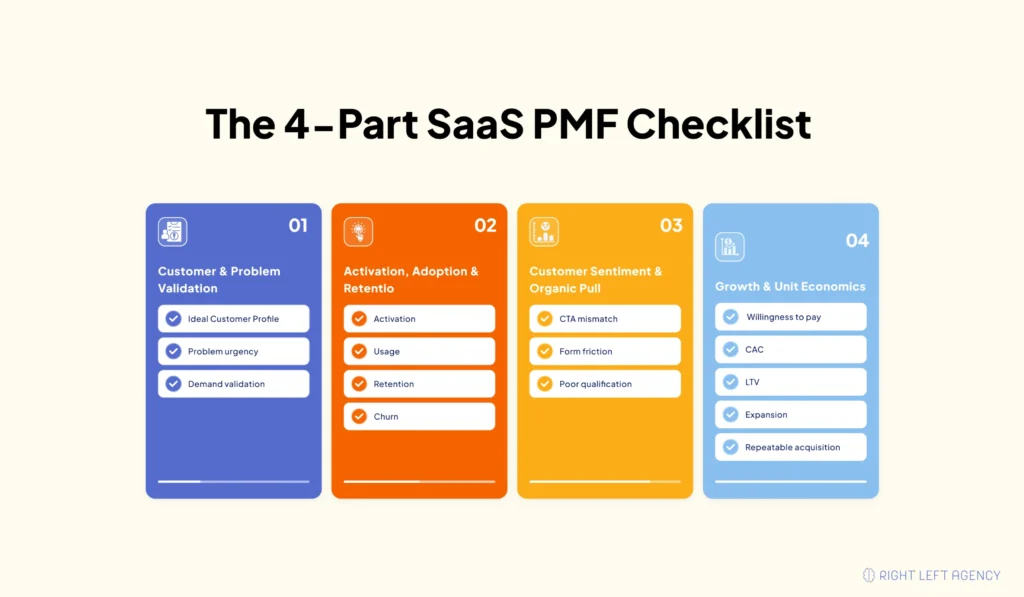
Use this checklist as a diagnostic rather than a rigid pass/fail test. Score each signal as strong, developing, or weak, then look for patterns across the four categories.
Customer & Problem Validation
You have stronger PMF evidence when your ICP is clear, and the problem you solve is urgent, recurring, costly, and important enough for customers to pay to address.
Use these checks:
- Your ICP is clearly defined by meaningful characteristics.
- Your buyer and key decision-makers are understood.
- The problem occurs frequently enough to require a solution.
- The problem creates measurable cost, risk, or friction.
- Customer interviews confirm the problem in their own words.
- Prospects already use workarounds or existing budgets to solve it.
- Pre-sales, LOIs, or paid pilots validate demand.
- Customers understand why your solution is preferable.
Your ideal customer profile should be specific enough to guide product, positioning, pricing, and acquisition decisions.
The problem also needs genuine problem-solution fit. A prospect saying your product is interesting is weaker evidence than a customer paying for a solution because the underlying problem is urgent. Demand validation can come from pre-sales, letters of intent, or paid pilots — the important signal is behavioral commitment, not simply positive opinions.
Activation, Adoption & Retention Signals
Activation and retention reveal whether customers receive enough ongoing value to keep using and paying for your SaaS.
Use these checks:
- Customers reach meaningful value quickly.
- Qualified users consistently activate.
- Customers regularly use core product capabilities.
- Usage reflects the value promised during acquisition.
- Retention is stable or improving across cohorts.
- Churn is measured and understood.
- The retention curve begins to flatten.
- Customers renew because of ongoing value.
Activation means reaching meaningful initial value. Adoption goes further: customers repeatedly incorporate the product into their workflows. Renewal alone doesn’t prove adoption, since a customer can renew while barely using the product.
Retention is one of the strongest quantitative PMF signals. A commonly cited benchmark is roughly 40% retention in some SaaS contexts — a different figure from the Sean Ellis “40% rule” covered below, which measures survey sentiment rather than usage. Neither is a universal PMF threshold; interpret both based on your product, market, business model, and measurement method.
Similarly, roughly 3–5% monthly revenue churn is sometimes cited as a useful benchmark range, but it shouldn’t be treated as a guarantee of PMF.
A flattening retention curve matters because it can indicate that the customers who remain are continuing to find durable value rather than steadily abandoning the product.
Customer Sentiment & Organic Pull
Strong PMF usually creates customer sentiment and advocacy that go beyond simple satisfaction.
Use these checks:
- Customers describe the product as important to their workflow.
- Customers identify meaningful losses if the product disappears.
- Customers provide strong qualitative feedback.
- A meaningful share selects “very disappointed” in PMF surveys.
- Interviews reveal a recurring unmet need.
- Customers recommend the product without prompting.
- Referrals and word of mouth contribute to acquisition.
The Sean Ellis “40% rule” is a widely cited qualitative PMF signal. It asks users how disappointed they’d be if they could no longer use the product; the “very disappointed” response rate is used to assess perceived product value. Treat it as a signal, not a universal pass/fail rule.
Organic advocacy matters for the same reason. Customers voluntarily recommending a product provide evidence that its value extends beyond a transactional purchase.
Growth & Unit Economics Signals
A SaaS is closer to marketing-readiness when customer value translates into willingness to pay, repeatable acquisition, expansion, and sustainable unit economics.
Use these checks:
- Customers demonstrate willingness to pay.
- Pricing reflects perceived product value.
- Existing customers expand their usage or spend.
- Upsell and cross-sell opportunities emerge naturally.
- Customer acquisition becomes more repeatable.
- CAC is understood by channel.
- LTV and CAC support sustainable growth.
- Trial or sales conversion is improving.
- Sales win patterns are becoming repeatable.
- The validated market is large enough to support growth.
Expansion revenue can signal PMF because customers are choosing to increase their relationship with the product. Upsell and cross-sell behavior can indicate the product delivers enough value to justify broader adoption.
CAC, LTV, and the LTV: CAC ratio provide the economic layer. Strong retention doesn’t automatically make a SaaS ready to scale if acquiring every customer remains prohibitively expensive.
Pricing and willingness-to-pay validation should also happen before major acquisition expansion. Your pricing strategy should reflect demonstrated customer value rather than assumptions about what the market will accept.
Are You Ready to Scale Marketing?
The clearest warning signs are weak retention, unclear customer definition, low perceived value, inefficient acquisition, and economics that deteriorate as you grow. Marketing-readiness is stronger when customer value, retention, sentiment, acquisition, and economics reinforce one another:
| Not Ready | Ready |
|---|---|
| Retention is weak or continuously declining | Retention is stable or improving |
| ICP keeps changing | ICP is clear and consistent |
| Customers struggle to explain the product’s value | Customers clearly articulate its value |
| Acquisition requires constant pushing or discounting | Acquisition patterns are becoming repeatable |
| CAC rises without corresponding LTV improvement | Unit economics are becoming sustainable |
| Few organic referrals exist | Word of mouth contributes to acquisition |
| Activation remains inconsistent | Customers consistently reach meaningful value |
| Pricing and willingness to pay remain uncertain | Customers demonstrate willingness to pay |
| Expansion revenue is limited or absent | Upsell, cross-sell, or expansion is emerging |
A red flag doesn’t necessarily mean you should stop all marketing — it means you should avoid assuming that more acquisition is the solution. If weak conversion is caused by unclear messaging, a website conversion audit may uncover the bottleneck. If customers convert but consistently churn, increasing traffic won’t address the underlying product problem.
What to Fix Before You Increase Marketing Spend
When PMF signals are mixed, fix the problems closest to customer value before increasing top-of-funnel investment:
ICP clarity → Positioning and messaging → Activation and retention → Pricing validation → Acquisition scale
Start with the ICP. If you don’t know precisely who receives the most value, every downstream marketing decision becomes less precise.
Next, strengthen positioning and messaging. If qualified prospects can’t understand the problem you solve or why your solution is different, more traffic can increase CAC rather than improve efficiency.
Then fix activation and retention. There’s little value in acquiring customers faster if they consistently fail to reach value or leave shortly after conversion.
Finally, validate pricing and willingness to pay. Scaling paid acquisition before understanding whether customers will pay sustainably can magnify an economic problem.
The Marketing-Readiness Framework: Scale, Fix, or Validate
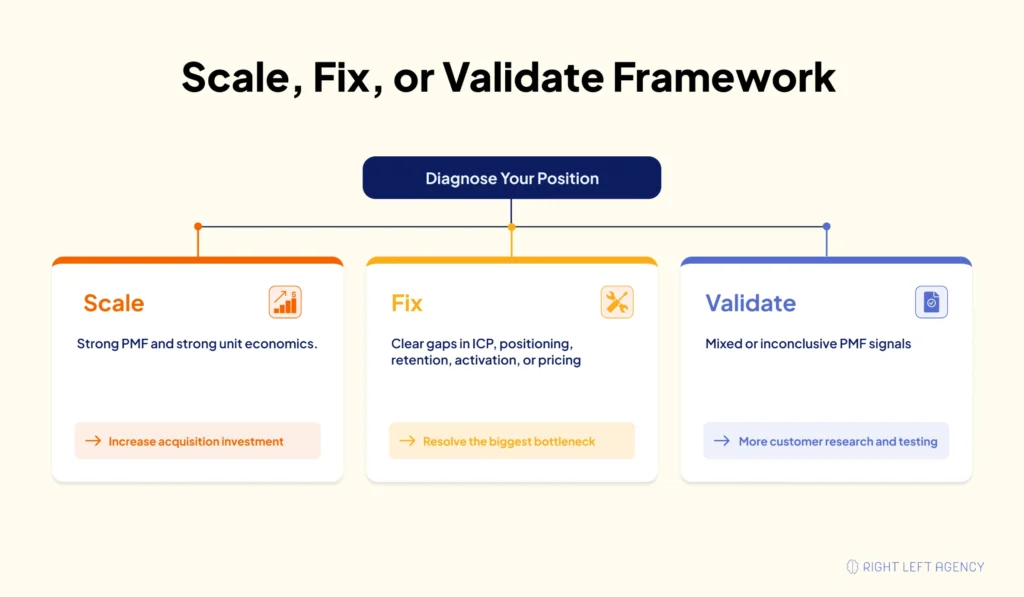
Use three outcomes to translate your PMF evidence into a practical marketing decision:
| Outcome | What It Looks Like | Recommended Next Step |
|---|---|---|
| Scale | Strong retention, clear ICP, positive sentiment, repeatable acquisition, and sustainable economics | Increase investment in the channels most likely to compound growth |
| Fix | Clear gaps in positioning, ICP, retention, activation, pricing, or economics | Resolve the highest-impact bottleneck before materially increasing spend |
| Validate | Evidence is mixed, inconsistent, or insufficient | Run customer research, usage analysis, pricing tests, or further validation |
Two concepts sit between PMF and acquisition scaling. Channel-market fit means an acquisition channel can reliably reach and convert your validated market. Message-market fit means your positioning resonates with the needs, priorities, and language of that market.
A SaaS can have strong PMF but weak channel-market fit. It can also have a strong product but weak message-market fit. Product-market fit is the foundation of marketing-readiness — not the entire growth strategy.
How Product-Market Fit Affects SEO, Content, Paid Acquisition, and Demand Generation
PMF affects how efficiently every major SaaS marketing channel turns attention into qualified demand and durable revenue.
SEO and content can increase visibility, but traffic can’t compensate for unclear ICP or weak positioning. If content attracts the wrong audience, more organic traffic may create activity without meaningful pipeline. Once PMF and ICP are clearer, SEO work can focus on the problems and buying contexts that matter to the validated market.
Paid acquisition can expose weak economics quickly. If customers churn after conversion, more clicks and leads simply increase the amount of money entering a leaky system. When PMF is stronger, paid search can amplify validated demand rather than compensate for unresolved product problems.
Demand generation depends on relevant messaging, market understanding, and a product that delivers on its promise. Stronger PMF and message-market fit make it easier to build qualified demand.
FAQ
What is product-market fit for a SaaS company, and how do you define it? Product-market fit exists when a clearly defined customer segment has a meaningful problem, receives value from your solution, and demonstrates that value through adoption, retention, payment, referrals, or expansion. It’s better viewed as a spectrum of evidence than a single milestone.
What’s a good SaaS retention benchmark for PMF? Roughly 40% retention is a commonly cited benchmark in some SaaS contexts, but it’s not a universal threshold. Evaluate retention alongside product type, customer segment, business model, and other PMF signals.
Is product-market fit permanent? No. Markets, customer expectations, competitors, and product value can change, so PMF should be monitored continuously rather than treated as a permanent achievement.
Should I pause marketing spend entirely if I don’t have PMF? Not necessarily. Continue useful learning and targeted marketing, but avoid aggressively scaling acquisition until the most important PMF gaps are understood and addressed.
How long does it typically take to reach product-market fit? There’s no reliable timeframe that applies across SaaS companies. Focus on the quality and consistency of evidence rather than an arbitrary timeline.
How do I decide whether to scale, fix, or validate? Use the strength of your combined PMF signals. Strong evidence supports Scale; identifiable bottlenecks support Fix; mixed or insufficient evidence supports Validate.
What is channel-market fit? The alignment between a validated market and an acquisition channel’s ability to reach and convert that market efficiently.
What is message-market fit? Your positioning and messaging resonating with the problems, priorities, and language of the market you’re targeting.
How does PMF affect SEO, paid acquisition, and demand generation? PMF provides the foundation for efficient acquisition. Strong customer value and retention allow SEO, paid acquisition, content, and demand generation to amplify demand instead of compensating for unresolved product-market problems.
Final Takeaway
Product-market fit isn’t a box you check once and never revisit — it’s an ongoing assessment of whether the right customers consistently find meaningful value in your product.
Before increasing marketing investment, examine ICP clarity, problem validation, activation, adoption, retention, customer sentiment, referrals, willingness to pay, expansion, CAC, LTV, and repeatable acquisition. Then decide deliberately: Scale when the evidence is strong, Fix when a clear bottleneck is limiting growth, Validate when the evidence is still inconclusive.
The objective isn’t simply to spend more on marketing — it’s to build a growth system where product-market fit gives every additional marketing dollar a stronger chance to compound.
If you’re not sure which category you fall into, that’s exactly what a Product Marketing Growth Audit is for — we’ll help you pressure-test your PMF evidence and map it to a marketing-readiness decision. [Request a Product Marketing Growth Audit].