Key Takeaways
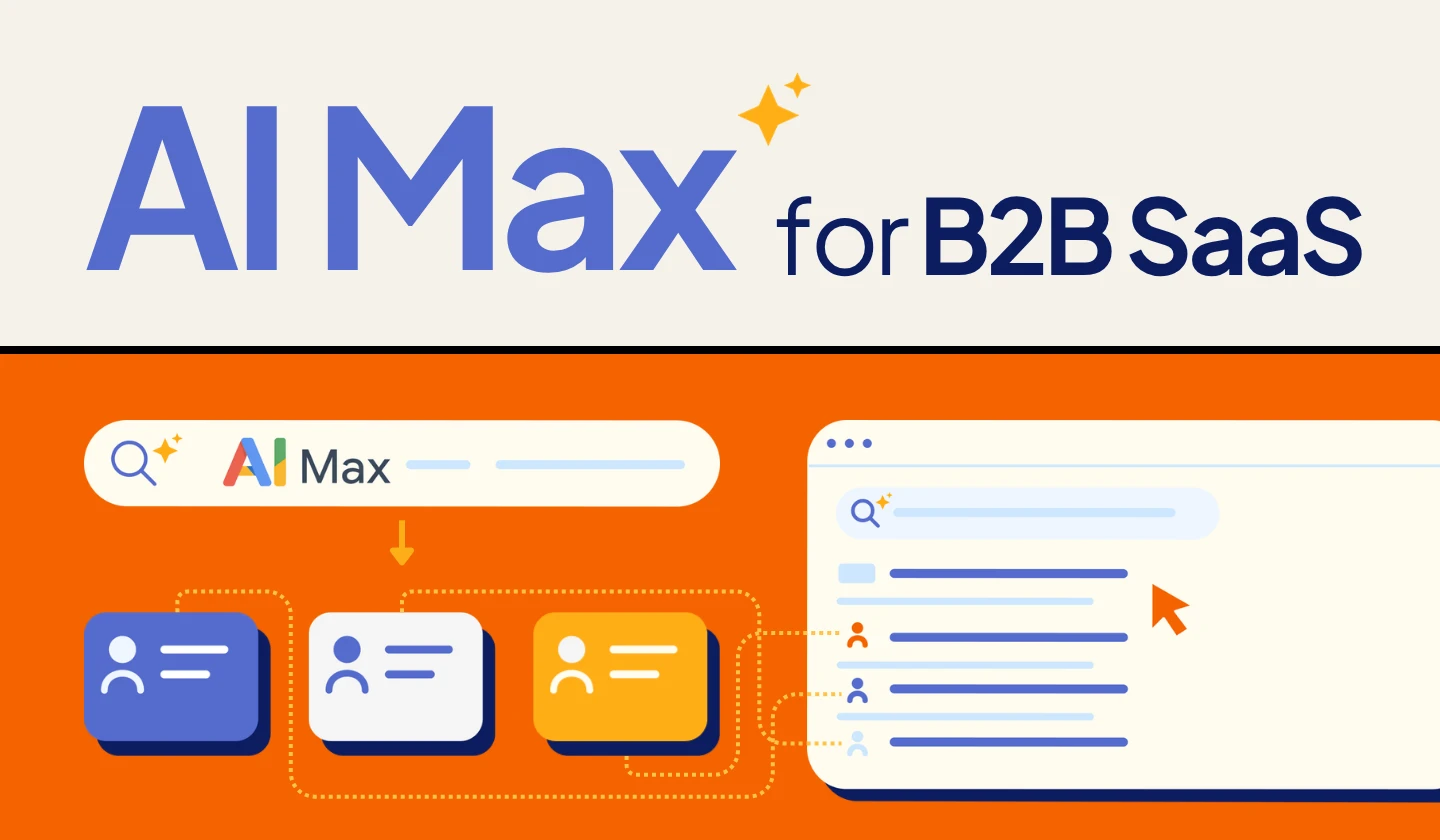
- AI Max expands Search reach through automated matching, ad customization, and landing-page selection.
- More conversions don’t always mean better pipeline, as not every lead becomes a qualified opportunity.
- CRM conversion data helps Google Ads optimize for qualified leads and sales opportunities.
- Final URL expansion needs control to prevent traffic from reaching unsuitable landing pages.
- Measure AI Max success through lead quality, cost per opportunity, and pipeline contribution.
Google AI Max can help B2B SaaS companies reach relevant buyers beyond their existing Search keywords. But additional reach doesn’t automatically mean more qualified pipeline.
Results depend on your conversion tracking, campaign controls, landing pages, and ability to measure what happens after someone submits a form.
The real question isn’t whether AI Max increases conversions. It’s whether those conversions become qualified sales opportunities.
This guide explains which AI Max features to enable, which to restrict, and how to evaluate their impact on lead quality and pipeline.
What Is Google AI Max for B2B SaaS?
AI Max is a suite of AI-powered targeting and creative features within Google Search campaigns. Introduced in May 2025, it helps advertisers discover additional relevant searches, customize ad messaging, and select landing pages based on user intent.
Unlike Performance Max, AI Max isn’t a separate campaign type. It adds automation to existing Search campaigns while retaining many familiar controls.
What’s Changed in 2026?
Google has continued updating AI Max since its introduction.
Starting in September 2026, Google began automatically upgrading eligible Search campaigns using text customization, formerly known as automatically created assets, to AI Max.
This means some advertisers may already have AI Max settings available or enabled through the upgrade process.
Before changing your campaigns, review their current settings rather than assuming AI Max requires a new manual activation.
Source: Google Ads: About Text Customization.
How AI Max Works
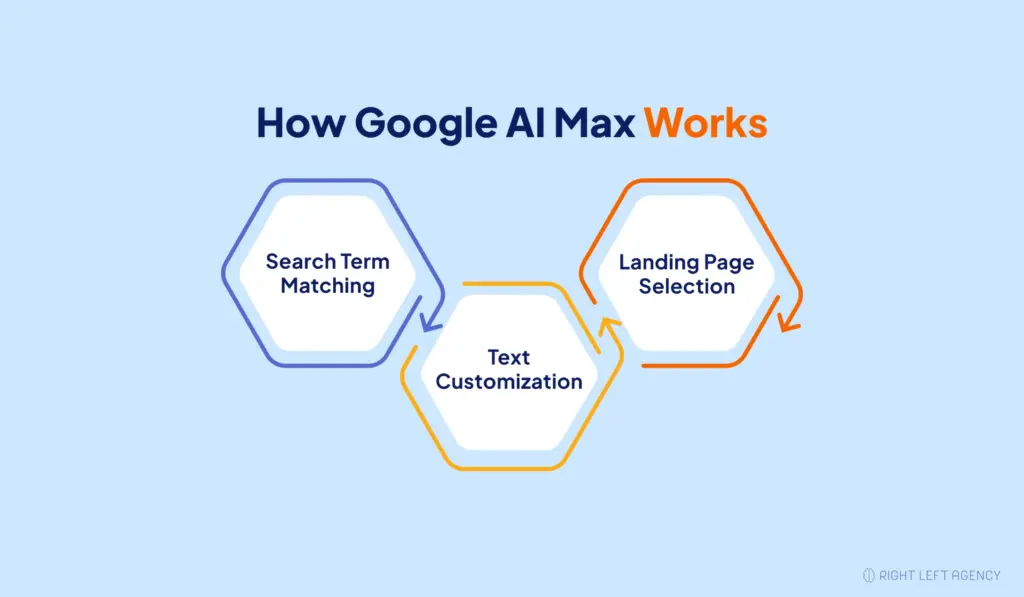
AI Max includes two main feature groups: search term matching and asset optimization.
Search term matching
Search term matching uses broad match, landing-page signals, and keywordless technology to identify relevant queries beyond your existing keyword list.
For example, an enterprise workflow software company may discover searches describing operational challenges rather than directly mentioning its software category.
Advertisers can manage search term matching at the ad-group level after enabling AI Max.
Text customization
Text customization creates additional headlines and descriptions based on existing ads, keywords, and landing-page content.
It can help match ad messaging to different search intents, but generated copy still needs review for accuracy and relevance.
Final URL expansion
Final URL expansion allows Google to select a relevant landing page from your website instead of always using the original final URL.
This may improve relevance when your website contains several suitable commercial pages.
However, it requires text customization and can introduce landing-page or messaging-control concerns if not configured carefully.
Brand and location controls
AI Max also provides controls for branded searches and geographic intent.
These can help advertisers align campaigns with target markets and manage unwanted brand-related traffic.
Google explains these capabilities in its AI Max documentation.
Why B2B SaaS Needs a Different AI Max Strategy
B2B SaaS companies often operate with longer sales cycles, smaller qualified audiences, and higher customer acquisition costs than consumer-focused businesses.
That changes how automated advertising should be evaluated.
A form submission may count as a conversion in Google Ads, but the person submitting it may not have the budget, authority, company profile, or purchasing intent required to become a customer.
Three challenges make this distinction important.
1. Lead Volume Doesn’t Always Reflect Lead Quality
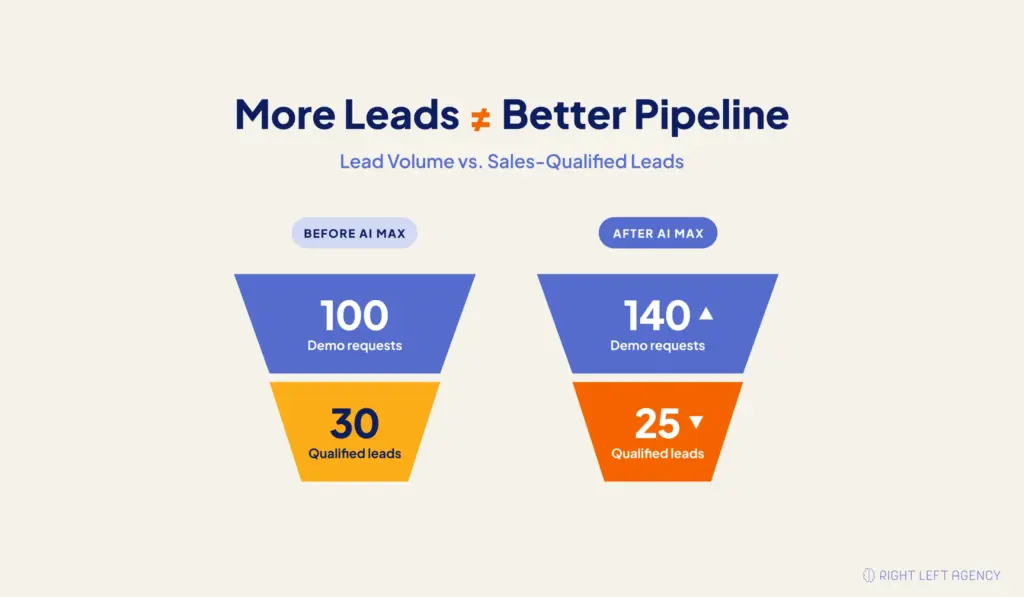
Consider a SaaS company generating 100 demo requests in one month.
Of those, 30 become sales-qualified leads.
After enabling AI Max, demo requests increase to 140, but only 25 become sales-qualified.
| Metric | Before AI Max | After AI Max |
|---|---|---|
| Demo requests | 100 | 140 |
| Sales-qualified leads | 30 | 25 |
| Lead-to-SQL rate | 30% | 17.9% |
The campaign appears more successful when measured by total conversions.
However, fewer leads progress into the sales pipeline.
This is why B2B SaaS paid search management should connect advertising metrics with CRM outcomes rather than relying exclusively on platform-reported conversions.
2. Long Sales Cycles Delay Quality Signals
A lead might submit a demo request today but take several weeks to become a qualified opportunity.
Google Ads immediately records the submission, while the sales team needs more time to determine its value.
Without downstream conversion data, automated bidding has less information about which initial conversions produce meaningful business outcomes.
3. Broader Matching Can Introduce Irrelevant Traffic
AI Max can identify relevant search opportunities beyond existing keywords. However, broader matching may introduce searches from audiences outside your ideal customer profile (ICP).
For example, an enterprise project management platform might attract searches related to free personal productivity tools.
Both audiences may be interested in project management, but their commercial value differs significantly. The goal isn’t to avoid automated expansion. It’s to ensure that additional reach supports the right buyers.
Why AI Max Needs CRM Conversion Data
Offline conversion tracking connects advertising activity with downstream sales outcomes.
For B2B SaaS companies, it provides a clearer view of which campaigns generate qualified leads, sales opportunities, and customers.
AI Max can operate without offline conversion imports. However, accounts optimizing exclusively toward form submissions may struggle to distinguish high-value prospects from low-intent conversions.
How Offline Conversion Tracking Works
A typical B2B SaaS conversion journey includes:
- Someone clicks a Google Search ad.
- The visitor submits a demo request.
- The lead enters the CRM.
- Sales evaluates the lead’s qualification.
- The lead becomes an SQL or sales opportunity.
- Relevant conversion-stage data is sent back to Google Ads.
This gives advertisers a way to evaluate campaign performance beyond the original form submission.
Google supports several approaches, including enhanced conversions for leads, Google Ads Data Manager, and supported CRM integrations.
Which Conversions Should You Track?
Not every funnel event should have the same role in campaign optimization.
| Conversion event | Business meaning | Suggested use |
|---|---|---|
| Form submission | Initial interest | Measure lead volume |
| Marketing-qualified lead | Meets marketing criteria | Evaluate lead quality |
| Sales-qualified lead | Accepted by sales | Track sales readiness |
| Opportunity created | Active commercial opportunity | Measure pipeline generation |
| Closed-won customer | Generated revenue | Evaluate acquisition outcomes |
The appropriate primary conversion actions depend on data quality, sales-cycle length, and available conversion volume.
For accounts with limited opportunity data, qualified leads may provide a more practical optimization signal than waiting exclusively for closed-won deals.
Businesses should also avoid double-counting multiple stages of the same buyer journey when evaluating overall performance.
The objective is to give automated bidding meaningful signals while maintaining enough reliable data to support optimization.
Which AI Max Features Should You Enable?
There is no universal AI Max configuration that works for every B2B SaaS company.
The right setup depends on your conversion tracking, target audience, landing pages, and campaign performance.
Use the following recommendations as a starting point.
| Feature or control | Recommendation | Why it matters |
|---|---|---|
| Search term matching | Test with controls | Discover additional demand while monitoring query quality |
| Text customization | Enable and review | Improve ad relevance without compromising product accuracy |
| Final URL expansion | Restrict or disable when necessary | Prevent unsuitable landing pages from receiving paid traffic |
| Locations of interest | Align with target markets | Match geographic intent to serviceable regions |
| Brand exclusions | Apply where appropriate | Manage unwanted brand-related traffic |
| URL exclusions | Use when expansion is enabled | Prevent selected pages from serving as landing pages |
| URL inclusions | Use selectively | Guide landing-page selection toward relevant URLs |
These recommendations aren’t fixed rules. Review individual account requirements before applying them.
Search Term Matching: Expand Carefully
Search term matching can uncover high-intent queries that conventional keyword strategies miss.
However, advertisers should regularly review the Search terms report.
Watch for:
- Queries from users outside your ICP
- Informational searches with limited commercial intent
- Irrelevant competitor-related traffic
- Searches for free alternatives when targeting enterprise buyers
- Queries unrelated to your core product
Use negative keywords and applicable brand controls to reduce irrelevant traffic.
Avoid assuming that every unfamiliar search term is low-quality. Evaluate intent alongside actual lead outcomes.
Text Customization: Review Generated Messaging
Text customization can create messaging variations relevant to different searches.
For example, an enterprise security SaaS company may serve buyers looking for compliance reporting, access management, or monitoring software.
Automated assets can help adapt messaging to these needs.
However, generated copy may not always reflect the product’s exact capabilities, supported integrations, or commercial positioning.
Review headlines and descriptions for accuracy, relevance, and consistency with your landing pages.
Final URL Expansion: Protect Conversion Pages
Final URL expansion deserves particular attention for B2B SaaS lead generation.
Many SaaS websites contain product pages, industry landing pages, blogs, help center articles, and customer support resources.
Not every page is suitable for paid acquisition.
If automated landing-page selection sends visitors to pages without a clear product explanation or conversion path, performance may suffer.
Before enabling expansion, identify unsuitable destinations and configure the appropriate exclusions.
Important: URL inclusions do not automatically restrict AI Max to only those pages while final URL expansion is enabled.
Google may still select other relevant URLs.
If stricter landing-page control is necessary, consider disabling final URL expansion and using the available URL inclusion options.
Also review responsive search ad pinning requirements. Google notes that pinning may not be respected when final URL expansion or URL inclusions are used.
Source: Google Ads: Final URL Expansion.
The B2B SaaS AI Max Readiness Framework
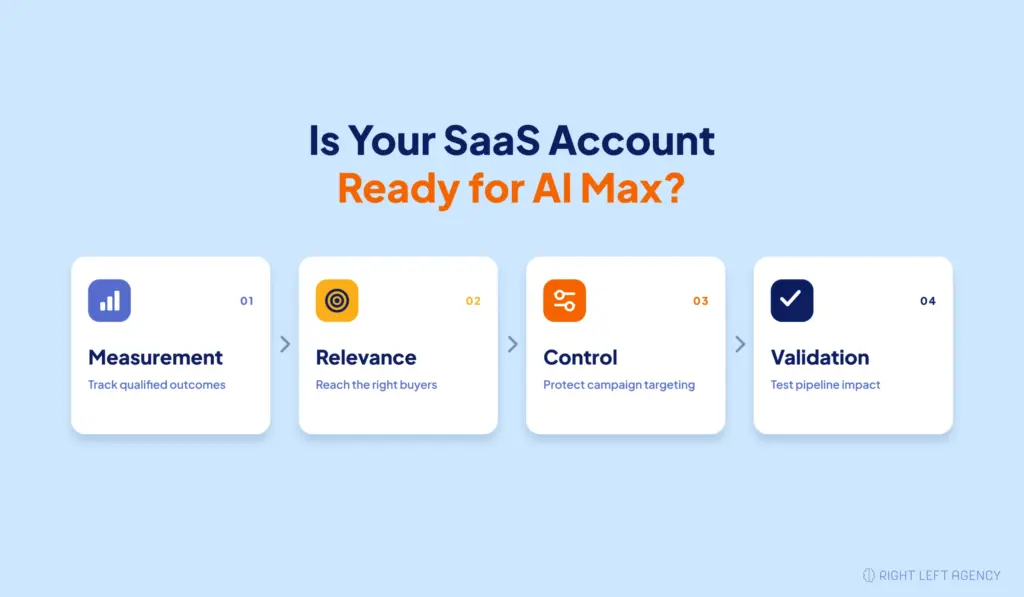
Before expanding automation, evaluate your account across four areas.
1. Measurement: Are You Tracking Qualified Outcomes?
Confirm that Google Ads records the actions that matter to your business.
Check conversion accuracy, CRM integration, and the primary conversion actions used for bidding.
2. Relevance: Are You Attracting the Right Buyers?
Review existing search terms to identify which queries generate qualified opportunities.
Look for patterns in commercial intent, target industries, company fit, and irrelevant traffic.
3. Control: Can You Protect Your Campaigns?
Review landing pages, geographic targeting, brand controls, and negative keywords.
Identify where automated expansion could introduce traffic outside your target audience.
4. Validation: Can You Measure the Impact?
Document your current qualified lead volume, acquisition costs, and pipeline contribution.
Establish how you will compare performance after testing AI Max.
The goal isn’t to activate every AI feature. It’s to create enough visibility and control to determine whether automation improves business outcomes.
AI Max vs Performance Max for B2B SaaS
AI Max enhances existing Search campaigns, while Performance Max is a separate campaign type designed to reach audiences across multiple Google advertising channels.
Neither is automatically better for every B2B SaaS company.
The decision depends on your acquisition strategy, conversion measurement, available resources, and target audience.
| Comparison | AI Max for Search | Performance Max |
|---|---|---|
| Campaign structure | Features within Search campaigns | Separate automated campaign type |
| Channel coverage | Google Search inventory | Multiple Google advertising channels |
| Search control | Retains Search campaign structure | Uses broader cross-channel automation |
| Search-term insights | AI Max-specific search reporting | Search-term insights and campaign reporting |
| Landing-page automation | Optional final URL expansion | Supports final URL expansion |
| Best starting situation | Existing Search campaigns with defined keyword intent | Cross-channel acquisition objectives |
| Main measurement concern | Quality of expanded Search traffic | Quality and contribution of cross-channel traffic |
| Recommended approach | Test incrementally within Search | Evaluate incremental value alongside existing campaigns |
When AI Max May Be Better
AI Max may be a suitable starting point when a SaaS company already generates qualified leads through Search and wants to discover additional relevant queries.
It allows marketers to test expanded matching and creative automation without replacing their existing Search strategy.
When Performance Max May Make Sense
Performance Max may be useful when a SaaS company wants to extend acquisition beyond Search.
For example, a product-led SaaS business with established conversion data may want to test how additional Google channels contribute to trials and qualified users.
However, Performance Max isn’t limited to e-commerce or high-volume accounts.
Its suitability depends on campaign goals, creative resources, conversion signals, and the broader advertising strategy.
Can You Run Both?
Yes. AI Max for Search and Performance Max can operate within the same Google Ads account. However, advertisers should understand how campaigns interact and how overlapping search opportunities are handled.
Google explains that when an eligible query can match both AI Max and Performance Max, Ad Rank may determine which campaign serves.
For B2B SaaS, evaluate which setup contributes more qualified pipeline at an acceptable acquisition cost, rather than which reports the most conversions.
How to Measure AI Max Pipeline Performance
AI Max should be evaluated using both advertising metrics and downstream sales outcomes.
An increase in Google Ads conversions can be positive, but it doesn’t automatically establish an increase in qualified demand.
Focus on the following metrics.
MQL-to-SQL Conversion Rate
This measures the percentage of marketing-qualified leads that become sales-qualified leads.
Formula:
MQL-to-SQL rate = (SQLs ÷ MQLs) × 100
A declining rate may indicate reduced lead quality.
However, changes in qualification criteria, sales processes, or lead sources can also affect results.
Cost Per Qualified Opportunity
This measures how much advertising spend is required to generate a qualified sales opportunity.
Formula:
Cost per qualified opportunity = Advertising spend ÷ Qualified opportunities
For SaaS companies with long sales cycles, this is often more meaningful than cost per lead.
Pipeline Contribution
Track the number and value of opportunities generated by paid search.
Use consistent attribution definitions and account for the time required for leads to progress through the CRM.
Search-Term Quality
Review AI Max search-term reporting to understand where additional reach comes from.
Evaluate query relevance, matching sources, selected landing pages, and downstream qualification.
Revenue Contribution
Where reliable data is available, connect campaign activity to acquired customers and revenue.
Longer sales cycles may require evaluating historical lead cohorts rather than only recently generated conversions.
How to Test AI Max Performance
A simple before-and-after comparison may be misleading. Seasonality, budget changes, competitor activity, and sales qualification processes can all affect campaign results.
Whenever possible, use a controlled experiment. Google provides AI Max experiments that allow advertisers to test AI Max features against a control within eligible Search campaigns.
A structured test should include:
- Define the objective. Decide whether you’re trying to improve qualified leads, acquisition cost, or pipeline contribution.
- Establish a control. Use an appropriate experiment setup or comparison baseline.
- Keep measurement consistent. Avoid changing qualification definitions during testing.
- Account for conversion delays. Allow enough time for leads to progress through the CRM.
- Review business outcomes. Decide whether to expand, restrict, or discontinue features based on the results.
Low-volume B2B SaaS accounts may need longer observation periods. Don’t assume that a few weeks of results are conclusive when opportunities take months to mature.
For accounts without sufficient data for a reliable experiment, document the limitations and make conservative decisions.
Should You Manage AI Max In-House?
B2B SaaS companies can manage AI Max internally when they have the necessary advertising expertise, reliable conversion measurement, and time to review performance.
The main challenge isn’t enabling the features. It’s maintaining the connection between automated advertising, qualified leads, and the sales pipeline.
When In-House Management Makes Sense
An internal team may be well-positioned when:
- Conversion tracking is accurate.
- CRM qualification stages are clearly defined.
- Someone regularly reviews search terms and landing pages.
- The team can evaluate pipeline performance.
- Campaign testing has clear ownership.
When a Paid Search Agency May Help
Specialist support may be useful when the business struggles to connect advertising activity with downstream revenue.
A paid search partner can help evaluate campaign structure, tracking gaps, lead qualification, landing-page relevance, and testing opportunities.
At Right Left Agency, the focus is on connecting paid search activity with the broader SaaS growth strategy, including lead quality, customer acquisition, and pipeline performance.
For AI Max, this means assessing whether expanded search demand is attracting suitable buyers and contributing to measurable business outcomes.
The objective isn’t to add automation for its own sake. It’s to identify which changes improve acquisition efficiency.
Protect Your Paid Search Pipeline
AI Max can expand Search campaign reach, but stronger advertising performance requires more than additional clicks and conversions.
For B2B SaaS companies, the priority is understanding which campaigns generate qualified opportunities and contribute to revenue.
Before expanding automation, review your conversion tracking, landing pages, search-term quality, and CRM reporting.
Right Left Agency helps B2B SaaS teams connect paid search performance with qualified pipeline and customer acquisition goals.
Request a Paid Search Opportunity Audit to identify tracking gaps, campaign inefficiencies, and opportunities to improve Google Ads performance.
Frequently Asked Questions
Should B2B SaaS Companies Use AI Max for Search?
AI Max is worth testing when existing Search campaigns have clear objectives, relevant landing pages, and reliable conversion measurement. It can help discover additional demand, but results should be evaluated using qualified leads and pipeline outcomes.
Does AI Max Hurt Lead Quality?
AI Max doesn’t inherently reduce lead quality. However, expanded matching may bring in less relevant traffic when campaigns lack controls or meaningful conversion signals. Search-term reviews and CRM measurement help identify these problems.
Do You Need Offline Conversion Tracking Before Using AI Max?
Offline conversion tracking isn’t technically required to enable AI Max. However, it’s strongly recommended for B2B SaaS companies optimizing beyond form submissions. CRM conversion data helps identify which leads become qualified opportunities.
Should B2B SaaS Companies Turn Off Final URL Expansion?
Final URL expansion should be restricted or disabled when automated landing-page selection could send visitors to unsuitable pages. Companies with well-structured commercial websites may benefit from testing it with exclusions and ongoing review.
What Is the Difference Between AI Max and Performance Max?
AI Max adds automated targeting and creative features to Search campaigns. Performance Max is a separate campaign type that reaches audiences across multiple Google channels. Both can support B2B SaaS acquisition when configured around relevant business objectives.
How Long Should You Test AI Max?
Testing duration depends on conversion volume, bidding behavior, and sales-cycle length. Use controlled experiments when possible, and allow enough time to evaluate meaningful outcomes. A fixed test period isn’t equally reliable for every account.