

Key Takeaways
- Construction SaaS marketing must address both office buyers and field users.
- Segment contractors by type before building messaging, channels, or campaigns.
- Translate software features into clear contractor-specific business and jobsite outcomes.
- Match each marketing channel to the buyer, intent, and sales stage.
- Measure success by qualified pipeline, not traffic, clicks, or lead volume.
Marketing construction SaaS to contractors requires selling to two audiences at once: the office decision-maker evaluating ROI and risk, and the field team expected to use the software every day.
Ignore the office buyer, and you may never get budget approval. Ignore the field user, and you may win the contract but lose adoption.
That is why generic B2B SaaS playbooks often underperform in construction technology.
A stronger approach connects the full buying journey:
Segment → Buyer → Pain → Message → Channel → Demo → Proof → Pipeline
This guide shows how to apply that framework to construction SaaS marketing.
Why Construction SaaS Marketing Is Different
Construction software is rarely bought and used by the same person.
An owner, operations leader, or finance stakeholder may approve the investment. Project managers and superintendents influence the decision. Field crews ultimately determine whether the software becomes part of the daily workflow.
That creates two different sets of expectations.
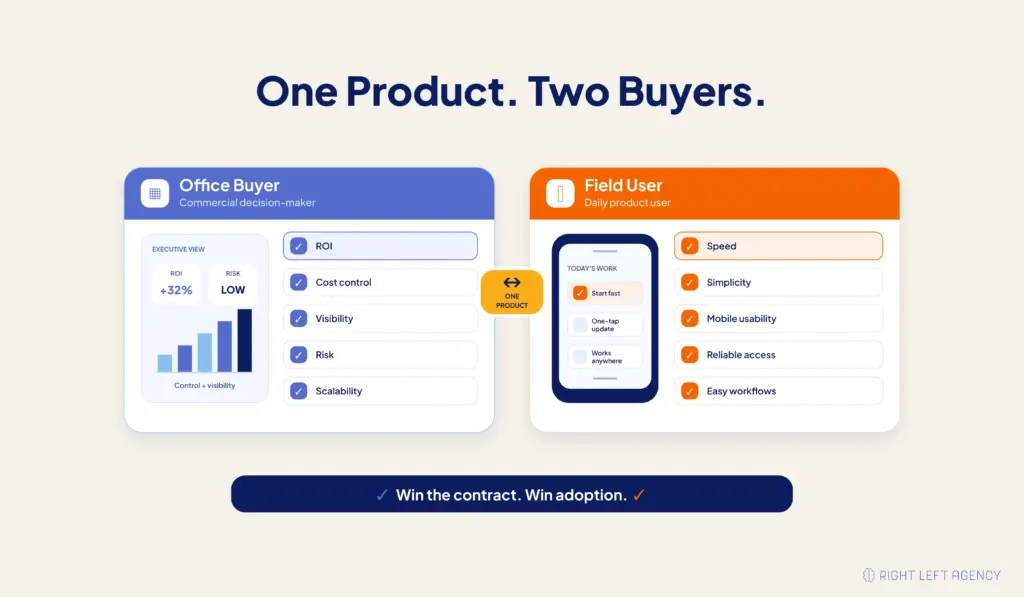
Office buyers typically care about:
- ROI
- Cost control
- Project visibility
- Standardization
- Risk
- Scalability
Field users care about:
- Speed
- Simplicity
- Mobile usability
- Reliable access on-site
- Minimal disruption to existing workflows
The result is a purchase decision made in the office and a verdict delivered on the jobsite.
Generic SaaS messaging often assumes one value proposition can satisfy both groups. In construction, it usually cannot.
The industry also relies heavily on relationships, referrals, reputation, and peer validation. That makes trust just as important as reach.
For a broader view of the category, see our construction SaaS overview and construction SaaS industry page.
Start With the Contractor Segment You Want to Win
Contractors is too broad to be a useful target audience.
Different contractor types operate differently, measure value differently, and respond to different messages.
| Contractor Segment | Typical Priority | Messaging Angle |
|---|---|---|
| General Contractors | Coordination across trades and schedules | Reduce project friction and improve visibility |
| Specialty Contractors | Productivity and margin protection | Complete more work with less administrative burden |
| Residential Builders | Ease of use and low complexity | Manage projects without enterprise overhead |
| Commercial Contractors | Standardization and control | Create consistent execution across projects |
General Contractors
General contractors coordinate subcontractors, schedules, documentation, and dependencies across multiple teams.
Messaging should focus on reducing coordination problems, improving project visibility, and minimizing time spent chasing updates.
Improve productivity is too broad.
Keep project teams working from current information and reduce coordination gaps is closer to the problem they recognize.
Specialty Contractors
Trade and specialty contractors often operate with tighter margins and smaller administrative teams.
Their priority is not software sophistication. It is getting more work completed without adding unnecessary administrative effort.
Messaging should connect the product to:
- field productivity
- faster documentation
- fewer administrative tasks
- margin protection
- more billable work
Residential Builders
Residential contractors often need straightforward software without the complexity associated with large enterprise platforms. Ease of use can become a primary purchase criterion.
Messaging should emphasize simple workflows, faster setup, and the ability to manage jobs without adding unnecessary systems or process layers.
Commercial Contractors
Commercial contractors often manage more projects, stakeholders, documentation requirements, and operational complexity.
Messaging should focus on visibility, consistency, standardization, and control across projects.
Layer Company Size on Top of Contractor Type
Contractor type tells you how the company works. Company size tells you what kind of operational problem it is trying to solve.
A small specialty contractor and a mid-market specialty contractor may perform similar work but have very different software needs.
Growing construction companies are often trying to increase project capacity without increasing administrative headcount at the same rate.
For these buyers, the strongest message may be about scaling capacity, not simply improving efficiency.
Mid-market companies may care more about standardization, reporting, permissions, integration, and visibility across teams or locations.
Use company size as a second layer of segmentation rather than treating it as another contractor category.
Map the Construction Software Buying Committee
Once you know the contractor segment, identify who influences the purchase.
Construction software buying decisions often involve multiple stakeholders, each evaluating the product through a different lens.
| Role | Main Priority | Likely Objection |
|---|---|---|
| Owner / CEO | Business performance and ROI | “Is this worth the investment?” |
| Operations Leader | Standardization and visibility | “Will this create more oversight work?” |
| Project Manager | Workflow efficiency | “Will this actually save my team time?” |
| Superintendent | Field usability and adoption | “Will my crew actually use this?” |
| Estimator | Accuracy and workflow fit | “Does this fit how we already estimate?” |
| Finance / Controller | Cost and budget impact | “What is the real total cost?” |
| IT | Integration and security | “Will this work with our existing stack?” |
| Field User | Speed and simplicity | “Is this going to slow me down?” |
Owners and Operations Leaders
Owners typically evaluate software against business outcomes. They want to know whether the investment will improve performance, reduce risk, increase capacity, or provide better operational visibility.
Operations leaders care about consistency across projects without creating another system that requires constant oversight.
Project Managers and Superintendents
PMs and superintendents sit between leadership expectations and field execution. They are often accountable for adoption even when they did not choose the software.
Their concern is practical:
Will this make the workflow easier or create more work for the crew?
Estimators and Preconstruction Teams
Estimators care about speed, accuracy, and workflow compatibility. Software that requires them to replace a functioning estimating process needs a compelling reason for the disruption.
Finance and IT
Finance evaluates the real cost beyond the license fee, including implementation, training, migration, and ramp-up. IT evaluates integrations, compatibility, security, access, and technical requirements.
Field Users
Field users may not control the budget, but they can determine whether the investment succeeds. They evaluate software based on what happens in real jobsite conditions.
Can they access what they need quickly?
Does the mobile workflow make sense?
Can they complete the task without unnecessary steps?
Marketing and sales need to treat field adoption as part of the buying decision, not something to solve after the contract is signed.
Build Construction SaaS Messaging Around Contractor Outcomes
Strong construction SaaS messaging moves through three levels:
Problem → Outcome → Capability
Starting with the feature skips the reason the buyer should care.
Lead With the Problem
Start with a problem the contractor already recognizes.
Instead of:
Streamline project collaboration.
Lead with something closer to the actual workflow:
Keep field and office teams working from current project information without chasing updates across multiple systems.
The second version gives the product a reason to exist.
Translate Features Into Contractor Outcomes
Every product capability should be translated into an operational or business result.
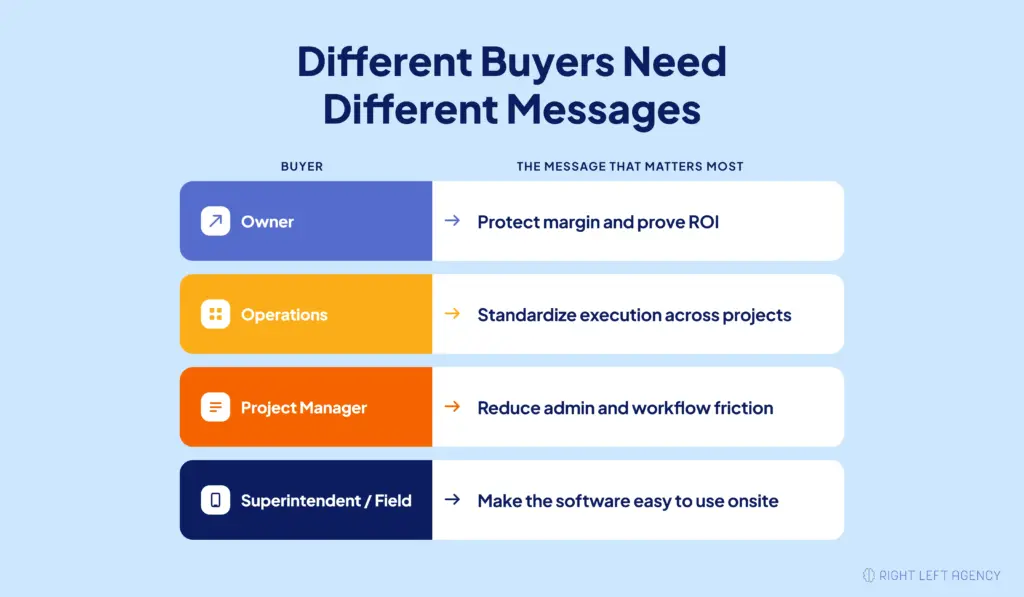
| Buyer | Core Pain | Messaging Direction |
|---|---|---|
| Owner | Margin and ROI | Protect margins and increase project capacity |
| Operations | Inconsistent execution | Standardize workflows across projects |
| Project Manager | Administrative burden | Spend less time chasing information |
| Superintendent | Crew resistance | Give the field a workflow they can actually use |
| Estimator | Slow or disconnected processes | Improve speed without rebuilding the workflow |
| Finance | Unclear financial return | Connect cost to measurable business impact |
| IT | Integration risk | Fit into the existing technology environment |
| Field User | Added complexity | Make daily tasks faster and simpler |
Use Construction-Specific Language
Generic SaaS phrases such as:
- streamline workflows
- improve collaboration
- increase efficiency
- drive productivity
are too vague on their own.
Use language that reflects how contractors actually work:
- RFIs
- punch lists
- change orders
- takeoffs
- project updates
- field documentation
- schedules
- crews
- jobsites
The closer the message is to the buyer’s actual workflow, the less translation they have to do.
Make ROI Concrete
Saving time and money is not enough.
Connect value to something the contractor can recognize inside the business.
That might mean:
- reducing administrative effort
- avoiding duplicated work
- shortening a workflow
- increasing project capacity
- improving documentation accuracy
- reducing time spent chasing information
Specific outcomes make price easier to evaluate because the buyer has something concrete to compare the investment against.
Lead With Proof When Skepticism Is High
Construction buyers may already have experience with software that performed well in a sales demo but struggled in real field conditions.
When skepticism is high, proof should appear early.
Do not make prospects read an entire landing page before seeing evidence that another contractor successfully used the product.
If your messaging still sounds interchangeable with every other SaaS company after this exercise, the problem may be positioning rather than copywriting. See how we approach SaaS positioning and branding.
Best Marketing Channels for Construction SaaS Companies
Construction SaaS channel strategy should follow the buyer.
The right question is not:
Which B2B SaaS channels should we use?
It is:
Which channel reaches this buyer at this stage of the decision?
SEO and High-Intent Search
SEO is strongest when office-side buyers are actively researching a problem, category, or vendor.
Useful bottom-of-funnel content includes:
- software comparisons
- buying guides
- alternative pages
- implementation guides
- vendor evaluations
- use-case pages
SEO can capture demand that already exists, especially when the prospect is moving from problem awareness toward vendor evaluation.
Paid Search
Paid search reaches buyers actively looking for a solution. It is particularly useful for category, comparison, competitor, and high-intent commercial searches.
But it is primarily an office-side acquisition channel. It should not be expected to solve field adoption by itself.
LinkedIn and Account-Based Marketing
LinkedIn can reach:
- owners
- executives
- operations leaders
- finance leaders
- other office-side decision-makers
It is much less reliable for reaching field crews.
That makes LinkedIn useful for account penetration and buying-committee engagement, but insufficient as the entire go-to-market strategy.
Industry Content and Webinars
Educational content can reach buyers earlier in the research process.
It is especially useful when the buyer understands the operational problem but has not yet decided what type of software or approach will solve it.
Trade Associations, Events, and Partnerships
Industry environments can create credibility that digital advertising alone cannot.
Organizations and events such as AGC, ABC, World of Concrete, and CONEXPO put software companies closer to the communities contractors already know.
These channels can support:
- awareness
- trust
- demonstrations
- partnerships
- customer conversations
- peer validation
Email Nurture and Retargeting
Construction software purchases can involve multiple stakeholders and longer evaluation cycles.
Email and retargeting help keep the product visible after prospects:
- download content
- visit comparison pages
- attend an event
- request information
- view a case study
- complete a demo
Customer Referrals and Peer Proof
A recommendation from another contractor can carry more weight than a vendor claim.
Customer referrals, case studies, peer references, and category review platforms such as Capterra, Software Advice, and Software Connect can help reduce perceived risk.
Match Channel to Buyer and Intent
| Buyer Stage | Primary Buyer | Useful Channels | Objective |
|---|---|---|---|
| Problem Unaware | Owner / Operations | Industry content, associations, webinars | Build awareness |
| Problem Aware | Operations / PM | SEO, educational content | Define the problem |
| Solution Aware | Owner / Operations / PM | Search, events, referrals, reviews | Build trust |
| Vendor Evaluation | Buying committee | Comparisons, case studies, peer proof | Make the shortlist |
| Sales Evaluation | Buying committee | ABM, retargeting, direct outreach, demo | Move toward purchase |
| Adoption Validation | PM / Superintendent / Field | Product proof, pilot, field demo, customer reference | Reduce adoption risk |
For a broader channel and GTM view, see our construction technology marketing strategy guide.
Reach the Field User Before the Sale
If field adoption matters to the purchase, field proof should appear before implementation. Do not wait until onboarding to demonstrate that the product works on a jobsite.
Show Real Field Workflows
Use screenshots, videos, product demonstrations, and customer examples that show how the software is used in the field.
A desktop dashboard may impress an executive while doing little to answer a superintendent’s biggest concern.
Use Field-Specific Customer Proof
A testimonial from an executive proves business value. A testimonial from a project manager, superintendent, or field user proves usability. Strong construction SaaS marketing benefits from both.
Build Field Champions
When possible, involve the people who will use the product during evaluation. A field champion can help validate whether the software fits the existing workflow and reduce resistance after the purchase.
Use Pilots Strategically
For products where adoption risk is a major objection, a focused pilot can prove usability better than another presentation.
The goal is not to give unlimited free access. It is to let the buyer validate the workflow that matters most.
Make Adoption Part of the Business Case
Field adoption should not be treated as separate from ROI.
A product that promises operational improvement only creates value when people consistently use it. That makes adoption evidence part of the marketing case itself.
How to Build a Construction SaaS Demo Contractors Actually Want
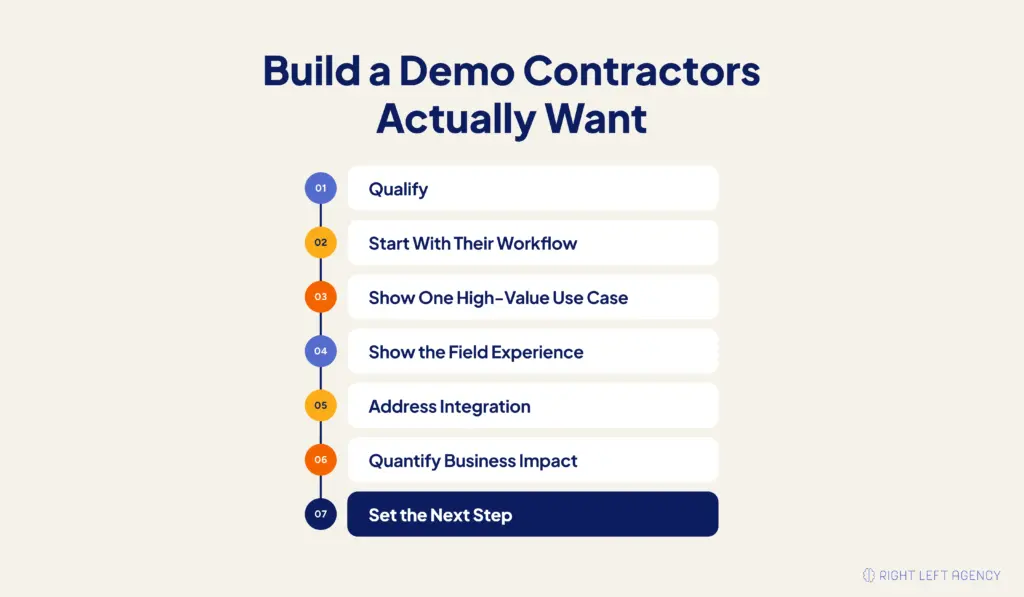
The demo is where the office/field split becomes visible.
The prospect is evaluating two questions:
- Does the software solve the business problem?
- Will the people doing the work actually use it?
A demo that answers only the first question leaves a major purchase risk unresolved.
Qualify Before the Demo
Before the call, establish:
- contractor segment
- project type
- company size
- current workflow
- current software
- primary pain point
- intended users
- other decision-makers
Without this context, the demo becomes a generic product tour.
Start With Their Existing Workflow
Begin with what the prospect already does. Then show where the product improves that workflow. This makes the software easier to understand because the buyer is comparing it against something familiar.
Demonstrate One High-Value Use Case First
Do not begin by showing every feature. Start with the problem that caused the prospect to book the demo. Prove that use case first. Additional capabilities can follow once the primary value is clear.
Show the Field Experience
If field adoption matters, show the field-facing product.
Demonstrate:
- mobile workflows
- required steps
- information access
- field documentation
- relevant offline or connectivity considerations where applicable
Do not assume the office dashboard proves usability for the crew.
Address Integration and Implementation
Buyers need to understand how the product fits into their existing environment.
Address:
- current software
- integrations
- migration
- implementation
- onboarding
- training
Avoid leaving these questions until after the prospect becomes interested.
Quantify the Business Impact
Connect the workflow shown in the demo to a measurable business outcome. The more clearly the buyer can connect the product to operational or financial value, the easier it becomes to evaluate the cost.
End With a Clear Next Step
Every demo should end with a specific action.
That might be:
- stakeholder demo
- technical review
- field-user session
- pilot
- implementation discussion
- proposal
Do not leave the prospect wondering what happens next.
Adapt the Demo to the Stakeholder
| Stakeholder | Demo Focus |
|---|---|
| Owner | Business performance and ROI |
| Operations Leader | Standardization and cross-project visibility |
| Project Manager | Workflow efficiency and time savings |
| Superintendent | Field usability and adoption |
| Finance | Cost and financial impact |
| IT | Integrations, security, and compatibility |
| Field User | Speed and ease of daily use |
What Proof Construction Software Buyers Need Before They Buy
Not all proof has equal strength.
A useful hierarchy is:
- Feature claim — the vendor says the product works
- Product screenshot — the buyer can see the capability
- Customer testimonial — someone else validates the experience
- Relevant case study — the product worked in a comparable situation
- Quantified result — the outcome is measurable
- Peer reference — another contractor directly validates the product
The more skeptical the market, the sooner stronger proof should appear.
Use the strongest evidence available across:
- landing pages
- ads
- sales collateral
- comparison content
- demos
- follow-up sequences
A relevant construction customer with a specific result usually provides more confidence than another generic product claim.
Common Construction SaaS Marketing Mistakes
Avoid these common problems:
- Marketing to construction companies instead of a defined contractor segment
- Treating company size and contractor type as the same segmentation model
- Leading with features instead of recognizable contractor problems
- Using generic SaaS terminology instead of jobsite language
- Optimizing for lead volume instead of qualified demos
- Ignoring field users during the buying process
- Treating adoption only as an implementation problem
- Using LinkedIn or paid search as the entire channel strategy
- Showing every feature during a demo
- Running the same demo for every stakeholder
- Hiding proof until late in the buyer journey
- Measuring traffic without measuring pipeline
- Ignoring objections such as “we already use spreadsheets,” “we’re too small,” or “changing systems will disrupt active projects”
Measure Construction SaaS Marketing by Pipeline, Not Traffic
Traffic tells you whether people are finding you. Pipeline tells you whether the right people are moving toward a purchase.
| Vanity Metric | Revenue-Oriented Metric |
|---|---|
| Impressions | Qualified demo requests |
| Website traffic | Demo show rate |
| Clicks | Marketing-qualified opportunity rate |
| Raw lead volume | Demo-to-opportunity rate |
| — | Opportunity-to-close rate |
| — | Customer acquisition cost |
| — | Pipeline generated by contractor segment |
The final metric is especially important.
If one contractor segment generates strong traffic but weak opportunities while another generates fewer visits and more revenue, the second segment may deserve more investment.
Measurement should help answer:
Which segment, message, channel, and demo motion produces qualified pipeline?
Build a Construction SaaS Marketing System That Works Beyond the Click
Contractors do not buy software the same way every B2B SaaS audience does. Winning the contract is only one part of the job. The product also has to survive the jobsite.
That is why effective construction SaaS marketing connects the entire buying journey:
Segment → Buyer → Pain → Message → Channel → Demo → Proof → Pipeline
When each part reinforces the next, marketing does more than generate traffic or leads. It helps attract the right contractor, build confidence across the buying committee, reduce field-adoption risk, and create qualified pipeline.
Ready to build a construction SaaS marketing program around a qualified pipeline?
Frequently Asked Questions
How do you market construction software to contractors?
Start by segmenting contractors by type, then map the buying committee inside that segment. Build separate messaging for office decision-makers and field users, choose channels based on buyer intent, and use demonstrations and proof to reduce both financial and adoption risk.
What marketing channels work best for construction SaaS?
There is no single best channel. SEO and paid search are effective for capturing office-side demand, while LinkedIn and ABM can reach business decision-makers. Trade associations, events, referrals, customer proof, and review platforms can strengthen trust throughout the buying process.
How should construction SaaS messaging differ from generic SaaS messaging?
Construction SaaS messaging should focus on real contractor workflows and outcomes rather than generic claims such as streamlining operations. It should also account for both the economic buyer evaluating ROI and the field user evaluating usability.
What do contractors care about when evaluating software?
It depends on the stakeholder. Owners focus on ROI, operations leaders on visibility and consistency, project managers on workflow efficiency, superintendents on adoption, finance on cost, IT on integration and security, and field users on speed and ease of use.
How do you get contractors to request software demos?
Match the message and channel to the buyer’s stage. Educational content can build problem awareness, while comparison pages, case studies, peer proof, high-intent search, and targeted outreach can move active buyers toward a demo.
What should a construction SaaS demo include?
A strong demo should include pre-demo qualification, a workflow-first walkthrough, one high-value use case, the field-facing experience, integration and implementation details, a clear business impact, and a defined next step.
How do you market to general contractors versus subcontractors?
General contractors often respond to messaging around coordination, visibility, and reduced project friction. Specialty contractors typically respond more strongly to productivity, administrative efficiency, and margin protection.
Who is the real buyer for construction SaaS — the office or the field?
Functionally, both. The office typically controls budget and approves the purchase. The field determines whether the software becomes part of daily operations. Successful construction SaaS marketing needs to win both sides.