

Key Takeaways
- SaaS SEO is built to attract qualified buyers, not just more visitors.
- Traditional SEO often focuses on rankings, traffic, leads, and direct sales.
- SaaS buyers need more education because their decisions take longer.
- SaaS keyword research should focus on intent, product fit, and revenue value.
- The best SaaS SEO strategy connects content, product value, pipeline, and growth.
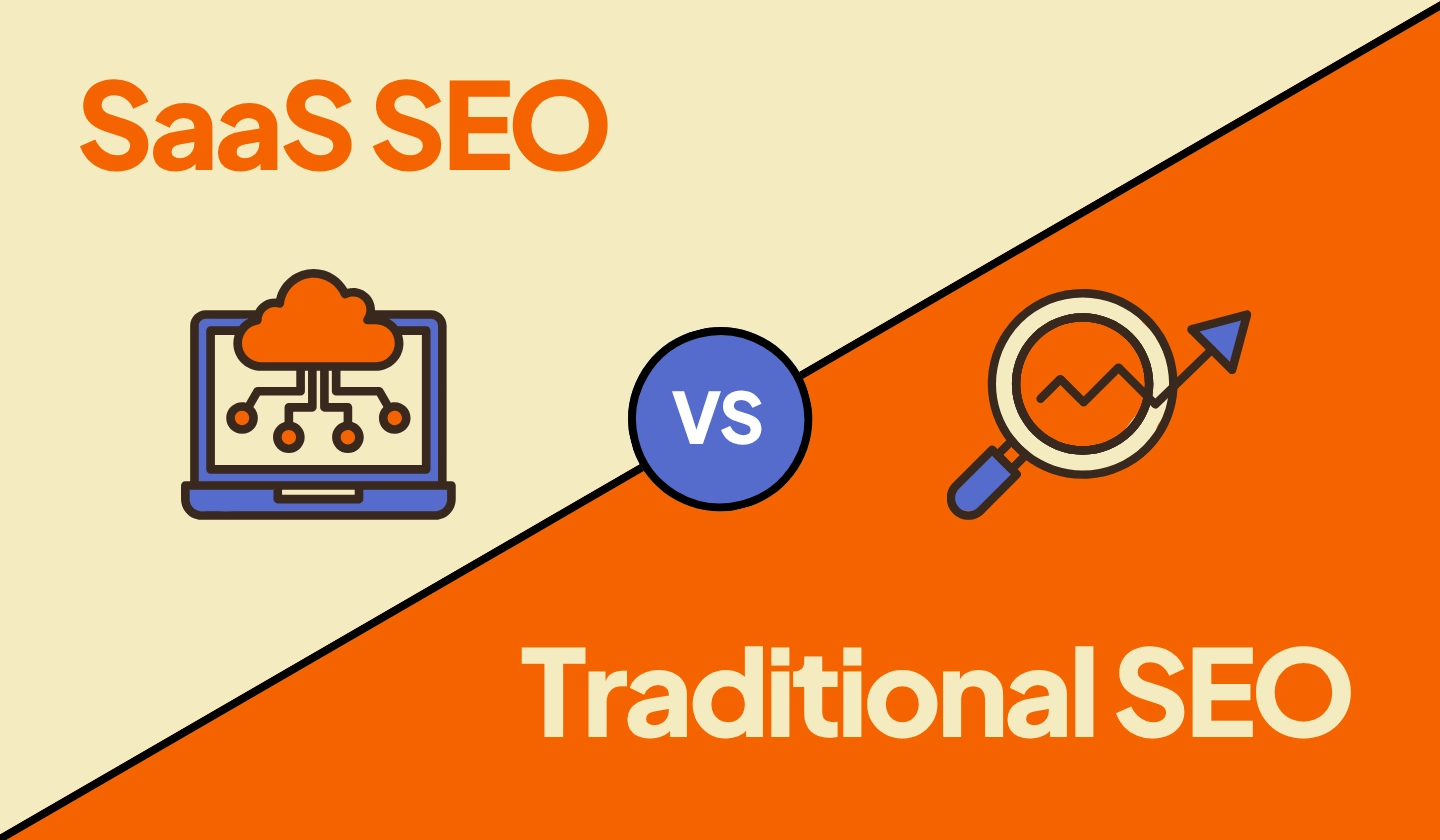
SaaS SEO and traditional SEO both help websites earn visibility in search. On the surface, they may look similar. Both involve keywords, content, technical SEO, links, and page optimization.
But the purpose behind each strategy is very different.
Traditional SEO often helps businesses get traffic, leads, calls, purchases, bookings, or service inquiries. SaaS SEO has a bigger job. It needs to attract the right software buyers, educate them, build trust, and move them toward demos, trials, product signups, pipeline, and recurring revenue.
That difference matters because SaaS buyers rarely make quick decisions.
They compare tools. They read reviews. They check pricing. They involve other team members. They review integrations, security, workflows, and ROI before moving forward.
So, SaaS SEO cannot work like a simple traffic campaign. More visitors do not always mean more revenue. A SaaS company can publish dozens of blog posts, grow organic traffic, and still fail to generate qualified pipeline.
The real goal is not just to rank. The goal is to help the right buyers understand why the product matters and why it fits their problem.
A strong SaaS SEO strategy connects search intent with product value. It helps organic content support buyer education, sales conversations, product adoption, and long-term customer acquisition.
What Is Traditional SEO?
Traditional SEO is the process of improving a website’s visibility in organic search results. It helps people find businesses, products, services, or information through search engines.
For example, a dentist may target “dentist near me.” An e-commerce store may target “best running shoes for beginners.” A consultant may target “business strategy consultant for startups.”
In these cases, the searcher usually understands the need. They may want to call, buy, book, request a quote, or compare a few options before making a decision.
Traditional SEO usually supports goals like:
- Improving rankings for important search terms
- Bringing more visitors to product or service pages
- Generating calls, bookings, purchases, or inquiries
- Improving local search visibility
- Building awareness through helpful blog content
- Increasing direct conversions from search visitors
This approach works well for many local businesses, ecommerce brands, service companies, publishers, and general websites.
But SaaS companies often need a more specialized SEO model. Their buyers usually need more education, more proof, and more confidence before they convert.
What Is SaaS SEO?
SaaS SEO is the process of using organic search to attract, educate, and convert software buyers.
It helps SaaS companies turn search demand into product signups, free trials, demo requests, sales-qualified leads, pipeline, and recurring revenue.
A SaaS buyer usually needs more than a basic landing page. They want to know how the product works, who it is for, what problems it solves, how it compares with alternatives, and whether it fits their existing workflow.
For example, a CRM platform may target keywords like “best CRM for startups,” “HubSpot alternatives,” or “CRM Slack integration.” These searches show clearer product interest than broad informational searches.
A strong SaaS SEO strategy supports:
- Product education
- Free trial signups
- Demo requests
- Product-qualified leads
- Marketing-qualified leads
- Sales-qualified leads
- Organic pipeline
- Customer acquisition
- Monthly recurring revenue
- Annual recurring revenue
- Revenue attribution
SaaS SEO is not just about getting visitors onto a website. It is about helping the right buyers understand the product, trust the company, and move closer to a buying decision.
That is why SEO for SaaS companies should always connect back to revenue, not just rankings.
SaaS SEO vs Traditional SEO: Quick Comparison
| Difference Area | Traditional SEO | SaaS SEO |
|---|---|---|
| Main Goal | Traffic, leads, calls, sales, or bookings | Demos, trials, signups, pipeline, and ARR |
| Revenue Model | Often transactional or service-based | Subscription-based and recurring |
| Buyer Journey | Usually shorter and more direct | Longer, educational, and multi-stage |
| Sales Cycle | Often fast or simple | Often longer and sales-assisted |
| Stakeholders | Usually one buyer or fewer decision-makers | Marketing, finance, operations, IT, and leadership |
| Keyword Focus | Broad, local, product, or service keywords | Problem, category, feature, comparison, and integration keywords |
| Content Role | Inform and convert | Educate, qualify, nurture, and convert |
| Content Strategy | Blogs, service pages, product pages, and local pages | Topic clusters, use cases, features, comparisons, and integrations |
| CTA Style | Call now, buy now, request quote, or book now | Start trial, book demo, view pricing, compare plans |
| Conversion Types | Calls, purchases, forms, bookings, or inquiries | Trials, demos, PQLs, SQLs, and product signups |
| Success Metrics | Rankings, traffic, leads, and sales | CAC, LTV, MRR, ARR, SQLs, and pipeline contribution |
| Attribution Approach | Often lead-based or session-based | CRM, RevOps, pipeline, and revenue attribution |
| AI Search Readiness | Broad answer optimization | GEO, entity optimization, product context, and comparison clarity |
| Best Fit | Local, ecommerce, service, and publisher websites | B2B SaaS, PLG SaaS, and subscription software companies |
This comparison shows why SaaS SEO needs a different strategy. The foundation may be similar, but the execution must match how software buyers research, compare, and purchase products.
Key Differences Between SaaS SEO and Traditional SEO
1. The Business Goals Are Different
Traditional SEO often supports direct actions like calls, bookings, purchases, or quote requests. SaaS SEO supports subscription growth and long-term customer acquisition.
That means traffic volume is not enough. Lead quality matters more.
A broad keyword may bring thousands of visitors, but if those visitors do not match the target buyer, the traffic will not create meaningful revenue. A niche keyword may bring fewer visitors, but those visitors may be much closer to booking a demo or starting a trial.
For SaaS companies, the better question is not, “How much traffic did SEO bring?”
The better question is, “How much qualified pipeline did SEO influence?”
That is why SaaS teams should measure demos, trials, PQLs, SQLs, pipeline contribution, CAC, LTV, MRR, ARR, and revenue attribution.
The goal is simple: SEO should help the company acquire better customers more efficiently.
2. SaaS Buyer Journeys Are Longer
SaaS buyers rarely convert after one website visit. They research the problem, compare products, check pricing, review integrations, involve stakeholders, and look for proof.
A marketing manager may care about reporting, automation, and campaign performance. A finance leader may care about ROI, contract value, and payback period. An operations leader may care about workflow efficiency and adoption. An IT or security stakeholder may care about data protection, integrations, and implementation effort.
SaaS SEO needs to support all these questions across the full funnel.
| Funnel Stage | Buyer Search Example | Best Content Type |
|---|---|---|
| Awareness | How to reduce customer churn | Educational blog post |
| Consideration | Customer retention software | Category or solution page |
| Decision | Best churn prediction software | Comparison or alternatives page |
| Conversion | Book customer success software demo | Demo, pricing, or product page |
For example, a churn-reduction SaaS can build content around the full journey. At the awareness stage, it can target “how to reduce customer churn.” At the consideration stage, it can target “customer retention software.” At the decision stage, it can target “best churn prediction software” or competitor alternatives.
Each page should help the buyer move one step closer to the product.
3. SaaS SEO Must Capture and Create Demand
Traditional SEO often focuses on demand capture. It targets people who already know what they want and are actively searching for it.
SaaS SEO needs to do more. It should capture existing demand and help create demand.
Demand capture targets people already searching for a product category. For example, “best onboarding software” shows that the buyer already understands the category.
Demand generation targets people who feel the problem but may not know the solution yet. For example, “why users abandon onboarding” can educate readers before they ever search for onboarding software.
This is especially important for newer SaaS categories. If buyers do not know the product category yet, they will search for symptoms, workflow problems, or business pain points instead.
SaaS SEO should help create category demand while also capturing buyers who are ready to compare solutions.
4. Keyword Strategy Depends on Search Intent
Traditional SEO often prioritizes search volume, relevance, and ranking difficulty. SaaS SEO must also consider product fit, funnel stage, and revenue potential.
A keyword with low search volume can still be valuable if it attracts the right buyer.
For example, “SOC 2 compliance software for startups” may not have a massive search volume, but someone searching that phrase likely has a real business need and stronger buying intent.
A good SaaS keyword strategy should include several keyword types.
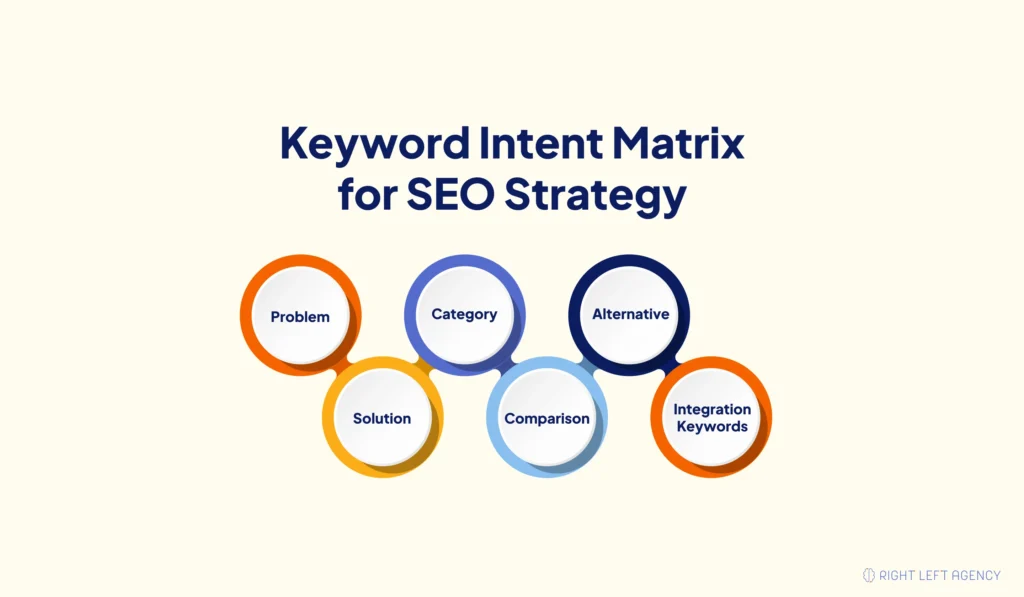
| Keyword Type | Example | Purpose |
|---|---|---|
| Problem-Aware | How to reduce customer churn | Educates early-stage buyers |
| Jobs-to-Be-Done | How to automate customer onboarding | Matches a specific business task |
| Solution-Aware | Customer retention software | Introduces a software category |
| Product Category | Best onboarding software | Captures active category demand |
| Feature-Based | Automated churn prediction tool | Matches specific product needs |
| Industry-Specific | CRM for construction companies | Targets niche SaaS buyers |
| Competitor Comparison | Tool A vs Tool B | Captures decision-stage buyers |
| Alternative | Best alternatives to HubSpot | Attracts competitor-aware prospects |
| Integration | CRM integration with Slack | Captures workflow-specific demand |
| Role-Based | Reporting software for RevOps teams | Matches stakeholder priorities |
This framework helps SaaS teams avoid vanity traffic. Instead of chasing every high-volume keyword, they can prioritize topics that connect with product value and revenue potential.
5. SaaS Content Must Educate Before It Converts
Many SaaS products solve complex problems through specific workflows. Buyers need context before they understand why the product matters.
That is why SaaS content cannot only explain a topic. It needs to connect the problem with the product, show practical use cases, and help readers understand the business value.
Traditional SEO content may convert with a simple offer. SaaS content usually needs more education, proof, and product clarity.
Useful SaaS content types include:
- Product-led blog posts that show real workflows
- Use-case pages that connect problems with outcomes
- Feature pages that explain business value
- Integration pages that capture workflow-specific demand
- Comparison pages that help buyers evaluate vendors
- Alternative pages that attract competitor-aware prospects
- Case studies that prove results with real examples
- Templates that support demand generation and lead capture
- ROI calculators that support finance-led decisions
- Product tutorials that reduce friction before trials or demos
For example, a project management SaaS can write about approval bottlenecks, but the article should not stop at explaining the problem. It should show how automated workflows reduce delays, improve accountability, and help teams deliver work faster.
That is product-led content. It educates the reader while making the product value easier to understand.
6. Product-Led Growth Changes SEO Priorities
Product-led growth, or PLG, uses the product as the main growth engine. In a PLG model, users often try the product before speaking with sales.
That changes how SEO should work.
PLG-focused SEO should not only bring visitors to blog posts. It should help users reach product value faster through templates, tutorials, use-case pages, product workflows, and onboarding content.
For example, an analytics SaaS may target an “executive dashboard template.” The page can explain what executives need from a dashboard, then offer a product-based template that helps users experience the value directly.
This connects SEO with product activation, not just awareness.
For PLG companies, SaaS SEO should support the full path from search to signup, activation, and expansion.
7. Conversion Paths Are Different
Traditional SEO conversions often include calls, quote requests, purchases, bookings, or form submissions. SaaS SEO conversions usually include free trials, demos, product signups, pricing page visits, and product tours.
The CTA should match the reader’s stage in the journey.
Top-funnel readers may not be ready for a demo. They may need a guide, checklist, template, or calculator.
Middle-funnel readers may want a webinar, comparison guide, or product tour.
Bottom-funnel readers may be ready for pricing, a demo, or a free trial.
Useful SaaS CTA examples include:
- Start a free trial
- Book a product demo
- View pricing
- Compare plans
- Try the product
- Download a template
- Calculate ROI
- See customer results
If organic traffic is not creating demos or trials, the issue may not be traffic volume. The issue may be intent, content quality, CTA alignment, or weak internal linking.
A strong SaaS SEO strategy connects the content journey with the conversion journey.
8. SaaS SEO Metrics Focus on Revenue
Traditional SEO teams often track rankings, traffic, impressions, and leads. SaaS teams should track those metrics too, but they are not enough.
SaaS SEO should connect organic search with revenue outcomes.
Important SaaS SEO metrics include:
- Organic traffic
- Keyword rankings
- Demo requests
- Free trial signups
- Product-qualified leads
- Marketing-qualified leads
- Sales-qualified leads
- Organic conversion rate
- Customer acquisition cost
- CAC payback period
- Customer lifetime value
- Monthly recurring revenue
- Annual recurring revenue
- Pipeline contribution
- Revenue attribution
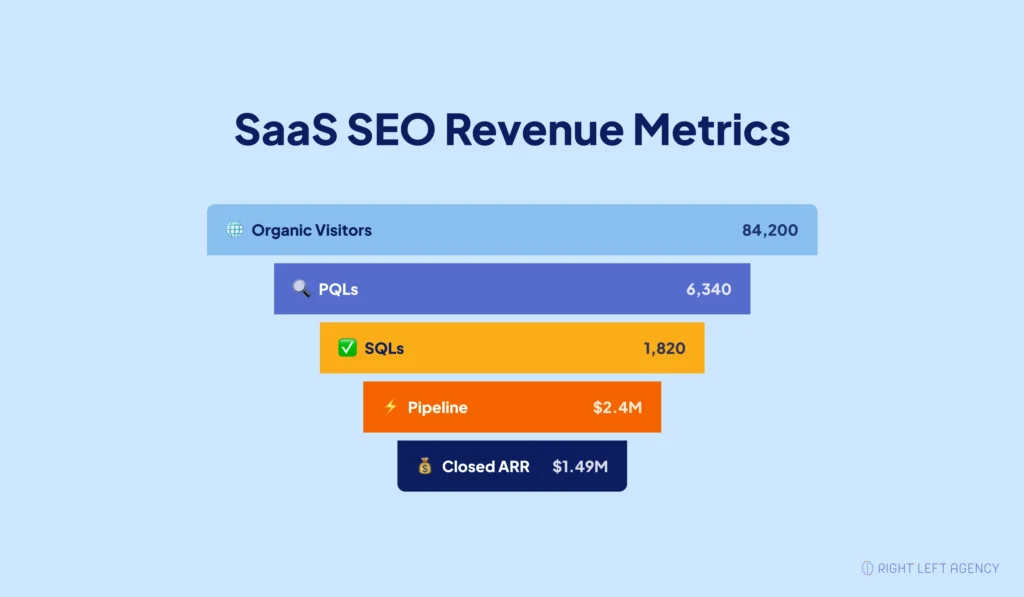
For example, one blog post may bring 10,000 monthly visits. Another page may bring only 300 visits but generate five qualified demo requests.
The second page may create more business value because it attracts visitors with stronger buying intent.
That is why SaaS SEO should be measured by business impact, not traffic alone.
Why Traditional SEO Tactics Often Fail for SaaS Companies
Traditional SEO tactics often fail for SaaS companies when they ignore how software buyers actually make decisions.
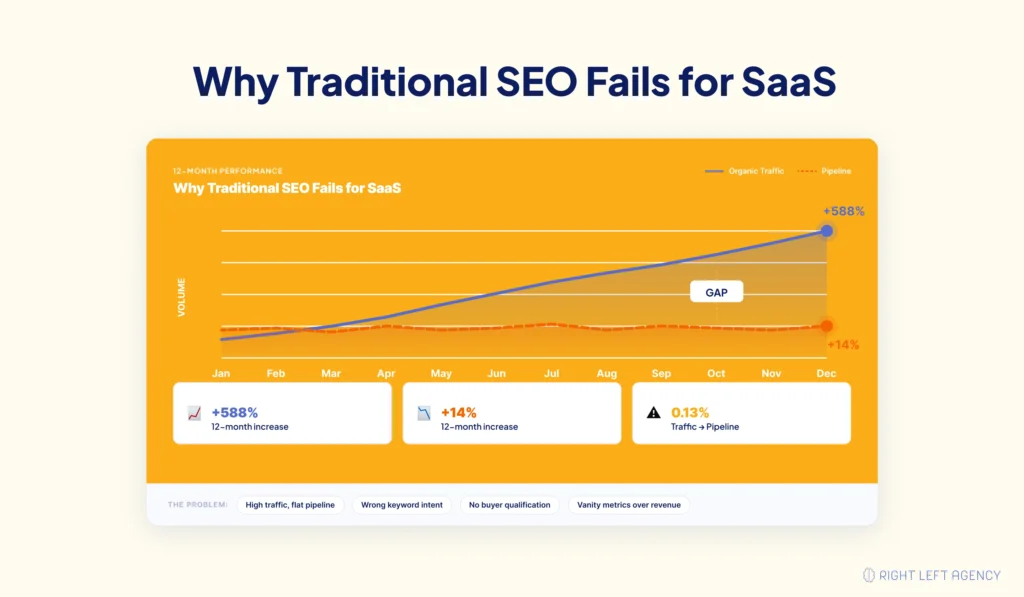
Generic traffic does not always create product interest. Broad content does not always support sales. Rankings do not always translate into pipeline.
SaaS companies need SEO that connects product relevance, buyer intent, and revenue outcomes.
Overreliance on High-Volume Keywords
Many SaaS teams chase high-volume keywords because the numbers look attractive, but high-volume traffic often lacks urgency, product fit, or buying intent.
A broad blog post may bring visitors from outside the target market. Those visitors may read and leave without ever considering the product.
A better SaaS SEO strategy prioritizes commercial relevance. Teams should ask whether each keyword can support product understanding, sales conversations, or future revenue.
Lack of Product Relevance
Generic blog content often explains a topic but never connects it to the product. That may satisfy a basic search, but it does not help buyers understand why the software matters.
For example, an HR SaaS should not only write about hiring challenges. It should show how its workflows reduce delays, improve approvals, and support better hiring decisions.
Product relevance helps turn education into evaluation.
Missing Bottom-Funnel Content
Many SaaS websites publish educational blogs but ignore bottom-funnel content. That leaves high-intent buyers searching elsewhere when they are ready to compare vendors.
Comparison pages, alternative pages, pricing pages, use-case pages, and integration pages are essential for SaaS SEO.
These pages often influence demo requests, sales conversations, and buying decisions directly.
Weak Alignment With Sales Teams
SEO teams often work separately from sales teams. That creates content gaps around objections, competitor questions, pricing concerns, and implementation fears.
Sales teams hear real buyer questions every week. SEO teams should use those insights to shape content topics, comparison pages, FAQs, and bottom-funnel assets.
For example, if prospects often worry about migration, the SEO team can create content around onboarding, implementation, integrations, and switching from competitors.
That content reduces friction before the sales call.
Failure to Connect SEO With Revenue
A SaaS SEO program becomes weak when reporting stops at rankings and traffic. Leadership needs to know which pages create qualified leads, pipeline, and revenue.
RevOps can help connect organic landing pages with CRM data. This makes it easier to understand which articles, product pages, and comparison pages influence opportunities and closed deals.
| Mistake | Why It Hurts | Better Fix |
|---|---|---|
| Targeting only high-volume keywords | Traffic may lack product fit | Prioritize intent and revenue value |
| Publishing generic blog content | Readers never understand the product | Add use cases and workflows |
| Ignoring comparison keywords | Buyers choose competitors elsewhere | Create honest comparison pages |
| Avoiding alternative pages | Competitor-aware buyers go unanswered | Build helpful alternative content |
| Missing sales alignment | Content ignores real buyer objections | Use sales calls for content insights |
| Measuring traffic only | Teams miss revenue impact | Track demos, SQLs, and pipeline |
| Ignoring internal links | Readers miss conversion pages | Link blogs to product pages |
A SaaS SEO audit can reveal these gaps quickly. It should review keyword intent, content quality, bottom-funnel coverage, internal links, conversion paths, and revenue attribution.
Unique Challenges in SaaS SEO
Long and Complex Buying Cycles
SaaS buying cycles often take weeks or months. Buyers compare tools, involve stakeholders, review pricing, calculate ROI, and seek internal approval.
This makes attribution harder. A buyer may read an awareness article today but convert months later after several more touchpoints.
SaaS SEO should support this journey with content for every stage, not just one blog post or one landing page.
Low Search Volume but High Commercial Intent
Many valuable SaaS keywords have low search volume. That does not mean they are not worth targeting.
A keyword like “customer onboarding software for fintech startups” may look narrow, but it can attract buyers with specific needs, budget, and urgency.
SaaS SEO should prioritize profitable intent over vanity visibility.
Competing With Software Review Sites
SaaS companies often compete with G2, Capterra, Gartner, and other review platforms. These sites frequently rank for category, comparison, and “best software” keywords.
That can make it harder for SaaS brands to control the buyer journey.
To compete, SaaS companies need strong category pages, comparison pages, alternative pages, review-style content, and use-case pages. They should explain who the product fits, how it works, and what outcomes it supports.
Educating Buyers in New Software Categories
Some SaaS products create or serve categories that buyers do not fully understand yet. In these cases, search volume may not show the full market opportunity.
Buyers may search for symptoms before they search for a product category.
For example, they may search “manual reporting takes too long” before they search for a specific analytics platform. Content should name the problem, explain the cost of inaction, and introduce the software category naturally.
This helps build category demand over time.
Long Attribution Windows
SaaS attribution is rarely simple. A buyer may first discover a brand through a blog post, return through a comparison page, attend a webinar, and later book a demo.
Last-click reporting does not show the full impact of SEO.
That is why SaaS companies should use CRM and RevOps reporting to understand first-touch, assisted-touch, and conversion-touch influence.
Technical Products Need Clear Education
Technical SaaS products can confuse buyers if the content is too abstract or feature-heavy. Buyers need to understand how the product solves real workflow problems.
Feature pages should explain benefits before technical capabilities. Blog posts should use practical examples. Use-case pages should show how different teams use the product.
Clear content makes complex software easier to trust.
Multiple Decision-Makers Influence the Sale
B2B SaaS purchases often involve several stakeholders. Each stakeholder has different questions.
Marketing may care about campaign performance. Finance may care about ROI. Operations may care about workflow efficiency. IT may care about security and integrations.
SaaS SEO should create content that answers each stakeholder’s concerns before the sales conversation starts.
How to Build a Better SaaS SEO Strategy
A better SaaS SEO strategy starts with customer understanding and revenue goals. You need to know who buys, what they care about, and how they make decisions.
Use this framework to build a stronger SaaS SEO program.
1. Define Your ICP First
Start with your ideal customer profile before choosing keywords.
Define the target industry, company size, buyer roles, pain points, use cases, objections, budget triggers, and decision criteria.
This prevents your team from chasing irrelevant traffic and helps content attract buyers with stronger product fit.
2. Map Keywords by Funnel Stage
Group keywords by awareness, consideration, decision, and conversion intent.
Awareness keywords should educate readers. Consideration keywords should compare solutions. Decision keywords should help buyers evaluate vendors. Conversion keywords should move readers toward demos, trials, pricing, or signups.
This creates a natural path from problem awareness to product evaluation.
3. Run Intent-Based Keyword Research
SaaS keyword research should prioritize intent over volume.
Every keyword should connect with a buyer problem, product capability, use case, or commercial opportunity.
A simple scoring system can help. Score each keyword by intent, ICP fit, product fit, and revenue potential. Then prioritize topics that support the pipeline, not just traffic.
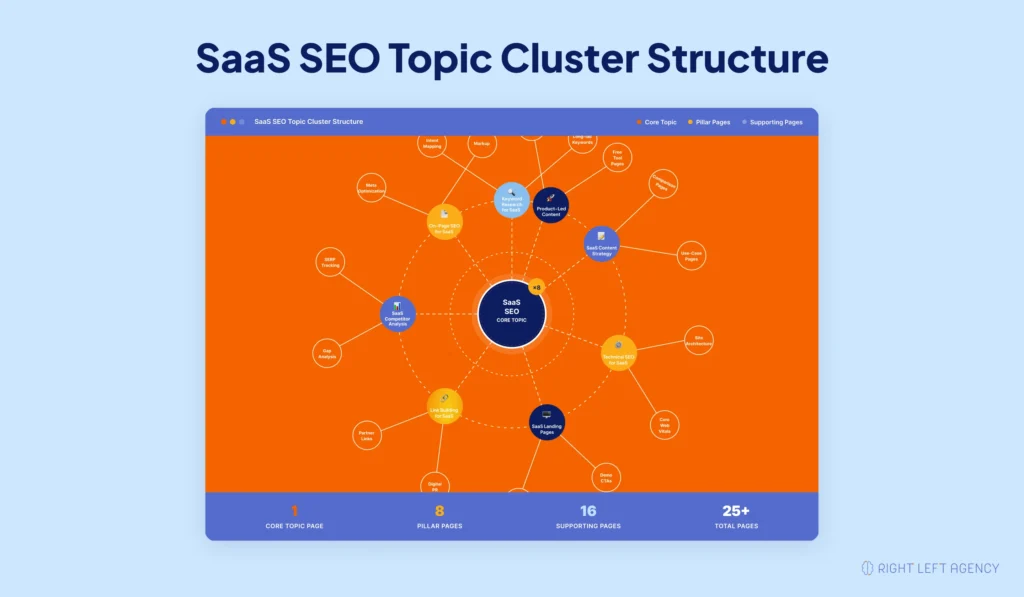
4. Build SaaS Topic Clusters
SaaS topic clusters help build topical authority around product use cases and buyer problems.
A strong topic cluster includes educational blogs, use-case pages, feature pages, integration pages, comparison pages, and bottom-funnel pages.
For example, a customer success platform can build a churn cluster. The cluster may include churn prevention, customer health scores, renewal workflows, customer success software, and competitor comparisons.
Together, these pages support education, authority, and conversion.
5. Use Product-Led Content
Product-led content connects real problems with product workflows.
It does not force product mentions into every paragraph. Instead, it shows how the software helps users complete important tasks.
For example, an expense management SaaS can explain approval delays. Then it can show how automated routing reduces finance bottlenecks and improves control.
This makes the product easier to understand without turning the article into a sales pitch.
6. Create Bottom-Funnel SaaS Pages
Bottom-funnel pages serve buyers who already understand their needs.
Important BOFU pages include:
- Comparison pages for buyers choosing between vendors
- Alternative pages for competitor-aware prospects
- Integration pages for workflow-specific needs
- Pricing pages for budget and packaging questions
- Use-case pages for specific business problems
- Industry pages for niche buyer contexts
These pages often convert better than broad informational blogs because the searcher is closer to action.
7. Use Programmatic SEO Carefully
Programmatic SEO can help SaaS companies scale structured landing pages. It works best for integration pages, templates, glossaries, comparison pages, and use-case variations.
However, programmatic SEO should never create thin or repetitive pages.
Each page should answer a real search need, include useful context, show product relevance, and guide users toward the next step.
8. Strengthen Internal Linking
Internal links help readers move from education to evaluation.
Link educational blogs to relevant features, use cases, comparisons, integrations, pricing, and demos. Link bottom-funnel pages to case studies, product pages, and conversion pages.
Strong internal linking improves user experience and helps search engines understand topical relationships.
Suggested internal link anchors include:
- SaaS SEO services
- B2B SaaS marketing services
- SaaS content strategy guide
- Technical SEO service
- SEO audit service
- SaaS lead generation
- Product-led growth
- SaaS case studies
9. Measure Revenue Impact
Track meaningful conversions beyond rankings and organic sessions.
Measure demos, trials, PQLs, MQLs, SQLs, pipeline, revenue, CAC, LTV, MRR, ARR, and attribution.
A page may influence a buyer months before conversion. That influence still matters. Strong SaaS SEO programs connect SEO, RevOps, sales, and leadership reporting.
AI Search Optimization for SaaS SEO
AI search is changing how software buyers discover and compare solutions. Google AI Overviews, ChatGPT Search, and other answer engines can summarize products, categories, and alternatives before users visit a website.
That means SaaS brands need content that is easy for both people and AI systems to understand.
Generative Engine Optimization, or GEO, focuses on clear answers, strong entity coverage, structured content, and helpful context. For SaaS companies, this means explaining the product category, use cases, integrations, pricing factors, alternatives, and ideal customers clearly.
For example, an HR SaaS page should define the category, explain who uses the product, describe the problems it solves, and compare the product with spreadsheets, manual workflows, or competing tools.
SaaS teams can improve AI search visibility by adding:
- Clear product-category definitions
- “Best for” and “not best for” sections
- Comparison tables
- Role-based use cases
- Integration explanations
- Pricing context
- FAQs with direct answers
- Structured data where relevant
- Entity-rich content around PLG, RevOps, ARR, SQLs, CAC, and LTV
AI search optimization should still start with human value. If readers can understand the content clearly, search engines and AI systems can understand it better too.
When Should a SaaS Company Use SaaS SEO?
A SaaS company should use SaaS SEO when the product needs education before conversion.
It is especially useful when buyers compare multiple software options, involve different stakeholders, or need proof before booking a demo or starting a trial.
Use SaaS SEO when:
- Your product needs education before conversion
- Buyers compare competitors before booking demos
- Organic traffic does not convert into pipelines
- Your sales cycle is long or complex
- Your company sells subscription-based software
- Demos, trials, or signups drive growth
- Multiple stakeholders influence the buying decision
- Generic blog traffic produces weak opportunities
SaaS SEO also helps companies that are building new categories. Educational content can create demand around the problem, while bottom-funnel content captures buyers when they become ready to compare solutions.
Final Thoughts
Traditional SEO is a useful foundation for visibility, crawlability, content structure, and organic growth. But SaaS companies need more than a standard SEO playbook.
They need SEO that understands software buyers, longer sales cycles, product education, stakeholder concerns, and recurring revenue.
The strongest SaaS SEO strategy combines education, demand capture, product-led content, bottom-funnel pages, AI search readiness, and revenue measurement.
For SaaS companies, SEO should not only create visibility. It should educate buyers, build trust, support sales conversations, create qualified pipelines, and contribute to recurring revenue growth.
That is the real difference between SaaS SEO and traditional SEO.
Book a growth session to better understand how a SaaS SEO strategy can benefit your business.
FAQs
What is the main difference between SaaS SEO and traditional SEO?
SaaS SEO targets software buyers across longer and more complex buying journeys. Traditional SEO usually supports broader goals like traffic, visibility, leads, or direct sales. The biggest difference appears in keywords, content, conversions, and revenue metrics.
Is SaaS SEO only for B2B SaaS companies?
SaaS SEO works especially well for B2B SaaS companies, but B2C SaaS and product-led companies can use it too. Any subscription software business can benefit from better organic visibility and stronger buyer education.
Why does SaaS SEO take longer?
SaaS SEO takes longer because buyers need education, trust, proof, and internal approval. They often compare tools, review pricing, check integrations, and involve several stakeholders before converting.
What keywords should SaaS companies target?
SaaS companies should target problem-aware, solution-aware, product category, feature, comparison, alternative, integration, industry-specific, and Jobs-to-Be-Done keywords. These terms often attract buyers with stronger commercial intent.
How do you measure SaaS SEO success?
Measure SaaS SEO through organic traffic, rankings, demos, trials, PQLs, MQLs, SQLs, CAC, LTV, MRR, ARR, pipeline contribution, and revenue attribution. These metrics show whether SEO creates real business value.
Can traditional SEO work for SaaS companies?
Traditional SEO can support SaaS visibility and technical performance. However, SaaS companies need a deeper strategy around buyer education, product value, long sales cycles, and recurring revenue outcomes.
What content works best for SaaS SEO?
The best SaaS content includes use-case pages, feature pages, comparison pages, alternative pages, integration pages, case studies, templates, product tutorials, and product-led educational articles.
How long does SaaS SEO take to show results?
SaaS SEO usually takes several months to show meaningful results. Timelines depend on competition, authority, content quality, technical performance, keyword intent, and conversion tracking.
What is Product-Led Growth in SaaS SEO?
Product-Led Growth (PLG) uses the product as the main growth engine. In SaaS SEO, PLG content shows product value before users convert through templates, tutorials, workflows, use cases, and signup-focused content.
Why does revenue attribution matter in SaaS SEO?
Revenue attribution helps teams understand which SEO pages influence pipeline and closed revenue. It connects organic search with CRM data, sales opportunities, and business outcomes.