

Key Takeaways
- Inbound marketing for SaaS helps software companies reduce dependency on paid acquisition by using SEO, content, lead nurturing, and conversion-focused assets to attract better-fit buyers.
- SaaS inbound marketing is not just blogging. It connects content, product education, sales enablement, email marketing, and customer retention.
- The best SaaS inbound strategy covers the full funnel: awareness, consideration, decision, and retention.
- SaaS companies should measure inbound marketing by pipeline, demo requests, free-trial signups, SQLs, CAC, LTV, and revenue influence, not by traffic alone.
- Inbound works best when it is built around a clear ICP, strong positioning, buyer pain points, and high-intent search behavior.
A SaaS founder launches a great product, turns on paid ads, sends cold emails, and expects demos to follow. But after a few months, the cost per lead keeps rising, the sales team is chasing low-fit prospects, and the pipeline still depends on how much money goes into campaigns that week.
That is where inbound marketing for SaaS becomes more than another marketing tactic. Inbound marketing for SaaS is a growth strategy that uses SEO, educational content, lead nurturing, email marketing, and conversion-focused pages to attract qualified software buyers. Instead of relying only on ads or outbound sales, SaaS companies use inbound to educate prospects, build trust, and convert visitors into demo requests, free trial signups, customers, and long-term users.
For SaaS companies, this matters because buyers rarely convert after one touchpoint. They research problems, compare solutions, read reviews, consult internal stakeholders, evaluate pricing, and seek evidence before committing. A strong inbound marketing strategy supports that entire journey.
What Is Inbound Marketing for SaaS?
Inbound marketing for SaaS is the process of attracting potential customers through useful, relevant, and search-friendly content instead of interrupting them with cold outreach or purely paid promotion.
In simple terms, it helps your ideal customers discover your product while they are already searching for answers.
For example, a project management SaaS company might create content around topics like “how to manage remote teams,” “best project tracking tools,” “project management software comparison,” and “how to improve team productivity.” Each piece of content helps buyers move closer to understanding their problem and considering the product as a solution.
SaaS inbound marketing usually includes:
- SEO-driven blog content
- Pillar pages and topic clusters
- Use-case and industry landing pages
- Comparison and alternative pages
- Lead magnets
- Email nurturing
- Webinars
- Case studies
- Product education content
- Conversion-focused CTAs
What makes SaaS inbound marketing different from general inbound marketing is the business model. Traditional inbound marketing often focuses on generating leads. SaaS inbound marketing has to go further. It needs to support product education, free trial activation, demo conversion, onboarding, retention, and expansion because revenue continues after the first signup.
That is why SaaS inbound marketing should never stop at “publish more blog posts.” It should connect the full buyer journey with the full customer lifecycle.
Why Inbound Marketing Matters for SaaS Companies
SaaS growth is difficult when every new lead depends on paid ads, cold outreach, or referrals. Those channels can work, but they can also become expensive, inconsistent, and hard to scale. Inbound marketing gives SaaS companies a way to build long-term demand.
For example, a paid campaign may generate leads this month, but once the budget stops, the lead flow stops. A well-built inbound asset, such as a comparison page or product category guide, can continue bringing in qualified visitors long after publication.
When done correctly, inbound helps SaaS companies:
- Attract qualified organic traffic from people already searching for relevant problems and solutions.
- Educate buyers before sales calls so prospects understand the problem, the category, and the value of the product.
- Reduce dependency on paid acquisition by building evergreen content assets that can drive traffic over time.
- Support long B2B buying cycles where multiple stakeholders need information before making a decision.
- Improve lead quality by matching content to buyer pain points and funnel stages.
- Build trust before conversion with useful guides, case studies, webinars, and customer proof.
- Support retention through onboarding content, product education, help resources, and customer success materials.
For SaaS companies, inbound marketing also connects directly to key growth metrics. A strong content and SEO system can help reduce customer acquisition cost over time, improve lead-to-demo conversion rates, increase product-qualified leads, and support expansion by educating existing users.
The biggest mistake SaaS teams make is treating inbound as a traffic channel only. Traffic matters, but traffic alone does not grow a SaaS business. The real goal is to attract the right people, answer the right questions, and move buyers toward revenue-generating actions like demo requests, free trial signups, product activations, and paid conversions.
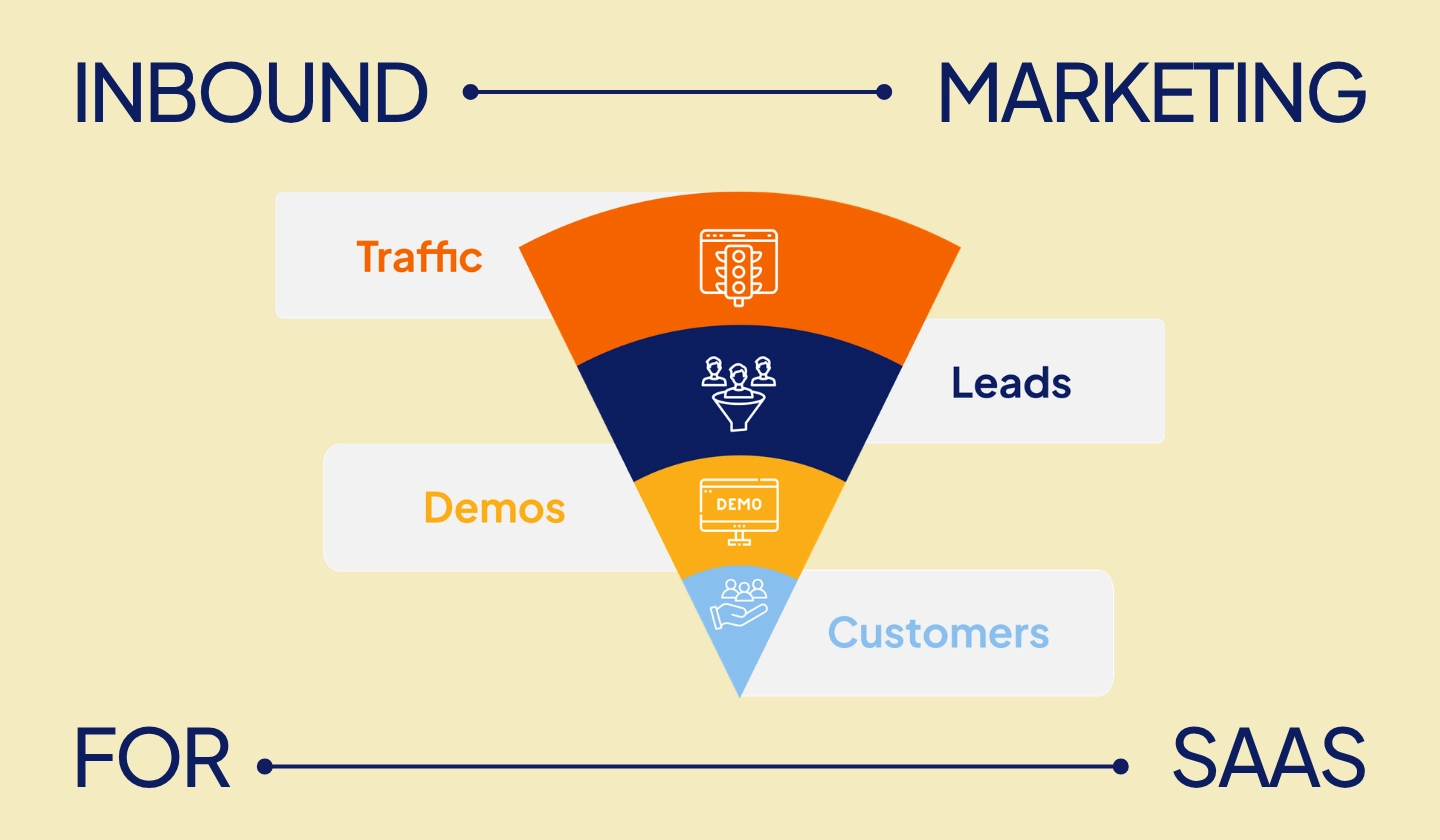
How the SaaS Inbound Marketing Funnel Works
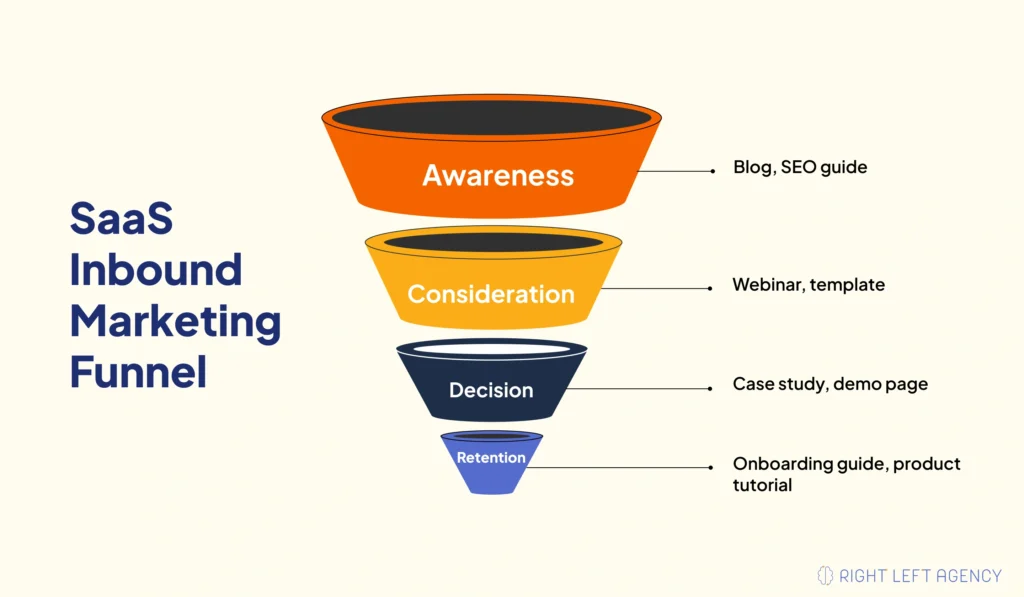
Inbound marketing for SaaS works best when it supports every stage of the funnel.
A first-time visitor reading a basic educational blog post is not in the same mindset as someone searching for “best CRM software for startups” or “HubSpot alternative.” Each buyer needs different content based on their awareness level and intent.
You can also think of these stages as TOFU, MOFU, BOFU, and post-purchase content: TOFU attracts problem-aware buyers, MOFU educates solution-aware buyers, BOFU converts product-aware buyers, and retention content helps customers adopt and expand.
Here is how the SaaS marketing funnel usually works:
| Funnel Stage | User Intent | Content Type | Goal |
|---|---|---|---|
| Awareness | The buyer has a problem, but may not know the solution yet | Educational blogs, how-to guides, thought leadership content, industry trend articles | Attract relevant traffic and build trust |
| Consideration | The buyer understands the problem and is comparing possible solutions | Webinars, templates, solution guides, use-case pages, category pages | Capture leads and educate prospects |
| Decision | The buyer is evaluating vendors or is ready to speak with sales | Case studies, comparison pages, pricing pages, demo pages, testimonials | Convert visitors into demos, trials, or sales opportunities |
| Retention | The buyer is now a customer and wants more value from the product | Onboarding guides, help center content, product tutorials, customer success emails | Improve activation, adoption, retention, and expansion |
The most effective SaaS inbound strategies do not focus only on top-of-funnel education. They also create bottom-of-funnel content that captures buyers who are closer to making a decision.
For example, a SaaS company might need educational content like “how to manage customer support tickets,” but it also needs high-intent content like “best help desk software for SaaS companies,” “Zendesk alternatives,” and “customer support software pricing.”
That mix is what turns inbound from a blog strategy into a revenue strategy.
Best Inbound Marketing Strategies for SaaS
There is no single tactic that makes inbound marketing work for SaaS. The best results come from combining SEO, content strategy, lead capture, nurturing, conversion optimization, and sales alignment.
Here are the most important strategies to include.
Build an SEO-Led Content Strategy
SEO is one of the strongest foundations of SaaS inbound marketing because it helps you reach buyers when they are actively looking for answers.
But SaaS SEO should not be limited to broad informational keywords. A strong SaaS SEO strategy maps keywords across the funnel.
That means targeting:
- Problem-aware keywords
- Solution-aware keywords
- Product category keywords
- Comparison keywords
- Alternative keywords
- Integration keywords
- Use-case keywords
- Pricing and buying-intent keywords
For example, a sales automation SaaS company should not only target “how to improve sales productivity.” It should also create content around “best sales automation tools,” “sales automation software for small businesses,” and “sales automation CRM integration.”
This helps the company capture both early-stage researchers and high-intent buyers.
Create Topic Clusters Around Core SaaS Problems
Topic clusters help SaaS companies build topical authority.
Instead of publishing random blog posts, build content around the main problems your product solves. Each cluster should include one pillar page and several supporting articles that go deeper into related questions.
For example, a customer onboarding SaaS could create topic clusters around:
- User onboarding
- Product adoption
- Customer retention
- Feature activation
- Customer success automation
Each cluster should internally link related articles together so users and search engines can clearly understand the connection between topics.
This creates a tightly knit content architecture, signaling deep topic authority to search engines while smoothing the educational path for potential buyers.
Use BOFU Content to Capture High-Intent Leads
Many SaaS companies publish too much top-of-funnel content and not enough bottom-of-funnel content.
Top-of-funnel content is useful for awareness, but bottom-of-funnel content is where buyers are closer to making a decision.
BOFU SaaS content includes:
- Alternative pages
- Comparison pages
- Use-case pages
- Industry-specific landing pages
- Pricing-related content
- Case studies
- Demo pages
- “Best software for” articles
For example, someone searching “best accounting software for SaaS startups” likely has much stronger buying intent than someone searching “what is accounting automation.”
Both keywords can matter, but the second one educates while the first one may convert faster.
A balanced inbound strategy needs both.
Offer Lead Magnets and Webinars
Not every visitor is ready to book a demo. Some need more education before speaking with sales.
Lead magnets help convert those visitors into contacts your team can nurture.
Useful SaaS lead magnets include:
- Templates
- Checklists
- Benchmark reports
- ROI calculators
- Comparison worksheets
- Playbooks
- Product evaluation guides
- Webinars
For example, a SaaS company selling marketing analytics software could offer a “SaaS Marketing Attribution Checklist” or a “Pipeline Reporting Template.”
The goal is not just to collect emails. The goal is to offer something genuinely useful that matches the buyer’s problem and stage in the funnel.
Nurture Leads With Email and Marketing Automation
Most SaaS buyers will not convert immediately after reading one article or downloading one resource.
This is where targeted lead nurturing steps in. Automated email workflows keep your brand top-of-mind while delivering contextual value that guides prospects toward a buying decision.
A SaaS lead nurturing sequence might include:
- A helpful guide related to their pain point
- A case study from a similar company
- A product use case
- A comparison resource
- A webinar invite
- A soft CTA to book a demo or start a trial
Marketing automation can also segment leads based on behavior. For example, someone who reads three comparison pages may be more sales-ready than someone who only downloaded a top-of-funnel checklist.
This helps marketing and sales focus on the right leads at the right time.
Use Case Studies and Social Proof
SaaS buyers want proof before they commit.
They want to know whether your product works for companies like theirs, whether implementation is realistic, and whether the results are believable.
That is why case studies and social proof are essential parts of SaaS inbound marketing.
Strong proof assets include:
- Customer case studies
- Testimonials
- Review snippets
- Customer logos
- Before-and-after examples
- ROI stories
- Industry-specific success stories
A strong case study should not only say the customer was happy. It should explain the problem, why the customer chose your product, how they used it, and what changed after implementation.
For SaaS companies, proof reduces risk. And reducing risk is often what helps buyers take the next step.
Inbound Marketing Metrics SaaS Companies Should Track
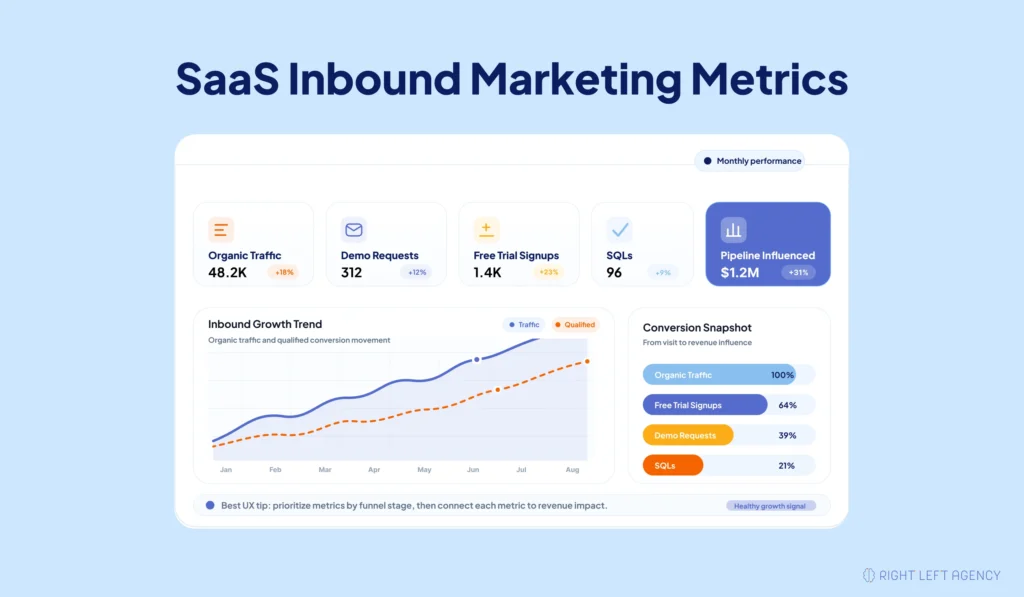
SaaS teams should not measure inbound marketing only by blog traffic.
Traffic can be useful, but it does not always mean the content is creating a pipeline. A better approach is to measure the full journey from search visibility to revenue impact.
| Metric | Why It Matters | What to Do With It |
| Organic traffic | Shows whether SEO content is attracting visitors | Segment traffic by funnel stage, ICP fit, and conversion path |
| Demo requests | Shows whether content is driving sales conversations | Review which pages assist or generate demo requests |
| Free trial signups | Tracks product-led conversion from inbound traffic | Compare trial quality by source and content type |
| SQLs | Shows which leads are ready for sales follow-up | Identify which content creates sales-ready leads |
| Pipeline influenced | Connects inbound to revenue opportunities | Prioritize content that appears in opportunity paths |
The most important question is not, “How many people visited the blog?”
The better question is, “Which content helped generate qualified leads, sales conversations, product signups, and revenue?”
That shift changes how the SaaS inbound marketing strategy works. Instead of chasing keywords only because they have high search volume, the team can prioritize keywords and topics that support the buying journey.
Common SaaS Inbound Marketing Mistakes to Avoid
Inbound marketing can become expensive and slow when SaaS companies execute it without a clear strategy.
Here are the most common mistakes to avoid.
Creating Only Top-of-Funnel Blog Content
Educational blog content is important, but it cannot carry the full strategy alone.
Balance educational content with BOFU pages, use-case pages, comparison pages, case studies, and conversion-focused landing pages.
Ignoring Bottom-of-Funnel Keywords
BOFU keywords often have lower search volume, but they can drive better leads.
Keywords with terms like “best,” “software,” “platform,” “alternative,” “comparison,” and “pricing” often show stronger buying intent. These should be part of your SaaS inbound strategy.
Not Defining the ICP Clearly
If your ideal customer profile is unclear, your content will feel generic.
Before creating content, define who the buyer is, what problems they have, what triggers their search, what objections they face, and what would make them choose your product.
Publishing Content Without CTAs
Every content asset should guide the reader toward the next step.
That does not mean every blog post needs a hard demo CTA, but each page should include a relevant action, such as downloading a guide, reading a case study, joining a webinar, comparing solutions, or booking a demo.
Not Aligning Content With Sales Conversations
Your sales team hears real objections every week.
Those objections should become content ideas. If prospects keep asking about implementation, pricing, integrations, switching from competitors, or ROI, your inbound content should answer those questions.
Measuring Only Traffic
Traffic is only one part of the story.
A SaaS company can generate thousands of monthly visits and still have a weak pipeline. Track how content influences leads, demos, trials, SQLs, and revenue.
Not Updating Old Content
SaaS markets change quickly. Competitors shift positioning, product features change, and search results evolve.
Old content should be refreshed regularly to keep it accurate, useful, and aligned with current search intent.
Weak Internal Linking
If blog posts, product pages, comparison pages, and case studies are not connected, users may not know where to go next. Search engines also get weaker signals about which pages matter most. Fix this by linking every new article to relevant product pages, use-case pages, BOFU pages, and supporting guides.
No Lead Nurturing System
Capturing an email is not enough. If leads do not receive useful follow-up content, they may forget the problem or choose another vendor. Fix this by creating nurture sequences based on funnel stage, content downloaded, product interest, and sales readiness.
Steps To Build an Inbound Marketing Strategy for SaaS
A strong SaaS inbound strategy needs structure. Random content will not create predictable growth.
Here is a simple framework.
1. Define Your ICP and Buyer Personas
Start with the customer.
Identify the company type, industry, team size, pain points, budget, buying committee, and decision triggers. The clearer your ICP is, the easier it becomes to create content that attracts qualified prospects.
2. Map Customer Pain Points and Buying Stages
List the problems your buyers experience before they search for a solution.
Then map those problems to funnel stages. Some questions will be early-stage and educational. Others will show buying intent. This helps you create content for the full buyer journey.
3. Research Keywords by Funnel Stage
Do not choose keywords based only on search volume.
Group keywords by awareness, consideration, decision, and retention. This helps you build a balanced content strategy that attracts traffic and supports conversions.
4. Prioritize by Business Impact
Score each opportunity by ICP fit, buying intent, product relevance, ranking difficulty, and conversion potential. Start with pages that are close to revenue, such as comparison pages, use-case pages, demo-supporting content, and case studies, before scaling broad awareness content.
5. Build Topic Clusters and Pillar Pages
Choose your core product-related topics and create pillar pages around them.
Then create supporting blog posts, comparison articles, and use-case pages that link back to the pillar content. This improves user experience and helps build authority around important topics.
6. Create BOFU Landing Pages and Case Studies
Build pages for buyers who are close to making a decision.
This includes demo pages, comparison pages, alternative pages, industry pages, integration pages, and customer stories. These assets help convert traffic into a pipeline.
7. Add Lead Magnets and Conversion-Focused CTAs
Match CTAs to the reader’s intent.
A top-of-funnel reader may want a checklist or guide. A decision-stage buyer may want a demo, pricing conversation, or product comparison. The CTA should feel like the natural next step.
8. Set Up Email Nurturing and Automation
Once a visitor becomes a lead, use email to continue the conversation.
Segment leads by interest, funnel stage, and behavior. Send content that answers questions, builds trust, and moves them closer to a demo or trial.
9. Track Performance Through CRM and Analytics
Connect your content and campaigns to actual business outcomes.
Use analytics and CRM data to understand which pages generate leads, which leads become opportunities, and which content influences revenue.
10. Refresh and Optimize Content Regularly
Inbound marketing is not a one-time project.
Review your content performance, update old posts, improve internal links, add better CTAs, and expand content that is already ranking or converting.
Inbound Marketing vs Outbound Marketing for SaaS
Inbound and outbound marketing can both work for SaaS companies, but they work in different ways.
Inbound marketing attracts buyers through helpful content, SEO, product education, and trust-building. Outbound marketing reaches prospects directly through channels like cold email, paid ads, LinkedIn outreach, and sales development.
The best SaaS companies often use both.
| Category | Inbound Marketing | Outbound Marketing |
|---|---|---|
| Approach | Attracts buyers through content and search | Reaches prospects directly |
| Cost Structure | Often compounds over time | Usually requires ongoing spend or sales activity |
| Timeline | Slower to build, stronger long-term value | Faster to launch, often shorter-term impact |
| Buyer Intent | Captures existing search and research behavior | Creates direct awareness with selected accounts |
| Scalability | Scales through evergreen assets and SEO | Scales through budget, lists, and sales capacity |
| Best Use Case | Sustainable demand, education, trust, organic growth | Target account outreach, fast testing, and direct pipeline creation |
The goal is not to choose one funnel forever.
For example, an early-stage SaaS company might use outbound to validate messaging and generate early conversations. Then, as the company learns more about buyer pain points, it can turn those insights into inbound content.
Inbound and outbound work best together when they share the same messaging. Sales teams can use inbound content in outreach, while marketing can use sales objections to create better BOFU content. For example, if outbound prospects often ask about implementation time, that question should become a blog post, sales enablement asset, or FAQ section.
When Should a SaaS Company Invest in Inbound Marketing?
A SaaS company should invest in inbound marketing when it wants to build a more sustainable growth engine instead of depending only on short-term acquisition channels.
Inbound marketing is especially useful when:
- You have a clear ICP
- Your buyers search for solutions online
- Paid acquisition is becoming expensive
- Your sales team answers the same questions repeatedly
- You need more qualified organic leads
- You want to reduce CAC over time
- You have customer proof or case studies
- Your product needs education before buyers convert
- Your sales cycle involves multiple stakeholders
If the product, ICP, or positioning changes every month, avoid building a large SEO program too early. Start with founder-led content, sales call insights, BOFU landing pages, and customer proof.
Once the ICP, positioning, and core use cases become clearer, the company can invest more heavily in SEO, topic clusters, lead magnets, and full-funnel content.
Inbound marketing works best when it is consistent. It takes time to build authority, rankings, trust, and conversion paths, but once the system starts working, it can become one of the most valuable growth assets a SaaS company owns.
Final Thoughts
Inbound marketing for SaaS is not just about publishing blog posts. It is a complete growth system that connects SEO, content strategy, lead capture, email nurturing, sales enablement, product education, and customer retention.
The SaaS companies that win with inbound are the ones that understand their buyers deeply. They know what questions prospects ask, what objections slow down deals, what proof buyers need, and what content helps people move from problem-aware to product-ready.
If your SaaS content is attracting traffic but not enough qualified demos or trials, start with an inbound audit. Review your ICP, funnel gaps, BOFU pages, nurture sequences, CTAs, and sales handoff process. That will show whether your next move should be stronger content, better conversion paths, improved nurturing, or expert support.
That is how inbound becomes more than a marketing channel. It becomes a SaaS growth engine.
FAQs About Inbound Marketing for SaaS
What is inbound marketing for SaaS?
Inbound marketing for SaaS is a strategy that uses SEO, content, lead capture, email nurturing, product education, and conversion paths to attract and convert qualified software buyers. It helps SaaS companies build trust, generate demos or trials, and support long-term customer growth.
What is the difference between SaaS inbound marketing and SaaS content marketing?
SaaS content marketing focuses on creating and distributing useful content. SaaS inbound marketing is broader because it connects content with SEO, lead capture, email nurturing, conversion paths, CRM tracking, sales enablement, and customer retention.
Why is inbound marketing important for SaaS companies?
Inbound marketing is important for SaaS companies because software buyers often need education before they buy. A strong inbound strategy helps attract qualified traffic, answer buyer questions, support long sales cycles, generate better leads, and reduce dependency on paid acquisition over time.
What are the best inbound marketing strategies for SaaS?
The best SaaS inbound marketing strategies include SEO-led content, topic clusters, bottom-of-funnel pages, lead magnets, webinars, email nurturing, case studies, comparison pages, and product education content. These tactics work best when they are connected to the full SaaS buyer journey.
How long does SaaS inbound marketing take to work?
SaaS inbound marketing usually takes time because SEO, content authority, lead nurturing, and conversion optimization build gradually. Some early signs may appear within a few months, but stronger results usually come from consistent publishing, optimization, internal linking, and funnel tracking over a longer period.
Does inbound marketing work for early-stage SaaS startups?
Yes, but early-stage SaaS startups should start small. They should focus on customer pain points, founder-led content, sales call insights, and bottom-of-funnel pages before investing heavily in large SEO content programs.
What metrics should SaaS companies track for inbound marketing?
SaaS companies should track organic traffic, keyword rankings, demo requests, free trial signups, MQLs, SQLs, landing page conversion rate, trial-to-paid conversion rate, CAC, LTV, and pipeline influenced by content. The goal is to measure revenue impact, not just website visits.