


B2B content marketing is a simple promise. You create useful information for people inside other companies so they can solve real problems and move a purchase forward. You plan topics around their jobs, publish in formats they like, and measure how those assets help sales start better conversations and close deals.
You may know the common formats already: articles, guides, case studies, short videos, webinars, tools, and newsletters all play a role. The difference here is focus. We align every piece with one role, one stage, and one clear next step.
Why B2B Content Marketing Matters Now
These days your buyers do their homework long before they ever talk to a sales rep. What you can do is meet them early with strong B2B content. It helps you join that first conversation and gives your internal champion the proof they need to back you up.
And since budgets face closer scrutiny than ever, content that shows value fast is what really wins attention. Done right, it shortens the path to trust, helps deals move forward, and positions you as the safer choice.
Read: SaaS Content Marketing Playbook
What You Will Learn in This Blog
Today, you will figure out how to build a practical B2B content marketing strategy without burning out. We will cover how to plan, create, and distribute assets so people actually see and use them.
You will also learn how to connect content directly to sales enablement, track content assisted opportunities, and measure cycle time. And of course, every step is designed to work even if you only have a small team.
Who This Blog Is For
This blog post is meant for B2B marketers, founders, and sales leaders who care about real pipeline, not vanity metrics. If you are running lean, juggling multiple roles, or trying to stretch a modest budget, the systems here will keep you consistent and effective.
How to Use This Guide for Maximum Impact
The best way to use this guide is to start with one path and stick with it. Begin with the Quick Plan to create momentum in your very first week.
From there, work through the Strategy Stack and B2B Content Distribution Strategy so you build a system rather than scattered posts. Then explore Formats That Work Right Now and B2B Content Marketing Examples to see what you can replicate with purpose.
Finally, measure results with the section on Reporting and Quarterly Reviews. This way, you can prove impact, decide what stays, and know exactly what to update or retire. If you already publish content and need proof fast, skip ahead to the Quick Plan and Measurement sections, then circle back to strengthen your foundation.
Quick Plan: 90 Day Baseline
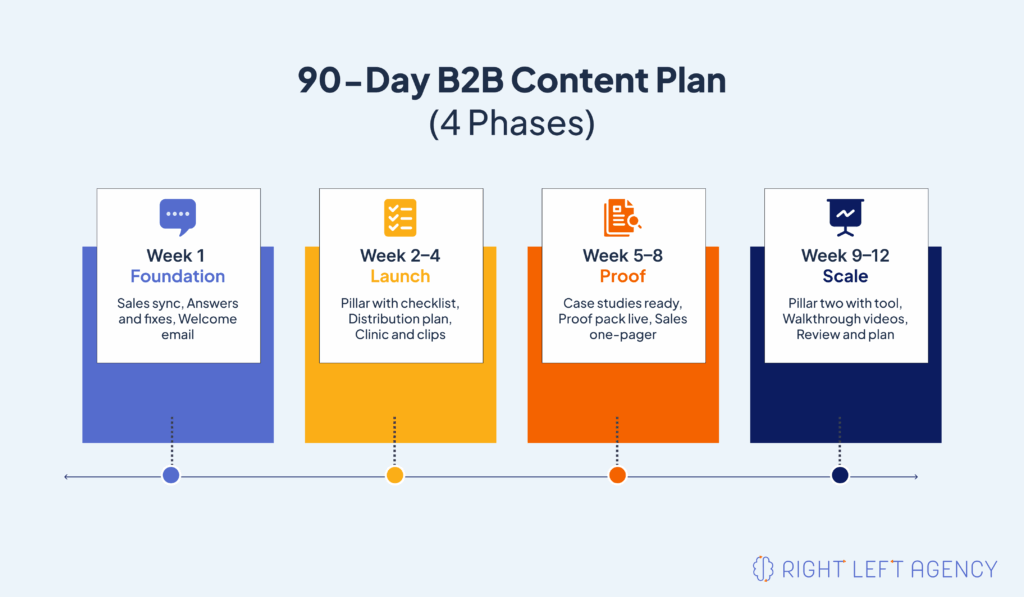
Week 1: Sit down with sales for one focused hour and gather the ten most common buyer questions. What you can do is turn three of them into short answers on your site, then fix two conversion leaks on key pages. Add a simple newsletter signup and one welcome email that shares your best resources.
Weeks 2 to 4: Publish one pillar guide that solves a clear job and pair it with a checklist or spreadsheet. Plan distribution upfront with five moves across web, email, LinkedIn, a partner share, and a small paid boost. To make things engaging, run a short live clinic, collect questions, and repurpose four clips.
Weeks 5 to 8: Release two short case studies and one longer version with clear results. Create a proof pack page with certifications and security notes so buyers feel confident. Also, prepare a one pager for your main product line so sales can send it quickly.
Weeks 9 to 12: Launch your second pillar guide with a simple tool and record two walkthrough videos. Review performance, cut content that does not help pipeline, and mark the winners for updates. End with a brief retrospective and plan your next quarter using real signals.
The B2B Content Strategy Stack
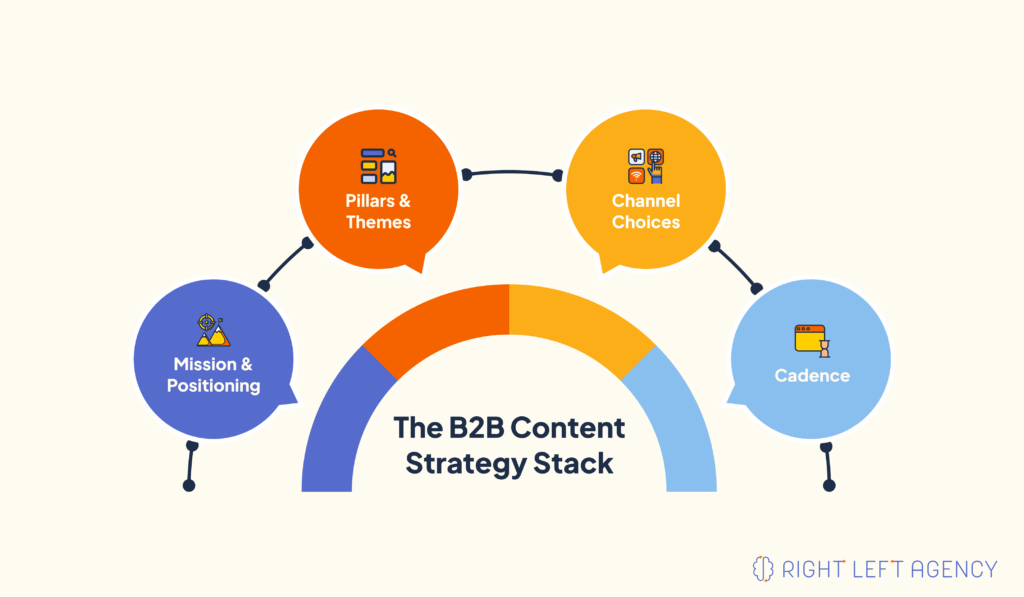
Think in layers so you do not get lost.
Mission and Positioning
Start by writing one clear sentence: who you serve, what problem you solve, and what proof you bring. Keep it steady so every piece of content speaks with the same clear voice.
Pillars and Themes
Pick three to five pillars that map to buyer outcomes. For example, you might focus on efficiency, compliance, data quality, or vendor risk. Each pillar becomes the base for topics and content series.
Channel Choices
Choose your main and secondary channels. For most B2B teams that means website, LinkedIn, newsletters, and sales enablement. Over time, you can layer in search, webinars, or partner channels as you grow.
Cadence
Set a rhythm you can sustain. A good start is one pillar article every two weeks, one case study per month, two LinkedIn posts weekly, and one webinar each month. Of course, you can scale up once you see traction.
Goals, Metrics, and Strong Guardrails
Clear goals keep you on track. Begin with three simple ones:
- Reach qualified buyers inside target accounts.
- Create qualified hand‑raises that sales can work.
- Reduce sales cycle time with helpful content.
Turn those into metrics. Track visitors from target accounts, content assisted opportunities, and time to close. Add supporting signals like newsletter growth, repeat visitors, and demo to close rate. For extra insight, you can track scroll depth and content influenced revenue.
Guardrails are equally important. They prevent random acts of content. Agree on what not to do: no fluffy posts, no unstructured opinions, and no content without a clear next step. This way, every piece drives purpose.
Ideal Customer Profile and Buying Committee
Your ideal customer profile is not just a broad description. What you can do is define it with firmographics, specific pains, and a narrow starting lane so your content feels focused. Once that is clear, map out the buying committee so you know who really makes decisions.
In B2B, you often meet a user, a manager, finance, and an executive. Each role has a reason to care, and of course, each one looks for different proof. The trick is to write content that gives every person exactly what they need.
A simple way to organize this is with a two-column table. On the left list the role, and on the right list what that role wants to see. For instance, security wants evidence of controls, finance looks for ROI, and users simply want speed and fewer steps.
Now that you see this map clearly, it becomes much easier to build content that speaks to every person in the deal and keeps the buying process moving.
B2B Content Pillars That Win Attention
Not every content idea deserves attention, so focus on pillars that buyers share with colleagues. To make things simple, here are proven types of content pillars you can rely on.
Practical Guides and Roadmaps
Teach the entire job your buyer wants done, step by step. Add checklists, examples, and keep it grounded in real practice. Why? Well, because practical content gets saved and reused. Then link tools and templates that make applying the guide even easier.
Original Research and Benchmarks
Data carries weight in B2B. You can run surveys, study product usage, or even turn support insights into trends. A short summary creates reach, and a full report captures leads. This balance builds authority and shows you know the market better than others.
Case Studies and Win Stories
Showcase how a customer went from pain to results. Buyers care about the messy starting point, the decision moment, and the final win. Keep numbers clear and skip the hype. This way, people can picture their own success through someone else’s story.
Teardowns and Reviews
Help buyers evaluate. Compare methods, highlight tradeoffs, and explain what to avoid. People love sharing this type of content because it saves time and provides shortcuts in decision making.
Decision Tools
Create calculators, templates, or checklists that buyers can use inside their company. What this does is make champions look good in internal meetings and gives them the confidence to push your solution forward.
Read: Top Marketing Strategies for SaaS Companies and Startups in 2025
Editorial Operating System for B2B Content Creation
If you want to ship content on time without burning out, you need a clear operating system. Think of it as your team’s playbook that keeps things moving smoothly.
Roles
Every role matters, even if one person wears multiple hats. You need a strategist, an editor, a subject expert, a designer, and someone who ensures distribution. Naming roles gives structure and prevents chaos, especially in small teams.
Intake and Prioritization
Keep a backlog of ideas from sales calls, product updates, and recurring customer questions. What you can do is score them by impact, urgency, and effort. Then plan two sprints at a time so you are not overwhelmed by too many random ideas.
Draft Process
Start with a solid brief. Outline the goal, the reader, the structure, and the takeaway. Then write a rough draft quickly, refine for clarity, and finally polish for accuracy and tone. This three-step rhythm helps content move forward without perfection bottlenecks.
Quality Bar
A simple three-point check can save you. Ask yourself: is it accurate, is it complete, and is it easy to read? If one fails, do not publish. This prevents weak content from slipping through and keeps your standard visible to the whole team.
Review
Bring in three perspectives before shipping. A subject expert checks accuracy, a marketer checks flow, and sales checks if buyers will actually care. With this mix, you catch blind spots early and save time on rework later.
Governance
Keep a style guide so the tone stays consistent. Define rules for updating or retiring old content, and make sure one person owns the content library. Why? Because broken links and outdated content make you lose trust fast.
SEO That Serves Value First
SEO is how you earn compounding traffic, but you need to write for people first so they stay and act.
Start with problems and jobs to be done. Build topic clusters around each content pillar. For each cluster write a pillar page that explains the outcome. Then write supporting pieces that answer specific how‑to questions.
Use simple on‑page rules. Clear H1 and H2. Descriptive title and meta description. Short, meaningful URLs. Alt text that helps. Internal links that guide the reader to the next useful page.
Use search intent to shape the page. If the query seeks a definition, give a clean answer and an example. If it seeks a comparison, show a head‑to‑head view that is fair and useful. If it seeks a vendor, include a quick way to talk to sales. Now that search is crowded, add depth that others skip. Include screenshots, short videos, and real templates. Update quarterly. Keep a changelog at the bottom so readers trust you.
Socials and Community Playbook
Your buyers are already active on LinkedIn and niche communities, so meet them there. Share quick wins, small stories, and short insights that spark replies. The idea is simple: give value first and let conversations grow naturally.
Encourage leaders and product teams to post too. What you can do is hand them weekly prompts like a quick teardown, a lesson from a recent call, or a small metric that shifted. Then reply to every thoughtful comment so the thread keeps momentum.
Communities also matter. Join the right groups, share answers, and post useful checklists. Do not pitch aggressively. Instead, when someone asks for help you can solve, offer the next step quietly and respectfully. That builds trust and keeps the door open.
Email That People Actually Read
Email carries more weight than any other channel when you use it with care. Keep a steady cadence and write the way you speak. Share one main idea in each send, set the value in the first lines, and close with a single next step so readers know what to do.
Now, tailor the message by role and stage so people feel seen. Evaluators get short case studies with outcomes and screenshots. Finance receives a clear ROI note with a simple worksheet. Users get quick wins and a short clip they can try today. Keep the list healthy by removing bounces and inactive contacts so deliverability stays strong.
Then layer a small automation on top of every new pillar. The first email shares the short version and links to the tool. The second follows a few days later and asks one helpful question so people can reply and start a real conversation.
B2B Content Distribution Strategy
Creation without distribution is waste. So we make distribution a first‑class step.
Plan distribution inside the brief. For each piece define five actions before you draft anything. For example, you will post a short thread on LinkedIn, share one clip with a partner, send a tight email to a small segment, answer one community question with a link, and run one paid boost to target accounts for a week.
Then build a content hub on your site. Every piece points back to this hub. You keep the hub updated so sales and success teams can find the right asset fast.
Paid Distribution Without Wasting Budget
Start small and target tight audiences. Promote a strong case study, a short calculator, or a benchmark. Use short tests on LinkedIn and in industry newsletters. Watch cost per qualified visit and cost per demo start, not just clicks.
You can also try sponsored placements in curated emails and podcasts. These reach people who actually care. Keep your creative simple and helpful. Offer a real tool or checklist.
Sales Enablement Content That Shortens Cycles
The goal here is simple: help sales remove friction so deals close faster. What you can do is build a small but powerful library that directly addresses the most common objections buyers raise.
Start with the basics. Create one clear one-pager for each product line, a proof pack with certifications and security notes, and internal competitor comparison sheets. To make it easy, add a short deck that champions can use when briefing their VP.
Now, of course, none of this matters if reps cannot find what they need. So give them a simple search page where everything lives, and add a feedback button so they can request new content when deals get stuck.
Formats That Work Right Now
Formats always evolve, but what never changes is human behavior. People want content that feels clear, trustworthy, and worth their time. Right now, these formats deliver just that.
Short Video and Screen Walkthroughs
Record quick walkthroughs that solve one task in four minutes or less. Show your screen, explain step by step, and close with a clear next move. Why? Because people want practical help they can use instantly.
Live Clinics and Roundtables
Host a short monthly session with an expert and a customer. Take live questions, share honest answers, and upload the replay with timestamps. This way, people can revisit key moments and share them with teammates.
Mini Case Studies
Keep them tight and focused. Write 200–400 words that highlight one win, add a chart or screenshot, and post it on LinkedIn and in your newsletter. Link back to the full story so curious buyers can dig deeper.
Definitive Guides With Tools
Instead of just theory, publish guides that come with a usable tool like a spreadsheet or checklist. People save these resources and return to them, which keeps your brand top of mind.
Opinion Pieces From Leaders
Leaders can share short takes on market direction, but the key is to keep them grounded in customer stories and real data. This makes thought leadership feel credible instead of fluffy.
B2B Content Marketing Examples You Should Steal With Pride
Look at what is already winning and then adapt it to your niche. Use the ideas below as starting points and shape them to your audience.
Start with a weekly industry note that delivers one fresh insight, one chart, and one short take. Send it the same day each week so readers build a habit, and close with one clear way to act on the idea.
Run a quarterly benchmark that turns anonymized product data into a simple chart and a sharp takeaway. Teams will cite it in internal decks and link back when they explain decisions.
Host a one‑job workshop that solves a real task. Record the session, clip it into four short videos, publish a practical guide on your site, and equip sales with a one pager pulled from the same material.
Build a library of mini case studies grouped by industry and use case. Buyers want to see someone like them, then they want a path to repeat the win, so give them both in a few clear paragraphs.
Publish a teardown series where you review public examples and explain what to copy and what to avoid. Keep it kind and specific so people learn and share it with their teams.
B2B Content Marketing Tactics for Each Funnel Stage
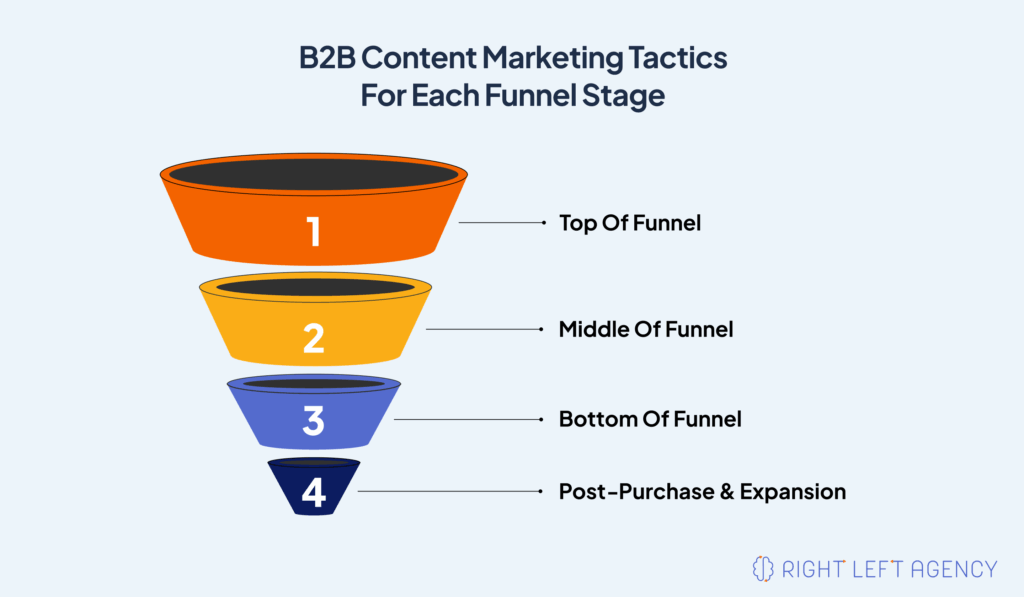
Think of your funnel as a journey. What you want to do is match each stage with the right content so buyers naturally move from learning to buying.
Top of Funnel
Here, people are just learning. Teach a concept, name the problem, and show one simple path forward. Guides, checklists, and short videos work best. Keep calls to action light, like newsletter signup or a tool download.
Middle of Funnel
Buyers are comparing. Help them see fit and weigh options with case studies, teardown posts, webinars, and ROI tools. Invite them to talk, but only when they are ready. That way, it feels like a natural step.
Bottom of Funnel
This is where the champion needs proof for the internal meeting. Provide proof packs, security notes, pilot plans, and clear ROI summaries. A short trial with guardrails can also give confidence without adding risk.
Post-Purchase and Expansion
Your work does not stop at the sale. Help customers adopt and expand with playbooks, quick win videos, and user roundtables. Advanced tips in newsletters keep power users engaged and eager to grow with you.
Repurposing and Recycling Framework
To think clearly about scale, you need a repeatable repurposing flow. Start with one strong pillar piece. Cut it into clips for social, a short email, and a set of mini graphics. Turn Q&A from the live session into a short FAQ. Update the pillar quarterly and launch it again.
Keep a tracker. When you publish a new piece, schedule three future touches. For example, you can revisit it in six weeks with new data, then in three months with fresh examples, and then in six months with a video.
B2B Content Marketing Ideas You Can Ship This Quarter
Here is a fast list to spark action. You do not need all of them. Pick what fits your market and your bandwidth.
- Launch a short two-question monthly pulse survey. Share one chart and a clear takeaway to spark conversation.
- Publish a teardown of a process your buyers run often. Pair it with a simple downloadable template so they can try it themselves.
- Record a quick screen walkthrough that solves a common problem. Share it with prospects on social and email, and also surface it for customers inside your product experience (like a help center or resource tab).
- Create a proof pack page that shows certifications, security practices, uptime records, and architecture notes to build trust.
- Build a lightweight calculator that helps a manager estimate savings, ROI, or risk reduction. Keep it practical and easy to use.
- Publish a mini case study every two weeks and organize them by industry or use case so sales can share them quickly.
- Run a live clinic on a hot topic. Collect questions during registration and address the most common ones in the session.
- Host a weekly internal content office hour so sales and success teams can request or shape assets in real time.
- Draft a partner co-marketing checklist and commit to one joint webinar this quarter to reach new audiences.
- Build a content hub page that maps specific buyer problems to existing resources, making it easy for prospects to self-serve.
B2B Content Marketing Best Practices Checklist
Use this checklist when you plan and review.
- Each piece starts with a real job to be done.
- You write for one role and one stage, not for everyone.
- You include one clear next step that helps the reader.
- You plan distribution inside the brief before you draft.
- You show proof through data, screenshots, or a simple story.
- You link to helpful assets on your site so people can go deeper.
- You track a small set of metrics that tie to the pipeline.
- You update winners and retire weak pieces.
- You keep the tone clear, kind, and direct.
- You build for the long term so your content compounds readers.
The 90‑Day Execution Plan
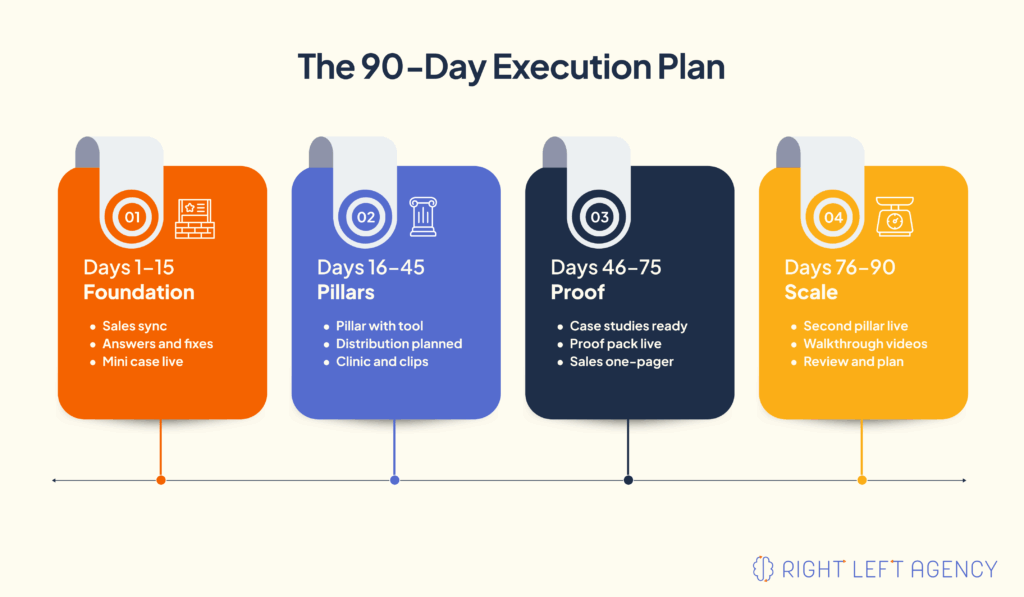
You want speed and proof, not endless planning. So here’s a simple roadmap you can start this week.
Days 1 to 15: Foundation and Quick Wins
Start with a sales sync to align goals. Collect the top ten buyer questions and turn three into short, helpful articles. Patch two key conversion leaks on your website. Add a newsletter signup form and send a single welcome email with your most valuable resources. Close the phase by publishing a mini case study to build early trust.
Days 16 to 45: Pillars and Distribution
Create your first in-depth pillar guide and pair it with a small, practical tool like a checklist. Before publishing, map out a distribution plan: share highlights on LinkedIn, send a summary in your newsletter, and run a modest paid promotion (a “boost”) to extend reach beyond your existing followers. Host a live clinic, gather audience questions, and repurpose those insights into posts and short video clips.
Days 46 to 75: Proof and Enablement
This stage is about credibility. Publish two short case studies and one detailed one. Build a dedicated proof pack page plus a concise one-pager for your main product line. Equip sales with a simple way to search all assets. Run a quick two-question pulse survey, then share one chart and a clear takeaway with your audience.
Days 76 to 90: Scale and Review
Deliver your second pillar guide with another small tool attached. Record two short walkthrough videos to make your content actionable. Review performance metrics, cut anything that isn’t contributing to the pipeline, and schedule updates for the content that performs best. End the quarter with a retrospective involving sales and customer success to align on lessons learned and priorities for the next cycle.
Budget, Team, and Tooling
Start lean and stay focused. You can run a strong program with just a strategist, one or two writers, a part-time designer, and a distribution lead. Later, you might bring in a researcher for benchmarks and a video editor once short clips begin driving results.
What you should do is invest in tools that make life easier. A simple CMS, basic analytics, a screen recorder, and a survey tool will do the job. As your program grows, layer in extras like a webinar platform, podcast host, or lightweight design software.
Of course, you need some budget for promotion. Keep a small paid spend for boosts and sponsorships, focusing only on target accounts and specific roles. Review spending every two weeks so you can shift budget toward the best-performing placements.
Risk Management and What to Stop Doing
The biggest risk is simple: creating content that no one sees. That is why planning distribution early is critical. Another big risk is attracting the wrong audience, so make sure you clearly define your ideal customer profile (ICP), use relevant examples, and speak in their language.
What you can stop doing is just as important. Stop chasing keywords that do not connect with your product. Stop publishing content that does not solve a real job. And do not gate everything. Instead, gate only true assets like benchmarks or calculators that buyers need to share internally.
Measurement, Reporting, and Quarterly Reviews
Measure reach, engagement, and revenue impact as one story. For reach, track visitors from target accounts and newsletter growth; for engagement, watch time on page, shares, replies, and webinar attendance; for revenue, follow content assisted opportunities, win rate on content exposed deals, and sales cycle time.
Use one dashboard that sales and leadership can read in a minute. Show three graphs and three headline numbers, and add a short note under each that explains what changed and why. Keep the tone plain and human.
Close each quarter with a review. Keep your two biggest winners and schedule updates, retire or merge the two weakest pieces, and choose two experiments for the next cycle.
Read: Building a B2B Brand: What to Expect from a Branding Marketing Agency
Closing Note
You now hold a full system for B2B content marketing. You can map intent to assets, create with purpose, and distribute where it matters. You can also measure what drives results and refine every quarter.
So here is the next step. Start small this week. Publish one helpful piece and let it work for your buyer. Then keep showing up consistently, because that is how trust and pipeline grow.
Frequently Asked Questions
Which Platform Is Most Effective for B2B Content Marketing?
LinkedIn delivers strong reach to decision makers, while your website and email convert attention into pipeline. Use LinkedIn to spark conversations, then move people to owned channels where you can nurture and measure.
Which Type of Content Is Most Effective for B2B Marketing?
Case studies, short videos, and practical guides perform well across the funnel. Use case studies and research for proof late in the journey, and short video to earn fast reach early.
What Is a B2B Content Strategy?
It is a plan that ties your ideal customer profile (ICP), a small set of pillars, chosen formats, and distribution to pipeline goals. You set cadence, define success metrics, and build sales handoffs so content moves deals forward.
How Does B2B Content Marketing Work?
You publish assets that solve real problems for buyers and distribute them where those buyers already spend time. Sales then uses proof packs, one pagers, and case stories from that library to progress conversations.
What Is the 95-5 Rule in B2B Marketing?
Roughly five percent of your market is ready to buy now and ninety five percent is not. So you balance brand programs that build future demand with activation that captures in-market buyers.
What Is the 3-2-1 Rule on LinkedIn?
Think of it as a simple rhythm, not a standard. Post three helpful ideas each week, join two meaningful comment threads each day, and send one quality message that continues a real conversation.
Which Channel Is Best for B2B Marketers?
Pair organic social for reach, search-driven blogs for capture, and email for nurture. This mix shows up consistently in programs that create qualified hand-raises.
Is Social Media Good for B2B Marketing?
Yes, when you show clear value and a point of view. LinkedIn is the safest bet for quality reach, but you still need a content hub and email to turn attention into revenue.
What Are the B2B Social Media Trends for 2025?
Short video and executive- or creator-led posts continue to rise on LinkedIn, supported by employee advocacy. Plan lightweight series you can sustain and clip wins into reusable assets.
What Is an Example of B2B Content Marketing?
Publish a quarterly benchmark that turns anonymized product data into one sharp chart and takeaway. Pair it with a checklist or calculator, share the short version on LinkedIn, and send the full guide to your segment for replies and demos.