Key Takeaways
- Brand bidding should deliver incremental value or justify its cost.
- Competitor keywords should target buyers considering alternatives.
- Low CPA and high ROAS do not prove incremental growth.
- Controlled experiments help measure additional conversions and revenue.
- Incremental acquisition value should guide SaaS ad budgets.
Brand and competitor keyword campaigns can report strong Google Ads performance without necessarily generating additional SaaS customers.
Branded ads may produce inexpensive demo requests from users who already know your product. Competitor campaigns may attract costly clicks from people with little intent to switch providers.
B2B SaaS companies should bid on brand and competitor keywords when the expected incremental business value justifies the cost, and reduce or stop spending when reliable evidence indicates otherwise.
The challenge is separating conversions attributed to advertising from the customers and revenue it actually creates.
This guide explains when to bid, when to reduce investment, and how incrementality testing can help SaaS teams make more defensible paid search decisions.
What Are Brand and Competitor Keywords in SaaS Google Ads?
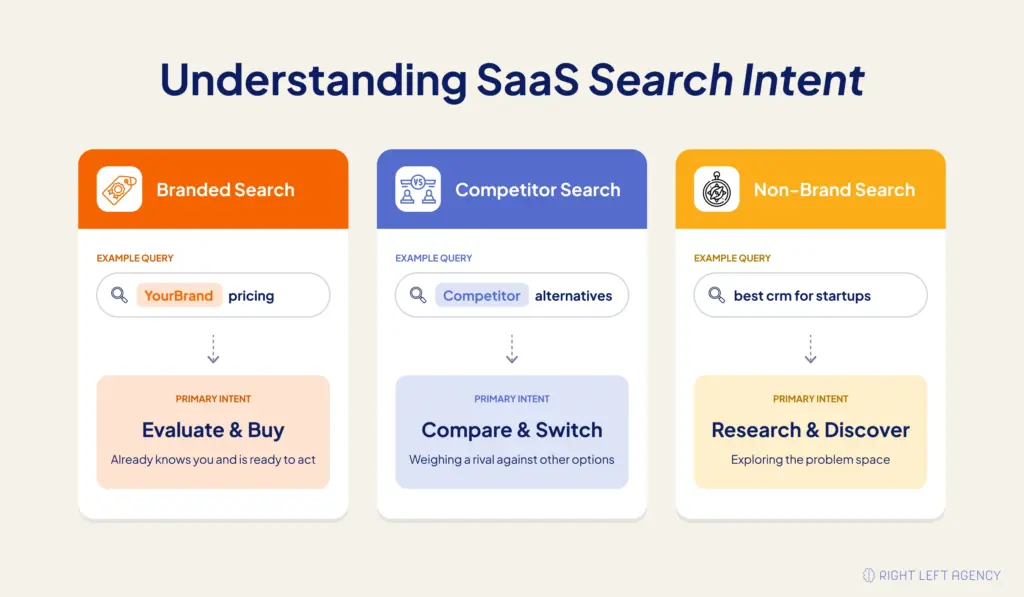
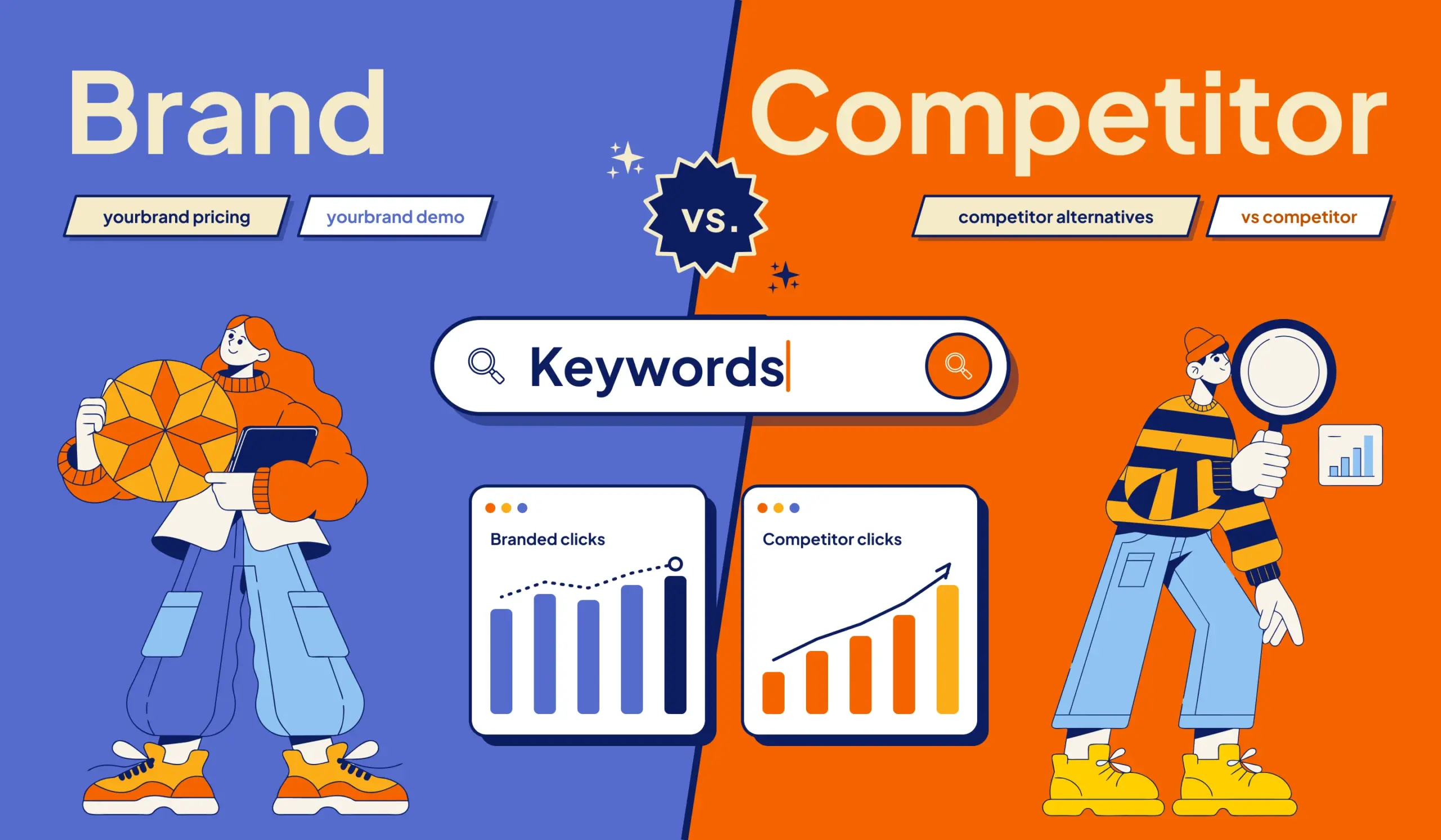
Brand keywords include searches for your company’s name, products, or recognizable brand variations. Competitor keywords contain names of competing companies or products.
Both can reach buyers who already know a vendor, but their intent and acquisition potential differ.
| Keyword category | Example | Typical intent | Main measurement challenge |
|---|---|---|---|
| Own brand | [Your SaaS] pricing | Evaluate a known provider | Paid-organic substitution |
| Competitor | [Competitor] alternatives | Compare potential solutions | Switching intent and lead qualification |
| Non-brand | Workflow automation software | Research a software category | Acquiring relevant new demand |
For example, a search for your SaaS pricing page may come from someone already planning to evaluate your business. A competitor-alternative search may come from a prospect considering a different solution.
Neither query automatically establishes that paying for the click creates an additional customer.
This distinction matters because branded campaigns often look efficient in Google Ads reporting while their actual contribution to new-customer acquisition remains uncertain.
Should SaaS Companies Bid on Their Own Brand Keywords?
SaaS companies should consider brand bidding when competitors target their brand, organic visibility is limited, or paid ads support high-intent searches.
However, these conditions do not automatically prove incremental value.
When Competitors Appear on Your Branded Searches
Competitors may advertise on searches for your SaaS brand or product. Branded ads can reinforce your positioning and direct users to relevant pages.
Evaluate competitor activity, search impression share, and changes in qualified conversions.
Google Ads Auction Insights provides competitive insights but does not prove incremental revenue.
Competitive pressure may justify brand protection, but its value must be measured.
When Organic Visibility Is Limited
Branded ads can support product launches, rebranding, or weak organic visibility while directing users to pricing, integration, or demo pages.
Google’s 2012 Search Ads Pause research found that an average of 50% of paid ad clicks alongside a top-ranked organic result were incremental.
However, the study measured clicks, not SaaS customers or revenue. Results vary by advertiser.
Test whether branded ads generate additional qualified outcomes beyond organic search.
When Branded Searches Show Commercial Intent
Pricing, demo, integration, and enterprise-related searches often indicate product evaluation.
Paid ads can guide these users toward relevant pages, but some may convert organically without advertising.
Measure incremental qualified opportunities rather than treating every paid conversion as additional demand.
When Should SaaS Companies Reduce or Stop Brand Bidding?
SaaS companies should consider reducing branded search spending when credible measurement indicates that advertising adds too little qualified business value relative to its cost.
The decision should be based on incremental outcomes, not organic ranking or reported CPA alone.
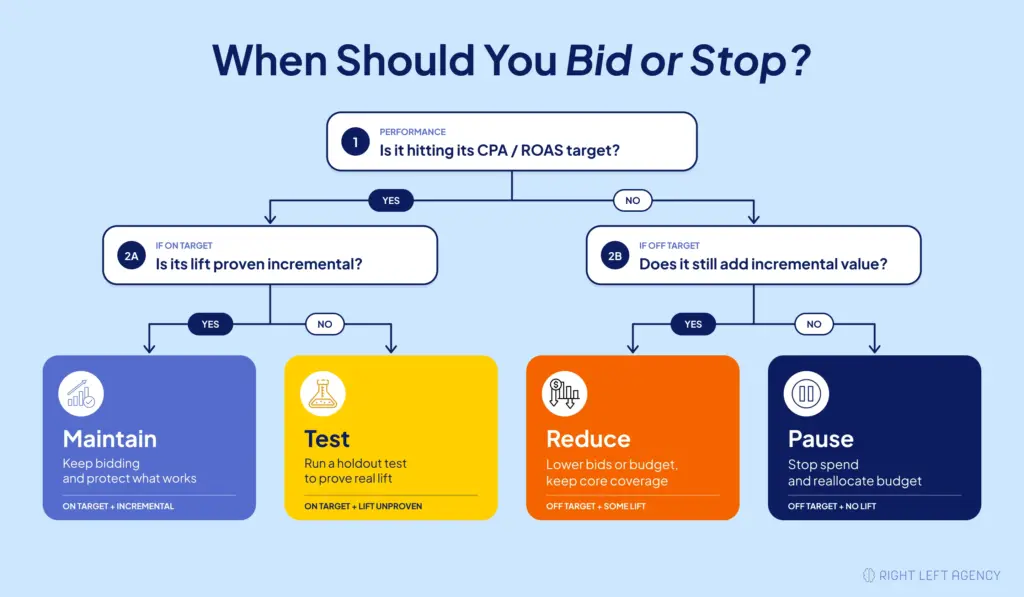
When Paid Ads Primarily Replace Organic Conversions
Branded search cannibalization occurs when paid ads receive clicks or conversions that otherwise might have occurred through organic results.
For example, after branded ads are removed, paid conversions may fall while organic conversions rise.
If total qualified opportunities remain stable, some previous paid conversions may have represented a shift in channel attribution rather than additional acquisition.
A before-and-after observation can reveal this possibility, but it cannot prove causation because demand, competition, and other conditions may have changed.
A controlled experiment provides stronger evidence.
When Existing Customers Dominate Search Traffic
Existing customers may search for account logins, billing information, documentation, or support. These interactions can produce paid clicks without contributing to new-customer acquisition.
Review search terms and CRM records to distinguish prospective buyers from existing customers.
Where appropriate, exclude irrelevant navigational queries or evaluate customer-retention campaigns separately.
When Incremental Value No Longer Justifies Spending
Rising CPCs, weak incremental pipeline growth, and limited customer acquisition lift may indicate that the budget could be better used elsewhere.
Before pausing a campaign, consider how confident the measurement is and whether the decision is reversible.
| Campaign condition | Recommended action |
|---|---|
| Positive incremental acquisition economics | Maintain |
| Competitive pressure with uncertain incremental impact | Test |
| Weak but potentially improvable incremental results | Optimize or reduce |
| Credible evidence of insufficient incremental value | Reduce or pause |
| Inconclusive experiment | Improve measurement or retest |
Do not stop brand bidding solely because your website ranks first organically.
When Is Competitor Keyword Bidding Worth It for B2B SaaS?
Competitor keyword bidding is worthwhile when it reaches prospects evaluating alternative solutions and generates qualified customers at an acceptable incremental cost.
The best opportunities align with your SaaS product’s strengths and the searcher’s buying intent.
Prioritize Competitor Alternatives and Comparison Searches
Queries such as these can indicate active product evaluation:
- [Competitor] alternatives
- [Competitor] vs [Your SaaS]
- Software like [Competitor]
- [Competitor] replacement
These searches may reflect interest in features, pricing, integrations, or switching providers. Prioritize keywords that align with your product and ideal customer profile.
Evaluate Pricing, Migration, and Switching Intent
Competitor pricing and migration searches may indicate buying or switching interest.
Target queries where your SaaS offers relevant advantages in pricing, functionality, integrations, or implementation.
Use accurate comparison pages that highlight meaningful differences, address switching concerns, and provide clear next steps.
Avoid Competitor Searches With Weak Buying Intent
Broad competitor searches often include logins, support requests, and documentation queries with limited acquisition value.
Review search terms, apply relevant negative keywords, and prioritize qualified opportunities over clicks or form submissions.
Follow Google’s Trademark Policies
Google generally allows competitor trademarks as keywords, but certain trademark uses in ad text may be restricted, particularly for direct competitors or misleading advertisements.
Review the Google Ads Trademark Policy and applicable legal requirements before launching campaigns.
How Should You Structure Brand and Competitor Campaigns?
Brand, competitor, and non-brand search should be reported separately so that differences in user intent, acquisition quality, and campaign economics remain visible.
Distinct campaigns may be appropriate when separate budgets, targeting controls, or experiments are needed.
However, unnecessary fragmentation can create complexity without improving measurement.
Separate Reporting by Search Intent
Evaluate each search category using:
- Advertising spend.
- Search terms.
- Attributed conversions.
- Qualified leads.
- Sales opportunities.
- Pipeline and customers acquired.
Blended reporting can hide inefficiency when inexpensive branded conversions lower an account’s average CPA.
Use a structured B2B SaaS Google Ads audit to assess measurement reliability, campaign intent, and downstream lead quality before making major budget decisions.
Control Search Terms and Brand Targeting
Review keyword match types, search terms, negative keywords, and campaign overlap.
Google Ads supports brand inclusions for Search campaigns and brand exclusions for Search and Performance Max.
Brand inclusions can constrain serving to queries associated with selected brands, while exclusions prevent serving on associated brand queries.
In current AI Max configurations, brand inclusions may be available at campaign or ad-group level, while brand exclusions operate at campaign level.
These settings should be applied selectively because unnecessary restrictions can limit relevant conversion opportunities.
Align Landing Pages With Search Intent
| Search intent | Recommended landing page |
|---|---|
| Own-brand pricing | Pricing or plans page |
| Own-brand demo | Product demo page |
| Competitor alternatives | Alternatives page |
| Product comparison | Accurate comparison page |
| Migration or replacement | Migration and implementation page |
Competitor landing pages should offer useful comparisons, explain verifiable product differences, and make the advertiser’s identity clear.
Avoid presenting unsupported claims or disguising your business as the competitor.
What Does Incrementality Mean in SaaS Google Ads?
Google Ads incrementality estimates the additional conversions or business outcomes caused by advertising compared with what would have happened without that advertising.
It differs from attribution, which assigns credit for observed conversions based on a measurement model.
Attributed Conversions vs. Incremental Conversions
Consider a hypothetical branded campaign reporting 100 attributed demo requests.
A valid experiment might estimate that only 20 additional demo requests occurred because the advertising was active.
The campaign would therefore have:
- 100 attributed demo requests.
- 20 estimated incremental demo requests.
The remaining attributed requests are not necessarily worthless. They simply cannot all be assumed to have been caused by the advertising.
This distinction is why inexpensive branded conversions do not automatically represent efficient incremental acquisition.
Why Incremental Pipeline Matters for B2B SaaS
B2B SaaS acquisition often involves several stages:
Click → Lead → Qualified Opportunity → Customer → Revenue
An incremental click does not guarantee a qualified lead, and an additional demo request does not guarantee an additional customer.
Incremental qualified opportunities can therefore provide a useful intermediate measure when customer outcomes take longer to observe.
However, pipeline value is not realized revenue and should never be presented as equivalent to revenue ROAS.
How to Test Incrementality in SaaS Google Ads
The proposed RLA Search Incrementality Decision Framework organizes brand and competitor bidding evaluation into five stages.
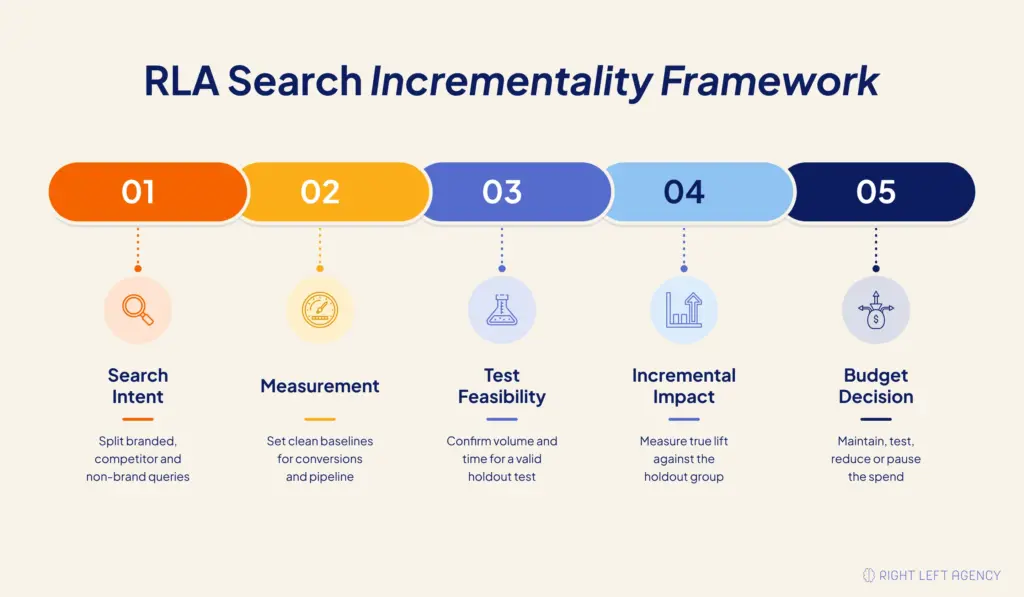
Each stage produces an output that supports the next decision.
| Stage | Primary question | Required output |
|---|---|---|
| 1. Intent | What demand are we targeting? | Classified search intent |
| 2. Measurement | Can we trust the data? | Validated tracking and CRM outcomes |
| 3. Feasibility | Can we measure incremental impact reliably? | Experiment design |
| 4. Impact | What additional value did ads create? | Estimated lift and uncertainty |
| 5. Decision | Does the added value justify the cost? | Maintain, optimize, retest, reduce, or stop |
Step 1 — Classify Search Intent
Separate owned-brand, competitor, and non-brand queries.
Within those groups, identify commercial, informational, and navigational searches.
For competitor campaigns, distinguish alternative-seeking prospects from existing customers of another provider.
The output should be a clearly defined set of searches and audiences that can be evaluated consistently.
Step 2 — Validate Tracking and CRM Outcomes
Before testing, confirm that Google Ads and your CRM measure meaningful acquisition outcomes reliably.
Check for duplicate conversion actions, missing identifiers, inconsistent qualification definitions, and incomplete offline conversion records.
Establish a baseline for total paid and organic conversions, qualified opportunities, and customers.
The goal is to ensure that the experiment measures real business outcomes instead of merely changes in attribution.
Step 3 — Select a Feasible Incrementality Test
Choose a method based on campaign reach, conversion volume, geographic coverage, and access to platform measurement features.
| Method | When useful | Main limitation |
|---|---|---|
| Geographic holdout | Sufficient comparable geographic markets | Spillover and market differences |
| Eligible Conversion Lift study | Supported campaigns and measurement goals | Platform eligibility requirements |
| Standard campaign experiment | Comparing settings or bidding approaches | Does not automatically establish ad-on vs. no-ad impact |
| Before-and-after pause analysis | Exploratory diagnosis with limited testing options | Weak causal evidence |
Randomized geographic experiments can provide stronger causal evidence than a simple campaign pause comparison when markets and experimental conditions are suitable.
Google’s geography-based Conversion Lift provides a controlled measurement option for eligible advertisers, but it is not available to all accounts and has specific feasibility requirements.
Step 4 — Estimate Incremental Outcomes and Uncertainty
A geographic holdout generally compares comparable treatment markets where the tested advertisements remain active with control markets where those advertisements are withheld.
A defensible design should:
- Select appropriate markets and evaluate historical comparability.
- Define the outcome, meaningful effect size, and analysis method before testing.
- Maintain reasonably comparable business conditions.
- Account for geographic spillover and delayed conversions.
- Compare total business outcomes with suitable statistical adjustments.
The results should estimate incremental outcomes and their uncertainty.
For low-volume SaaS accounts, customer-level lift may be difficult to measure precisely. Qualified opportunities may be a useful intermediate outcome when they are meaningfully connected to eventual revenue.
An inconclusive result does not establish that the campaign has no effect.
Step 5 — Make a Budget Decision
Use the estimated incremental benefit, marginal cost, uncertainty, and business risk to choose the next action. Maintain campaigns with sufficiently convincing incremental economics.
Optimize campaigns when targeting or lead quality can improve. Retest when uncertainty materially affects an important decision.
Reduce or pause campaigns when credible evidence indicates that the expected additional business value does not justify the investment.
The goal is not to prove that every campaign works. It is to make better acquisition decisions.
Which Metrics Should Guide SaaS Brand and Competitor Bidding?
Campaign-level diagnostics and incremental business outcomes serve different purposes.
| Metric | What it measures | Main limitation |
|---|---|---|
| CTR | Engagement with the advertisement | Does not establish lead quality |
| CPC | Cost of acquiring a paid click | Low cost does not imply profitability |
| Search impression share | Visibility in eligible auctions | Does not measure incremental customers |
| Attributed conversions | Outcomes credited to ads | Does not establish causation |
| Qualified opportunities | Sales-relevant outcomes | Can be delayed and low-volume |
| Incremental conversions | Additional outcomes caused by advertising | Requires a credible counterfactual |
| Incremental CAC | Cost per additional customer | Sensitive to uncertainty and cost definitions |
| Incremental revenue | Additional revenue caused by advertising | May require long observation periods |
Incremental Cost per Qualified Opportunity
When opportunity creation is the primary outcome:
Incremental cost per qualified opportunity = Incremental campaign cost ÷ Incremental qualified opportunities
This metric is useful when B2B SaaS sales cycles make closed-won customer outcomes difficult to observe during the experiment.
Incremental Customer Acquisition Cost
When customer-level outcomes can be estimated:
Incremental CAC = Incremental acquisition cost ÷ Incremental customers
The numerator should reflect the relevant incremental acquisition cost difference between tested conditions, including other materially affected costs when evaluating fully loaded CAC.
Incremental Return on Ad Spend
Incremental ROAS = Incremental revenue ÷ Incremental advertising spend
Use actual or appropriately measured incremental revenue rather than unqualified pipeline estimates.
For SaaS businesses with recurring revenue, define the revenue period clearly and avoid mixing customer lifetime value with short-term advertising spend without an explicit methodology.
SaaS Brand Bidding Incrementality Example
Consider a hypothetical B2B SaaS company testing whether branded search advertising generates additional qualified opportunities.
The company conducts a geographic experiment. After appropriate normalization and baseline adjustment, the estimated outcomes are:
| Metric | Brand Ads Active | Brand Ads Paused |
|---|---|---|
| Incremental advertising spend | $8,000 | $0 |
| Total demo requests | 150 | 135 |
| Qualified opportunities | 45 | 40 |
| Pipeline created | $225,000 | $200,000 |
The estimated incremental impact is:
- 15 additional demo requests.
- 5 additional qualified opportunities.
- $25,000 in additional pipeline.
Incremental cost per qualified opportunity
$8,000 ÷ 5 = $1,600
Incremental pipeline-to-ad-spend ratio
$25,000 ÷ $8,000 = 3.125x
The company would need to determine whether the additional opportunities justify the advertising cost based on expected close rates, contribution margins, and customer economics.
The 3.125x figure represents pipeline relative to spending, not incremental revenue ROAS or profit.
These figures are illustrative point estimates. They do not include confidence intervals, statistical power calculations, or potential measurement bias.
A real experiment could produce uncertainty broad enough that the decision remains inconclusive.
What About Competitor Campaigns?
Suppose a competitor campaign reports a higher CPA but generates qualified opportunities that align closely with the SaaS company’s ideal customer profile.
It may still be a worthwhile investment.
However, CRM-attributed opportunities alone do not prove incremental acquisition. Some prospects may have discovered the business through other channels.
Evaluate competitor campaigns according to their additional acquisition contribution and associated cost, using causal testing when feasible.
Brand and competitor campaigns should not be compared only through reported CPA because they may capture different types of demand.
Common Mistakes in SaaS Brand and Competitor Keyword Bidding
1. Treating Every Branded Conversion as Incremental
Some users would convert through organic search without the paid advertisement.
Evaluate total outcomes rather than attributing all business value to the paid channel.
2. Pausing Brand Ads Solely Because Organic Rankings Are Strong
High organic visibility does not establish that paid ads add no value.
Use credible evidence of substitution and incremental performance before reducing investment.
3. Judging Competitor Campaigns Only by CPC or CPA
Expensive leads may create valuable opportunities, while inexpensive leads may not qualify.
Measure CRM outcomes and incremental acquisition economics.
4. Ignoring Navigational Competitor Searches
Competitor login, support, or documentation queries may have limited relevance to new-customer acquisition.
Review search terms and apply appropriate targeting controls.
5. Confusing Auction Competition With Incremental Value
Auction Insights shows competitive participation, not additional customers or revenue caused by advertising.
Use competitive reports for context, not causal conclusions.
6. Overinterpreting Inconclusive Tests
Small sample sizes and delayed conversions can produce uncertain results.
Document uncertainty and consider whether further testing is economically worthwhile.
Make Better SaaS Google Ads Decisions With Incrementality Testing
Brand and competitor keyword campaigns can support SaaS customer acquisition, but strong Google Ads reporting does not automatically establish additional business value.
The most defensible decisions combine search intent, reliable CRM measurement, controlled experiments where feasible, and incremental acquisition economics.
Before increasing or eliminating spending, determine whether the campaign creates enough additional qualified pipeline and revenue to justify its cost.
Want to understand whether your SaaS Google Ads campaigns generate qualified pipeline or simply receive credit for existing demand?
Explore Right Left Agency’s Paid Search Advertising Services to evaluate your paid search strategy and measurement approach.
Frequently Asked Questions
Should SaaS companies bid on their own brand name in Google Ads?
SaaS companies should consider brand bidding when the campaign can deliver economically valuable incremental conversions or justify its competitive protection costs. Strong organic rankings or low reported CPA alone should not determine the decision. Evaluate qualified pipeline and, where feasible, test whether paid ads increase total business outcomes.
Do branded Google Ads cannibalize organic search traffic?
Branded Google Ads can capture clicks or conversions that would otherwise occur through organic search. The extent varies by search query, competition, organic visibility, and advertiser circumstances. A controlled experiment is more reliable than assuming that all branded paid traffic is either incremental or cannibalized.
Is bidding on competitor keywords allowed in Google Ads?
Google generally allows trademarks to be targeted as keywords. However, certain trademark uses in ad text may be restricted, including misleading uses and some direct-competitor advertisements. Advertisers should review Google’s trademark policy and relevant legal requirements before publishing competitor-focused advertising.
How can SaaS companies measure branded search incrementality?
SaaS companies can use an appropriately designed control-based experiment, such as a geographic holdout, to estimate additional outcomes caused by branded ads. The analysis should measure total qualified opportunities or customers across relevant channels, account for baseline differences, and report uncertainty rather than relying solely on attributed conversions.
How long should a SaaS Google Ads incrementality test run?
The required duration depends on conversion volume, expected effect size, statistical power, and conversion delays. B2B SaaS campaigns may need longer observation periods to capture qualified opportunities or customers. Define feasibility and stopping criteria before starting rather than using a universal testing duration.