


Selling software as a service (SaaS) to other businesses (B2B) can be daunting, particularly in a competitive market.
If you’re committed to growing your business and want to see ongoing, sustainable growth, your sales strategy can’t just be good. It has to be sharp, precise, and adaptable.
It must help you find the best customers, engage them with the right messaging, follow them throughout the sales process, and continue engaging long-term.
In this article, we are going to cover the elements that make up a successful B2B SaaS sales strategy, working our way through everything from identifying customers to closing deals. By the end, you’ll have a clear understanding of building B2B sales strategies to help your SaaS business skyrocket.
What Is B2B SaaS Sales Strategy?
A B2B SaaS sales strategy is a structured, repeatable plan that defines how a software-as-a-service company identifies, engages, converts, and retains business customers, using specific sales motions, channels, messaging, pricing, and processes that align with the target market, product complexity, and buying behavior.
Unlike B2C sales, B2B SaaS sales involve selling to businesses and often require more complex processes.
B2B sales strategy is a blueprint of your approaches for lead generation, nurturing prospects, conducting demos, managing the sales pipeline, and ultimately converting leads into paying customers.
A successful B2B SaaS sales strategy is based on a deep understanding of the unique challenges businesses face in your target market, providing solutions to those problems, and continuously adapting your approach based on customer feedback and market demand over time.
What Are the Key Elements of Creating a Successful B2B SaaS Sales Strategy?
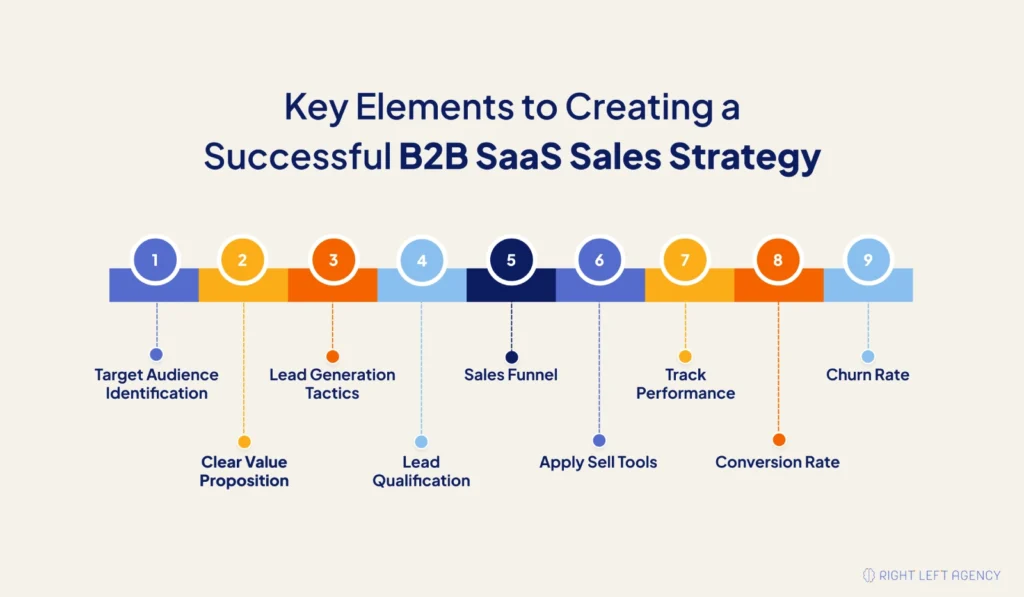
1. Target Audience Identification
A sales strategy should begin with a clear understanding of your target audience. It is not possible to sell to everyone, so knowing who would benefit most from your SaaS solution is crucial.
Start with creating a buyer persona. Specific profiles of your ideal customers based on data and research. These personas help you understand which businesses are most likely to buy your product.
For example, suppose you are selling a project management tool. Your ideal customer would be SMBs (small- to medium-sized businesses) with marketing, construction or technology services.
Questions to ask during this phase:
- What problems does my software solve?
- What are the typical pain points in the businesses I am targeting?
- What size companies do I want to target?
- What industries would benefit most from my product?
The better you are at clarifying these aspects of your business, the more effective your sales messaging and outreach will be.
2. Craft a Clear Value Proposition
The second step after you have determined your target audience is creating a value proposition that clearly explains how your product will address their individual pain points.
A great value proposition would make you stand out among competitors and will make the prospects believe that your solution is what they are looking for.
When using B2B SaaS, you will need your value proposition to address business owners and business decision-makers.
It should outline:
- What your product does- a concise explanation of what your product is all about.
- What value it adds to the business- emphasize the actual results (e.g., it saves time, it makes the business more efficient, it costs less, etc).
- Why it is better than alternatives- this may contain exclusive features, price benefits, or testimonials.
💡Pro Tip: Keep it simple. Your value proposition must be comprehensible in one sentence. Clarity is key.
3. Focus on Lead Generation Tactics
Generation of high quality leads is the backbone of a good sales strategy. Your sales process will not have a place to turn to without leads.
In B2B SaaS, it is possible to generate leads in multiple ways, such as:
- Content Marketing: Use blogs, eBooks, white papers, and webinars to attract businesses that are likely to be interested in your solution. Use SEO to make your content visible to your target audience.
- Social Media Marketing: Platforms like LinkedIn and X are great ways to reach the target business decision-makers. Post useful content, engage with prospects, and participate in relevant, industry-based conversations. This falls under the criteria of inbound sales which greatly influence your business.
- Cold Outreach: Direct outreach (cold email, cold call, or LinkedIn message) proves beneficial results when working with potential leads. This can also be defined as outbound sales. Pay attention to personalization in order to increase the probability of a positive response.
- Paid Advertising: Run paid ads on LinkedIn or Google Ads if you have the budget. These platforms enable you to focus on businesses in terms of industries, company size, and other factors.
4. Lead Qualification
After lead generation, the second important step is lead qualification. Lead qualification involves making decisions on the leads to pursue.
Not all leads are right for your SaaS product, and screening them saves you time.
In order to qualify leads, the following factors should be considered:
- Budget: Can they afford your solution?
- Decision-making authority: Are you addressing the right person?
- Need: Does your product solve a significant pain point for them?
- Preparedness: Is your lead seeking a solution, or are they merely window shopping?
Tools like CRM systems can make the qualification process smoother and track the leads at any point of the funnel.
5. Follow a Sales Funnel
A well-defined sales funnel is essential to your B2B SaaS sales strategy. It helps with directing the buying process, from awareness to decision making.
To improve your funnel:
- Trace every step: Awareness, Interest, Consideration and Decision.
- Offer value at each level by having engaging content, demos, and free trials.
- Nurture leads through with email campaigns and personalized offers.
6. Apply Sales Tools and Automation
Your B2B SaaS sales strategy can be significantly improved by using sales tools and automation. These tools facilitate work, boost efficiency, and improve accuracy.
You can follow the ways given below to maximize the use of tools and automation:
- Use CRM software to manage and track leads.
- Automate follow-up emails and reminders.
- Use analytics to improve and evaluate your sales efforts.
7. Track Performance
Performance monitoring enables you to gauge the performance of your B2B SaaS sales strategy. It is difficult to optimize or enhance without data.
Key performance indicators (KPIs) that should be monitored are:
- Conversion rate at each stage of the funnel.
- Monthly recurring revenue (MRR).
- Average size and length of sales cycle.
8. Lead-to-Customer Conversion Rate
This measure will inform you of the effectiveness of your B2B SaaS sales approach in converting leads to paying clients. A high conversion rate means that your plan is reaching the right audience.
Consider the following to improve it:
- Concentrate on high quality leads that meet your ideal customer profile.
- Create compelling, personalized offers that push leads to action.
- Follow up promptly and consistently to keep leads engaged.
9. Monitor Churn Rate
Another important customer satisfaction and retention indicator in your B2B SaaS sales approach is churn rate. A high churn rate may indicate a problem.
Reduce churn by:
- Providing excellent customer service and onboarding.
- Collecting feedback on a regular basis to enhance your product/service.
- Engaging customers with content and updates to keep them invested.
💡Pro Tip: Treat it like you are consulting them, not selling to them. Find their actual pain points before you talk about your solution. You will never be able to have a sales call that follows an exact template, so you have to improvise.
The Stages and Sales Models You Can Follow to Sell a SaaS
When you are selling a B2B SaaS product or service, it involves more than just the product or service you are offering. You need to communicate the value of your sales stages and business model.
Stages help you evaluate your current position. Understanding which stage you’re in will help you plan your next step, as each stage requires a different action plan.
After that, choose a model to sell your SaaS. Defining a sales model will help align your strategy and attract more targeted customers.
Here are the steps you need to know:
Stages of B2B SaaS Sales Process

After you have your leads qualified, it’s time to start them on the sales journey. A well-structured sales system is essential for converting leads into customers.
1. Awareness Stage
At this phase, your customers are simply becoming aware of your product. They could have discovered your content, heard about your SaaS through word-of-mouth, or stumbled upon you from paid ads.
The objective at this stage is simply to get their attention and offer value in the form of educational content.
Key Strategies: Content marketing, social media, search engine optimization (SEO), and paid ads.
2. Consideration Stage
Once a lead knows about your solution, they enter the consideration stage. Here, they begin to scrutinize your SaaS product more closely.
Now is the time for product demos, free trials, and case studies to demonstrate how your solution can help resolve their pain points.
Key Strategies: Webinars, one-on-one demos, free trials, and customer testimonials.
3. Decision Stage
The decision stage is when the lead is ready to make a purchase. They’re after one last reassurance, pricing options, and maybe comparisons with competitors.
This is where your sales team needs to come up with custom proposals, easy-to-understand pricing, and whatever last-minute incentives it takes to close the deal.
Key Strategies: Custom proposals, customized emails, and negotiations.
4. Post-Sale Stage
The journey doesn’t end after a deal is closed. In reality, that’s where customer success enters the picture.
Quote: “Start working with your prospects as if they’ve already hired you.” — Jill Konrath
You want your new client experience to be smooth and continue to engage them so that they remain satisfied and become loyal long-term clients.
Key Strategies: Onboarding, support, periodic check-ins, and customer training.
SaaS B2B Sales Models: Which One Will Fit You?
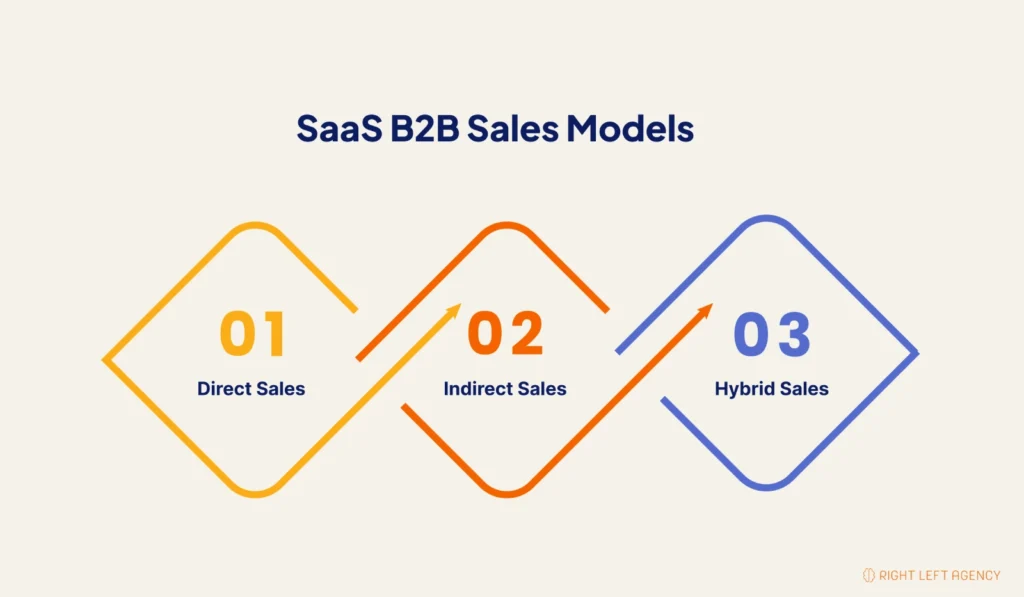
You actually have a few B2B SaaS sales models to choose from while selling SaaS. You have to decide which one is right for your business. It varies with your product complexity, target audience, and scalability.
1. Direct Sales
This is the old school sales model where your in-house sales team contacts prospects directly.
Direct sales is what you want if your product has a lot of customization or education. This approach is ideal for enterprise SaaS businesses.
2. Indirect Sales
Indirect sales use third-party partners or resellers to sell your product. This is a model that is typically used to grow quickly, particularly for SaaS companies prioritizing a large market.
However, it comes with headaches, including less control over the customer experience.
3. Hybrid Sales Model
A hybrid model is a combination of both direct and indirect sales, allowing you the freedom to target both larger enterprises with a direct approach, as well as smaller shops via partners or resellers. This is usually the most scalable model for a growing SaaS company.
Here is a table for easy understanding of the sales models mentioned above:
| Sales Model | Description | Best For |
|---|---|---|
| Direct Sales | Prospects are directly approached by sales reps. | High-touch sales, complicated solutions, enterprise SaaS. |
| Indirect Sales | Using third-party resellers or distributors. | Product subject to high volume, scalable sales for more mainstream products. |
| Hybrid Sales | Leveraging partners or affiliate networks. | Ability to scale up and reach more people without scaling up costs. |
Common Mistakes You Should Avoid When Creating a SaaS Sales Strategy
As you build your B2B SaaS sales strategy, remember to avoid common pitfalls that can sabotage success.
Here are the most common mistakes:
Targeting the Wrong Audience
One of the biggest mistakes you can make with your B2B SaaS sales strategy is targeting the wrong audience. Your sales efforts will fall flat if you focus on the wrong market.
Be clear on who your ideal customer is. Pay attention to businesses who have the need and budget for your service. That makes sure your sales strategy leads to higher conversions.
Ignoring Customer Success
It’s natural to only think of winning new clients, but customer success is equally important. Satisfied customers renew, upgrade, and refer others.
Also, don’t forget to invest in customer support and success teams for long-term relationships with the clients.
Not Using Data to Drive Decisions
Many SaaS businesses operate on intuition instead of data. However, data-based decisions are definitely more effective.
Track customer behavior, sales performance, and engagement metrics using analytics tools to adjust your strategy as necessary.
Inadequate Marketing
Marketing is a crucial factor for B2B SaaS sales. Without proper marketing, potential customers will never find your SaaS product. Make sure your marketing efforts align with your target audience.
Create clear, engaging content and leverage digital platforms such as social media and email marketing. This will raise brand awareness and attract leads.
Overcomplicating the Sales Process
A straightforward sales process is the key to closing deals fast. If your sales process is too convoluted, leads might lose interest.
Keep your sales funnel clear and easy. Stay focused on adding value and solving your customers’ pain points. An easier process yields faster conversions and happier customers.
Lack of After-Sales Support
Your relationship with customers doesn’t end after the sale. Strong after-sale support is necessary for customer retention.
Provide continued support, training and resources to help customers succeed. This is trust building and renewal encouraging, and will create lifelong partners out of your buyers.
Conclusion
Creating an effective B2B SaaS sales strategy is not about the latest sales tricks, or hunkering down and closing as many deals as possible.
It’s about developing a scalable, sustainable process to attract leads, nurture them as they move through the sales funnel, and ideally become long-term customers.
Focus on these critical elements and refine your approach, and you can drive ongoing growth for your SaaS business.
The B2B SaaS market is a crowded place, but the right approach, tools, and mindset can help your business skyrocket. Begin with a well-defined target market, compelling value proposition and focused sales process – and you’ll soon begin to see the results of your efforts.