

Key Takeaways
- The best SaaS development agencies help companies build secure, scalable, and user-friendly software products.
- Early-stage teams should prioritize discovery, MVP planning, UX design, and technical trade-offs.
- Scaling SaaS teams should prioritize architecture, DevOps, integrations, security, and post-launch support.
- A reliable SaaS development agency should understand both software engineering and the SaaS business model.
- Your best-fit agency depends on product stage, budget, technical complexity, internal team, and growth goals.
- After launch, SaaS teams should plan for maintenance, performance optimization, user feedback, and product iteration.
Choosing the wrong SaaS development agency doesn’t just delay your launch. It can saddle your product with technical debt, stall revenue, and force expensive rebuilds down the line. Some founders spend six months building, only to discover the platform can’t hold up under real users. That’s why agency selection isn’t just a hiring decision. It’s a product, growth, and revenue decision.
The right agency depends entirely on where you are. Early-stage founders need a partner who leads with discovery, MVP scoping, and validation. Scaling teams need depth in architecture, cloud infrastructure, security, integrations, and the operational muscle to support a live product.
The strongest SaaS development agencies cover the full lifecycle. From product strategy and UI/UX design through frontend and backend engineering, API integrations, cloud deployment, QA, and post-launch support. What separates them from general software vendors isn’t the service list. It’s whether they understand how SaaS products actually grow: recurring revenue models, subscription billing, user retention, and the infrastructure decisions that become either foundations or bottlenecks as you scale.
What Does a SaaS Development Agency Do?
A SaaS development agency helps companies plan, design, build, launch, and scale cloud-based software products. The best agencies go beyond writing code; they combine product strategy, architecture, UI/UX, engineering, QA, DevOps, and post-launch support into a single, coordinated process.
Strategy and Planning
- Product discovery
- Market and user research
- MVP scoping
- SaaS architecture planning
Design and Development
- UI/UX design
- Frontend and backend development
- API and third-party integrations
- Payment and billing integration
Launch and Support
- Cloud deployment and DevOps setup
- QA testing and security planning
- Product maintenance
- Performance optimization
What sets a SaaS-focused agency apart from a general software vendor is domain fluency. They understand how recurring revenue products actually work: subscription billing, user roles, retention workflows, admin dashboards, third-party integrations, and the kind of scalable cloud infrastructure that supports long-term growth.
SaaS Development Agency Comparison
| Agency | Best For | Core Services | Ideal Stage | Delivery Model / Region | Pricing Signal | Not Best For |
|---|---|---|---|---|---|---|
| Netguru | MVPs and scaleups | Discovery, UX, development, cloud, QA | Startup to growth | Europe/global delivery | Premium/custom | Very low-cost prototypes |
| BairesDev | Enterprise SaaS and team extension | Staff augmentation, dedicated teams, custom SaaS, modernization | Mid-market to enterprise | Nearshore/global delivery | Custom/team-based | Heavy early product strategy |
| Simform | Cloud-native SaaS platforms | Product engineering, cloud, DevOps, AI, data, QA | Growth to enterprise | US/global delivery | Custom/project-based | Simple MVPs with low complexity |
| Intellias | Enterprise SaaS and modernization | SaaS consulting, cloud, platform engineering, support | Mid-market to enterprise | Europe/global delivery | Enterprise/custom | Lean first-version products |
| Appinventiv | SaaS MVPs and app-based products | MVP, custom SaaS, integrations, cloud migration, maintenance | Startup to enterprise | Global delivery | Custom/project-based | Narrow boutique technical tasks |
| STX Next | Python, AI, data, and cloud SaaS | Python, AI/ML, data, cloud, backend engineering | Mid-market to enterprise | Europe/global delivery | Custom/team-based | Brand design or simple marketing sites |
| Cheesecake Labs | Nearshore SaaS product teams | Strategy, UI/UX, web, mobile, AI, data | Startup to enterprise | Brazil/US nearshore delivery | Custom/flexible | Backend-only work without product input |
| Brainhub | SaaS product engineering | Web apps, frontend, backend, team extension | Startup to growth | Europe/global delivery | Custom/team-based | Full marketing or GTM strategy |
Our Selection Methodology
We reviewed these SaaS development companies based on publicly available service pages, SaaS-specific positioning, product engineering focus, delivery model, technical expertise, and buyer-fit signals.
This list is not based on paid placement. It is also not a ranking of “best overall” for every SaaS company. It is a shortlist based on different use cases, because the right agency depends on your product stage, budget, internal team, and technical complexity.
We limited the list to a small set of agencies to keep the guide practical and easier to compare, rather than creating a long directory-style roundup.
How We Evaluated Each Agency
- SaaS-specific service pages or case studies
- Experience with MVPs, scaling, modernization, or enterprise SaaS
- Technical capability across cloud, DevOps, APIs, security, and architecture
- Product discovery and strategy process
- UI/UX and product design support
- Delivery model: project, dedicated team, or staff augmentation
- Public proof signals such as portfolios, reviews, rankings, or client examples
- Post-launch maintenance and support
A strong SaaS product development company should do more than write code. It should help you reduce product, technical, security, and budget risk before expensive development begins.
Best SaaS Development Agencies by Use Case
| Use Case / Situation | Recommended Agency | Why |
|---|---|---|
| MVP development | Netguru, Appinventiv | Discovery, MVP planning, UX, and early-stage development |
| Enterprise SaaS | Intellias, BairesDev | Scalable architecture, modernization, and larger engineering teams |
| Cloud-native SaaS | Simform | Cloud, DevOps, backend, AI, data, and platform infrastructure |
| Python, AI, or data-heavy SaaS | STX Next | Python, AI, ML, data pipelines, automation, and backend systems |
| Nearshore product teams | Cheesecake Labs | Product design, full-stack development, and nearshore collaboration |
| Product engineering | Brainhub | Engineering execution, team extension, and SaaS product delivery |
| Limited budget, testing demand | No-code tool, freelancer, or lightweight MVP partner | Low commitment, fast validation, minimal upfront cost |
| Need more engineering capacity | Dedicated team or staff augmentation partner | Scales with your team without a full agency engagement |
| Long-term product ownership | In-house team after agency launch | Agencies hand off; in-house owns the roadmap |
List of the Best SaaS Development Agencies
This list is not ranked from best to worst. Each agency is included because it fits a different SaaS development need. Use the comparison tables first, then review the agency profiles that match your product stage, budget, and technical requirements.
1. Netguru
Best For: Startups and scaleups that need product strategy, UX design, and engineering support.
Netguru is a practical choice for SaaS founders who need a design-led product team before writing code. It works especially well when the product still needs validation, MVP scoping, UX planning, and early engineering support.
Netguru’s SaaS development services focus on concept-to-launch support, SaaS consulting, product strategy, design, development, QA, and continuous improvement.
Reference checked: Official SaaS development service page, June 2026.
Core Services
- SaaS product development
- Product discovery
- UI/UX design
- MVP development
- Web and mobile development
- Cloud application development
- API development
- QA and testing
Why Netguru Stands Out
Netguru is a good match when product experience matters as much as engineering. Its discovery and design process can help founders avoid overbuilding and focus on what users need first.
Pros
- Structured product discovery process
- Suitable for MVPs and scaleups
- Good balance of design and engineering
- Useful for founders who need product clarity
Cons
- May not fit very small MVP budgets
- Larger projects may require more stakeholder coordination
Not Ideal For
Netguru may not be ideal for teams that only need a very small prototype or the lowest-cost build possible.
Best Fit
Choose Netguru if you need a SaaS product development agency that can support strategy, design, engineering, and launch planning together.
2. BairesDev
Best For: Enterprise SaaS companies and teams that need nearshore engineering support.
BairesDev is a large SaaS development company known for custom software development, nearshore delivery, staff augmentation, and dedicated teams.
Its SaaS service positioning focuses on custom SaaS solutions, modernization, scalable applications, and faster product launches. This works best for SaaS teams that already know what they need to build but lack enough engineers to deliver it quickly.
Reference checked: Official SaaS development service page, June 2026.
Core Services
- Custom SaaS development
- SaaS modernization
- Dedicated development teams
- Staff augmentation
- Web development
- Cloud-based software engineering
- Enterprise software development
Why BairesDev Stands Out
BairesDev works well for SaaS companies that need speed, scale, and development capacity. Its model suits enterprise teams that want to extend their internal engineering team without hiring slowly.
Pros
- Large engineering talent network
- Good for scaling development capacity
- Suitable for enterprise and mid-market SaaS teams
- Nearshore delivery model for US-based companies
Cons
- Less suitable for founders who need deep product strategy
- Best suited for companies with clear technical direction
Not Ideal For
BairesDev may not be ideal for founders who need heavy product discovery, positioning, or UX strategy before development.
Best Fit
Choose BairesDev if you need a SaaS software development company to extend your engineering team or modernize an existing platform.
3. Simform
Best For: Cloud-native SaaS platforms, AI-enabled products, and platform engineering.
Simform is a digital product engineering company focused on product engineering, cloud, DevOps, data, AI/ML, and scalable software systems.
Its service focus includes cloud and DevOps engineering, product engineering, data engineering, AI/ML, UX-led engineering, and QA. Simform is better suited for complex SaaS platforms than simple web apps.
Core Services
- Product engineering
- Cloud and DevOps engineering
- AI/ML engineering
- Data engineering
- Platform modernization
- UX-led engineering
- Backend development
- QA engineering
Why Simform Stands Out
Simform is best suited to technical SaaS products that need cloud architecture, backend systems, automation, and scalable engineering.
Pros
- Strong cloud and DevOps capability
- Suitable for AI and data-heavy SaaS products
- Good match for high-growth SaaS platforms
- Practical for complex backend systems
Cons
- May be more technical than needed for simple MVPs
- Requires clear product and business goals for best results
Not Ideal For
Simform may not be ideal for simple SaaS MVPs with limited technical complexity or low infrastructure needs.
Best Fit
Choose Simform if your SaaS team needs cloud, DevOps, backend, and platform engineering support.
4. Intellias
Best For: Enterprise SaaS platforms, product modernization, and complex software ecosystems.
Intellias provides SaaS consulting, product development, cloud support, and platform engineering services.
Its SaaS positioning focuses on performance, availability, scalability, cloud computing, and end-to-end product development. Intellias is better suited to companies that already have complex product requirements and need enterprise-level engineering, cloud planning, and long-term platform support.
Core Services
- SaaS consulting
- SaaS product development
- SaaS application development
- Cloud migration
- Product modernization
- Platform engineering
- Security-focused engineering
- Long-term support
Why Intellias Stands Out
Intellias is a reliable option for enterprise SaaS products that need planning, architecture, and ongoing development. It is especially relevant when scalability, compliance, and system complexity matter.
Pros
- Enterprise software experience
- Suitable for complex SaaS platforms
- Covers consulting, development, and support
- Good fit for modernization projects
Cons
- May not fit small MVP budgets
- Enterprise delivery may feel heavy for early startups
Not Ideal For
Intellias may not be ideal for teams that need a lean first version, fast prototype, or low-budget MVP.
Best Fit
Choose Intellias if you need a custom SaaS development company for a complex, enterprise-level, or modernization-focused project.
5. Appinventiv
Best For: SaaS MVPs, app-based SaaS platforms, and end-to-end development.
Appinventiv offers a wide range of SaaS development services, including SaaS consulting, application development, custom SaaS development, MVP development, integrations, product development, and cloud migration.
Its service model covers the journey from early concept to development, launch, and post-launch support. This works well for teams that want one partner across the product lifecycle.
Core Services
- SaaS consulting
- SaaS MVP development
- Custom SaaS development
- SaaS application development
- SaaS integration services
- SaaS cloud migration
- SaaS product development
- Maintenance and support
Why Appinventiv Stands Out
Appinventiv has broad service coverage. It can support founders across discovery, design, development, integration, launch, and maintenance.
Pros
- Wide SaaS service range
- Suitable for MVP and app-based SaaS products
- Covers development and cloud migration
- Supports API and third-party integrations
Cons
- Broad service scope requires tight project management
- Buyers should confirm the assigned team has experience with similar SaaS workflows, integrations, and architecture
Not Ideal For
Appinventiv may not be ideal if you need a highly specialized boutique team for one narrow technical challenge.
Best Fit
Choose Appinventiv if you need a SaaS MVP development agency with end-to-end product development capabilities.
6. STX Next
Best For: Python-based SaaS products, AI platforms, data tools, and cloud systems.
STX Next is known for Python, AI, data, and cloud software engineering. This makes it a strong choice for SaaS products that depend on backend logic, data pipelines, machine learning, or automation.
Its positioning focuses on modern data, AI, and cloud solutions for enterprise and mid-sized companies. STX Next is especially relevant for analytics tools, fintech platforms, AI products, industrial software, and data-heavy SaaS systems.
Core Services
- AI and ML development
- Data engineering
- Cloud software development
- Python development
- Product engineering
- Backend development
- Digital transformation
Why STX Next Stands Out
STX Next is a suitable partner for technical SaaS products where backend quality matters. Its Python and data engineering background can support complex platforms.
Pros
- Strong Python engineering background
- Suitable for AI and data-driven SaaS
- Practical for cloud-based platforms
- Good match for complex backend development
Cons
- Less focused on simple no-code-style MVPs
- Design and UX scope should be clarified before hiring
Not Ideal For
STX Next may not be ideal if your main need is brand design, marketing site development, or a lightweight MVP.
Best Fit
Choose STX Next if your SaaS development project requires Python, cloud, data, or AI engineering.
7. Cheesecake Labs
Best For: Nearshore SaaS product teams, product design, and full-stack development.
Cheesecake Labs provides strategy, design, and engineering services for mobile, web, blockchain, and AI applications.
Its service positioning combines product strategy, design, full-stack engineering, AI, data, and flexible delivery models. This works well for US teams that want nearshore collaboration across product design and full-stack engineering.
Core Services
- Product strategy
- UI/UX design
- Web development
- Mobile development
- AI application development
- Data engineering
- Full-stack software engineering
- Staff augmentation
Why Cheesecake Labs Stands Out
Cheesecake Labs is a good match for SaaS teams that need product thinking and technical execution. Its design and engineering mix can reduce handoff gaps between planning and development.
Pros
- Product design and engineering under one roof
- Nearshore delivery for US companies
- Suitable for web and mobile SaaS products
- Flexible team models
Cons
- Blockchain and AI focus may not fit every SaaS buyer
- Buyers should verify SaaS-specific portfolio relevance before hiring
Not Ideal For
Cheesecake Labs may not be ideal for backend-only projects that do not require product design or cross-functional collaboration.
Best Fit
Choose Cheesecake Labs if you need a SaaS app development agency with nearshore delivery, product design, and full-stack engineering support.
8. Brainhub
Best For: SaaS product engineering and team extension.
Brainhub is a software development company focused on product engineering, team extension, and SaaS development.
Its SaaS company ranking highlights SaaS product development services, expertise, team structure, and working culture. Brainhub fits teams that need engineering support and want a product-focused development partner.
Core Services
- Software development
- Web app development
- Frontend development
- Backend development
- Team extension
- Product engineering
- SaaS application development
Why Brainhub Stands Out
Brainhub fits SaaS teams that need execution-focused engineering support. It can help teams expand development capacity without hiring a full internal team.
Pros
- Product-focused engineering approach
- Suitable for SaaS engineering teams
- Useful for team extension
- Good match for web applications
Cons
- Not a full go-to-market or marketing partner
- Discovery scope should be clarified before starting
Not Ideal For
Brainhub may not be ideal if you need full marketing, positioning, sales strategy, or revenue operations support with development.
Best Fit
Choose Brainhub if you need a SaaS product development agency focused on engineering execution and team extension.
How to Choose the Right SaaS Development Agency
Direct answer: Choose a SaaS development agency by reviewing SaaS case studies, architecture experience, discovery process, security practices, pricing clarity, code ownership terms, and post-launch support.
Choosing the right SaaS development partner takes more than comparing portfolios. You need to understand how each agency thinks, plans, builds, communicates, secures, and supports your product after launch.
If you are pre-launch, prioritize discovery, MVP planning, and UX. If you are scaling, prioritize architecture, DevOps, security, performance, and support.
1. Review SaaS-Specific Case Studies
Do not only look for beautiful websites or mobile apps. Look for real SaaS product development examples.
Check whether the agency has built:
- Dashboards
- Subscription platforms
- Admin panels
- User role systems
- Billing workflows
- API-connected products
- Multi-tenant applications
2. Ask About Product Discovery
A reliable agency should not start with code. It should start with discovery.
This process should clarify:
- User needs
- Core features
- MVP scope
- Technical risks
- Development timeline
- Product roadmap
- Budget priorities
Before development begins, align the agency’s discovery process with your product positioning, ICP, use cases, and go-to-market goals.
3. Check Architecture Experience
SaaS products need the right architecture from the beginning.
Ask about:
- Cloud infrastructure
- Database design
- Multi-tenant architecture
- API structure
- Security layers
- Performance planning
- Scalability
Poor architecture can slow your product down when users grow. It can also create problems for performance, analytics, product expansion, and future growth.
4. Evaluate UI/UX Capability
Great SaaS products are not just functional. They are easy to use.
Your agency should understand:
- Onboarding flows
- Product dashboards
- Feature hierarchy
- User permissions
- In-app guidance
- Conversion paths
- Retention-focused design
Strong UI/UX design improves adoption and reduces churn.
5. Confirm Code Ownership
Before signing, clarify who owns the code.
Ask about:
- Source code ownership
- Repository access
- Documentation
- Third-party tools
- Licensing
- Deployment credentials
You should not be locked out of your own product.
6. Understand Post-Launch Support
Launch is not the end of SaaS development. It is the beginning of product improvement.
Ask if the agency supports:
- Bug fixes
- Feature updates
- Performance monitoring
- Security patches
- Cloud optimization
- Product analytics
- Maintenance retainers
A strong post-launch plan protects your product after users arrive.
7. Ask About Security and Compliance
Security is critical for SaaS, especially if the product stores customer data, payment data, health data, or business-sensitive information.
Ask how the agency handles:
- Authentication
- User permissions
- Data protection
- Backups
- Monitoring
- Security testing
- Incident response
- Compliance requirements
Depending on your market, your SaaS product may need GDPR, SOC 2 readiness, HIPAA, PCI, or other security considerations. Even if certification is not required yet, the architecture should not create future compliance problems.
Recap: Do not choose based on portfolio design alone. Choose based on SaaS experience, technical architecture, discovery quality, ownership terms, security practices, and post-launch support.
SaaS Agency Evaluation Checklist
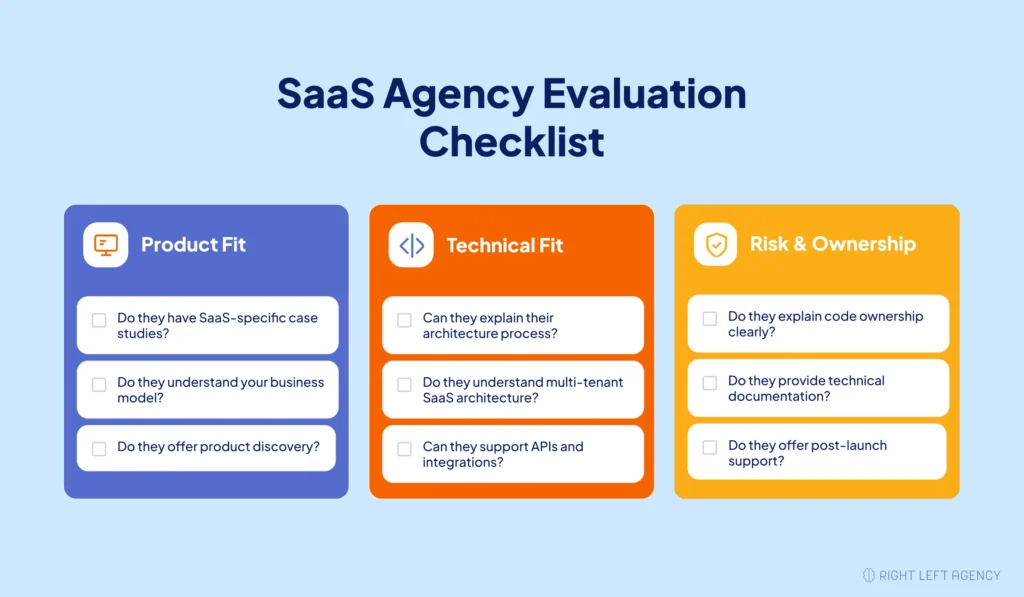
Use this checklist before signing with any SaaS development company.
Product Fit
☐ Do they have SaaS-specific case studies?
☐ Do they understand your business model?
☐ Do they offer product discovery?
☐ Can they explain which features should wait until after the MVP?
☐ Can they explain trade-offs between speed, cost, scalability, and feature depth?
Technical Fit
☐ Can they explain their architecture process?
☐ Do they understand multi-tenant SaaS architecture?
☐ Can they support APIs and integrations?
☐ Do they offer QA and testing?
☐ Do they provide DevOps and cloud deployment?
☐ Can they support UI/UX design?
Risk and Ownership
☐ Do they explain code ownership clearly?
☐ Do they provide technical documentation?
☐ Do they offer post-launch support?
☐ Can they support security and compliance needs?
☐ Can they work within your budget and timeline?
☐ Do they communicate clearly during sales calls?
If an agency struggles to answer these questions, it may not be the right partner.
When a SaaS Development Agency May Not Be the Right Fit
A SaaS development agency is not always the best option.
You may not need an agency if:
- You only need a small landing page or prototype.
- You already have a full internal product team.
- Your scope is unclear, and you are not ready for discovery.
- You need the lowest-cost build possible.
- You want full daily control over every technical decision.
- You only need one narrow technical task.
- You are testing an idea that can be validated with no-code tools first.
- You only need extra developers, and your internal team already has senior product, architecture, QA, and delivery leadership.
In these cases, freelancers, no-code tools, staff augmentation, or an in-house hire may be more practical.
This does not mean agencies are a bad choice. It means the right model depends on your stage, budget, product risk, and internal leadership.
SaaS Development Agency vs In-House Team vs Freelancers
Different hiring models work for different stages.
| Option | Best For | Pros | Cons |
|---|---|---|---|
| SaaS development agency | MVPs, full builds, modernization | Strategy, design, engineering, process | Higher cost than freelancers |
| In-house team | Long-term product ownership | Full control and deep product knowledge | Slow and expensive to hire |
| Freelancers | Small tasks or prototypes | Flexible and affordable | Harder to manage at scale |
| Dedicated team/staff augmentation | Scaling engineering capacity | Flexible and fast | Needs strong internal product and technical leadership |
| No-code/low-code team | Fast validation and internal tools | Lower upfront cost and faster testing | May limit scalability, customization, and long-term architecture |
A SaaS development agency is usually best when speed, structure, and multi-disciplinary support matter. An in-house team is better for long-term ownership. Freelancers are useful for small tasks, but they are risky for full SaaS platforms unless you have strong technical leadership.
For most SaaS startups, the best path is often staged: use no-code or a prototype to validate demand, hire an agency to build the first scalable version, then move more product ownership in-house once the product has traction.
How Much Does It Cost to Hire a SaaS Development Agency?
Hiring a SaaS development agency can cost from $3,000 for a simple MVP to $150,000+ for a complex platform. The final cost depends on product scope, architecture, integrations, security requirements, team location, timeline, and post-launch support.
These ranges are directional, not fixed quotes. A US-based enterprise agency, nearshore team, and offshore development partner may price the same scope very differently.
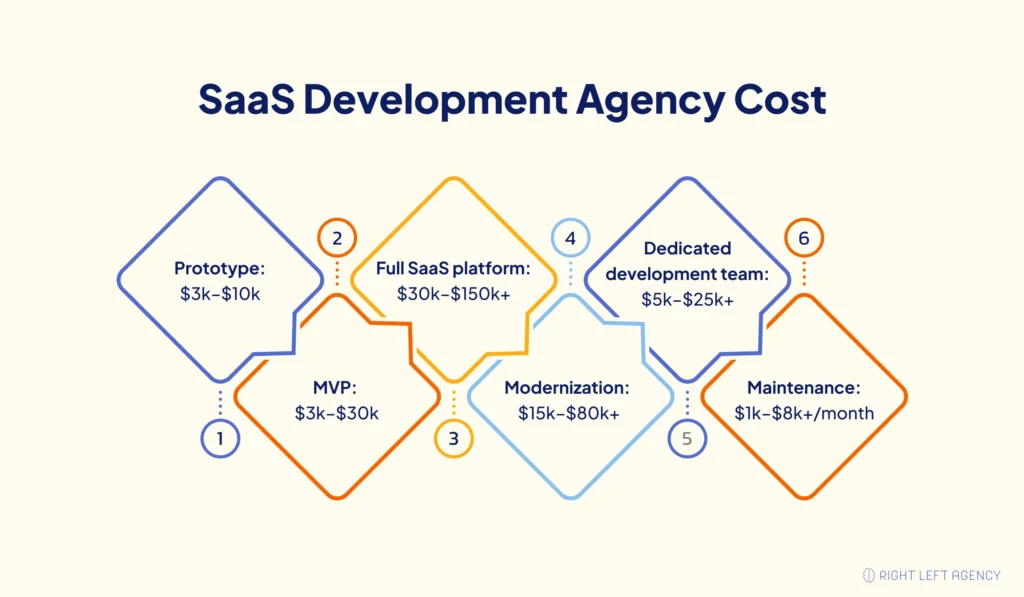
A fixed-scope project, dedicated team, and staff augmentation model can also produce very different monthly and total costs.
| Project Type | Estimated Cost Range | Best For |
|---|---|---|
| SaaS prototype | $3,000–$10,000 | Idea validation |
| SaaS MVP development | $3,000–$30,000 | Early-stage founders |
| Full SaaS platform | $30,000–$150,000+ | Funded startups and scaleups |
| SaaS modernization | $15,000–$80,000+ | Existing products |
| Dedicated development team | $5,000–$25,000+ per month | Ongoing development |
| Maintenance and support | $1,000–$8,000+ per month | Post-launch support |
Common SaaS Development Cost Drivers
- Number of user roles
- Billing complexity
- API integrations
- AI or automation features
- Compliance needs
- Cloud infrastructure
- Data migration
- QA and testing depth
- Product analytics
- Ongoing maintenance
Features like AI, complex user permissions, usage-based billing, HIPAA or GDPR compliance, real-time data, and multiple integrations can increase development cost.
The cheapest quote is not always the lowest-risk option. A poorly scoped build can create technical debt, missed launch dates, and expensive rebuilds.
The right SaaS product development agency should protect your budget by building the right product, not just the most features.
SaaS Agency Red Flags
Not every SaaS development agency is a good fit.
Strategy Red Flags
- No SaaS-specific case studies — they may not understand subscription products or SaaS architecture.
- No discovery process — they may build before understanding users, risks, and priorities.
- No understanding of your business model — they may build software that does not support revenue.
- Too much focus on features — they may ignore user experience, adoption, and retention.
Technical Red Flags
- No DevOps or deployment plan — this can create launch, uptime, and performance issues.
- No security or compliance discussion — SaaS products often handle customer data, permissions, billing, and integrations.
- No documentation process — poor documentation makes it harder to maintain, scale, or transfer the product later.
- No analytics or product measurement plan — SaaS teams need usage data to improve activation, retention, and conversion.
Commercial Red Flags
- Vague pricing — unclear estimates often lead to scope issues later.
- Unrealistic timelines — fast promises can create poor architecture and technical debt.
- No post-launch support — SaaS products need bug fixes, monitoring, and feature updates.
- No clear code ownership terms — you may face vendor lock-in.
- Unclear team structure — if you do not know who will handle product, design, engineering, QA, and project management, delivery risk increases.
A weak agency can create technical debt that slows your growth for years.
Questions to Ask Before Hiring a SaaS Development Agency
Ask these questions before choosing a SaaS development partner.
Product Strategy Questions
- Have you built SaaS products similar to ours?
- Can you show relevant SaaS case studies?
- What is your product discovery process?
- How do you define MVP scope?
- How do you prioritize features?
- How will you help us decide what not to build in the MVP?
Technical Architecture Questions
- How do you design scalable SaaS architecture?
- Which cloud platforms do you work with?
- How do you handle API integrations?
- How do you manage performance as usage grows?
- How do you document architecture decisions?
Security and Compliance Questions
- How do you handle authentication and permissions?
- How do you manage customer data security?
- Do you have experience with GDPR, SOC 2 readiness, HIPAA, or PCI requirements?
- How do you handle backups, monitoring, and incident response?
- What security testing is included before launch?
Pricing and Timeline Questions
- How do you estimate project cost?
- What assumptions is this estimate based on?
- What can increase the budget?
- How do you handle scope changes?
- What does the delivery timeline look like?
- What is included in the proposal?
Ownership and Support Questions
- Who owns the source code?
- Will we get technical documentation?
- Can another team take over the codebase later if needed?
- What project management tools do you use?
- What happens after launch?
- Do you provide maintenance and support?
The answers will show whether the agency is a true partner or just a development vendor.
After Launch: Growth and Iteration
Choosing a SaaS development agency solves the product-building problem. But after launch, your SaaS needs maintenance, product feedback loops, performance monitoring, onboarding improvements, and growth systems.
After launch, your priority is not only traffic. It is learning how users interact with the product. Track onboarding, activation, feature usage, bugs, performance, support tickets, and churn signals.
Then connect those insights with SEO, paid acquisition, landing pages, lifecycle campaigns, and conversion paths that turn visitors into demos, trials, and revenue.
After your SaaS product is live, your team should focus on:
- Product analytics
- Onboarding improvements
- Feature usage tracking
- Bug fixes and maintenance
- Performance optimization
- Security patches
- Cloud optimization
- User feedback loops
- Lifecycle marketing
If your product is already live but not converting traffic into demos, trials, or qualified leads, explore Right Left Agency’s B2B SaaS marketing services to connect product insights with SEO, paid media, landing pages, and lead generation.
For more SaaS growth insights, visit the Right Left Agency blog.
FAQs
What is a SaaS development agency?
A SaaS development agency helps companies build subscription-based software products that run in the cloud. This includes product discovery, UX design, software engineering, cloud deployment, integrations, QA, security, and post-launch improvements.
How do I choose the best SaaS development agency?
Choose the best agency by reviewing SaaS case studies, architecture experience, discovery process, communication quality, pricing clarity, UI/UX skills, security planning, code ownership terms, and post-launch support.
How much does it cost to build a SaaS product?
The cost to build a SaaS product can range from $30,000 for a simple MVP to $500,000+ for a complex platform. The final cost depends on features, design, architecture, integrations, cloud infrastructure, security, and maintenance needs.
How long does SaaS development take?
A basic SaaS MVP may take 3–6 months. A full SaaS platform can take 6–12 months or longer. The timeline depends on scope, technical complexity, team size, feedback cycles, and product requirements.
What is the difference between SaaS MVP development and full SaaS product development?
SaaS MVP development focuses on building the smallest useful version of the product to validate the idea, users, and core workflow. Full SaaS product development includes broader architecture, role permissions, billing, integrations, scalability, QA, security, analytics, and long-term support.
Should I hire a SaaS agency or freelancers?
Hire a SaaS development agency if you need product strategy, design, engineering, QA, and support in one team. Freelancers can work for small tasks, but they are harder to manage for complex SaaS platforms.
What services do SaaS development agencies offer?
Most SaaS development agencies offer discovery, UX design, MVP development, frontend and backend engineering, integrations, cloud deployment, QA, security, and maintenance.
What should I look for in a SaaS development agency portfolio?
Look for SaaS dashboards, subscription workflows, admin panels, integrations, onboarding flows, cloud deployments, and products similar to your business model. A general app portfolio is not enough.
What is the difference between a SaaS development company and a software development company?
A general software company can build many types of applications. A SaaS development company focuses on cloud-based subscription products, user management, billing, integrations, scalability, security, and recurring revenue workflows.
Final Thoughts
The best SaaS development agencies help you build more than software. They help you create a product that users can adopt, trust, and keep using.
The best agency is not always the biggest or most expensive one. It is the partner that understands your product stage, technical risks, users, budget, and growth model.
If you are building from scratch, choose an agency that can guide discovery and MVP development. If you are scaling, choose a team with cloud, DevOps, security, and architecture experience.Once your product is live, do not stop at development. Connect your SaaS product with SaaS SEO and growth strategy, paid media, lead generation, and conversion strategy so your software can become a real growth engine.