Key Takeaways
- Prioritize ICP alignment and decision-maker relevance over the total number of contacts.
- Verify contact accuracy, email validity, and data freshness before purchasing.
- Review data sources, privacy requirements, and permitted outreach methods.
- Test representative samples and use consistent quality metrics to compare vendors.
- Evaluate cost per usable contact instead of relying on the advertised price per record.
Buying a B2B sales lead list can help your team identify potential customers faster. But more contacts do not automatically mean more qualified opportunities.
A database might contain thousands of email addresses, yet many could belong to people outside your target market, employees who have changed jobs, or contacts with no influence over purchasing decisions.
For B2B companies, poor-quality contact data creates more than wasted prospecting time. It can affect campaign efficiency, sales productivity, and the reliability of your pipeline reporting.
Before purchasing a list, you need to know whether the contacts are relevant, accurate, sufficiently current, and appropriate for your intended outreach.
This guide covers ten essential quality checks for evaluating B2B contact data, along with a practical testing framework to help you compare vendors before committing your budget.
What Makes a High-Quality B2B Sales Lead List?
A high-quality B2B sales lead list contains accurate, up-to-date contact information from companies that match your ideal customer profile (ICP). It should identify relevant decision-makers, support your sales strategy, and meet applicable data privacy requirements.
Quality matters more than volume. A smaller list of relevant, verified contacts can be more valuable than thousands of poorly targeted records.
| Quality Factor | What to Evaluate |
|---|---|
| ICP alignment | Companies match your target market |
| Contact relevance | Appropriate decision-makers and influencers |
| Accuracy and freshness | Correct, recently verified information |
| Data completeness | Essential contact and company details |
| Source and compliance | Transparent sourcing and lawful use |
| CRM readiness | Usable, properly formatted, duplicate-free records |
| Vendor reliability | Documented quality claims and clear remedies |
Remember, verified contact information does not guarantee buying intent. The goal is to identify relevant, reliable, and legally usable contacts that support qualified sales opportunities.
10 Quality Checks Before Buying B2B Contact Data
Not every sales lead list is suitable for every organization. The following checks help B2B sales and marketing teams evaluate whether a provider’s records are relevant, reliable, and worth purchasing.
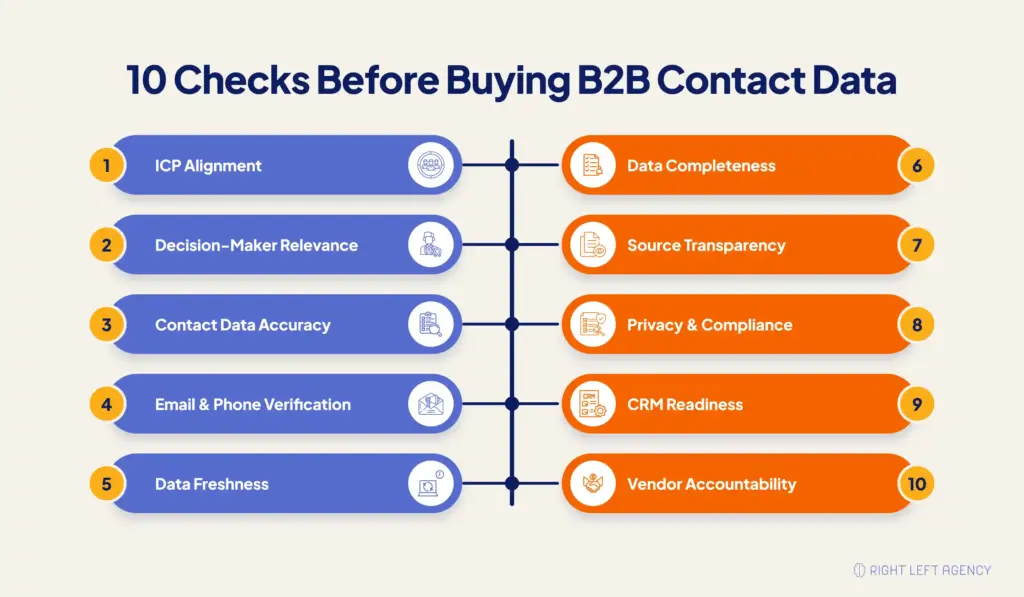
1. Does the Lead List Match Your Ideal Customer Profile?
A quality lead list should match your ideal customer profile (ICP), including industry, company size, location, and business requirements.
What to check: Request a sample, verify ICP alignment, and distinguish confirmed company information from estimates. Prioritize relevant contacts over database size.
Learn more about building B2B sales lead lists.
2. Are the Contacts Relevant Decision-Makers and Buying Influencers?
Reaching the right company matters, but contacting the right people is equally important.
What to check: Verify job titles, departments, seniority, and current employment. For account-based marketing (ABM), ensure the list includes relevant decision-makers and buying influencers.
3. How Accurate Are the Company and Contact Details?
Incorrect job titles, outdated employers, and inaccurate company details can undermine outreach and segmentation.
What to check: Independently verify a sample of contact records, including names, roles, employers, domains, and locations.
Field Accuracy Rate = (Correct Fields ÷ Total Fields Checked) × 100
4. Are Email Addresses and Phone Numbers Properly Verified?
Unverified contact details can waste prospecting time and create email deliverability issues.
What to check: Review verification methods, timestamps, and the handling of uncertain records. Distinguish verified emails from addresses guessed using company naming patterns.
Remember, a verified email does not guarantee delivery or permission to contact someone.
5. When Was the Contact Data Last Updated?
Outdated contact information can result from job changes, company restructuring, or inactive communication channels.
What to check: Request record-level verification dates and understand the vendor’s update process. Prioritize recent verification of employment, job titles, and contact details.
6. Does the List Include All the Data Your Sales Team Needs?
Incomplete records make targeting, personalization, and lead qualification more difficult.
What to check: Confirm that required fields are available, including contact names, job titles, company details, industry, location, and relevant contact information.
Complete-Record Rate = (Records With All Required Fields ÷ Total Records) × 100
Completeness does not guarantee accuracy.
7. Can the Provider Explain Where Its Contact Data Comes From?
Transparent data sourcing helps establish reliability and identify potential usage restrictions.
What to check: Ask how records are collected, whether third-party information is licensed, and how corrections or removal requests are handled.
Publicly available information is not automatically available for unrestricted marketing use.
8. Does the Data Meet Applicable Privacy and Outreach Requirements?
Purchased B2B contact data must comply with applicable privacy and marketing regulations.
Key requirements:
- EU GDPR: Requires an appropriate lawful basis for processing personal data and compliance with relevant obligations.
- UK GDPR and PECR: Govern personal data processing and electronic marketing, with different rules for corporate and individual subscribers.
- US CAN-SPAM: Requires compliant commercial emails, including accurate sender information and an opt-out mechanism.
What to check: Verify data sourcing, applicable lawful basis or consent evidence, permitted use, and suppression procedures.
Vendor compliance claims alone are insufficient.
9. Is the Data Free From Duplicates and Ready for CRM Integration?
Duplicate records and inconsistent formatting can increase costs, create repeated outreach, and affect reporting accuracy.
What to check: Identify duplicate contacts, verify CRM field compatibility, and check overlap with existing records. Test a small import before adding the complete list.
10. Can the Vendor Prove Its Quality Claims and Offer Clear Remedies?
Claims such as “premium verified contacts” are only useful when supported by measurable standards.
What to check: Review sample-testing options, accuracy definitions, replacement policies, refund terms, and data usage restrictions.
Choose vendors that provide transparent quality evidence and clear remedies for invalid records. Remember that data-quality guarantees do not guarantee sales results.
How to Test a B2B Lead List Before Purchasing
The most reliable practical approach is to evaluate a representative sample against requirements established before you see the vendor’s results.
This helps prevent a purchasing decision based only on database size, advertised accuracy, or price.
Step 1: Define the Minimum Requirements
Document your ICP, target job functions, geographic markets, mandatory fields, and intended outreach channels.
Also establish what would make a record unusable.
For example, a record could be rejected because the company falls outside your ICP, the person no longer works there, or a required contact field cannot be verified.
Legal and permitted-use requirements should be treated as mandatory conditions.
Step 2: Request a Representative Sample
For an initial screening, a sample of 50–100 records can reveal obvious problems if the provider allows it.
However, this is an illustrative starting point, not a statistically guaranteed sample size.
The appropriate sample depends on the dataset’s size, diversity, cost, and the level of uncertainty your organization can accept.
If the database covers multiple industries, countries, or company-size segments, include records from those categories rather than evaluating only a convenient subset.
Step 3: Measure Four Different Quality Metrics
A useful evaluation separates different types of data failure.
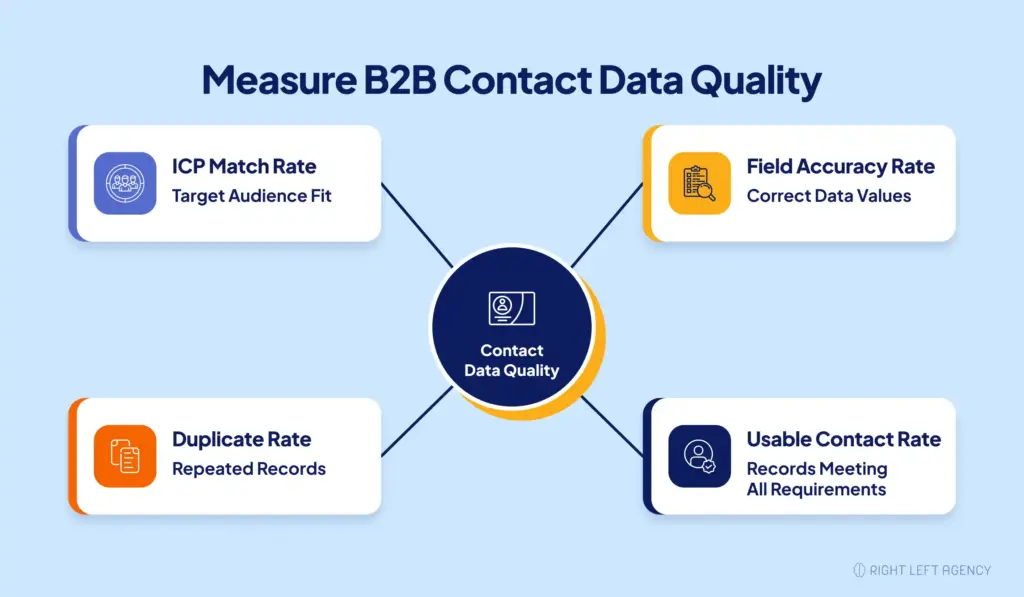
| Metric | How to Calculate It | What It Measures |
|---|---|---|
| ICP match rate | Matching company records ÷ records reviewed × 100 | Target-market relevance |
| Field accuracy rate | Correct field values ÷ field values checked × 100 | Information accuracy |
| Duplicate rate | Duplicate records ÷ records reviewed × 100 | Record redundancy |
| Usable-contact rate | Usable unique records ÷ records reviewed × 100 | Overall practical usability |
For the usable-contact rate, define a record as usable only when it meets all mandatory requirements, including the relevant compliance and permitted-use conditions.
Unverified or uncertain records should be classified separately rather than automatically counted as accurate.
Step 4: Use a Vendor Quality Scorecard
The following scorecard helps teams compare evidence consistently.
Assign each check a score from 0 to 2.
| Quality Check | Evaluation Criteria | Maximum Score |
|---|---|---|
| ICP alignment | Company match against target criteria | 2 |
| Role relevance | Current, appropriate buying contacts | 2 |
| Data accuracy | Independently checked field values | 2 |
| Contact verification | Documented validation evidence | 2 |
| Data freshness | Meaningful verification timestamps | 2 |
| Data completeness | Required fields available and usable | 2 |
| Source transparency | Sufficient provenance evidence | 2 |
| Compliance | Documented legal and usage suitability | 2 |
| CRM readiness | Matching, deduplication, and formatting | 2 |
| Vendor accountability | Clear guarantees and remedies | 2 |
| Total | 20 |
Scoring: 0 means insufficient evidence or a failed requirement, 1 means partially demonstrated, and 2 means the requirement is adequately supported.
The scorecard is a suggested decision-support tool, not an industry-standard certification.
A high score does not override a critical compliance failure, unacceptable sourcing uncertainty, or another mandatory requirement.
Step 5: Make a Purchase Decision Based on Evidence
Compare the observed sample results with your requirements.
Document unresolved issues, determine whether further testing is needed, and review contractual protections.
Use the scorecard to support the decision, not replace professional judgment.
Example: Evaluating Two B2B Contact Data Vendors
Consider a hypothetical B2B SaaS company purchasing contact data for a campaign targeting US-based financial services businesses with 100–500 employees.
The sales team wants relevant technology and finance decision-makers at companies that fit its ICP.
Two vendors submit competing proposals.
| Evaluation Factor | Vendor A | Vendor B |
|---|---|---|
| Total records offered | 1,000 | 750 |
| Purchase price | $700 | $900 |
| Sample size reviewed | 100 | 100 |
| ICP matches in sample | 65 | 90 |
| Usable unique contacts in sample | 40 | 80 |
| Observed usable-contact rate | 40% | 80% |
Vendor A offers more contacts at a lower price, but only 40% of its sample meets the quality requirements, compared with 80% for Vendor B.
- Vendor A: 1,000 × 40% = 400 estimated usable contacts.
- Vendor B: 750 × 80% = 600 estimated usable contacts.
Assuming representative samples and compliance approval, Vendor B offers better value despite its higher price.
Note: The cheapest lead list does not always provide the best value. These figures are illustrative estimates, not guaranteed results.
How Much Does a Quality B2B Sales Lead List Really Cost?
Price per record is a useful purchasing metric, but it can be misleading when data quality differs.
A more meaningful comparison is cost per usable contact.
Cost per Usable Contact = Total Data Cost ÷ Usable Unique Contacts
Applying this formula to the hypothetical vendor estimates above:
| Metric | Vendor A | Vendor B |
|---|---|---|
| Purchase price | $700 | $900 |
| Estimated usable contacts | 400 | 600 |
| Estimated cost per usable contact | $1.75 | $1.50 |
Vendor B has a higher upfront cost but a lower estimated cost per usable contact. Actual costs may vary based on verified records, integration, and additional fees.
However, usable contacts do not guarantee sales. Success depends on effective targeting, outreach, and conversion strategies.
Learn how these factors support pipeline growth in our SaaS lead generation guide.
When Should You Walk Away From a B2B Contact Data Vendor?
Some issues can be resolved through additional documentation, revised segmentation, or a new sample.
Others should stop the purchase.
| Evaluation Finding | Recommended Decision |
|---|---|
| Requirements met and evidence documented | Consider purchasing |
| Verification methods are unclear | Request more information |
| Moderate quality issues with agreed remedies | Retest before approving |
| Significant ICP mismatch | Reject the proposed dataset |
| Unverifiable sourcing or unresolved legal concerns | Do not proceed until resolved |
| No meaningful quality definitions or remedies | Reconsider the vendor |
Do not approve a purchase solely because a vendor provides a generous discount or replacement guarantee.
Replacing inaccurate records has limited value if the new records are equally irrelevant or cannot be used for your intended purpose.
The final decision should reflect the dataset’s suitability, documented risks, and expected business value.
Final Thoughts: Choose Contact Quality Over Contact Volume
A quality B2B sales lead list should contain accurate, relevant, and legally usable contacts. Before purchasing, verify ICP alignment, data accuracy, freshness, and vendor reliability.
Contact quality supports prospecting, but successful lead generation also requires effective targeting and conversion strategies.
At Right Left Agency, we help B2B and SaaS businesses build strategies that generate qualified opportunities. Explore our lead generation services to learn more.
Frequently Asked Questions
Is Buying a B2B Sales Lead List Worth It?
Yes, if the contacts match your ICP, contain accurate information, and can be used lawfully. Quality data can accelerate prospecting, but it does not guarantee qualified leads or sales.
How Do You Verify a B2B Contact List Before Buying?
Request a representative sample and check ICP alignment, contact accuracy, verification dates, duplicates, and data sources. Compare the results against your quality requirements.
How Often Should B2B Contact Data Be Updated?
Update frequency depends on the data type and its use. Job titles, employment status, and contact details generally require more frequent verification than company information.
Is It Legal to Buy B2B Email Lists?
Buying B2B email lists may be legal, depending on applicable privacy laws, data sources, and intended use. Purchasing contacts does not automatically grant permission for unrestricted marketing.
What Is the Difference Between a B2B Lead List and a Contact Database?
A B2B lead list contains selected prospects for a specific campaign, while a contact database stores broader business and contact information. Neither automatically represents qualified leads.