Key Takeaways
- Focus on activated trials and paying customers instead of just signups.
- Choose meaningful bidding signals with reliable data and manageable delays.
- Measure acquisition performance by cost per activated user and paying customer.
- Connect product activation and payment data to Google Ads for better optimization.
- Improve onboarding and product experience alongside advertising performance.
Your Google Ads campaigns are generating more free trial signups. Cost per trial is falling, and conversion numbers look promising. But new paying customers and monthly recurring revenue (MRR) aren’t growing at the same pace.
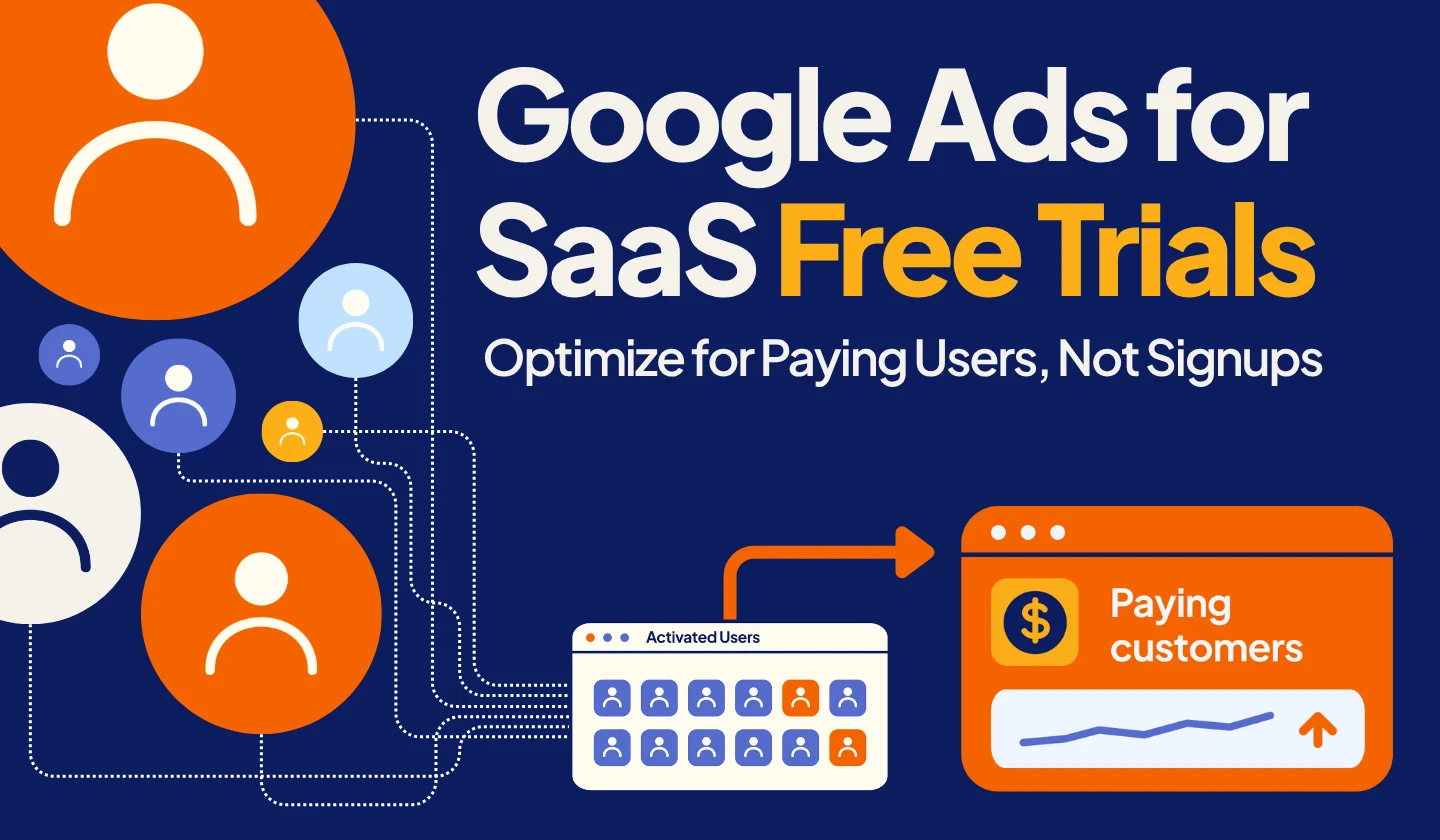
The problem may not be your advertising budget. It may be what you’re asking Google Ads to optimize for. For SaaS free trial campaigns, the goal is to select the deepest meaningful conversion event that occurs frequently and quickly enough to provide reliable bidding feedback.
That might be a completed product setup, an activated trial, a product-qualified account, or a first payment. The right choice depends on how often the event occurs, how long it takes after an ad click, and whether it indicates future customer value.
For SaaS companies investing in paid search advertising, improving conversion signals is often worth evaluating before increasing budgets.
Why Google Ads Finds Trial Users Who Never Pay
Google Ads can generate inexpensive free trial signups without acquiring profitable customers because Smart Bidding optimizes toward the conversion goals selected for a campaign. If registration is the primary bidding objective, Google prioritizes opportunities likely to produce registrations rather than directly optimizing for future subscription revenue.
That distinction matters.
A SaaS business might attract users who register but never complete onboarding, don’t match its ideal customer profile, or only want a permanently free solution.
The campaign records a conversion. The business still needs a customer. Not every user who fails to pay is necessarily a poor-quality prospect. Some may need more time or support to understand the product.
However, when acquisition is measured only through registration volume, marketing teams cannot easily distinguish promising trial users from those unlikely to become customers.
Cost per Trial Isn’t the Same as Customer Acquisition Cost
Cost per trial measures advertising spend divided by trial registrations. Customer acquisition cost (CAC) measures the broader cost of acquiring paying customers, including relevant sales and marketing expenses.
Consider two hypothetical campaigns:
| Metric | Campaign A | Campaign B |
|---|---|---|
| Ad spend | $6,000 | $6,000 |
| Trial signups | 300 | 150 |
| Cost per trial | $20 | $40 |
| Activated users | 45 | 75 |
| Paying customers | 9 | 18 |
| Ad spend per paying customer | $667 | $333 |
Campaign A delivers twice as many trials at half the cost per signup. Campaign B generates twice as many paying customers from the same advertising investment.
If you evaluate performance only through cost per trial, Campaign A looks stronger. If your objective is acquiring paying customers efficiently, Campaign B performs better.
The takeaway: Trial volume matters, but advertising decisions should also consider activation, customer conversion, and acquisition economics.
Map Your SaaS Trial Journey Into Meaningful Conversion Events
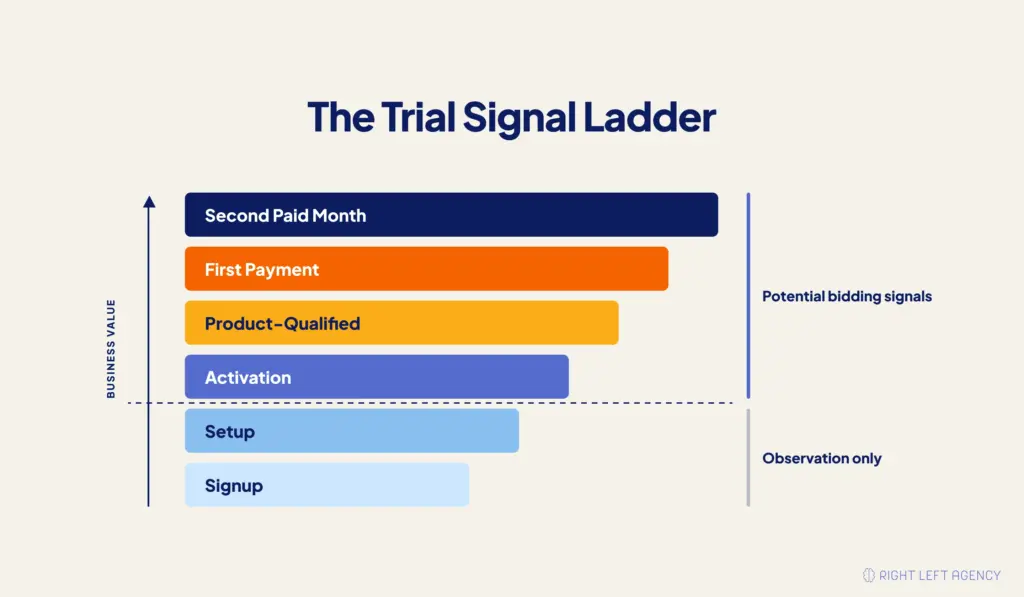
Before changing your bidding strategy, identify the actions that indicate progress toward becoming a paying customer.
A trial registration, completed product setup, activated account, and first payment represent different levels of customer engagement.
To evaluate these events, use the Trial Signal Ladder, a six-stage decision framework for identifying which customer actions may provide useful advertising optimization signals.
The Trial Signal Ladder
| Stage | Conversion Event | What It Indicates | Typical Data Source |
|---|---|---|---|
| 1 | Trial signup | A user registers for a trial | Website or application |
| 2 | Setup complete | Essential product configuration is finished | Product analytics |
| 3 | Trial activation | The user experiences meaningful product value | Product analytics |
| 4 | Product-qualified | Product behavior indicates stronger buying intent | Product analytics or CRM |
| 5 | First payment | The user becomes a paying customer | Billing platform |
| 6 | Second paid month | The customer continues beyond the initial payment period | Billing platform |
Each stage provides a different signal.
Earlier events generally occur sooner and more frequently, making them easier to measure and potentially more useful for bidding.
Later events may have a closer relationship with revenue but can occur less frequently or take longer to appear in Google Ads.
A deeper conversion event isn’t automatically a better bidding signal. It becomes more useful when its frequency, timing, attribution quality, and relationship with customer value support effective optimization.
How to Define an Activation Event That Predicts Payment
An activation event should represent the moment a user begins experiencing meaningful value from your product.
For example:
| SaaS Product | Potential Activation Event |
|---|---|
| Project management platform | Creates a workspace, invites a teammate, and completes a collaborative task |
| Analytics platform | Connects a data source and generates a useful report |
| Marketing automation platform | Creates and launches an automation |
| CRM platform | Imports contacts and begins managing sales opportunities |
These are possible activation definitions, not universal standards.
To select the right event, compare historical trial cohorts. Identify the actions completed by users who eventually purchased a subscription and compare them with users who abandoned the trial.
A useful activation event should be:
- Predictive: Associated with a higher likelihood of paid conversion.
- Timely: Recorded soon enough after the ad interaction to provide actionable feedback.
- Consistent: Defined and measured accurately, ideally once per account for account-level acquisition.
- Meaningful: Evidence of genuine product usage rather than superficial activity.
For example, simply opening an analytics dashboard may not demonstrate value. Successfully connecting a data source and producing a useful report might be a stronger activation signal.
However, correlation doesn’t establish causation. Validate the event against customer outcomes before using it as the main bidding objective.
If you need a starting point, RLA’s SaaS free trial conversion calculator can help you evaluate your existing trial-to-paid performance.
Decide Which Conversion Event Google Ads Should Bid On
Choose the deepest meaningful conversion event that occurs frequently enough and soon enough after the ad click to provide useful bidding feedback. Continue optimizing for signups when downstream data is unreliable, test activation when it is meaningful and sufficiently measurable, and evaluate payment-based optimization when revenue data supports it.
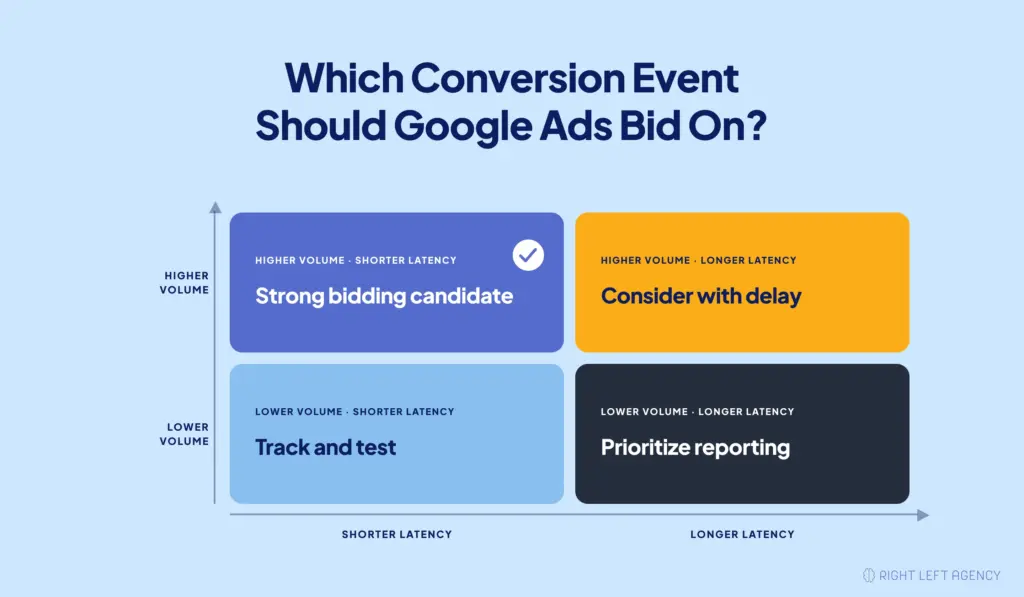
The decision depends on two important factors: conversion volume and conversion latency.
The Volume × Latency Matrix
The Volume × Latency Matrix is a practical decision framework for evaluating which stage of the Trial Signal Ladder may be suitable for bidding.
It considers:
- Conversion volume: The number of eligible, attributed conversion events available within a consistent reporting period.
- Conversion latency: The time between the advertising interaction and the event being recorded, including applicable reporting delays.
| Conversion Volume | Conversion Latency | Recommended Approach |
|---|---|---|
| Higher | Shorter | Strong candidate for primary bidding optimization |
| Higher | Longer | Consider deeper optimization while accounting for delayed feedback |
| Lower | Shorter | Track and test cautiously before switching |
| Lower | Longer | Generally more suitable for reporting until the signal becomes more useful |
This is an editorial decision framework, not an official Google Ads classification. There is no universal conversion-count threshold that guarantees successful activation- or payment-based bidding.
What qualifies as sufficient volume depends on your campaign structure, conversion history, data quality, and customer journey.
Practical Example: Choosing Between Signups, Activation, and Payment
Consider a hypothetical B2B SaaS business offering a 21-day product trial.
Its Google Ads campaigns generate the following results:
| Conversion Event | Attributed Events per Week | Typical Time After Ad Click |
|---|---|---|
| Trial signup | 200 | Same day |
| Product setup complete | 110 | 1 day |
| Trial activation | 60 | 2 days |
| First payment | 8 | 21 days |
Hypothetical Google Ads-attributed events, not total product activity across every acquisition channel. These figures are not recommended minimum thresholds or actual campaign results.
Assume the company has validated that users completing the activation milestone are more likely to become paying customers.
It also confirms that activation events are recorded consistently, associated with the correct accounts, and attributed accurately enough for campaign measurement.
The business now has three options.
Option 1: Continue optimizing for signups.
Signups provide frequent and timely feedback. However, this objective does not directly distinguish users who experience product value from those who register and leave.
Option 2: Test activation-based bidding.
Activation occurs regularly, is recorded relatively quickly, and has a demonstrated relationship with payment.
This makes it a reasonable candidate for a controlled experiment.
Option 3: Optimize directly for payments.
The first payment is closest to realized revenue. However, only eight attributed payments occur weekly, with a typical delay of 21 days.
That may provide limited timely data for direct bidding optimization.
For this hypothetical account, testing activation-based bidding would be a reasonable next step while continuing to monitor payments and revenue.
The recommendation does not guarantee improvement. The experiment must determine whether activation-based bidding produces better acquisition economics.
When Should You Continue Bidding on Signups?
Signup-based bidding may remain appropriate when:
- Activation tracking is missing or inconsistent.
- Too few eligible downstream conversions are attributed to Google Ads.
- The relationship between activation and payment hasn’t been validated.
- Customer data cannot be connected reliably.
- Downstream events arrive too late for useful optimization feedback.
In these situations, continue improving your conversion tracking while measuring downstream performance separately.
When Should You Optimize for Activation?
Activation is a stronger candidate when it represents meaningful product value, occurs with sufficient frequency, and can be measured reliably.
For example, if completing an integration is strongly associated with paid conversion, Google Ads may benefit from using that event rather than registration alone.
Depending on the account, Maximize Conversions or Target CPA may be suitable for testing activation-focused bidding.
The goal isn’t simply more activated users. It’s to determine whether acquiring those users improves customer acquisition efficiency.
When Should You Optimize for Paying Customers or Revenue?
Payment-based or value-based bidding becomes more relevant when paid conversions can be attributed reliably and provide enough usable data. Potential strategies include Maximize Conversions, Target CPA, Maximize Conversion Value, and Target ROAS.
For subscription businesses, actual first-payment revenue may provide a straightforward conversion value.
Estimated customer lifetime value may also inform optimization when supported by a reliable forecasting model, but it should not be treated as guaranteed revenue.
The decision rule: Select the deepest commercially meaningful event your campaign can measure accurately and learn from reliably.
Set Up Google Ads Conversion Tracking for Activation and Revenue
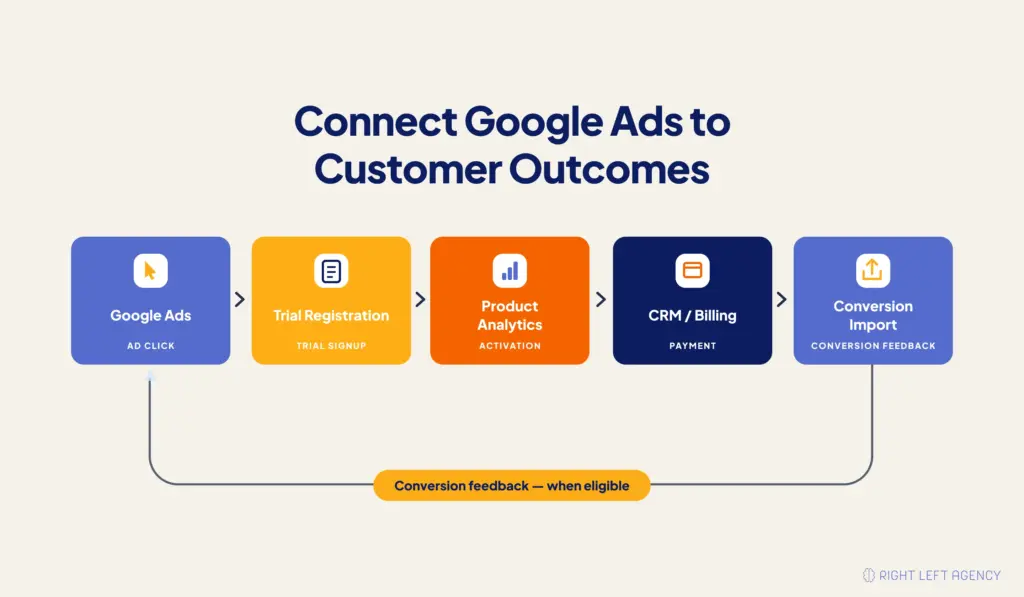
Optimizing for activation or payment requires connecting advertising interactions with meaningful product and customer outcomes.
This usually involves a combination of website tracking, product analytics, CRM records, and billing data. The appropriate implementation depends on where the event occurs and whether the data can be attributed reliably to Google Ads.
Configure Primary and Secondary Conversion Actions
Google Ads distinguishes between primary and secondary conversion actions.
Primary conversion actions are used for bidding when their associated standard conversion goals are selected for the campaign. Secondary actions are generally used for observation in the All conversions column.
However, an important exception applies: secondary conversion actions included in a custom goal can still influence bidding when that goal is selected.
For a campaign testing activation-based bidding, one potential setup is:
| Conversion Action | Potential Setting | Purpose |
|---|---|---|
| Trial signup | Secondary | Monitor registration volume |
| Trial activation | Primary | Optimize toward product value |
| First payment | Secondary | Measure downstream customer acquisition |
This configuration assumes activation is the selected bidding objective and has been validated.
If the campaign instead optimizes for payment, the selected primary action may change. Also check whether the campaign uses account-default or campaign-specific goals.
Do not assume that marking an action as primary automatically makes every campaign bid toward it. Avoid unintentionally optimizing for multiple stages of the same customer journey. A user may trigger signup, activation, and payment, potentially creating multiple counted conversion actions.
Review Google’s primary and secondary conversion actions guidance before making changes.
Connect Google Ads With Product Activation Data
Many SaaS activation events occur inside the product rather than on the marketing website.
For example, a user might click an ad, register for a trial, and complete an integration two days later.
Your measurement system needs to associate that integration event with the original acquisition where attribution is eligible and technically possible.
Depending on your infrastructure, relevant information may include:
- Google Click ID (GCLID) or other supported attribution identifiers.
- Consistent internal user and account identifiers.
- Conversion timestamps and event definitions.
- Eligible first-party customer information.
- Product analytics, CRM, and billing records.
A typical measurement flow is:
Google Ads click → Trial signup → Product activation → Analytics or CRM record → Supported conversion integration → Google Ads
The precise integration matters.
Choose the Right Conversion Import Method
Not every activation or payment event should be imported using the same method.
The appropriate Google Ads integration depends on the event source and how the conversion is recorded.
| Event Source | Potential Measurement Approach |
|---|---|
| Website registration | Google Ads website conversion tracking |
| Product event measured in GA4 | Eligible GA4 event imported into Google Ads |
| Supported mobile application event | Applicable app conversion integration |
| Qualified lead recorded in a CRM | Enhanced conversions for leads or another supported integration |
| Subscription payment recorded outside website tracking | Eligible downstream conversion integration, depending on the payment and attribution setup |
For product activation measured through GA4, confirm that the event is implemented correctly and eligible for use as a Google Ads conversion.
For CRM-based qualification or other eligible downstream lead events, enhanced conversions for leads may provide an appropriate solution.
A payment event recorded in a billing platform may require a different implementation from a website purchase already captured through a Google tag.
Do not automatically treat every product activation as a qualified lead or assume that enhanced conversions for leads is appropriate for every SaaS event.
Before importing conversions, confirm the event source, eligible integration method, attribution identifiers, and reporting requirements.
Understand Google’s 2026 Data Manager Changes
October 2026 implementation note: Beginning June 15, 2026, Google moved offline conversion import and enhanced conversions for leads uploads toward the Data Manager API, with restrictions on legacy Google Ads API upload access.
Certain existing integrations may have different access conditions.
For new implementations, review the supported Data Manager methods rather than assuming older API upload workflows remain available.
Google also recommends enhanced conversions for leads for eligible advertisers beginning downstream lead conversion measurement.
A practical implementation process is:
- Capture eligible attribution information when the user registers.
- Associate the signup with a consistent internal account.
- Record the activation or payment event when it actually occurs.
- Connect the downstream event to eligible attribution information.
- Send the conversion using an appropriate supported integration.
- Review Google Ads conversion diagnostics and reconcile imported records with source systems.
All customer data collection and sharing must follow applicable privacy requirements, consent obligations, and Google’s customer data policies.
Refer to Google’s offline conversion import documentation for current integration guidance.
Assign Conversion Values Carefully
An activated trial may be more valuable than an unactivated registration, while a first payment represents actual revenue.
However, estimated values need to reflect meaningful business differences.
Potential approaches include:
- Actual transaction values for paid conversions.
- Estimated intermediate-event values based on historical customer outcomes.
- Supported conversion value rules where measurable business differences justify adjustments.
Avoid assigning arbitrary values simply to make Smart Bidding favor one event.
Also consider whether reporting multiple events from the same customer could double-count value.
Before changing your bidding configuration, conduct a SaaS Google Ads audit to verify conversion actions, attribution, and selected campaign goals.
Switch Bidding Strategies Without Disrupting Campaign Performance
Changing the conversion event used for bidding can alter how Google Ads prioritizes traffic.
A campaign that previously optimized for trial registrations may begin pursuing different auction opportunities when activation or payment becomes the objective.
That transition should be tested rather than implemented across every campaign simultaneously.
Start With a Controlled Experiment
Before switching:
- Confirm that the new conversion event is recorded accurately.
- Review eligible event volume and reporting delays.
- Establish baseline signup, activation, and payment metrics.
- Define what would count as an improvement.
- Use a suitable Google Ads experiment or controlled comparison.
- Avoid changing multiple major campaign variables simultaneously.
Where feasible, keep targeting, creative, landing pages, and budgets consistent during the test.
This makes it easier to evaluate whether the bidding objective contributed to a change in results.
Allow Smart Bidding Time to Adjust
Smart Bidding performance may require time to stabilize after changes to conversion goals or actions.
Google’s guidance indicates that learning after these changes often takes one to two conversion cycles, although actual adjustment and evaluation periods depend on conversion volume, reporting delays, and the bidding strategy.
A conversion cycle includes the time between the ad click and the conversion, as well as the time required for imported conversions to appear in Google Ads.
For example, if customers typically pay three weeks after clicking an ad, evaluating paying-customer performance only a few days after changing the bidding goal would be premature.
Allow enough time for eligible conversions to occur and be reported before comparing outcomes. Avoid repeated manual changes while the bidding strategy is adjusting.
Fix the Conversion Signal Before Expanding Reach
Broad match, AI Max, and Performance Max can expand or automate advertising reach.
However, greater reach cannot automatically correct a poorly selected conversion objective.
If the account optimizes for registrations that rarely generate customer value, scaling may produce more of the same registrations.
Before increasing budgets or widening targeting, verify that your conversion goals align with the outcomes your business wants to acquire.
Improve the signals guiding Google Ads before asking it to find more users.
Reset Your Reporting Before Changing Bidding Goals
When Google Ads begins prioritizing activation or payment, traditional registration metrics may change.
Trial volume could decrease, and cost per trial could rise. That doesn’t necessarily mean performance has worsened.
The important question is whether the new approach improves the cost and quality of acquired customers.
Measure the Full Acquisition Funnel
| Metric | Calculation or Definition | Purpose |
|---|---|---|
| Cost per trial | Ad spend ÷ attributed trial signups | Measures registration efficiency |
| Activation rate | Activated trials ÷ trial signups | Measures progress toward product value |
| Cost per activated trial | Ad spend ÷ attributed activated trials | Measures activation acquisition efficiency |
| Trial-to-paid rate | Paying trial accounts ÷ trial accounts in the same cohort | Measures trial conversion |
| Ad spend per paying customer | Ad spend ÷ attributed new paying customers | Measures media efficiency |
| CAC | Relevant sales and marketing acquisition costs ÷ new customers | Measures broader acquisition cost |
| CAC payback period | Time required for customer contribution margin to recover acquisition cost | Measures how quickly acquisition investment is recovered |
CAC payback calculations should use a consistent revenue and margin model.
For a simplified subscription model with stable monthly contribution margin, payback can be estimated by dividing CAC by monthly contribution margin per customer.
However, more complex SaaS models may require adjustments for variable margins, customer segments, expansion revenue, and cohort behavior.
Understand What May Change After Switching
| Metric | Possible Direction | What to Evaluate |
|---|---|---|
| Trial volume | Decrease | Are acquired users more relevant? |
| Cost per trial | Increase | Is improved quality worth the higher registration cost? |
| Activation rate | Increase | Are more users reaching product value? |
| Cost per activated trial | Decrease | Is activation acquisition becoming more efficient? |
| Trial-to-paid rate | Increase | Are acquired users becoming paying customers? |
| Cost per paying customer | Decrease | Is advertising producing customers more efficiently? |
These are possible outcomes, not guaranteed improvements.
A successful test should demonstrate measurable gains in relevant downstream business metrics rather than simply showing a higher-quality conversion event in Google Ads.
Compare Mature Conversion Cohorts
Conversion delays can distort campaign comparisons.
For example, a campaign generating trials last week should not be evaluated against a campaign whose trial users have already completed their subscription decision period without accounting for cohort maturity.
Group users by acquisition or signup date and compare them over consistent measurement windows. Also recognize that Google Ads, GA4, your CRM, and billing platform may report different conversion totals because of attribution models, conversion timestamps, and counting rules.
Use consistent reporting definitions to understand how advertising contributes to customer acquisition. For additional guidance, see RLA’s article on SaaS marketing attribution.
When the Problem Is Your Free Trial, Not Your Google Ads
Better bidding signals can help attract users who are more likely to activate or purchase. They cannot fix a trial experience that prevents qualified users from experiencing product value.
If users consistently register but fail to activate, investigate the onboarding journey. Common issues include complicated setup, unclear next steps, missing integrations, technical problems, or a mismatch between advertising promises and the actual product experience.
If users activate but don’t become paying customers, investigate pricing, packaging, perceived value, and the upgrade experience.
These problems require coordination between marketing, product, and customer success teams. Before increasing advertising spend, identify where qualified users drop out of the funnel.
For detailed product-side strategies, read RLA’s guide to improving SaaS free trial conversion.
Trial vs. Freemium vs. Demo: Which Conversion Event Should You Optimize?
The best bidding signal depends on how your SaaS business acquires and converts customers.
A time-limited free trial, freemium platform, and sales-led demo funnel represent different customer journeys.
| Acquisition Model | Initial Conversion | Potential Deeper Bidding Signal |
|---|---|---|
| Free trial | Trial registration | Activation, product qualification, or first payment |
| Freemium | Free account creation | Meaningful usage, upgrade intent, or payment |
| Demo-led SaaS | Demo request | Qualified lead, sales opportunity, or closed customer |
Free trial campaigns may benefit from activation-based bidding when payment events are too sparse or delayed.
Freemium products may need to evaluate meaningful usage or upgrade behavior because the path to subscription can take longer. Demo-led SaaS companies may need to optimize for qualified opportunities rather than form submissions.
For sales-led acquisition, see RLA’s guide to improving low-quality paid advertising leads. Regardless of your acquisition model, use the deepest meaningful customer outcome that your campaigns can measure and learn from reliably.
Optimize Google Ads for SaaS Growth, Not Just Trial Volume
More trial signups don’t automatically translate into more paying customers. For SaaS companies, effective Google Ads optimization requires connecting advertising performance with meaningful product usage, subscription conversions, and acquisition economics.
The Trial Signal Ladder helps identify the events that matter across the customer journey.
The Volume × Latency Matrix helps evaluate which of those events may be practical bidding objectives.
Start by auditing your conversion goals, validating activation signals, and connecting downstream customer data to your advertising measurement. Then test deeper-funnel optimization before scaling.
At Right Left Agency, we help SaaS businesses connect marketing strategy with meaningful growth outcomes.
If your Google Ads campaigns generate free trials but not enough paying customers, review which conversion signals are guiding your bidding decisions.
CTA: Discuss Your SaaS Paid Search Strategy
Frequently Asked Questions
Should I optimize Google Ads for free trial signups or paying customers?
Optimize for the deepest meaningful event with reliable tracking, sufficient attributed conversion volume, and manageable delays. Paid conversions are closer to revenue, but activation may be more practical when payments are infrequent or delayed. Continue signup-based optimization when downstream data isn’t ready.
How many conversions does Google Ads need to optimize for activation or payment?
Google doesn’t provide a universal minimum that guarantees effective activation- or payment-based bidding. Conversion frequency, latency, attribution quality, and campaign conditions determine whether a deeper event is practical. Review historical data and run a controlled test before switching.
What is a good activation event for SaaS Google Ads?
A good activation event represents meaningful product value and has a validated relationship with paid conversion. Examples include completing an integration, launching a workflow, or generating a useful report. The event should occur consistently and be measurable through eligible advertising attribution.
Will my cost per trial increase if I optimize for activated or paying users?
It may. Campaigns prioritizing deeper conversion events can generate fewer registrations at a higher cost per trial. The change is worthwhile only if downstream acquisition economics improve. Evaluate cost per activated trial, paying customers, acquisition cost, and customer value.
Do I still need offline conversion tracking after Google’s 2026 Data Manager changes?
Yes, when important downstream outcomes occur outside standard website conversion tracking and need to be attributed to Google Ads. The 2026 changes affect supported upload methods rather than eliminating downstream measurement. Choose an eligible method based on your event source, such as supported GA4 imports, enhanced conversions for leads, or Data Manager integrations.