Key Takeaways
- Fix the signal before the bid by prioritizing qualified opportunities over form submissions.
- Low volume doesn’t mean Smart Bidding fails when conversion data and targets are reliable.
- Connect Google Ads with your CRM to optimize for qualified leads.
- Match bidding strategies to conversion data and campaign performance.
- Measure pipeline, not just leads, using opportunity costs and pipeline value.
- Know when not to scale and test before increasing ad spend.
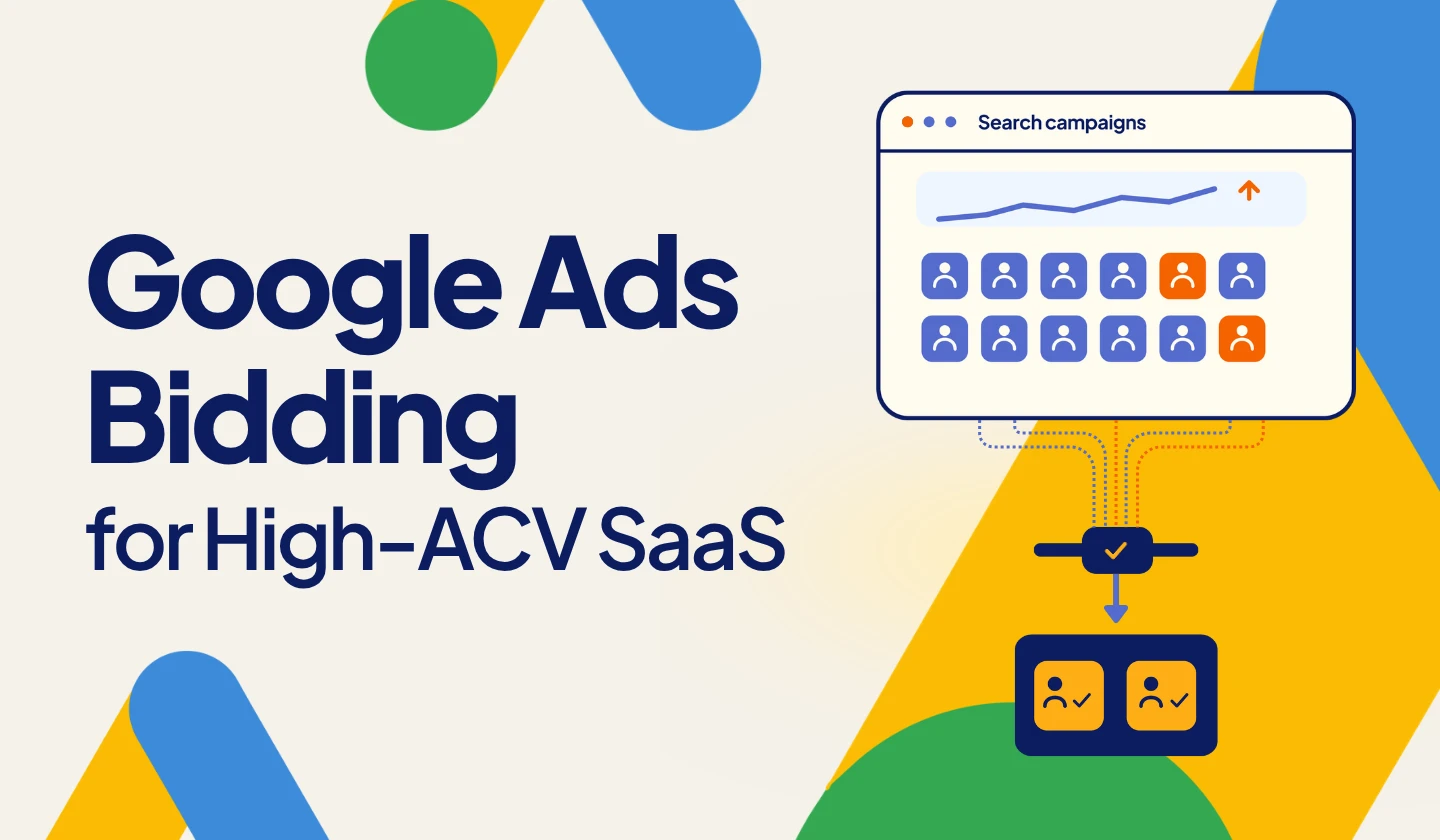
If your high-ACV SaaS account produces only a handful of qualified opportunities a month, Google Ads bidding becomes harder to optimize. The problem isn’t always your Target CPA or conversion volume. It’s often the signal you’re feeding Google Ads.
When campaigns optimize for form submissions instead of qualified pipeline, they can generate plenty of conversions without producing enough real sales opportunities.
The solution is to fix your conversion signals first, then match your bidding strategy to the data, budget, and pipeline outcomes your business actually has.
A conversion action must also belong to a goal selected for campaign optimization. Setting an action as primary doesn’t automatically make every campaign bid toward it.
Why High-ACV B2B SaaS Makes Google Ads Bidding Difficult
Google Ads Smart Bidding uses auction-time signals, historical performance, and conversion data to predict which clicks are most likely to produce results. But high-ACV B2B SaaS companies often have a different conversion pattern from businesses with shorter sales cycles.
You might generate 100 demo requests but only five qualified opportunities in a month. Those five opportunities could be worth considerably more than the other 95 submissions combined.
If Google Ads optimizes toward every demo request equally, your campaigns may attract more people willing to complete forms without necessarily attracting more potential customers.
The problem isn’t simply a lack of conversions. It’s a lack of reliable signals connecting advertising activity to business value.
What Happens When You Only Get a Few Qualified Opportunities?
Low qualified-conversion volume makes campaign performance harder to evaluate. When you generate only a handful of opportunities each month, one additional conversion can significantly change your reported cost per opportunity.
For example, spending $10,000 to generate five qualified opportunities produces a $2,000 cost per opportunity. Generating two additional opportunities reduces that figure to approximately $1,429. That’s a meaningful difference from a small volume change.
Smart Bidding can still operate with limited conversion data. However, sparse qualified-opportunity signals can make it harder to establish reliable performance patterns and evaluate bidding changes.
This is why applying a universal conversion threshold isn’t the right starting point. Instead, evaluate the quality, consistency, and timing of the conversion data available.
Why Aggressive Target CPA Settings Can Make Things Worse
When acquisition costs are high, reducing Target CPA can seem like an obvious way to improve efficiency. But setting an unrealistic target may restrict campaign delivery.
Google Ads attempts to find conversions while working toward your specified acquisition cost. If that target is significantly below what the campaign can realistically achieve, opportunities to generate conversions may become more limited.
For low-volume SaaS accounts, this can make it even harder to collect meaningful performance data. A lower Target CPA doesn’t automatically mean better acquisition efficiency.
Your target should reflect realistic conversion economics, not simply the lowest cost you’d like to pay.
The Long Sales Cycle Problem
High-ACV B2B SaaS purchases rarely happen immediately after a prospect clicks an ad. A buyer may request a demo, evaluate competing products, involve stakeholders, complete security reviews, and negotiate a contract before making a purchase.
That process may take several months. Meanwhile, Google Ads measures attributed conversions within configured conversion windows.
If important pipeline events occur after the applicable window, they may not be attributed to the original advertising interaction. This creates a measurement gap between early engagement and eventual revenue.
The solution is to review conversion windows, connect CRM data, and track meaningful pipeline milestones that occur early enough to support useful campaign decisions.
Diagnose Before You Touch the Bid Strategy
Before changing bidding targets, identify what’s actually limiting performance.
At Right Left Agency (RLA), we approach this through the Paid Search Efficiency System, a three-step diagnostic framework focused on connecting Google Ads performance with qualified pipeline.
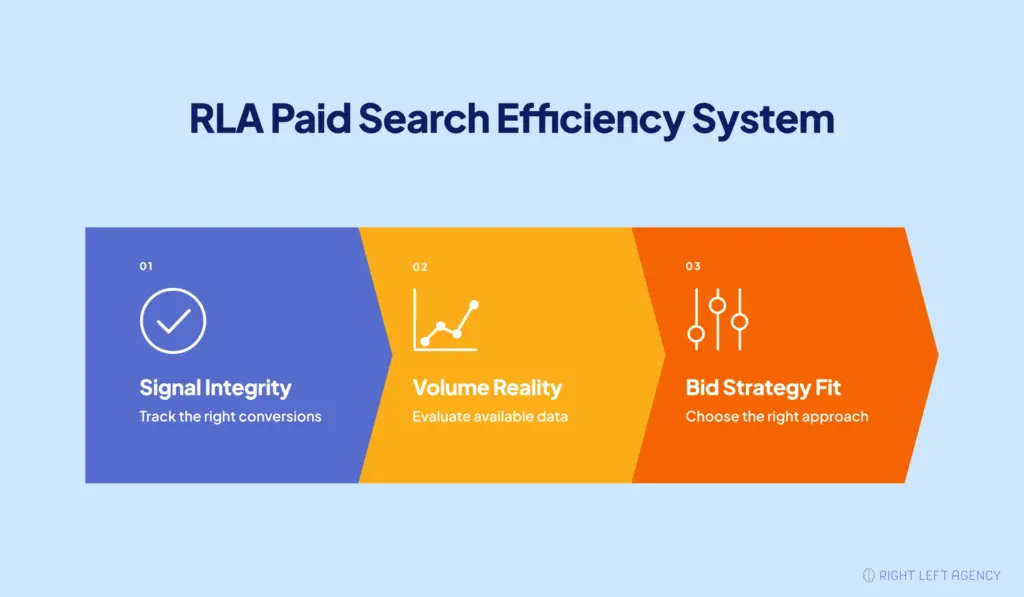
1. Signal Integrity: Are You Optimizing for the Right Outcomes?
Start with conversion tracking. Are your campaigns optimizing toward genuine buying interest or simply rewarding visitors for completing forms?
Review which conversion actions are primary, whether CRM outcomes are imported correctly, and whether duplicate or low-quality conversions distort reporting.
If your signals don’t reflect business value, changing the bid strategy won’t solve the underlying problem.
2. Volume Reality: How Much Reliable Data Do You Have?
Next, evaluate actual qualified-conversion volume. Look beyond the number of conversions displayed in Google Ads.
Consider how many leads qualify, how consistently opportunities are generated, and how long those outcomes take to appear.
A campaign with limited but reliable qualified-lead data presents a different challenge from one with hundreds of poorly tracked conversions.
3. Bid Strategy Fit: Does Your Strategy Match Your Account?
Only after reviewing signal quality and available data should you evaluate bidding. Consider your historical performance, acquisition costs, budget, conversion delays, and business objectives.
The goal isn’t to force every SaaS account into the same bidding strategy. It’s to select an approach that makes sense for the opportunities the account can realistically generate.
Signal integrity first. Volume reality second. Bid strategy fit third.
That sequence helps prevent bidding changes from masking more fundamental measurement problems.
Fix the Signal Before the Bid: Optimize for Pipeline, Not Form Fills
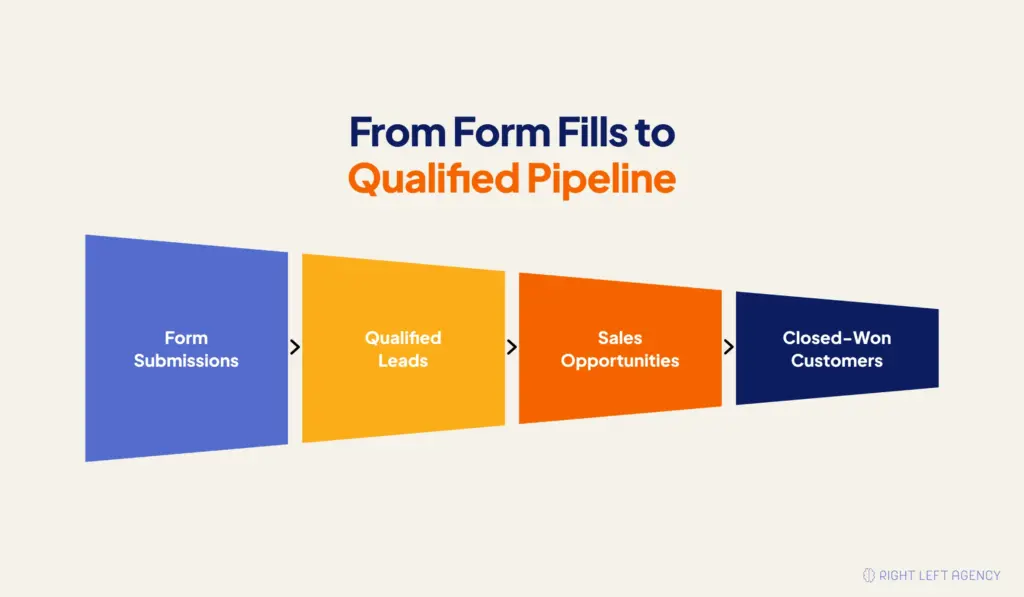
The highest-impact improvement in a low-volume SaaS account may be changing what you optimize toward.
When a primary conversion is an unqualified demo or contact-form submission, Smart Bidding works toward generating that action.
But form submissions can include low-fit businesses, competitors, students, job seekers, or prospects without purchasing authority.
These conversions may make Google Ads performance look healthy while contributing little to the sales pipeline.
The solution is to distinguish engagement from genuine commercial opportunity.
Choose Primary and Secondary Conversions Deliberately
Google Ads uses primary conversions for bidding when they’re included in the campaign’s selected conversion goals.
Secondary conversions are generally used for observation and reporting, unless included through a custom goal.
For high-ACV SaaS, qualified leads or opportunities may provide better optimization signals than raw submissions.
| Conversion action | Recommended approach |
|---|---|
| Newsletter signup | Secondary |
| Content download | Secondary |
| General form submission | Primary only if sufficiently qualified and appropriate for bidding |
| Qualified lead | Strong primary candidate |
| Sales-qualified opportunity | Primary candidate when reliable and timely |
| Closed-won customer | Track for revenue measurement and evaluate for value-based bidding |
Avoid making every funnel stage a primary conversion without considering overlapping events and how they affect optimization.
One prospect may become a qualified lead, opportunity, and customer. Your conversion setup should account for that progression rather than treating every event as an independent acquisition.
Choose the conversion goal that best balances business value with reliable, usable data.
Feed CRM Outcomes Back Into Google Ads
Your CRM knows what happens after someone submits a form. Google Ads should receive relevant information about those outcomes.
Offline conversion imports and enhanced conversions for leads can help connect advertising interactions with meaningful stages such as:
- Qualified lead
- Sales-qualified opportunity
- Closed-won customer
With this information, you can measure which campaigns, keywords, and searches contribute to pipeline rather than only generating inquiries.
Enhanced conversions for leads can also improve matching using first-party customer information and available click identifiers.
Accurate implementation matters. If identifiers are missing, CRM stages are inconsistent, or events are uploaded incorrectly, your conversion data may provide an incomplete view of performance.
For new API-based offline conversion workflows, Google’s Data Manager API is the recommended implementation route. Existing integrations should be reviewed against current Google requirements.
Build a Conversion Value Ladder
Not every conversion has the same potential value.
A qualified opportunity is typically worth more than a content download, while opportunities with different deal sizes or close probabilities may also have different expected values.
A simple way to estimate value is:
Expected conversion value = Expected deal value × Probability of closing
For example, if a qualified opportunity represents $20,000 in potential contract value and has a 20% estimated close probability, its expected value is $4,000. That value is an estimate, not guaranteed revenue.
For recurring-revenue SaaS businesses, decide whether annual contract value, customer lifetime value, or another financially meaningful measure best represents the outcome.
Use consistent assumptions, avoid double-counting funnel stages, and validate values against actual sales performance.
Accurate conversion values can eventually support bidding toward higher-value outcomes rather than treating every conversion equally.
How to Bid When Qualified Opportunities Are Scarce
There’s no single bidding strategy that works for every low-volume B2B SaaS account.
The right choice depends on what you’re measuring, how consistently those conversions occur, and whether your account has enough reliable information to support the strategy.
Google Ads Bidding Strategy Comparison
| Account condition | Strategy to consider | Why |
|---|---|---|
| Very limited qualified-conversion data | Maximize Conversions or Manual CPC | Evaluate performance while maintaining appropriate budget control |
| Reliable conversions without a stable CPA target | Maximize Conversions | Optimize conversion volume without an additional CPA constraint |
| Consistent conversion performance | Target CPA | Work toward a realistic acquisition cost |
| Reliable, differentiated conversion values | Maximize Conversion Value | Prioritize higher-value outcomes |
| Sufficient value data and a realistic return target | Target ROAS | Optimize conversion value against a return objective |
| Multiple compatible campaigns | Portfolio bidding | Coordinate bidding objectives across campaigns |
These are decision guidelines, not guaranteed performance thresholds.
Give Target CPA Room or Start Without a Target
An overly restrictive Target CPA can limit delivery. If you don’t yet have a reliable acquisition cost benchmark, Maximize Conversions may be a reasonable starting point, provided your conversion tracking is trustworthy.
Once you have enough performance evidence to establish a realistic CPA, evaluate whether a Target CPA strategy better supports your objectives.
Base that target on observed performance, qualified-conversion economics, and conversion delays. Avoid tightening targets simply because the previous week’s CPA increased.
Low-volume B2B SaaS accounts often need longer evaluation periods to distinguish ordinary fluctuations from meaningful changes.
Use Manual CPC Only When Direct Control Makes Sense
Manual CPC remains an option for certain tightly controlled Search campaigns. For example, you may want direct bid control when testing a narrow set of high-intent keywords.
However, Manual CPC doesn’t provide the same auction-time conversion optimization as Smart Bidding. It shouldn’t be the default recommendation simply because your campaign produces few qualified opportunities.
Evaluate whether the additional control outweighs the benefits of automated bidding.
Move to Value-Based Bidding When Pipeline Values Are Reliable
Value-based bidding can help shift optimization from conversion counts toward the expected business value of conversions.
Google Ads supports Maximize Conversion Value and Target ROAS. For Search campaigns, Google specifies at least 15 conversions in the previous 30 days at the conversion-tracking level for Target ROAS eligibility.
But meeting an eligibility threshold doesn’t guarantee strong performance. Before moving to value-based bidding, verify that conversion values are accurate, meaningful, and consistently recorded.
If your CRM data doesn’t reliably distinguish between low-value and high-value opportunities, improving the value model should come before changing bidding strategies.
Pool Data Without Overcomplicating Your Account
Splitting a small amount of conversion activity across many campaigns can complicate performance evaluation. Campaign consolidation or portfolio bidding may help when campaigns share compatible objectives.
However, placing multiple campaigns into one portfolio strategy doesn’t automatically solve insufficient qualified-conversion volume.
Consolidate where business goals, conversion actions, and targeting requirements justify it. Keep separate campaigns when budgets, geographic requirements, or business objectives genuinely differ.
The goal is to reduce unnecessary fragmentation, not eliminate useful campaign control.
Why More Google Ads Conversions Don’t Always Mean More Pipeline
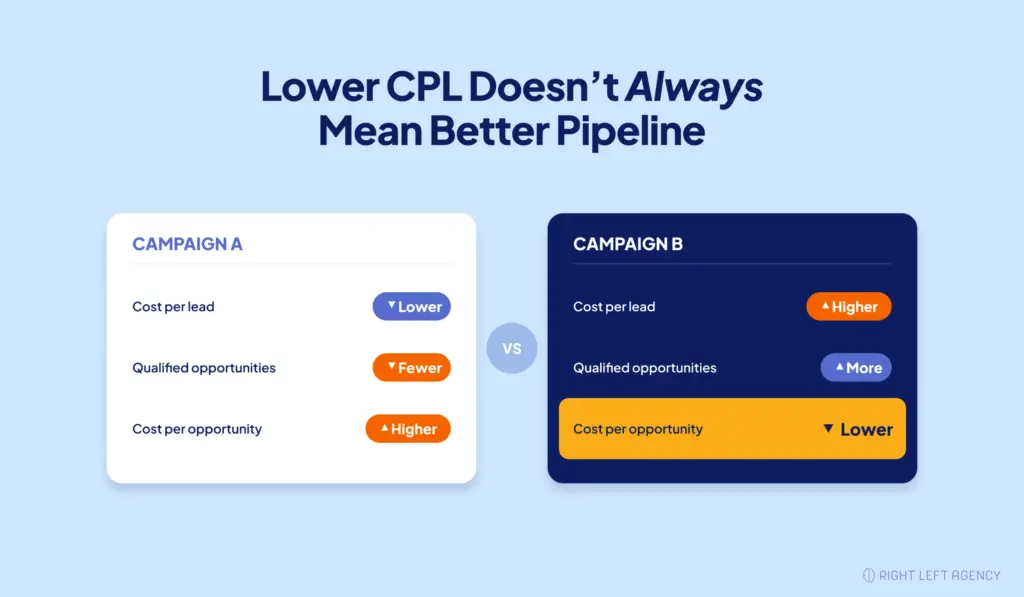
Imagine two B2B SaaS campaigns with identical advertising budgets.
| Metric | Campaign A | Campaign B |
|---|---|---|
| Ad spend | $10,000 | $10,000 |
| Form submissions | 100 | 50 |
| Cost per lead | $100 | $200 |
| Qualified opportunities | 5 | 10 |
| Cost per qualified opportunity | $2,000 | $1,000 |
Campaign A generates twice as many leads at half the cost per lead. On the Google Ads dashboard, it may appear to be the more efficient campaign. But Campaign B generates twice as many qualified opportunities at half the cost per opportunity.
Assuming similar opportunity quality and deal value, Campaign B provides a stronger potential pipeline outcome. This is the danger of optimizing only for lead volume.
A falling CPL can hide a rising cost per genuine sales opportunity.
For high-ACV B2B SaaS, the better question isn’t how many leads you generate. It’s how many of those leads become opportunities your sales team can realistically close.
Structure Your Account to Concentrate Qualified Demand
A low-volume account should avoid spreading its budget and conversion data across unnecessary campaign segments.
Start with a structure that supports clear business objectives and reliable measurement.
Prioritize High-Intent Keywords
Focus on searches that indicate meaningful buying interest.
Depending on your product, these may include software comparisons, product alternatives, enterprise-specific requirements, and solution-focused searches.
Use CRM outcomes to determine which keywords actually generate qualified opportunities. Don’t assume every commercially worded keyword attracts the right buyers.
Consolidate Campaigns Where Appropriate
Avoid creating separate campaigns for every small keyword theme unless there is a clear operational or strategic reason.
Too much fragmentation makes budgets, performance, and conversion trends harder to manage.
However, preserve meaningful differences in audiences, geographic targeting, conversion goals, and business objectives.
Avoid Constant Bidding and Tracking Changes
Frequent changes to conversion goals, bidding targets, and campaign structure can make performance harder to interpret and may trigger bidding adjustments.
Allow sufficient time for changes to take effect and for delayed conversions to appear.
With high-ACV SaaS, patience should be based on the actual sales and conversion cycle, not an arbitrary number of days.
Use Micro-Conversions for Diagnosis
Pricing-page visits, content downloads, and other engagement events can help explain prospect behavior.
Track them where useful, but don’t assume secondary conversions directly train standard Smart Bidding.
Use these signals to improve landing pages, campaign messaging, and lead qualification.
Measure Success Beyond Cost Per Lead
Cost per lead is useful, but it doesn’t tell you whether Google Ads is generating profitable customers.
High-ACV SaaS companies need a measurement framework that follows prospects beyond the initial conversion.
Cost per Qualified Opportunity
Formula: Google Ads spend ÷ Qualified opportunities
This shows how much advertising spend is required to create a qualified sales opportunity.
Use consistent qualification criteria and attribution rules when comparing campaigns.
Qualified Lead Rate
Formula: Qualified leads ÷ Total leads × 100
This reveals whether your campaigns attract prospects who meet your sales qualification criteria.
A lower CPL with a declining qualification rate may indicate that acquisition efficiency is getting worse rather than better.
Pipeline Value
Measure the value of sales opportunities attributed to paid search.
Where possible, distinguish between total pipeline, probability-weighted pipeline, and closed-won revenue.
Pipeline value represents potential business, not revenue already earned.
Customer Acquisition Cost
Track how much it costs to acquire an actual customer.
For a fully loaded CAC calculation, include the relevant acquisition expenses rather than advertising spend alone.
This helps connect campaign decisions with your broader business economics.
Conversion Lag
Measure how long prospects take to move from an advertising interaction to a qualified lead, opportunity, and customer.
Evaluate campaigns over periods that account for those delays.
The objective is to understand how advertising contributes to qualified pipeline and revenue, not just how efficiently it generates initial conversions.
When Google Ads Isn’t the Right Primary Channel for Your ACV and Volume
Sometimes the right decision isn’t to spend more on Google Ads.
If your target audience rarely searches for solutions like yours, qualified opportunities remain scarce, or acquisition costs exceed realistic customer economics, paid search may not justify becoming your primary growth channel.
That doesn’t mean Google Ads has no value. It may still support high-intent searches, competitor comparisons, or demand capture from a narrow group of potential buyers.
But broader growth may require a combination of channels.
Account-Based Marketing (ABM) can help you focus on a defined set of high-value companies.
Intent-led outbound can reach prospects whose business characteristics and buying signals suggest potential fit.
B2B SaaS SEO can build visibility across the research and comparison stages of a longer buying journey.
These approaches aren’t automatically more efficient than paid search. Their effectiveness depends on your market, product, audience, and execution.
When qualified search demand is uncertain, run Google Ads as a controlled experiment.
Measure its contribution to real opportunities, understand the economics, and scale only when the evidence supports it.
How RLA Approaches Paid Search for High-ACV SaaS
At Right Left Agency, we don’t treat Google Ads as an isolated bid-management task. We look at how your campaigns contribute to qualified leads, sales opportunities, and pipeline growth.
Our Paid Search Efficiency System starts with three questions:
Signal Integrity: Are you measuring conversions that represent meaningful business outcomes?
Volume Reality: Does your account have enough reliable data to evaluate and improve performance?
Bid Strategy Fit: Does your bidding approach match your conversion quality, business objectives, and acquisition economics?
This helps connect paid search decisions with the outcomes that matter beyond the Google Ads dashboard.
Because more conversions don’t necessarily mean more customers. And a lower cost per lead doesn’t always mean a healthier sales pipeline.
Turn Google Ads Spend Into Qualified SaaS Pipeline
Getting clicks and form submissions but not enough qualified opportunities?
RLA helps B2B SaaS companies connect Google Ads with CRM outcomes, improve conversion tracking, and build paid search strategies around qualified pipeline growth.
Frequently Asked Questions
How many conversions does Google Smart Bidding need?
Google Smart Bidding doesn’t have one universal conversion-volume requirement across all strategies. Data quality, conversion consistency, and bidding objectives affect performance. For Search campaigns, Target ROAS has a specific eligibility requirement of at least 15 conversions in the past 30 days at the conversion-tracking level. Focus on reliable conversion tracking and realistic targets rather than applying one threshold to every strategy.
Should I use Target CPA or Maximize Conversions for a low-volume SaaS account?
Maximize Conversions may be appropriate when conversion tracking is reliable but you don’t yet have a realistic CPA target. Target CPA can be useful when historical performance supports a meaningful acquisition-cost benchmark. Neither strategy automatically fixes poor lead quality.
Why is my Google Ads cost per lead low but my pipeline empty?
Your campaigns may be optimizing toward form submissions that rarely become qualified sales opportunities. Connect Google Ads with CRM conversion data and measure qualified lead rates, cost per opportunity, and pipeline value to determine whether your campaigns are attracting potential buyers.
What are offline conversion imports, and why do B2B SaaS companies need them?
Offline conversion imports send relevant CRM outcomes, such as qualified leads and sales opportunities, back into Google Ads. They help advertisers understand what happens after a lead submits a form and can provide more meaningful data for campaign measurement and bidding.
Should I optimize Google Ads for SQLs or closed-won customers?
Choose the conversion goal that provides the best balance of business value, reliability, and usable conversion volume. SQLs or qualified opportunities may be better bidding signals when closed-won outcomes are too infrequent or delayed. Continue tracking customers and revenue to evaluate longer-term performance.
Can Google Ads work with only a few qualified opportunities per month?
Yes. A low number of qualified opportunities doesn’t automatically make Google Ads ineffective. However, performance may be harder to evaluate, and restrictive bidding targets can limit delivery. Focus on accurate tracking, relevant search demand, controlled budgets, and realistic expectations.
Does portfolio bidding solve low conversion volume?
Not necessarily. Portfolio bidding coordinates strategies across compatible campaigns, but it doesn’t guarantee improved performance or eliminate limitations caused by sparse qualified-conversion data. Evaluate whether the campaigns share appropriate goals and business objectives before combining them.
When should a B2B SaaS company switch to value-based bidding?
Consider value-based bidding when you can reliably send differentiated conversion values into Google Ads and have sufficient performance data to evaluate results. Accurate values help the system distinguish higher-value opportunities from lower-value ones. Avoid switching before your conversion value model is trustworthy.