

Key Takeaways
- More organic traffic doesn’t automatically mean more SaaS pipeline.
- Weak ICP alignment and misread search intent are the most common reasons SaaS SEO attracts traffic but not qualified buyers.
- A blog can generate thousands of visits while the commercial pages that actually sell go unseen.
- When traffic grows and pipeline doesn’t, the break is usually downstream of SEO — in page type, conversion, qualification, or attribution.
- Diagnose where the funnel actually breaks before publishing more content.
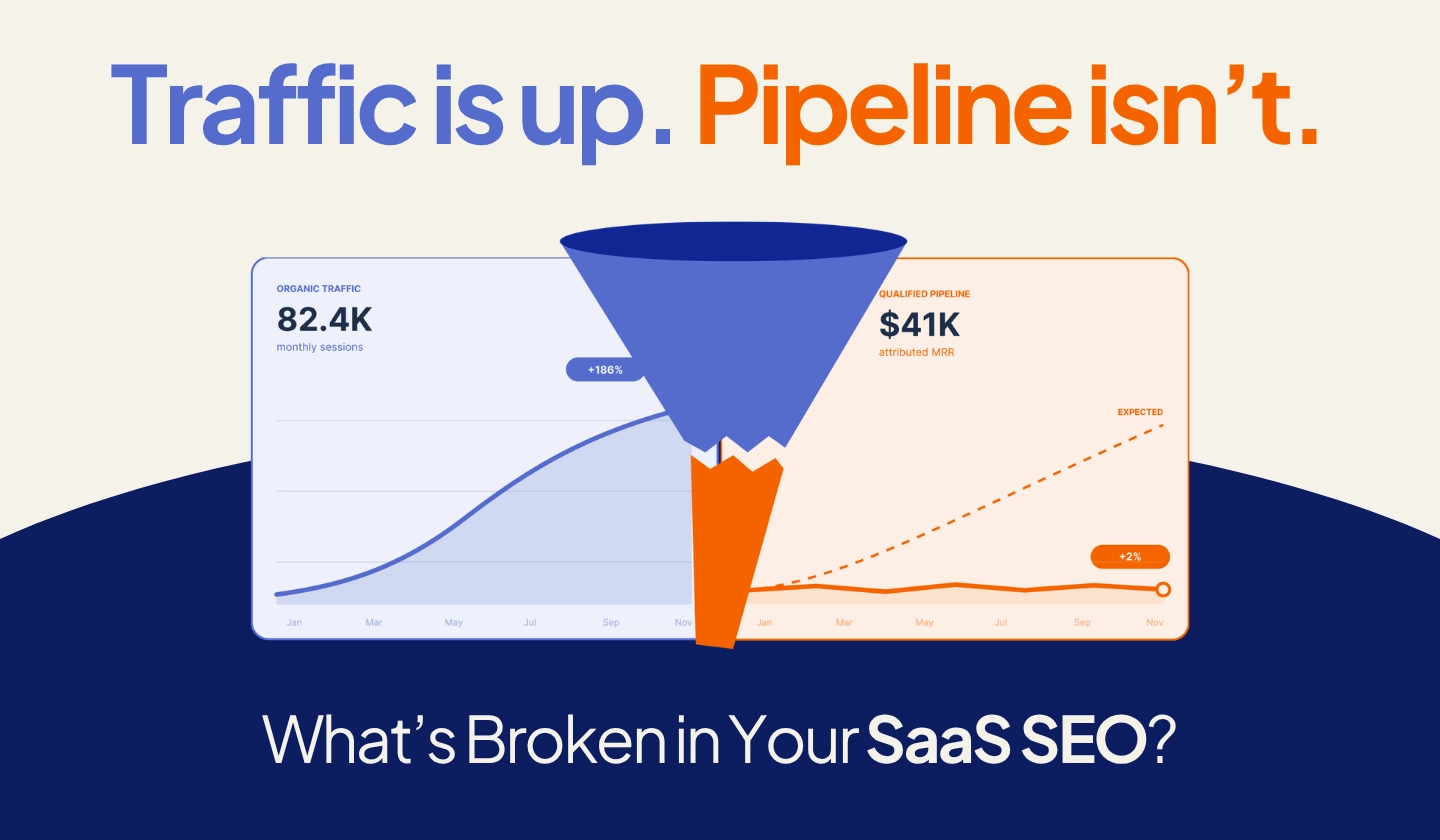
Your organic traffic is growing. Rankings are improving. Google Search Console shows more impressions and clicks than it did a few months ago.
But demos are flat. Trial signups are barely moving. Sales says the leads coming from SEO are weak. And the pipeline attributed to organic search is nowhere near what you expected.
If that sounds familiar, your SaaS SEO strategy may not have a traffic problem at all.
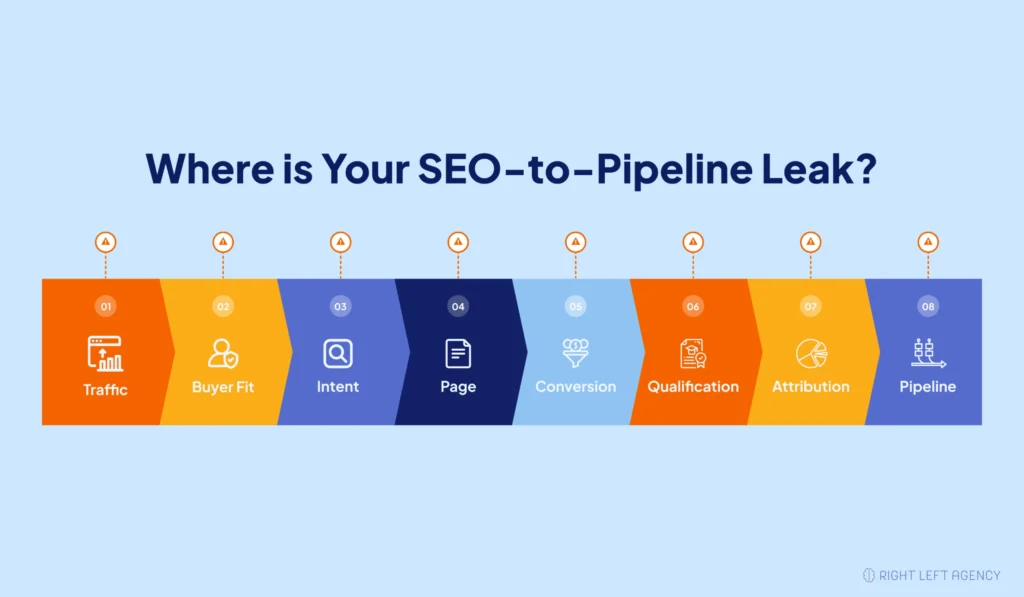
When SaaS SEO generates traffic but not pipeline, the problem usually lies somewhere between traffic quality, buyer fit, search intent, page type, conversion, qualification, or attribution.
Think of SaaS SEO as a connected revenue system:
Search Visibility → Buyer Fit → Search Intent → Page Type → Conversion → Qualification → Attribution → Pipeline → Revenue
If one part breaks, traffic can continue rising while commercial results remain flat.
This guide will help you identify where that break is happening, what data to examine, and what to fix before investing in more content.
Traffic Is an SEO Metric. Pipeline Is the Business Outcome
SaaS SEO should be measured by more than rankings and organic sessions. Traffic, impressions, clicks, and rankings are useful leading indicators, but they don’t prove that SEO is creating business value. The commercial outcome is whether organic search helps the right buyers move toward demos, trials, qualified opportunities, pipeline, and revenue.
That distinction matters because SEO can look successful inside an SEO dashboard while underperforming inside a revenue dashboard.
| SEO Activity Metrics | Business Outcome Metrics |
|---|---|
| Rankings | Qualified demos |
| Impressions | MQLs / PQLs / SQLs |
| Organic sessions | Opportunities |
| Click-through rate | Pipeline |
| Traffic growth | Closed-won revenue |
If organic traffic increases by 50% but qualified opportunities remain unchanged, the business hasn’t necessarily received 50% more value from SEO.
Traffic still matters. It simply shouldn’t be the final measure of success.
For a broader view of how SaaS marketing should connect acquisition and revenue, see Right Left Agency’s SaaS marketing ROI guide.
First, Identify Which Traffic-to-Pipeline Problem You Actually Have
The first step is to identify where the funnel breaks instead of assuming you need more traffic.
The same “SEO is generating traffic but no pipeline” symptom can have very different causes.
| Symptom | Likely Cause | Check First | Likely Fix |
|---|---|---|---|
| Traffic is growing, but conversions are flat | Intent, page, CTA, or CRO issue | Landing pages and queries | Improve intent alignment and conversion paths |
| Organic leads exist, but sales rejects them | ICP or qualification mismatch | Lead quality | Refine targeting and qualification |
| High-intent visitors do not convert | Messaging, proof, UX, or offer problem | Commercial pages | Improve positioning, proof, CTA, and reduce friction |
| Sales sees organic influence, but analytics does not | Attribution problem | CRM and source data | Improve attribution |
| Leads convert, but opportunities do not progress | Downstream funnel problem | MQL/PQL → SQL → opportunity | Fix qualification and sales handoff |
Traffic Is Growing, but Conversions Are Flat
f organic sessions are increasing while demos, trials, or signups remain flat, investigate what those visitors are searching for and which pages receive them.
The likely problem is somewhere between search intent and conversion.
Check:
- Organic landing pages
- Search queries
- Search intent
- ICP fit
- CTA alignment
- Internal links
- Conversion rate
- Form friction
- Page messaging
Don’t immediately assume the website needs more traffic.
If 80% of your new traffic comes from low-intent informational queries, another 20% traffic increase may simply produce more low-intent visitors.
Organic Leads Exist, but Sales Says They Are Low Quality
If SEO generates leads but sales consistently rejects them, investigate ICP fit before changing the entire SEO program.
The traffic may be topically relevant but commercially irrelevant.
Compare organic leads against:
- Company size
- Industry
- Geography
- Job role
- Use case
- Budget
- Buying authority
- Product fit
A lead isn’t automatically valuable because it came from an organic search result.
Right Left Agency’s SaaS lead generation framework similarly emphasizes qualified pipeline rather than lead volume, and recommends measuring SQLs, opportunities, pipeline value, and revenue — not just forms or traffic.
See Right Left Agency’s SaaS Lead Generation guide
High-Intent Visitors Reach the Site but Do Not Convert
If high-intent visitors reach relevant commercial pages but do not take action, the problem may be further down the funnel.
Evaluate:
- Positioning
- Messaging
- Value proposition
- Proof
- Testimonials
- Case studies
- Pricing
- Security
- Implementation
- Integrations
- CTA
- Form friction
The key question is: does the page give the buyer enough reason and enough confidence to take the next step?
Sales Sees Organic Influence, but Analytics Does Not
Your SEO may be contributing to pipeline without receiving appropriate attribution.
A buyer might discover your company through Google, read several articles, leave, return through direct traffic, speak with sales, and eventually become an opportunity.
A last-touch model may credit direct traffic. That doesn’t mean organic search had no influence.
Leads Convert, but Opportunities Do Not Progress
If organic leads become MQLs, PQLs, or SQLs but rarely become opportunities, the problem may exist after acquisition.
Review:
- Qualification rules
- Lead routing
- Sales response time
- Sales follow-up
- Product activation
- Sales handoff
- Opportunity criteria
Sometimes the leak isn’t in SEO at all — it’s in what happens after the click. That’s the case in most of the reasons below.
1. You’re Ranking for Searches Your Buyers Don’t Make
A keyword can be highly relevant to your topic and still be a poor source of SaaS pipeline if the searcher doesn’t match your ICP or buying intent.
This is one of the most common reasons SaaS SEO produces traffic without meaningful commercial results.
Search Volume Is Not the Same as Buyer Intent
Consider these searches:
- “What is customer onboarding?”
- “Customer onboarding software for SaaS”
The first search is primarily educational. The second suggests the searcher may be evaluating a solution. Both can be useful — they simply serve different stages of the buying journey.
A strong SaaS keyword strategy should consider search volume, search intent, ICP fit, business relevance, buying stage, and commercial potential. This is why keyword research should influence site architecture, not just blog topics.
Read the SaaS Keyword Research guide
Your SEO Audience Does Not Match Your ICP
Topical relevance is not the same as ICP relevance. An enterprise SaaS company may rank for topics that attract students, job seekers, researchers, small businesses, consumers, developers outside the target market, or free-tool users. Those visitors can generate engagement and even leads — but if they can’t realistically buy the product, that traffic won’t create much pipeline.
Evaluate ICP fit using factors such as company size, industry, geography, use case, technology environment, budget, buying role, and business maturity. The question to ask: would a company that searches this term plausibly become one of our customers?
Your ICP Changed, but Your Rankings Still Reflect the Old Market
SEO can preserve historical visibility long after your business changes direction. Suppose a SaaS company originally targeted small businesses and later moved upmarket into enterprise accounts. Its rankings may remain stable while the audience behind those rankings becomes less commercially valuable.
This can happen after repositioning, moving upmarket, changing industries or core use cases, narrowing the ICP, or changing pricing and packaging. If your business changed but your keyword universe didn’t, your SEO may be generating yesterday’s demand.
2. Your Blog Gets Visibility but the Pages That Sell Don’t
A common SaaS SEO problem is an imbalance between content visibility and commercial visibility. Your blog may rank for hundreds of keywords while your product, solution, use-case, comparison, and pricing pages receive little organic traffic. That creates a structural gap: the content attracts attention, but the pages that support buying decisions don’t capture enough search demand.
Product and Solution Pages Use Internal Language Instead of Buyer Language
SaaS companies often describe their products using internal terminology. Buyers search using problems, outcomes, categories, use cases, industry language, comparisons, alternatives, and specific capabilities. If your product page focuses heavily on proprietary feature names while buyers search for the problem those features solve, the page may struggle to capture commercially valuable demand.
Your SEO strategy and positioning strategy therefore need to work together. Ask: what language does the buyer use, what problem are they trying to solve, what outcome do they want, what alternatives are they evaluating, and what terms appear repeatedly in sales conversations? Your commercial pages should connect those search patterns with a clear product story.
The Wrong Page Type Ranks for Commercial Queries
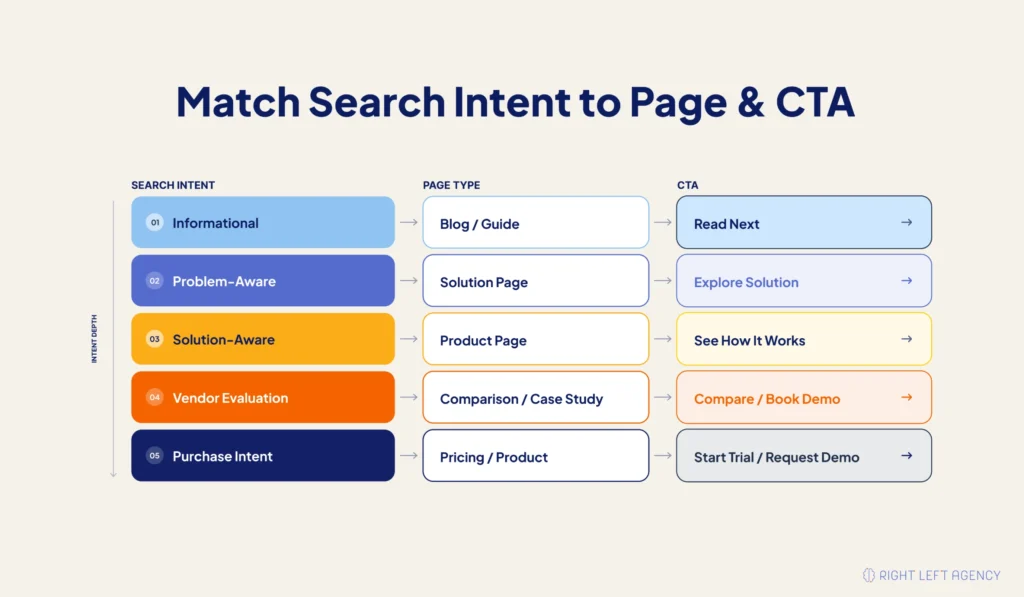
Search intent should determine page type.
Search intent should determine page type. A broad educational query may deserve a blog post. A solution, product category, comparison, alternative, integration, or pricing query may require a commercial page. A common SEO problem occurs when a blog post ranks for a commercially valuable query where a solution or product page should compete. You technically win the ranking — but you may still lose the commercial opportunity.
Check: what does the searcher actually want, what page type currently ranks, is that page type appropriate, and does the page help the visitor take the next logical step?
You’re Missing BOFU Search Assets
Bottom-of-funnel content supports buyers who are actively evaluating a solution. Important SaaS BOFU assets can include product pages, solution pages, use-case pages, industry pages, comparison pages, alternative pages, integration pages, feature pages, pricing pages, and case studies. These pages help capture demand closer to the point of evaluation.
Right Left Agency’s SaaS SEO checklist also emphasizes product, feature, use-case, and comparison pages as important high-intent assets.
3. Your SEO Strategy Is Too Top-of-Funnel Heavy
TOFU content isn’t inherently bad for SaaS SEO. The problem is an SEO portfolio that generates awareness without providing enough content for consideration and decision-making. A company can publish hundreds of educational articles and attract substantial organic traffic while still struggling to generate pipeline.
Informational Content Creates Awareness but Not Necessarily Pipeline
Informational content can build awareness, answer buyer questions, establish expertise, attract relevant audiences, introduce your brand, and support future buying decisions. But informational intent doesn’t necessarily indicate immediate purchasing intent — the mistake is expecting every educational article to generate direct demos.
Instead, build a connected journey: TOFU → MOFU → BOFU → Conversion. The goal isn’t to eliminate TOFU content. The goal is to prevent your entire content strategy from becoming TOFU.
Buyers Need Decision-Support Content Before They Convert
As buyers move closer to a decision, their questions change: Which solution is right for us? How does this product compare with competitors? What alternatives exist? Does it integrate with our stack? How difficult is implementation? Does it support our use case? What does it cost? Can we trust the vendor? What results have similar companies achieved?
That’s why comparison pages, alternative pages, use-case pages, integration content, pricing content, and case studies matter — they reduce uncertainty at the point when uncertainty can prevent conversion.
For a broader full-funnel content framework, see Right Left Agency’s SaaS content strategy guide.
4. Your Content Has No Path From Learning to Buying
Even highly relevant organic traffic can fail commercially when the content becomes a dead end. A visitor reads an article, gets the answer, and leaves. The article may have done its job — the problem is that the customer journey stopped there.
High-Traffic Informational Pages Become Dead Ends
Start with your highest-traffic organic pages. For each page, ask: is there a relevant next step, does it link to a related solution or use case, does it point toward an evaluation resource, and is the CTA appropriate for the visitor’s stage?
Not every informational page needs a “Book a Demo” CTA. Sometimes the correct next step is another educational resource, a solution page, a comparison, or a trial. The objective isn’t aggressive conversion — it’s relevant progression.
Internal Links Should Move Buyers Toward the Next Relevant Decision
Internal linking should do more than distribute authority. It should help visitors move through the buying journey. For example:
Educational article → Solution page → Use-case page → Comparison → Demo
The exact path depends on the SaaS business. The principle is consistent: Important organic pages should provide qualified visitors with a logical next step.
5. High-Intent Visitors Don’t Have Enough Reason to Convert
Sometimes SEO has already done its job — the right buyer found the right page through a relevant search. They still don’t convert. At that point, investigate conversion quality rather than traffic acquisition.
Your Positioning and Messaging Do Not Match Buyer Priorities
A technically optimized page can still fail to persuade. Buyers need to understand what problem this solves, who it’s for, what outcome it supports, why this solution is different, why they should trust the company, and why they should act now.
Your copy should reflect buyer language rather than internal product terminology. If the headline explains what the software is but not why the target customer should care, organic traffic may not translate into action.
Your Pages Lack Proof
High-intent buyers need evidence: customer case studies, testimonials, customer logos, quantified outcomes where substantiated, reviews, industry experience, product demonstrations, security information, and implementation information. The more consequential the purchase, the more uncertainty the page needs to remove.
Buyers Cannot Resolve Key Evaluation Questions
Depending on your SaaS category, buyers may need answers about pricing, security, integrations, implementation, migration, support, compliance, time to value, product limitations, and customer experience. Your commercial page doesn’t need to answer every question itself, but the overall website journey should make the answers easy to find.
Your Conversion Path Does Not Match Your SaaS Buying Motion
SaaS businesses do not all convert customers in the same way.
PLG SaaS
For product-led SaaS, the primary conversion may be:
- Free signup
- Free trial
- Product activation
- Key product action
- PQL creation
A demo can still matter, but it may not be the primary conversion.
Sales-Led SaaS
Sales-led SaaS may prioritize:
- Demo requests
- Qualified meetings
- Consultations
- Sales conversations
The page needs enough context and proof to make that conversation worthwhile.
Enterprise SaaS
Enterprise buyers may need information about:
- Security
- Procurement
- Integrations
- Implementation
- Stakeholder fit
- Business case
- Vendor credibility
Enterprise SEO therefore needs to support a longer evaluation journey.
Hybrid SaaS
Hybrid SaaS businesses may need both:
Self-serve conversion + sales-assisted conversion
Do not force every visitor into one path when the product supports multiple buying motions.
6. Your SEO May Be Generating Pipeline That You’re Not Measuring
Not every SEO pipeline problem is actually an SEO problem. Sometimes organic search is contributing to pipeline, but your attribution system is not capturing its role.
Organic-Sourced and Organic-Influenced Pipeline Are Different
Organic-sourced pipeline is pipeline that originates from organic search as part of the acquisition journey.
Organic-influenced pipeline includes opportunities where organic search contributed to the buyer journey, even if another channel receives the final conversion credit.
These measurements answer different questions.
A buyer might:
- Discover your company through Google.
- Read several articles.
- Leave the website.
- Return through direct traffic.
- Attend a webinar.
- Speak with sales.
- Become an opportunity.
A last-touch model might credit the webinar.
That does not mean SEO had no role.
Last-Touch Attribution Can Hide SEO’s Role
Last-touch attribution can be useful for understanding the final conversion interaction, but it’s less useful for a long B2B SaaS buying journey. The solution isn’t necessarily to abandon last-touch attribution — instead, compare it with other views of the journey.
Connect Search Data, Analytics, CRM, and Self-Reported Attribution
Each system answers different questions.
Google Search Console: search queries, organic clicks, impressions, search visibility, landing-page performance.
GA4: organic sessions, landing-page behavior, conversion events, user journeys.
CRM data: lead qualification, MQLs, PQLs, SQLs, opportunities, pipeline, closed-won revenue.
Self-reported attribution: a simple “How did you hear about us?” question can reveal discovery paths that digital analytics can’t reconstruct reliably.
For a deeper framework, explore Right Left Agency’s SaaS marketing attribution guide.
AI-Assisted Discovery Creates Additional Attribution Blind Spots
SaaS buyers increasingly use tools such as ChatGPT, Perplexity, and Google AI Overviews to research products, vendors, categories, and problems. That creates another layer of discovery: a buyer may encounter your company through AI-assisted research, later search for your brand directly, and then convert through a demo form. The original discovery may not appear cleanly in your analytics.
Treat missing referral data carefully. Combine analytics, CRM source data, self-reported attribution, search visibility, and branded search behavior — don’t interpret the absence of a trackable referral as proof that a channel had no influence.
7. SEO Gets the Blame, but the Leak Happens After Conversion
SEO controls only part of the revenue journey. Once someone becomes a lead or product-qualified user, qualification, sales, onboarding, and revenue operations take over.
Leads Enter the Funnel but Fail Between MQL, SQL, and Opportunity
A lead is not an opportunity. The progression may look like:
Lead → MQL/PQL → SQL → Opportunity → Pipeline → Closed-Won
If organic leads enter at the top but disappear before opportunity creation, investigate where the conversion rate falls.
Ask:
- Are qualification criteria too broad?
- Are leads actually within the ICP?
- Are PQL definitions meaningful?
- Are sales teams accepting the leads?
- Is product activation strong enough?
- Are opportunities being created consistently?
The objective is to identify the stage where the funnel breaks.
Sales Handoff and Response Can Break the Funnel
Relevant organic demand can be lost through poor operational execution.
Potential problems include:
- Slow response times
- Poor lead routing
- Unclear ownership
- Inconsistent qualification
- Weak follow-up
- Marketing and sales using different definitions of qualified demand
If marketing defines an SQL differently from sales, SEO performance will be difficult to evaluate accurately.
Right Left Agency’s SaaS lead generation guide covers the broader principle that SaaS lead generation should focus on qualified pipeline rather than lead volume.
Diagnose the Revenue System Before Declaring SEO a Failure
Before saying “SEO isn’t generating pipeline,” determine where the leak actually occurs: not enough relevant traffic, poor ICP fit, wrong search intent, wrong page type, weak conversion, poor qualification, attribution, sales handoff, or opportunity progression. That distinction determines what you should fix.
How to Diagnose Your SaaS SEO Pipeline Gap
Instead of immediately commissioning more content, perform a revenue retrofit on the organic traffic and content you already have.
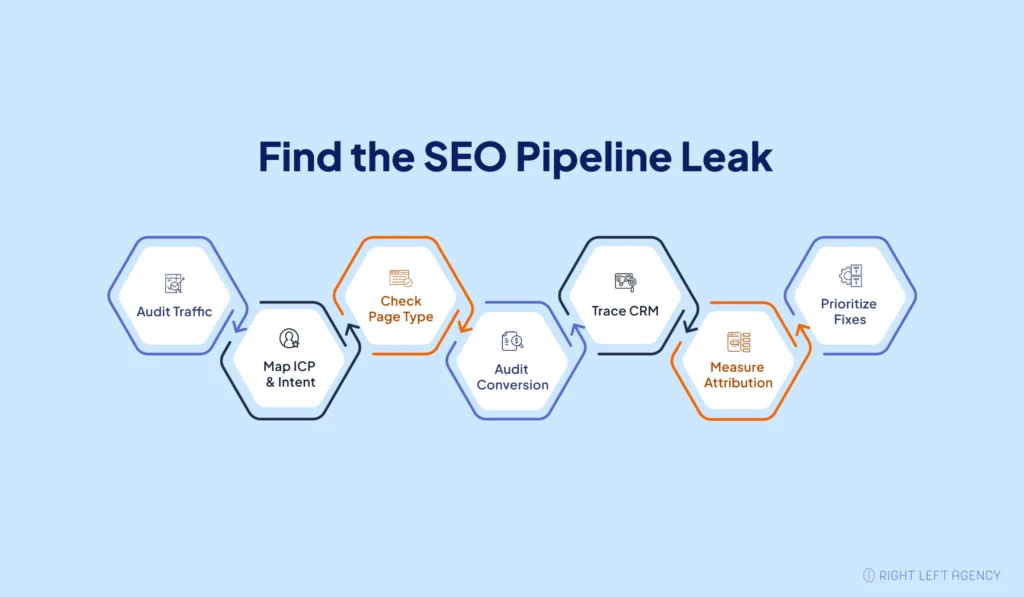
Step 1 — Audit the Organic Traffic You Already Have
Start with existing performance.
Review:
- Organic landing pages
- Organic sessions
- Search queries
- Rankings
- Non-brand traffic
- Conversion events
- Existing leads
- Commercial page traffic
Find the pages that already attract meaningful traffic.
Those pages can be some of your fastest optimization opportunities.
For a deeper process, use Right Left Agency’s Content Audit for SaaS guide.
Step 2 — Map Queries to Search Intent and ICP Fit
Classify important queries as:
- Informational
- Commercial
- BOFU
- Brand
- Non-brand
Then assess ICP fit.
A page attracting 50,000 visitors is not automatically more valuable than one attracting 2,000 visitors if those 2,000 visitors are substantially more likely to become customers.
Step 3 — Check Whether the Right Page Type Is Ranking
For commercially valuable queries, compare:
Search intent → Current ranking page → Desired page type
Look for:
- Blog ranking instead of product page
- Generic article ranking instead of solution page
- Missing comparison content
- Missing alternative content
- Missing integration pages
- Missing use-case pages
Fix page-intent mismatches before creating another large batch of articles.
Step 4 — Audit Each Page’s Conversion Path
For high-value organic landing pages, evaluate:
- CTA
- Internal links
- Page messaging
- Offer
- Proof
- Form friction
- Product relevance
- Buyer-stage alignment
Ask:
If the right buyer lands here, what should they do next?
If the answer is unclear, the page probably has a journey problem.
Step 5 — Trace Organic Leads Through the CRM
Do not stop at form submissions.
Follow:
Organic Lead → MQL/PQL → SQL → Opportunity → Pipeline → Closed-Won
Calculate the conversion rate between each stage.
This tells you whether the acquisition problem is actually an acquisition problem.
Step 6 — Separate Organic-Sourced From Organic-Influenced Pipeline
Build reporting that distinguishes:
- Organic-sourced pipeline
- Organic-influenced pipeline
- Branded vs non-brand organic contribution
- Commercial-page vs informational-page contribution
This creates a more useful picture of SEO’s commercial contribution.
Step 7 — Identify the Highest-Impact Leak Before Publishing More Content
Only after completing the previous steps should you decide whether you need more content.
If the problem is a broken CTA, publishing 50 more articles will not solve it.
If the problem is ICP mismatch, targeting the same audience with more content will make the problem worse.
If commercial pages have no visibility, expanding BOFU architecture may be more valuable than publishing another round of TOFU articles.
What Should You Fix First?
Not every SEO problem requires a complete strategy rebuild.
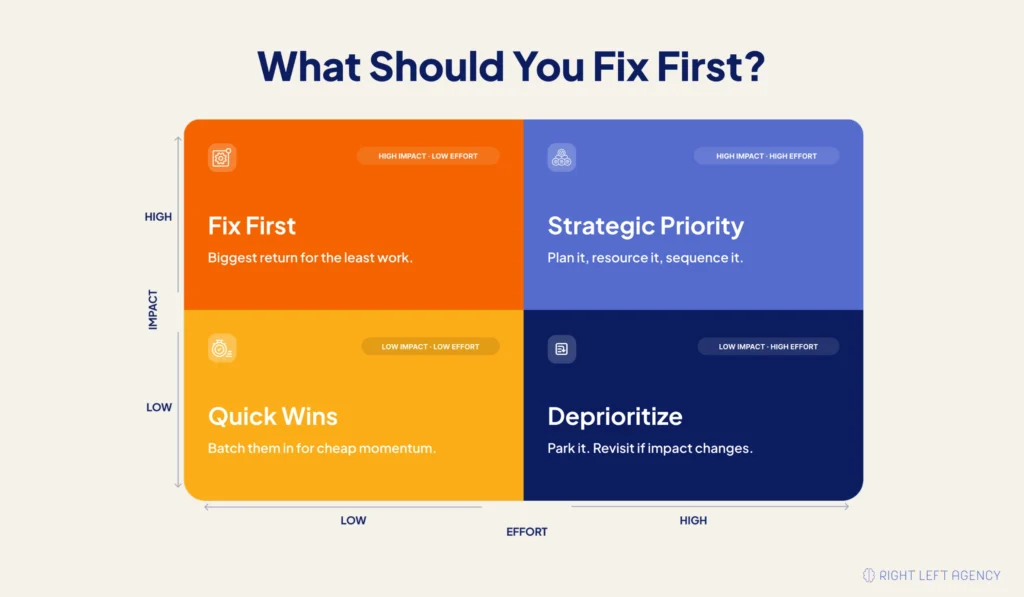
Quick conversion and journey fixes — high impact, relatively low effort: replace mismatched CTAs, add contextual internal links, connect high-traffic articles to commercial pages, fix obvious page-intent mismatches, add missing proof, improve weak commercial messaging, and reduce unnecessary form friction. These changes can unlock value from traffic you already have.
Strategic SEO rebuilds are necessary when keyword targeting consistently misses the ICP, most traffic has low commercial intent, commercial page architecture is missing, your ICP has fundamentally changed, positioning no longer matches search language, your content portfolio is heavily concentrated in TOFU, or historical rankings attract the wrong audience. These are structural problems that require more than rewriting CTAs or publishing a few new pages.
Measurement fixes should take priority when CRM source tracking is incomplete, organic pipeline isn’t reported, attribution stops at last touch, sales and marketing use different definitions, conversion events are unreliable, or self-reported attribution is missing. You can’t make confident SEO investment decisions without reliable measurement.
What SaaS SEO Should Actually Report
A mature SaaS SEO report should connect visibility to business outcomes.
Leading SEO metrics show whether the SEO engine is moving in the right direction: qualified non-brand visibility, commercial keyword rankings, organic traffic to commercial pages, search intent distribution, relevant organic landing-page traffic, SERP visibility.
Conversion metrics show whether organic visitors take meaningful actions: demo requests, trial signups, free signups, form conversions, PQLs, MQLs, SQLs.
Revenue metrics connect SEO with business performance: opportunities, organic-sourced pipeline, organic-influenced pipeline, pipeline value, closed-won revenue, CAC, marketing ROI.
The reporting hierarchy should move from: Visibility → Traffic → Conversion → Qualification → Pipeline → Revenue. Traffic remains useful — it simply shouldn’t be the final number.
For a broader revenue measurement model, see Right Left Agency’s SaaS marketing ROI guide.
When Should You Optimize Your Existing SEO Strategy—and When Should You Rebuild It?
The right decision depends on the evidence.
Optimize the existing program when: traffic is relevant, ICP alignment is strong, commercial pages already exist, high-intent queries are present, conversion paths have identifiable weaknesses, attribution can be corrected, and specific high-impact leaks are visible. In this situation, you may already own valuable demand — the opportunity is to convert more of it.
Rebuild the strategy when: the keyword universe fundamentally misses your ICP, most organic traffic is low-intent, commercial search architecture is missing, your positioning or ICP has changed significantly, content is disconnected from the product, or reporting can’t connect SEO to business outcomes. A strategy rebuild should start with the business, not simply a new keyword list: ICP → Buying Journey → Positioning → Search Demand → Page Architecture → Conversion → Measurement.
Evaluate external expertise when: SEO reporting stops at rankings and traffic, no meaningful commercial keyword strategy exists, organic pipeline isn’t measurable, content production continues despite known funnel gaps, the current provider can’t explain how SEO contributes to revenue, or your internal team knows traffic is growing but can’t identify the commercial constraint. The goal is a rigorous diagnosis when the relationship between organic search and revenue is unclear.
Right Left Agency’s SaaS SEO services are built around this broader model of connecting search visibility with leads, pipeline, revenue reporting, and conversion.
Final Takeaway: Stop Optimizing for Traffic Alone
If your SaaS SEO is driving traffic but not pipeline, find the leak before publishing more content.
Check your ICP, search intent, page types, conversion paths, CRM stages, and attribution to identify where the SEO-to-revenue journey is breaking:
Traffic → Lead → MQL/PQL → SQL → Opportunity → Pipeline → Revenue
Sometimes the fix is better targeting. Sometimes it is stronger commercial pages, conversion messaging, attribution, or sales qualification.
Find the constraint. Then fix it.
If your traffic is growing but pipeline isn’t, explore Right Left Agency’s SaaS SEO services
Frequently Asked Questions
Why is my SaaS website getting organic traffic but no demos?
The most common causes are poor search-intent alignment, weak ICP fit, informational-heavy traffic, missing commercial pages, unclear CTAs, weak proof, or conversion paths that do not match the SaaS buying motion. Attribution and downstream sales problems can also make healthy SEO appear ineffective.
Why are my organic leads low quality?
Low-quality organic leads usually indicate a mismatch between your SEO targeting and your ICP, or between the keywords you target and the buyer intent behind them. Compare organic leads against company size, industry, role, use case, geography, and product fit instead of measuring SEO by lead volume alone.
What SEO keywords are most likely to generate SaaS pipeline?
Commercial and bottom-of-funnel keywords are generally closer to pipeline because they indicate active solution evaluation. Examples include product-category, solution, comparison, alternative, use-case, integration, pricing, and industry-specific searches. The strongest opportunities combine buyer intent with strong ICP fit.
Should SaaS SEO focus on traffic or conversions?
SaaS SEO should track both, but conversions, qualified pipeline, and revenue should determine commercial success. Traffic and rankings show whether visibility is growing. Demos, trials, PQLs, MQLs, SQLs, opportunities, pipeline, and revenue show whether that visibility is creating business value.
How do I measure pipeline from SEO?
Connect search and analytics data with your CRM and track organic visitors through conversion, qualification, opportunity, pipeline, and closed-won stages. Report both organic-sourced and organic-influenced pipeline so you are not relying entirely on last-touch attribution.
What types of SaaS content are closest to conversion?
Commercial and evaluation content tends to sit closest to active buying decisions. This includes product pages, solution pages, use-case pages, comparison pages, alternative pages, integration pages, pricing pages, feature pages, and case studies.
Can SEO influence pipeline when buyers use ChatGPT and AI search?
Yes. AI-assisted research can influence discovery even when the eventual website visit comes through another channel. Because these journeys can be difficult to track, combine analytics, CRM data, search visibility, and self-reported attribution rather than relying only on referral data.
How long should SaaS SEO take to influence pipeline?
There is no universal timeline. Results depend on existing authority, search demand, competition, ICP alignment, commercial-page coverage, conversion rates, sales cycles, and the quality of the SEO strategy. Existing high-intent traffic can often provide faster opportunities than building visibility from scratch.
How do I know whether SEO or my website conversion rate is the problem?
Follow the chain: Traffic → Buyer Fit → Intent → Page → Conversion → Qualification → Attribution → Pipeline. If relevant high-intent visitors reach appropriate pages but do not act, investigate conversion. If the traffic itself is poorly aligned with your ICP or search intent, investigate the SEO strategy first.