

Key Takeaways
- Vertical SaaS is cloud-based software built for one specific industry, not a broad range of businesses.
- Unlike horizontal SaaS tools like Salesforce or HubSpot, vertical SaaS goes deep into niche workflows, compliance needs, and industry terminology.
- Vertical SaaS companies often see stronger retention because their tools become embedded in daily operations, making switching less likely.
- It can be a strong business model for founders targeting underserved, regulation-heavy, or workflow-complex industries.
- For buyers, it means faster onboarding, better compliance support, and software that actually fits their work.
Vertical SaaS (vertical software-as-a-service) is industry-specific software built to serve one niche or sector rather than every business type. Instead of offering broad, one-size-fits-all features, vertical SaaS platforms go deep into the workflows, terminology, compliance needs, and operational realities of a single industry.
Think software built specifically for dental practices, real estate agencies, or logistics companies. It differs from horizontal SaaS tools like generic CRMs or project management apps that work across all industries but go deep in none. A general project management tool helps any team track tasks. A vertical SaaS tool for construction companies tracks permits, subcontractors, site inspections, and compliance checklists. Same concept, completely different depth.
Here is what makes a platform truly vertical SaaS:
- Built for one industry: The product solves problems specific to a single sector, not a wide range of businesses.
- Uses industry language: The UI, features, and terminology match how people in that field actually work.
- Handles niche workflows: It manages processes that generic software simply does not cover.
- Supports compliance and reporting: Many vertical tools come with built-in support for industry-specific regulations, audits, and legal requirements.
- Reduces the need for heavy customization: Because it is already shaped around your industry, you spend less time forcing it to fit.
How Vertical SaaS Works
Vertical SaaS platforms are built by people who deeply understand a specific industry. They study how that industry operates, then build software that matches those exact workflows from the ground up.
Instead of starting with a blank, generic platform and adding plugins or custom fields to make it work, vertical SaaS starts with the industry problem and builds the solution around it.
Here is how that plays out in practice:
- Workflow fits from day one: The platform already knows your daily operations. Software for veterinary clinics can handle appointment types, pet records, and medication tracking without major setup.
- Industry-specific data fields: Fields, labels, and categories reflect what your industry actually tracks, whether that is patient vitals, lease agreements, or job site hours.
- Built-in compliance features: Healthcare tools come with HIPAA support. Legal software comes with case management and billing standards already baked in.
- Integrated reporting: Reports are pre-built around the metrics that matter to your sector, not generic dashboards you have to configure manually.
- Relevant integrations: The software connects with tools common in that industry rather than offering hundreds of integrations that do not apply to your work.
The result is software that aligns with the way the team already works, reducing setup friction and shortening the path to value.
Pro Tip: Before buying any SaaS tool, list the five workflows your team handles every single day. Then check whether the platform covers them natively or requires workarounds. If you need more than one or two workarounds, it is probably the wrong tool for your industry.
Vertical SaaS vs Horizontal SaaS
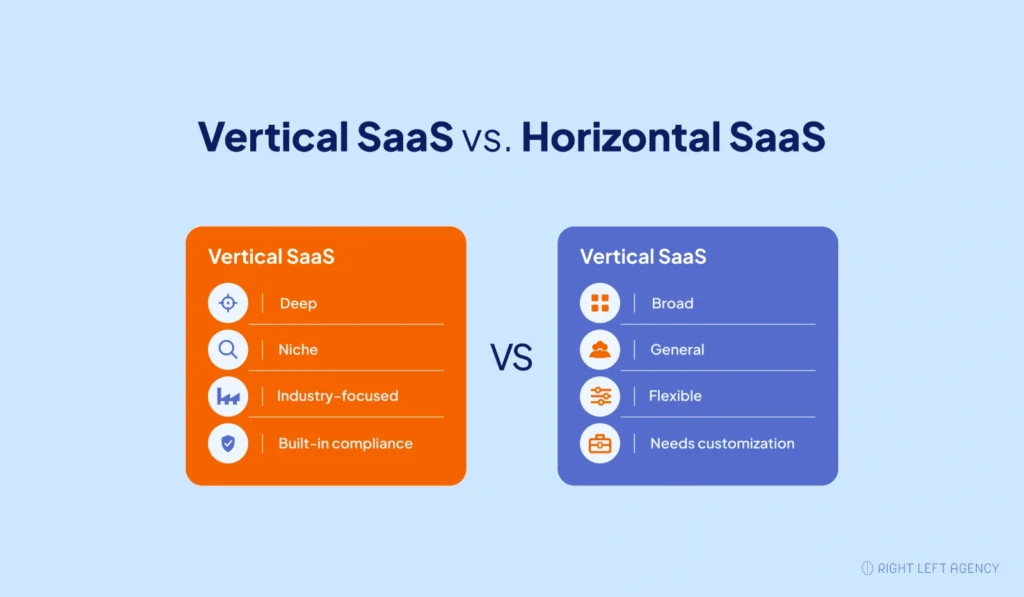
This is where a lot of people get confused. Both are cloud-based software. Both run on a subscription model. The real difference is focus.
Horizontal SaaS serves a broad range of industries and business types. Vertical SaaS serves one. Here is a side-by-side look:
| Feature | Vertical SaaS | Horizontal SaaS |
|---|---|---|
| Target audience | One specific industry or niche | Any business, across all industries |
| Industry focus | Deep and narrow | Broad and general |
| Workflow customization | Built-in for that sector | Requires heavy customization |
| Use cases | Dental software, construction management, and legal practice tools | CRM, email marketing, project management |
| Integration needs | Fewer but highly relevant integrations | Wide range of integrations across industries |
| Compliance support | High, often built in for that sector | Low, usually left to the user to configure |
| Scalability across industries | Limited to the target niche | Scales across many sectors |
| Example products | Property management software, healthcare EHR | Salesforce, HubSpot, Slack |
When does each model make sense?
If your business operates in a specialized field with unique workflows or compliance requirements, a vertical SaaS tool will often be a better fit than a generic one. You get more relevant features and spend less time building workarounds.
If your business has fairly standard operations that cut across departments, like sales, HR, or marketing, horizontal SaaS tools like HubSpot or Slack will serve you well. They are built for broad use and carry large communities behind them.
Key Characteristics of Vertical SaaS Platforms
Not every niche tool qualifies as true vertical SaaS. Here is what separates a genuine vertical SaaS platform from a generic tool with an industry-themed landing page:
- Industry-native workflows: The platform is designed around how work actually happens in that sector, not adapted from a general template. A trucking company’s software handles dispatch, driver logs, and load tracking. It does not just repurpose a generic task list.
- Specialized features that generic tools skip: Vertical SaaS includes features that would look out of place in a broad platform but are essential in the target industry. Think medication management in healthcare SaaS or title insurance tracking in real estate software.
- Compliance and regulatory support: Many industries operate under strict requirements. Vertical SaaS often includes built-in support for frameworks such as HIPAA, audit logging, data handling policies, or local licensing requirements.
- Industry terminology in the UI: The platform speaks the user’s language. A legal SaaS uses terms like “matter,” “retainer,” and “billable hours.” A hospitality tool talks about “occupancy,” “RevPAR,” and “PMS integration.”
- Higher product relevance for a specific audience: Because the tool is built for one group, every feature lands closer to home. Users feel less overwhelmed and find value faster.
- Deeper operational fit: Users rarely need to bend the tool to fit their work. The platform already matches how the team operates, which speeds up adoption.
Benefits of Vertical SaaS
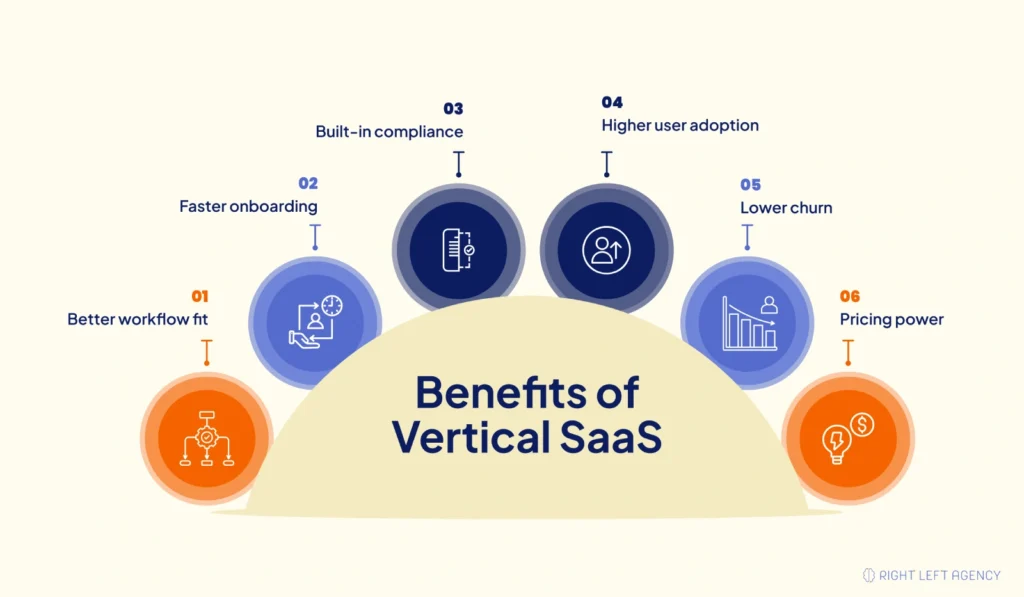
Businesses do not switch to vertical SaaS by accident. They do it because the benefits show up quickly and clearly once the platform is in place.
Here is what makes vertical SaaS worth choosing:
- Better workflow fit: When software understands your industry, your team spends less time working around it. Processes flow more naturally, and onboarding is faster.
- Faster time to value: The tool comes pre-built for your sector, so setup is quicker. You are not spending weeks configuring fields, workflows, and reports from scratch.
- Stronger relevance for niche users: Every feature in a vertical platform has a clear purpose for the people using it. There is far less noise compared to a bloated horizontal tool packed with features that do not apply to your work.
- Easier compliance alignment: For industries with strict regulations, vertical SaaS reduces the burden of staying compliant. The platform handles much of it by design.
- Lower churn for SaaS vendors: Users who rely on industry-specific software tend to stick around longer. The tool becomes part of daily operations, and the cost of switching, both in time and workflow disruption, is real.
- Pricing power: Because the software solves a specific, high-value problem, vertical SaaS vendors can often charge more than generic tools. Customers pay for precision.
In practice, the appeal of vertical SaaS is simple: teams spend less time adapting software to their work and more time using software that already fits their workflows.
Pro Tip: If you are evaluating vertical SaaS for your team, ask the vendor for a demo using your industry’s actual data and workflows, not a generic walkthrough. How the platform handles your real scenarios tells you far more than a scripted product tour.
Challenges of Vertical SaaS
Specialization is a strength, but it comes with trade-offs. Understanding these limitations helps both buyers and builders make smarter decisions.
- Smaller total addressable market: A vertical SaaS product serves one niche by definition. That limits the number of potential customers from the start. The upside is deeper penetration, but the ceiling is lower than that of a horizontal product.
- Dependence on one industry segment: If a sector faces an economic downturn, regulatory shift, or major technology change, a vertical SaaS company feels that pressure more sharply than a horizontal one.
- Building deep expertise takes time: To build truly useful vertical software, the team needs to understand the industry thoroughly. That takes time, focused hiring, and often close partnerships with industry insiders.
- Growth requires going deeper, not wider: Scaling a vertical SaaS business usually means expanding features within the niche or moving into adjacent verticals. Expanding broadly across industries often weakens the core value proposition.
- Sales cycles tied to industry conditions: Procurement decisions in healthcare, construction, or legal tend to be slower and more complex. The sales process can take longer than in industries with faster buying decisions.
For buyers, these trade-offs matter less than fit. For founders, they matter a lot because they shape market size, sales strategy, and expansion potential.
Examples of Vertical SaaS
The best way to understand vertical SaaS is to see it in action across different industries.
Healthcare
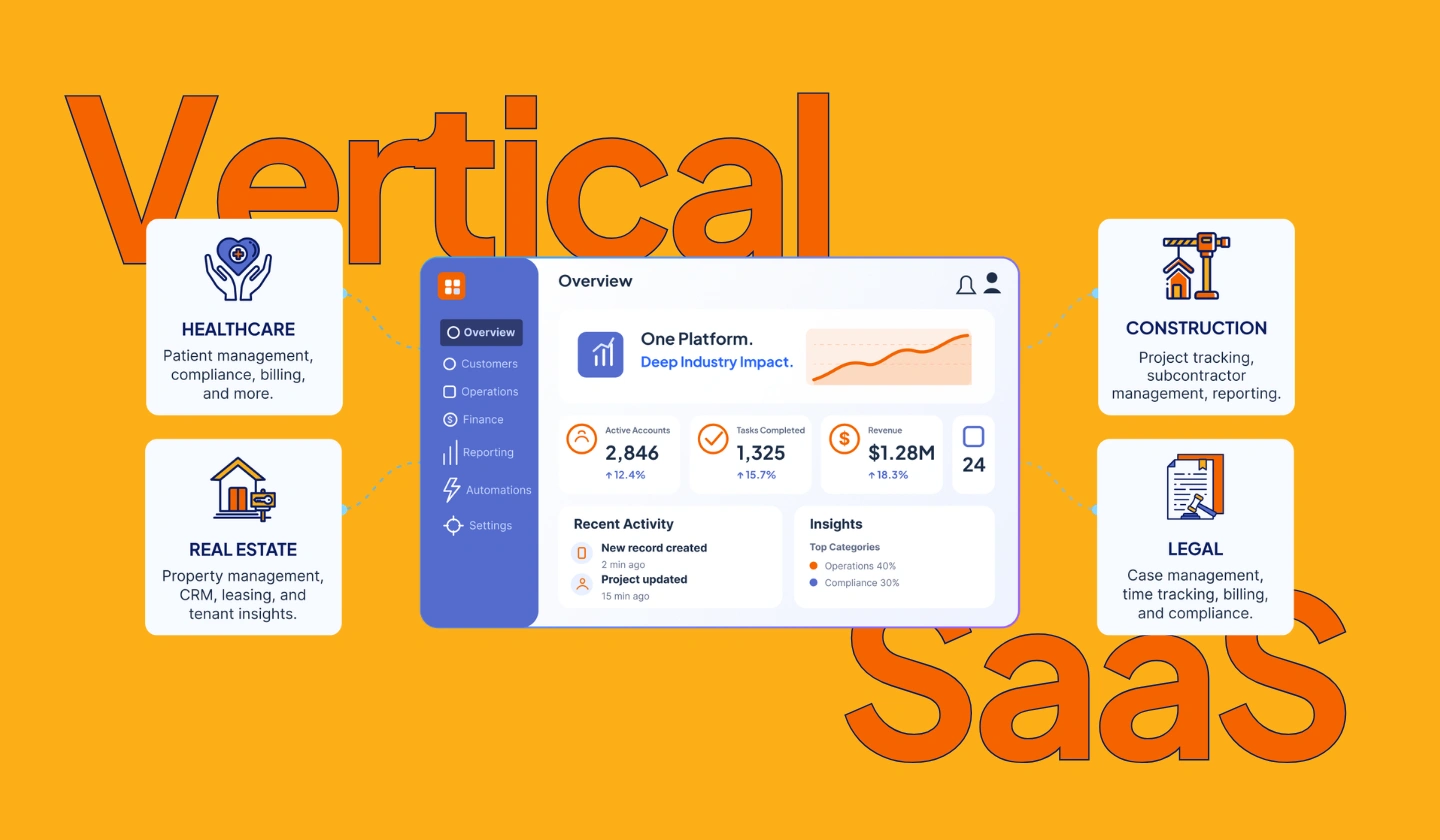
Healthcare SaaS includes tools like electronic health record (EHR) systems, patient scheduling platforms, and medical billing software. Patient data is complex, heavily regulated, and needs to move quickly across providers. These platforms handle HIPAA compliance, clinical workflows, appointment management, and insurance billing all in one place, replacing the fragmented mix of spreadsheets and paper forms that many clinics still rely on.
Real Estate
Property management software helps landlords, agencies, and property managers handle lease dates, maintenance tickets, rent collection, tenant communication, and vacancy turnover in one system. A generic CRM has no concept of lease expiry or maintenance request workflows. A dedicated property management platform does, and it handles all of it without custom configuration.
Construction
Construction management software covers project timelines, subcontractor coordination, site documentation, permit tracking, and budget oversight. It pulls together the job site, the office, and the supply chain into one platform built around how construction projects actually run, not how a generic task manager assumes they do.
Legal
Legal practice management software handles case files, hourly billing, document storage, court deadlines, and client communication. Law firms bill by the minute, manage privileged documents, and track court-imposed timelines. General business software was never designed with any of that in mind.
Finance and Fintech
Vertical SaaS in finance covers tools for accounting firms, loan origination platforms, and compliance management systems. Regulatory complexity in this space is high, and the cost of getting it wrong is even higher. Industry-specific software handles those requirements by default rather than leaving them to the user to configure.
Hospitality
Hotels and restaurants use vertical SaaS for reservation management, point-of-sale systems, staff scheduling, and inventory tracking. These platforms speak the language of RevPAR, covers, and occupancy. A generic operations tool simply does not have those concepts built in.
Logistics and Trucking
Fleet management software handles driver dispatch, route optimization, delivery tracking, and compliance with transportation regulations. Hours-of-service rules, load documentation, and route efficiency are not afterthoughts in logistics SaaS. They are built into the core of the product.
Education
Learning management systems and school administration platforms handle course delivery, student progress tracking, enrollment, and parent communication. Education runs on academic calendars, grade structures, and compliance requirements that are completely different from a standard business environment. Vertical SaaS is built around those rhythms.
Pro Tip: When researching vertical SaaS for your industry, look for tools built by teams with hands-on experience in your sector. Founders who have worked in the industry, not just studied it, tend to understand the nuances that matter most.
Who Is Vertical SaaS Best For?
Vertical SaaS is not for every business. But for the right ones, it changes how the entire team works.
Here is who gets the most value from it:
- Businesses in highly specialized industries. If your industry has its own jargon, compliance requirements, or complex workflows, a vertical tool will usually fit far better than a generic one.
- Teams that are frustrated by constant customization. If your team spends significant time building workarounds in your current software, that is a clear sign the tool was not made for you.
- Organizations with regulatory or reporting obligations. Industries like healthcare, finance, and legal rarely get by with general software. Compliance needs alone often justify a vertical solution.
- Founders exploring a niche SaaS opportunity. Building vertical software for an underserved industry can be a strong path for a startup. The deeper the pain point, the stronger the case for a purpose-built solution.
- Operations teams need industry-specific reporting. When the reports you need do not exist in your current tool or require heavy manual configuration each time, a vertical SaaS platform saves meaningful time every week.
A simple test: if your team relies on workarounds, spreadsheets, or custom fields just to handle everyday tasks, a vertical SaaS platform is worth a serious look.
Is Vertical SaaS a Strong Business Model?
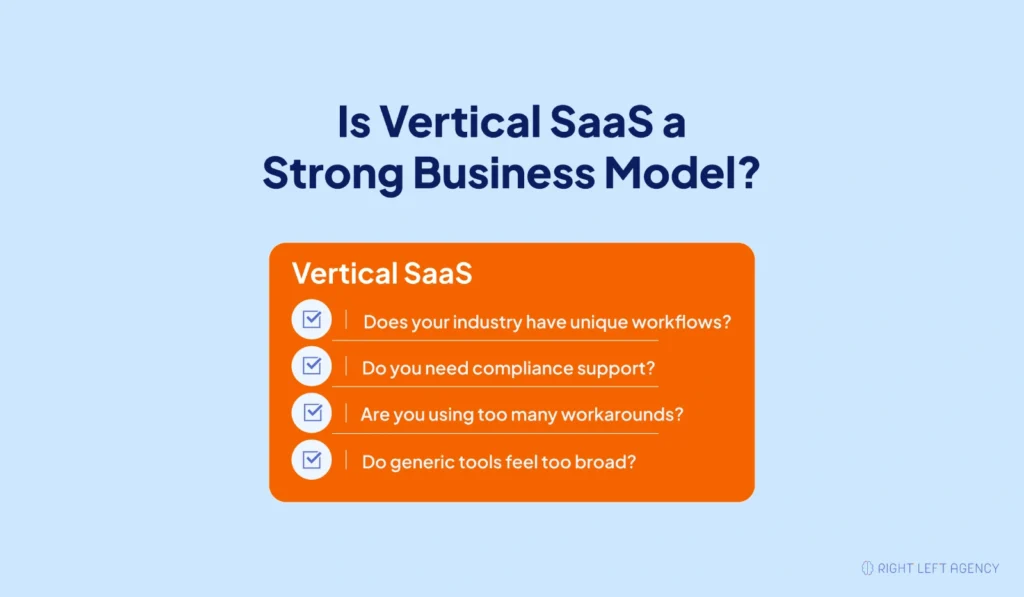
Vertical SaaS can be a strong business model because specialization can improve product-market fit, retention, and pricing power. The trade-off is a narrower total addressable market, which means success depends on deep industry knowledge and disciplined positioning.
When software fits a customer’s workflows closely, switching becomes costly, not just in terms of money but in time, retraining, and operational disruption. That stickiness is one reason vertical SaaS often sees lower churn than broader alternatives.
Specialization also creates defensibility. A healthcare SaaS company that understands clinical workflows, regulatory cycles, and billing complexity is not easy to replicate. That depth of industry knowledge takes years to build and acts as a real barrier to entry for competitors.
Pricing power follows naturally. Businesses that need a purpose-built solution will often pay more for it than they would for a generic tool that only partially solves their problem.
The challenge is that the total addressable market is smaller than horizontal SaaS. But many vertical SaaS companies offset that with higher average contract values, lower churn, and stronger customer relationships. Some also grow by expanding into adjacent verticals or building additional platform layers on top of their core niche.
For buyers, the better question is not whether the category is attractive in general, but whether a specific product solves your industry’s real workflows better than broader alternatives do. That is the only measure that actually matters when you are the one using the software every day.
Frequently Asked Questions About Vertical SaaS
How is Vertical SaaS different from Horizontal SaaS?
Horizontal SaaS serves many industries with broad, general-purpose features. Think of tools like Salesforce or Slack that work for almost any business. Vertical SaaS focuses on one specific industry and builds features around its exact workflows, terminology, and compliance needs. The difference is depth versus breadth.
What are examples of Vertical SaaS?
Some common examples include electronic health record systems in healthcare, property management platforms in real estate, legal practice management tools for law firms, and construction project management software for contractors. Each one is built around the specific operations of that sector rather than general business functions.
What industries use Vertical SaaS?
Healthcare, real estate, construction, legal, finance, hospitality, logistics, and education are among the most common industries using vertical SaaS. Any sector with complex, specialized workflows, compliance requirements, or niche operational needs is a strong candidate.
What are the benefits of Vertical SaaS?
The biggest benefits are better workflow fit, faster onboarding, built-in compliance support, and stronger user adoption. Because the software matches how the industry actually operates, teams spend less time configuring and more time using it effectively.
Is Vertical SaaS a good business model?
It can be a very strong model. Although the market is smaller than horizontal SaaS, vertical products can benefit from stronger retention, clearer positioning, and higher willingness to pay when they solve industry-specific problems well. Success depends on how deeply the product fits the workflows of its target sector.
What does vertical SaaS mean in simple terms?
Vertical SaaS simply means software built for one type of business or industry instead of all businesses. If a tool is designed specifically for dental clinics, it is vertical SaaS. If it can be used by any business regardless of industry, it is horizontal SaaS.
Final Thoughts on Vertical SaaS
Vertical SaaS is cloud-based software designed to serve the needs of one industry or niche. By focusing on one industry and solving its problems precisely, these platforms deliver more value per feature than any general-purpose tool could.
For founders, vertical SaaS remains attractive where industries still rely on fragmented tools, manual workarounds, or outdated workflows. The opportunity is strongest when the problem is clear, and the product solves it better than generic alternatives do.
For businesses operating in specialized fields, it is worth asking whether your current software was actually built for you, or just adapted to fit. The right vertical SaaS platform does not just automate your work. It understands it.