

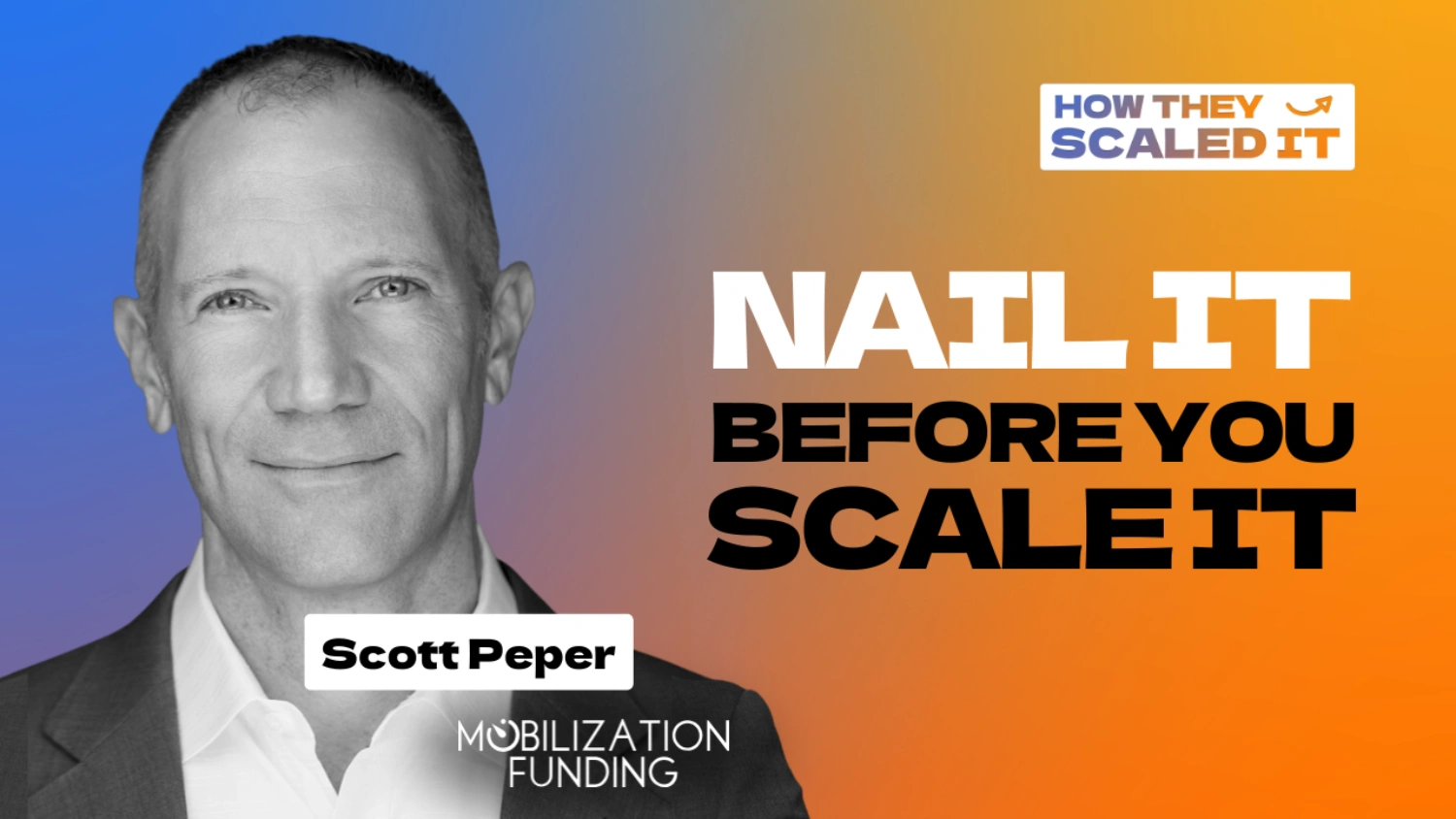
In this episode of How They Scaled It, host Courtney sits down with Scott Peper, Founder and CEO of Mobilization Funding, a specialized construction finance company helping subcontractors solve one of the industry’s biggest problems: cash flow. If you’ve ever wondered how founders identify underserved markets and build businesses around real operational pain points, this is the story behind the company that’s redefining construction funding.
Scott’s path into entrepreneurship wasn’t linear. He spent years in sales leadership roles across healthcare and medical devices, building a successful corporate career while quietly feeling something was missing. On paper, everything looked right — income, titles, promotions, stability. But internally, he felt boxed in.
That tension eventually led him toward entrepreneurship, though not in the dramatic “quit your job overnight” way many startup stories are told. Instead, it happened gradually through a small investment opportunity that evolved into a much larger realization: there was a massive problem in commercial construction that traditional lenders weren’t solving.
And more importantly, customers were desperate for someone who actually understood it.
The Entrepreneurial Pull Often Starts as Discomfort
One of the most relatable parts of Scott’s story is how he describes entrepreneurship before he even knew that’s what he wanted.
He didn’t initially frame it as a desire to “start a business.” Instead, he describes feeling unsettled in traditional roles, frustrated by ceilings, corporate structures, and the inability to fully execute ideas the way he envisioned them.
That experience is incredibly common among founders. Many entrepreneurs don’t begin with a perfectly formed startup idea. They begin with a feeling that their environment limits their impact.
For Scott, those feelings became clearer when he invested in what would eventually become Mobilization Funding. Even before officially stepping into the business, he noticed how energized he felt simply participating in strategy conversations and customer meetings.
That emotional signal mattered.
Founders often recognize opportunities not only through market gaps, but through energy, the type of work that pulls them in naturally.
The Business Wasn’t Broken — The Execution Was
What started as a passive investment quickly became much more hands-on when the original operator exited the company unexpectedly.
Initially, Scott and the remaining ownership group weren’t trying to scale a new business. They were simply trying to recover their investment and stabilize existing loans.
But something surprising happened during that process.
As they met with customers and learned more about the industry, they realized the underlying need was enormous. Commercial subcontractors faced constant working capital shortages because of how construction payment cycles operate. Companies were often required to fund payroll, materials, and labor weeks — sometimes months — before receiving payment themselves.
Traditional lenders struggled to assess this kind of “performance risk,” leaving many contractors stuck without practical financing options.
What stood out most wasn’t just the financial opportunity. It was how relieved customers felt when someone finally understood their reality.
Scott described one customer who grew from a few million dollars in annual revenue to nearly $10 million after gaining access to the right financing structure. That wasn’t just growth for growth’s sake. It translated into more employees, larger projects, and a more sustainable business.
That’s when the company’s mission became clear.
Why Most Businesses Scale Too Early
One of the strongest themes throughout the conversation is Scott’s belief that businesses should perfect delivery before aggressively scaling.
In today’s startup culture, founders are often encouraged to prioritize speed above all else. Raise capital quickly. Spend heavily on marketing. Scale fast.
Scott sees that differently.
He argues that many businesses pour fuel onto systems that aren’t fully working yet. The result is what he describes as the “leaky bucket” problem: companies spend heavily acquiring customers before proving they can consistently deliver a great experience.
And when customers have a bad experience, word spreads just as quickly as positive marketing.
That perspective has heavily shaped how Mobilization Funding operates today. Rather than prioritizing explosive growth immediately, the company focused on deeply understanding customer pain points and refining its product around real operational workflows.
That meant:
- Structuring repayment schedules around actual construction payment cycles
- Building high-touch customer service teams
- Creating educational resources for contractors
- Developing technology tools that simplified communication and funding requests
In Scott’s view, marketing should amplify a strong customer experience, not compensate for a weak one.
That philosophy has paid off. He shared that roughly 75% of the company’s annual funding volume now comes from existing customers.
That kind of retention only happens when customers trust both the product and the people behind it.
Leadership, Humility, and the Reality of Risk
The conversation also dives deeply into leadership and the emotional realities of entrepreneurship.
Scott’s perspective on founders is refreshingly grounded. He doesn’t romanticize entrepreneurship as freedom or glamor. Instead, he frames it primarily through the lens of responsibility and risk tolerance.
As he explains, employees and founders often want many of the same things:
- To contribute meaningful work
- To solve problems
- To grow professionally
- To feel part of a winning team
The difference is that founders willingly absorb far more uncertainty.
That uncertainty changes how leaders operate. Over time, Scott says he learned to delegate more effectively, empower employees, and allow room for mistakes instead of trying to control every outcome personally.
One of the most interesting qualities he now prioritizes when hiring is humility.
Not insecurity. Not passivity.
Humility in the sense that someone is confident enough to pursue excellence while remaining self-aware enough to admit what they don’t yet know.
That mindset, he believes, creates stronger teams, better learners, and more resilient organizations overall.
It also reflects how Scott approaches leadership internally: high standards paired with trust, coaching, and long-term development.
The Future of Construction Finance Is Still Wide Open
Even after years of growth, Scott believes the opportunity in construction finance is still massively underestimated.
Commercial construction remains one of the largest industries in the world, measured in trillions of dollars annually. Yet many subcontractors still struggle to access flexible capital solutions that align with the realities of project-based work.
Mobilization Funding’s long-term vision is to become the trusted financing partner contractors instinctively think of when traditional lending doesn’t fit their needs.
And importantly, Scott believes there’s still enormous room for innovation in the space.
The company continues investing heavily in technology, education, and customer support infrastructure, not simply to process loans faster, but to become a strategic operational partner for contractors navigating increasingly complex projects.
It’s a reminder that some of the best business opportunities still exist in industries most startups ignore.
Not every breakthrough comes from building the next consumer app.
Sometimes it comes from understanding a frustrating operational bottleneck better than anyone else.
Want to hear the full conversation?
Listen to Episode 28 of How They Scaled It on Spotify: https://open.spotify.com/episode/1wqBiTaVWSfv2Ub2iS4F8G
If you’re a founder looking to scale smarter, let’s talk. Right Left Agency helps brands like yours harness psychology-driven marketing for real growth. Get in touch today!
To learn more about Mobilization Funding, visit www.mobilizationfunding.com.