

Key Takeaways
- Vertical marketing means focusing your marketing on one specific industry or niche instead of targeting everyone, which cuts competition and builds trust faster.
- It works best when buyers in a market share similar needs, workflows, regulations, or buying habits.
- Compared to horizontal marketing, vertical marketing gives you sharper messaging, stronger credibility, and clearer positioning.
- In B2B and SaaS, vertical marketing works especially well because buyers tend to trust vendors who speak their industry’s language.
- The top vertical marketing strategies are industry-specific content, niche SEO, account-based marketing (ABM), ecosystem partnerships, and community building.
- Start with one vertical, prove yourself there, and expand into adjacent markets only once you have solid traction.
Most marketing teams try to reach everyone, and that usually means they reach no one well.
When your message is written for “any business” or “all industries,” it sounds generic to every reader. Nobody sees themselves in it. Your conversion rates reflect exactly that.
Vertical marketing solves this problem. You go narrow on purpose. You pick one specific industry, learn it inside out, and build your entire marketing around that audience’s real language, real problems, and real needs.
In this guide, we’ll walk you through what vertical marketing is, how it differs from horizontal marketing, and why so many businesses are using it to win in niche markets. We’ll also cover how it applies to B2B and SaaS companies, where going industry-specific can be a serious competitive edge.
Let’s get started.
Who Is This Guide For?
This guide is for you if you are:
- New to the concept and want a clear definition with real examples
- A marketer deciding between a vertical or horizontal approach
- A B2B founder is thinking about niche positioning for their product or service
- A SaaS company building an industry-specific go-to-market strategy
- A consultant, agency, or service business that wants to specialize in one industry
What Is Vertical Marketing?
Vertical marketing is a strategy where you focus your marketing on a specific industry or customer segment rather than going broad.
Instead of selling to “businesses of all sizes,” you sell specifically to independent dental clinics. Instead of writing generic copy, you write messaging built around the daily problems of property managers or community bank executives.
The word “vertical” refers to a slice of the market. A vertical market is a group of buyers who share similar needs because they work in the same industry or serve the same type of customer.
Here is a simple way to think about it. Horizontal marketing goes wide across many industries. Vertical marketing goes deep into one specific market. You stop trying to write for everyone and start writing for one audience whose world you know inside and out.
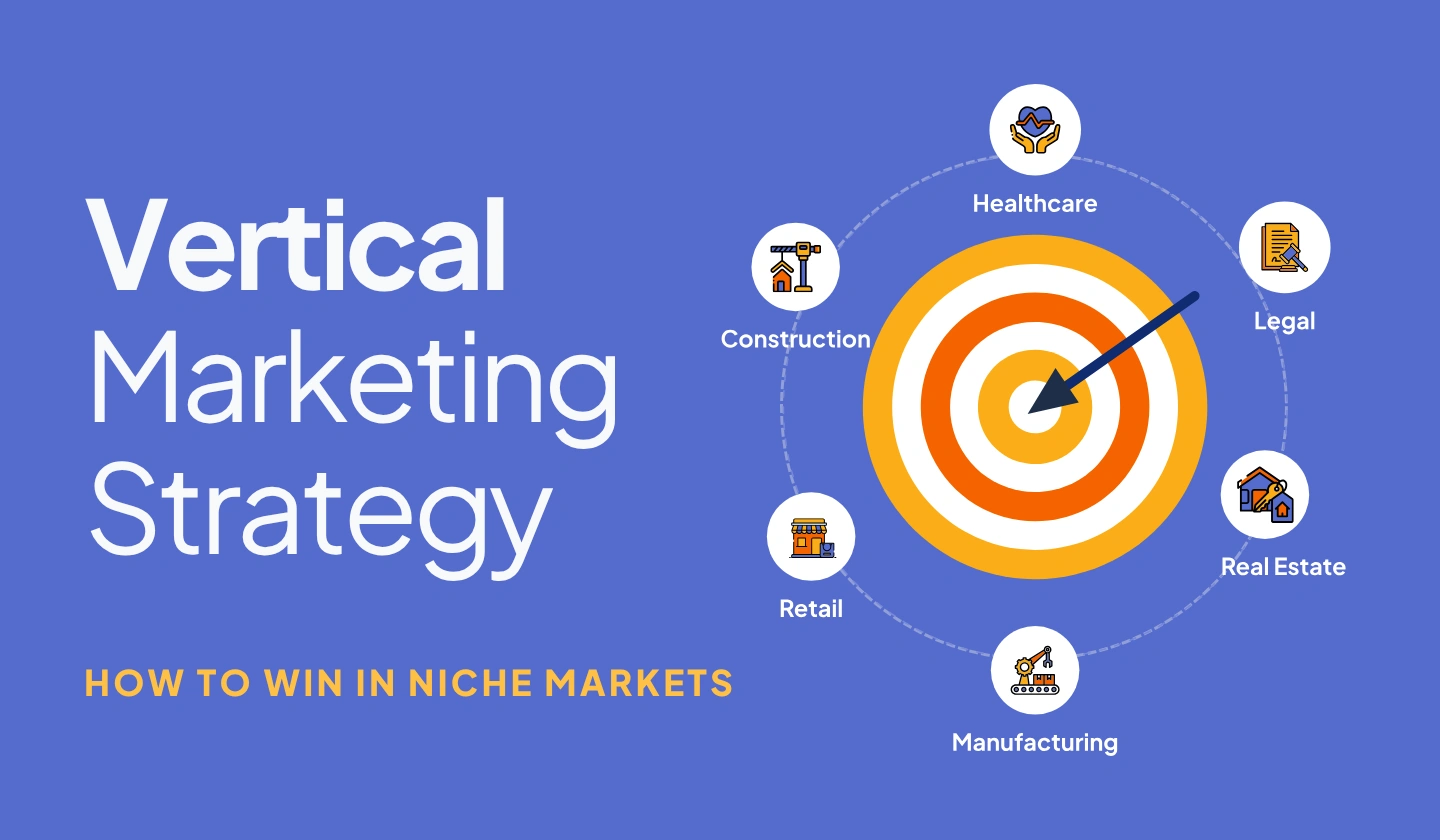
Some common vertical markets include:
- Healthcare (hospitals, clinics, home health agencies)
- Legal (law firms, in-house legal teams, legal operations)
- Real estate (property management, commercial brokerage, residential agents)
- Fintech (credit unions, wealth management firms, mortgage lenders)
- Construction (general contractors, specialty trades, project owners)
Vertical Marketing vs. Vertical Marketing System
These two terms sound alike, but they mean very different things.
Vertical marketing (or a vertical marketing strategy) is what most modern B2B and SaaS teams mean when they use the term. It means focusing your go-to-market efforts on one specific industry or customer type. A SaaS company that only markets to dental clinics is using a vertical marketing strategy.
A vertical marketing system is an older concept from traditional distribution theory. It refers to a coordinated channel model where producers, wholesalers, and retailers work together under one system to get products to customers more efficiently. Think of a manufacturer, distributor, and retailer all operating under one unified sales model.
Both use the word “vertical,” but they are not the same. One is about who you target. The other is about how your distribution channel is structured. Most people searching for “vertical marketing” today are looking for the niche-focused strategy, not the distribution model.
Vertical Marketing vs. Horizontal Marketing: What Is the Difference?
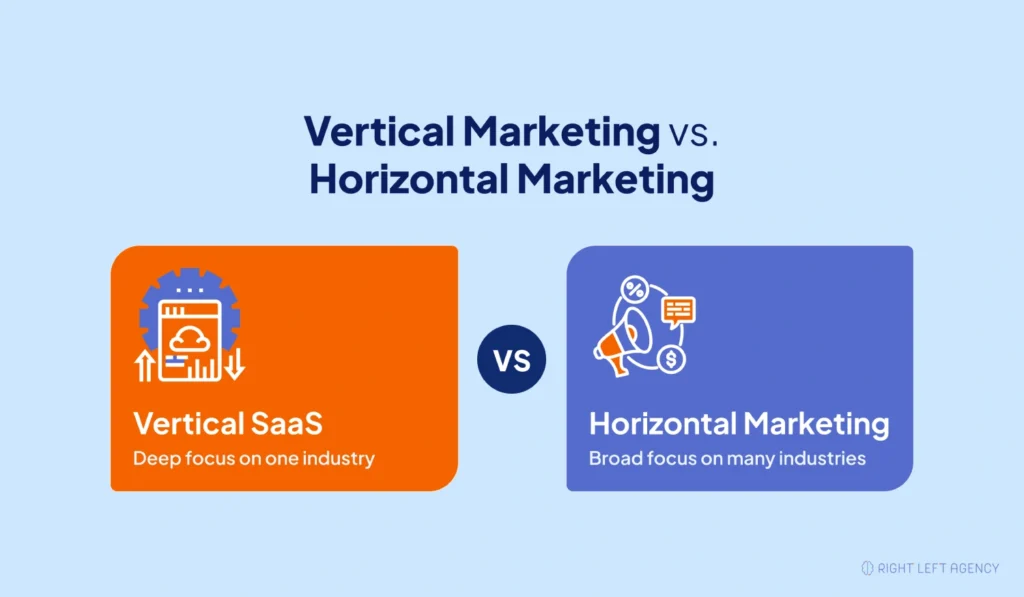
The simplest way to put it: horizontal marketing is broad, and vertical marketing is specific.
A cleaning company that serves offices, schools, hospitals, and retail shops is horizontal. A cleaning company that works only with medical clinics is vertical. A marketing agency that takes any client is horizontal. An agency that only works with law firms is vertical.
Horizontal tools like Slack, Zoom, or Google Workspace market to everyone because they genuinely work for everyone. That approach makes sense when your product has truly universal appeal.
Vertical marketing is the opposite. You build your messaging, content, and sometimes even your product features around one specific audience. A project management tool built only for architecture firms or a CRM designed only for real estate agents are classic examples.
Here is how the two compare side by side:
| Factor | Vertical Marketing | Horizontal Marketing |
|---|---|---|
| Audience | One specific industry or niche | Multiple industries or a broad market |
| Messaging | Industry-specific, tailored language | Broad, benefit-focused messaging |
| Product customization | High, built around niche workflows | Low to moderate, built for general use |
| Sales cycle | Longer, more consultative | Shorter, more transactional |
| Competition | Lower within the niche | Higher across all markets |
| Trust building | Faster, because of industry expertise | Slower, harder to stand out |
When does vertical marketing make sense?
Go vertical when your best customers all come from the same sector, when your product solves problems that look different across industries, or when you want to build deep credibility in one market fast.
When does horizontal make sense?
Go horizontal when your product has genuine universal appeal, or when you have already dominated one vertical and are ready to expand.
Real-World Examples of Vertical Marketing
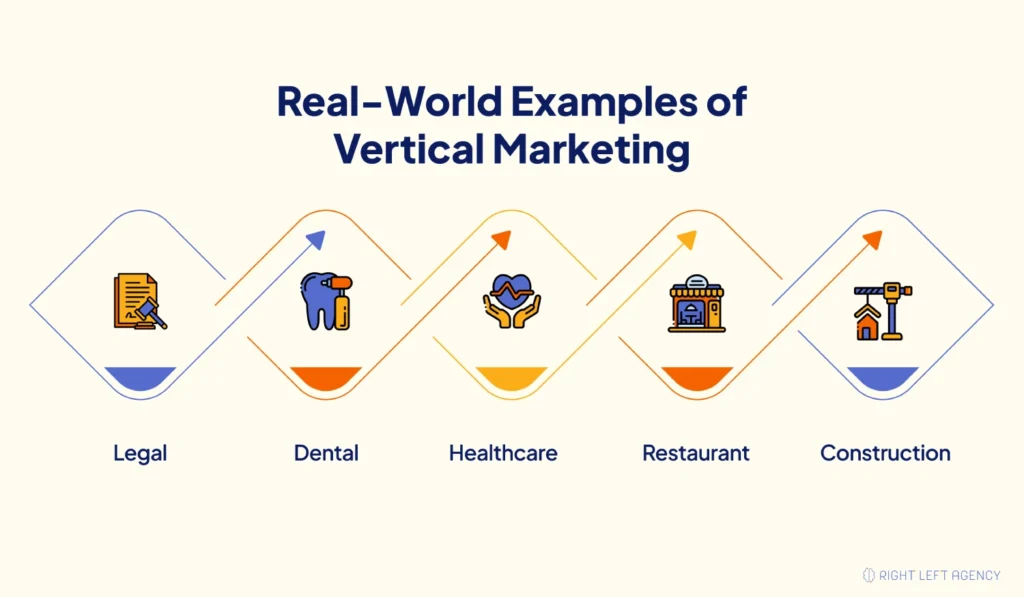
Vertical marketing is not just a SaaS thing. Here are examples across different types of businesses.
A law firm marketing agency
This agency only works with law firms. Its website, case studies, blog posts, and ads focus entirely on legal marketing challenges: getting clients, ranking locally for practice areas, and growing a firm’s reputation. A law firm visiting this site immediately feels it was made for them.
Dental practice management software
This software company focuses exclusively on dental clinics. All its messaging centers on appointment scheduling, patient reminders, front desk workload, and insurance claim processing. Dentists recognize their own daily frustrations the moment they land on the homepage.
A healthcare compliance consulting firm
This firm only serves healthcare organizations. Its content covers regulations, documentation standards, audit preparation, and risk management. They do not try to serve manufacturing or retail. Healthcare is their entire world.
A restaurant payment platform
This payment provider built its product specifically for restaurants. Everything it talks about — table turnover, tip management, online ordering, point-of-sale integrations — is something every restaurant owner cares about.
Construction estimating software
This tool targets general contractors. Its content and positioning center on project bidding, subcontractor coordination, change orders, and job costing. People in the industry trust it because it clearly understands how construction works.
Why Vertical Marketing Is Growing
Vertical marketing has been around for a long time, but right now, more B2B and SaaS companies are treating it as their primary growth strategy. Here is why:
Horizontal markets are too crowded. Categories like CRM, project management, and HR software have dozens of strong competitors. Differentiating on features alone is nearly impossible. But if you reposition as “the CRM built for independent insurance brokers,” your competitor set shrinks from dozens down to two or three.
Buyers expect solutions that fit their world. Today’s B2B buyers do not want to customize a generic tool to their workflows. They want software that already speaks their language and reflects their daily reality right out of the box.
Niche focus improves conversion and retention. When your messaging mirrors a buyer’s exact situation, they convert faster. When your product is built around their workflows, they stick around longer. Both of these outcomes improve revenue over time.
You can become the go-to name in an industry. In a vertical, you can own a category. You publish the benchmark reports. You host the industry webinar. You become the brand people associate with solving that specific problem. That kind of authority is nearly impossible to build with a broad horizontal approach.
AI is making niche targeting easier. Better data, intent signals, and AI-powered tools mean smaller teams can now run vertical go-to-market motions that used to need large headcounts. Targeting, content creation, and outreach have all gotten more accessible at the niche level.
Industry ecosystems fuel organic growth. Every vertical has its own conferences, publications, communities, and software partners. When you build a presence inside those ecosystems, your brand spreads through channels your buyers already trust.
Benefits of Vertical Marketing
Higher conversion rates
Specific messaging converts better than generic messaging. A property manager comparing software tools is far more likely to trust a page that talks about lease renewals, maintenance requests, and owner reporting than one that talks about “business productivity.” When buyers see their own situation in your copy, the decision to buy feels easier.
Stronger product-market fit
Focusing on one vertical forces you to deeply understand what buyers actually need. That constant feedback loop between market and product leads to a much tighter fit than broad positioning ever could.
Faster trust building
Buyers trust specialists. A dental clinic is more likely to choose scheduling software built specifically for dental practices than a generic tool that “works for any business.” Vertical positioning signals real expertise, and trust follows quickly when buyers feel understood.
Better retention and expansion
When your product is tailored to how a specific industry operates, customers find it harder to leave. Switching costs go up because your software reflects the real world. And because you understand how they grow, you are better placed to sell them more over time.
Easier upselling
Once you have a strong customer base in a niche, upselling becomes natural. You already know what they need next. New modules, services, or workflows that fit their next stage of growth are easy to pitch because they make obvious sense.
Word-of-mouth growth within the community
Tight-knit industries talk to each other. A great experience at one dental practice spreads to others at regional conferences. That kind of organic referral growth is hard to engineer, but it happens naturally when you serve a niche well.
According to 6sense’s Buyer Experience Report, B2B buyers complete roughly 70% of their purchase journey before they ever contact a vendor. That means your content, brand presence, and industry authority are doing most of the selling long before your sales team picks up the phone.
Vertical Marketing for B2B and SaaS
One of the most common applications of vertical marketing today is in B2B SaaS. Many software companies use it to position themselves as the best solution for a specific industry rather than competing as yet another general-purpose platform.
This approach flips the typical SaaS funnel. Instead of generating broad inbound demand through wide keywords and general campaigns, you start with deep industry knowledge. You build content and messaging around that knowledge. Then you use it to attract buyers who are already searching for an industry-specific solution.
Here is what this looks like in practice:
- A fintech company builds a library of compliance content for community banks, positions its platform as “built for banking,” and runs ABM campaigns targeting credit unions and small commercial lenders.
- A healthcare SaaS company creates content around patient no-shows, therapist scheduling, and documentation for physical therapy clinics. Instead of targeting “scheduling software,” it targets “scheduling software for physical therapy clinics.” It backs that up with LinkedIn campaigns aimed at clinic owners and operations managers.
- A real estate SaaS company publishes quarterly market reports, sponsors regional associations, and builds separate landing pages for property managers and commercial brokers.
In every case, the marketing is not really about the software. It is about the industry. The software earns attention because it is built around that industry’s specific problems.
Pro Tip: If you are early in building your vertical marketing strategy, start by interviewing five to ten of your best customers in the target industry. Ask what publications they read, what events they attend, and how they describe their biggest frustrations. That research will shape everything you build, from your homepage copy to your lead magnets.
Top 5 Vertical Marketing Strategies for B2B and SaaS
1. Industry-Specific Content Marketing
Content is the foundation of any strong vertical marketing strategy, but it has to be genuinely useful to your specific industry, not generic advice with an industry name dropped in.
The difference is easy to see with an example:
- Weak: “How to Improve Business Productivity”
- Strong: “How Independent Dental Clinics Can Reduce Missed Appointments Without Hiring More Front Desk Staff”
The second one works because it speaks to a specific audience, a specific pain, and a specific operational reality. Anyone running a dental clinic knows exactly who that article is for.
Great vertical content means publishing practical guides based on how your industry actually operates, writing case studies that show results in contexts buyers recognize, and creating benchmark reports using real data from your customer base.
Content formats that perform well in vertical marketing include workflow guides, ROI calculators built around industry metrics, compliance and regulatory explainers, and case studies featuring real customers in the niche.
Pro Tip: Keep the focus on industry problems, not your product. The best vertical content barely mentions the product. Readers who trust your expertise tend to trust your product.
2. Account-Based Marketing (ABM)
ABM is a natural fit for vertical marketing because you are already working with a defined audience. Instead of generating broad traffic and hoping the right accounts show up, ABM lets you pick your target accounts first and build campaigns specifically for them.
Here is a simple way to run a vertical ABM campaign:
- Build a list of 100 to 300 target accounts in one industry.
- Segment them by company size, location, tech stack, or business model.
- Build messaging for each decision-maker: the CEO, operations lead, finance head, or department manager.
- Support outreach with industry-specific landing pages, case studies, LinkedIn ads, and personalized email sequences.
This works especially well in industries with a clear list of players, like regional banks, law firms organized by practice area, or healthcare systems organized by specialty. You know exactly who you are going after.
3. Vertical SEO
Broad horizontal SEO means competing for high-volume keywords with dozens of well-funded competitors. Vertical SEO takes a different path: long-tail, industry-specific keywords where competition is lower and buyer intent is higher.
Here is the difference:
Broad keywords (high competition, lower intent):
- “CRM software”
- “project management tool”
- “appointment scheduling software”
Vertical keywords (lower competition, clearer buying intent):
- “CRM software for real estate brokers”
- “project management software for architecture firms”
- “appointment scheduling software for dental clinics”
Someone searching for a broad term is early in their research. Someone searching for a vertical keyword often knows what they want and is close to a decision. Vertical SEO also means using the actual terminology your buyers use: regulatory language, workflow jargon, job title-specific phrases. Earning backlinks from industry publications builds domain authority in ways that general SEO cannot.
4. Ecosystem and Partner Marketing
Every industry has its own software stack. Healthcare practices use specific EHR systems. Real estate firms use specific CRMs and MLS platforms. Construction companies use specific takeoff and estimating tools.
Building integrations with the tools your buyers already rely on gives you a distribution channel competitors simply cannot replicate without those same integrations. Buyers trust the tools they already use. When your product shows up inside that trusted ecosystem, some of that trust transfers to you.
But ecosystem partnerships go beyond software. A legal marketing agency can partner with bar associations, legal consultants, or law firm tech vendors. A construction company can collaborate with trade associations, training providers, or estimating consultants. A healthcare consultant can build relationships with compliance groups, industry newsletters, and professional communities.
Co-marketing with complementary vendors also opens access to their audiences. Joint webinars, co-branded reports, and referral programs all move faster in a niche because the audience overlap is so high.
5. Events and Community Building
In tight-knit industries, people talk to each other constantly. They go to the same conferences, read the same publications, and hang out in the same LinkedIn groups and Slack communities.
Showing up in those spaces as a real contributor, not just an advertiser, is one of the fastest ways to build brand recognition in a vertical.
You do not need to sponsor the biggest conference in your industry to get noticed. Some of the best visibility comes from smaller, focused settings: regional meetups, private Slack groups, niche LinkedIn communities. What matters is showing up consistently and adding real value.
A simple but effective approach: instead of just booking a booth at a conference, build around the event. Publish a pre-event guide. Host a small dinner for practitioners. Interview speakers afterward. Turn their insights into follow-up content. Your brand stays visible before, during, and after the event, not just on the day.
Vertical Content Framework: What to Create at Each Stage
Content in vertical marketing does more than drive SEO traffic. It builds the trust and credibility that make buyers feel confident before they ever talk to your sales team.
Here is how to think about content across the buyer journey:
Awareness stage — Publish industry trend reports, educational guides, and problem-focused blog posts. The goal is to reach buyers before they are actively searching for a solution. Show them you understand their world.
Consideration stage — Publish comparison pages, workflow guides, ROI calculators, buying checklists, and use-case pages. Buyers here are evaluating options and need to see how you fit into their specific workflows.
Decision stage — Publish case studies, demo pages, integration pages, implementation guides, and customer proof. Real stories from companies that look just like the buyer’s company are the most persuasive content you can produce.
Content types that consistently perform well in vertical marketing:
- Workflow guides showing step-by-step how your product fits into daily operations
- Vertical landing pages built for each industry you serve, with relevant language, case studies, and recognizable social proof
- Industry playbooks used as gated lead magnets (for example: “The Complete Guide to Tenant Communication Software for Property Managers”)
- Product walkthroughs and templates built around real industry workflows, not abstract feature lists
How to Build a Vertical Marketing Strategy (Step by Step)
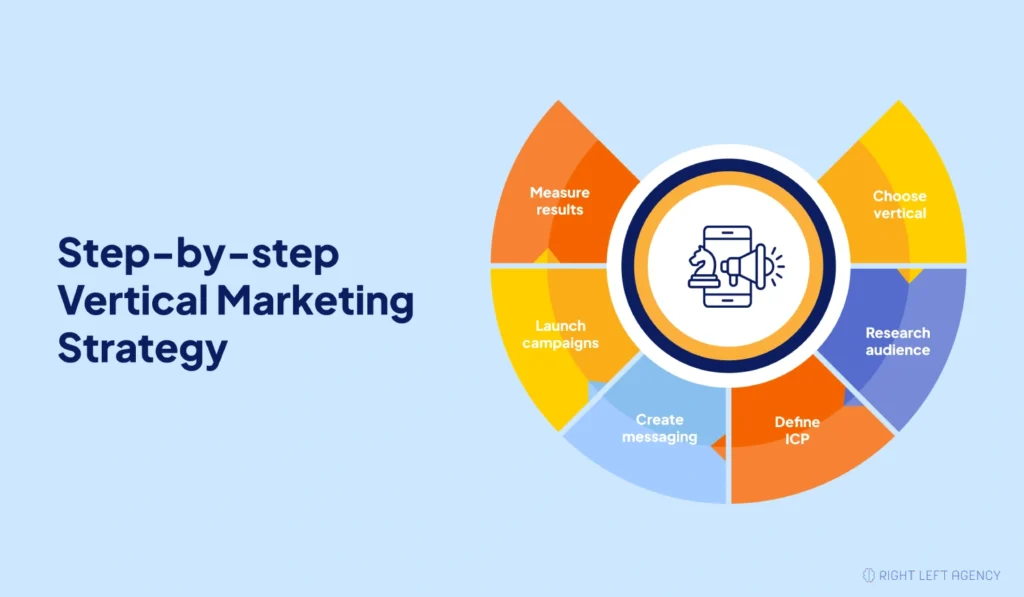
Step 1: Pick the right vertical
Look at your existing customer base. Which industry do your best customers come from? Where is your win rate the highest? Where do you see the best retention? Start there. If you are pre-product, factor in market size, competitive density, and your team’s domain knowledge.
Common mistake: Choosing a vertical purely because it looks profitable. Market size is just one factor. You also need to consider buyer urgency, sales cycle length, your team’s ability to create credible content, and how much competition already exists in that niche.
Step 2: Do deep industry research. Immerse yourself in the vertical. Read the trade publications. Go to conferences. Talk to practitioners. Join the communities. You cannot market well to an industry you do not understand from the inside.
Step 3: Define your ICP in detail. Your ideal customer profile needs to go beyond job title and company size. Here is an example of what a vertical ICP looks like in practice:
Example Vertical ICP: Independent Dental Clinics
- Target vertical: Independent dental clinics
- Company size: 3 to 20 providers
- Buyer: Practice owner or office manager
- Main pain points: Missed appointments, manual scheduling, front desk overload, patient communication gaps
- Buying triggers: Opening a new location, replacing outdated software, hiring more admin staff, and trying to reduce no-shows
- Best channels: Dental associations, local conferences, Google search, peer referrals, LinkedIn groups
- Content topics: Patient reminders, scheduling efficiency, front desk workflows, insurance billing, practice growth
Step 4: Build a tailored value proposition. Avoid generic lines like “streamline your workflows.” Write something that reflects the buyer’s actual situation: “Help dental practices reduce appointment gaps, improve patient reminders, and free up front desk time.” That is specific, believable, and meaningful to the right buyer.
Step 5: Align product, sales, and marketing. Vertical marketing only works when everyone moves in the same direction. Your product team needs to hear what buyers in the vertical actually need. Your sales team needs to use the same language and stories that marketing puts out. Alignment is not optional.
Step 6: Build your messaging framework. Document your positioning statement, key pain points, proof points, objection responses, and customer stories for the vertical. Every piece of content and every sales conversation should draw from the same framework.
Step 7: Launch targeted campaigns. Start with the highest-leverage channels for your specific vertical. That might be LinkedIn for a professional services niche, trade publications for healthcare, or partner channels for fintech. Put your budget where your buyers actually spend time.
Step 8: Measure what matters. Track pipeline from named accounts, conversion rates by industry segment, customer acquisition cost within the vertical, retention rates, and net revenue retention. Use those numbers to double down on what works and cut what does not.
Vertical Marketing Checklist
Use this checklist when you launch or audit your vertical marketing strategy:
Choose one target industry
Identify the top two or three buyer roles
Interview five to ten customers or prospects in the niche
Map the industry’s common pain points and workflows
Build industry-specific messaging and a clear positioning statement
Create dedicated vertical landing pages
Publish niche content and customer case studies
Partner with industry associations or complementary vendors
Track pipeline, conversion rate, CAC, and retention by vertical
Common Challenges in Vertical Marketing (and How to Handle Them)
Limited market size
A niche is, by definition, smaller than the broader market. Before committing to a vertical, estimate the total addressable market: how many target accounts exist, what your average contract value is, and what your realistic win rate looks like. If the vertical is too small, consider an adjacent niche with similar workflows and buyer profiles.
Over-specialization
Going too deep into one vertical can create problems if that industry hits a downturn. Avoid building around one customer’s unique request. Look for patterns across multiple customers in the same vertical and build around what is common, not what is rare.
Expanding to new verticals
After you dominate one niche, moving into adjacent verticals is harder than it looks. Your team’s instincts for the first vertical do not automatically transfer. Document what worked, then approach each new vertical as a fresh market entry.
Industry dependency
When regulatory changes, economic shifts, or consolidation hit your target market, your whole business feels it. This concentration risk is real, especially in regulated industries like healthcare or finance. Building a plan for adjacent verticals early gives you more flexibility later.
Customization vs. scalability
The more you tailor your product and messaging to one vertical, the harder it can be to scale those customizations. Finding the right balance, specific enough to differentiate but not so specific that it creates unsustainable complexity, is an ongoing challenge.
Running multiple verticals at once
Serving more than one vertical well requires dedicated resources for each. Most teams underestimate how much focused effort each vertical really needs. Spreading too thin too early is one of the most common mistakes in vertical marketing.
Key Trends Shaping the Future of Vertical Marketing
Micro-vertical strategies are gaining traction. Companies are going narrower, not broader. Instead of “healthcare SaaS,” the winning pattern is emerging as “software for pediatric physical therapy practices.” A smaller niche means less competition and more buyer trust.
AI is enabling better personalization. AI tools now make it possible to personalize content, outreach, and product experiences at a scale that used to require large teams. One core message can now be adapted into specific versions for clinic owners, operations managers, finance leads, or department heads. That said, AI-generated content gets generic fast without real customer research behind it. Use AI to scale your insights, not to replace them.
Embedded finance is expanding in vertical SaaS. More vertical SaaS companies are adding financial features directly into their platforms, such as payments, lending, and insurance. This creates a new revenue stream and ties the product more deeply into the industry’s core workflows.
Ecosystem-led growth is becoming a primary channel. Instead of relying only on outbound or inbound, more vertical companies are building growth through integrations, partner referral programs, and marketplace listings. The ecosystem becomes the distribution channel.
When Should You Hire a Vertical Marketing Agency?
If your team does not have the bandwidth or expertise to do deep industry research, build niche content, create vertical landing pages, and run ABM campaigns, a specialized agency can fill that gap.
When you evaluate agencies, look for three things: real experience in your target vertical, proof of results with similar companies, and a clear process for turning customer research into messaging and content. Ask to see examples of industry-specific content, landing pages, and campaign strategies. Any agency that only shows generic marketing work without vertical expertise is probably not the right fit.
The agencies below are listed based on their public positioning around B2B SaaS, content, demand generation, SEO, or vertical go-to-market strategy. Before you choose one, review their case studies, check client fit, and verify their experience in your specific industry.
- Right Left Agency specializes in building industry-specific content strategies, vertical landing pages, and thought leadership programs for B2B SaaS companies.
- Refine Labs is known for demand generation in B2B SaaS, with a data-driven approach to vertical GTM and a focus on pipeline quality over raw lead volume.
- Directive Consulting focuses on performance marketing for SaaS and tech, combining paid media, SEO, and conversion optimization.
- Omniscient Digital specializes in content-led SEO for B2B SaaS and is strong at building organic strategies that attract high-intent buyers in niche markets.
- GrowthMentors’ Agency Network connects SaaS companies with vetted growth advisors and agencies that focus on specific verticals.
Wrapping Up
Vertical marketing is a choice to compete on depth rather than reach.
The companies that win in niche markets are not trying to be everything to everyone. They pick one audience, understand that audience deeply, and build their messaging, content, product, and partnerships around what that market actually needs.
If you are just getting started, pick one vertical. Not two. Not three. One. Learn the buyers, talk to customers, build proof that you understand the space, and create content that shows you know it better than the generalists do.
Once you have real traction in that first vertical, you can move into adjacent markets with a clearer strategy and a much stronger foundation.
Frequently Asked Questions
What is an example of vertical marketing?
A software company that markets only to dental clinics is a clear example. Its website, case studies, ads, and product messaging all focus on dental-specific problems like appointment scheduling, patient reminders, insurance workflows, and front desk efficiency. Everything is built for one audience.
What is the difference between vertical and horizontal marketing?
Vertical marketing focuses on one specific industry or niche. Horizontal marketing targets a broad audience across many industries. A CRM built for real estate agents is vertical. A CRM built for all small businesses is horizontal.
What is a vertical marketing system?
A vertical marketing system is a coordinated distribution model where producers, wholesalers, and retailers work together under one system to serve customers more efficiently. This is different from a vertical marketing strategy, which is about targeting a specific niche or industry.
Is vertical marketing only for SaaS companies?
Not at all. SaaS companies use vertical marketing frequently, but so do agencies, consultants, manufacturers, service providers, and e-commerce brands. Any business that serves a specific industry can benefit from this approach.
Why is vertical marketing important in B2B?
B2B buyers want vendors who understand their industry. Vertical marketing lets you speak directly to a buyer’s specific problems, workflows, and goals. That builds trust faster, shortens sales cycles, and improves retention. It also cuts competition because few vendors will have built the same depth of expertise in your chosen niche.
How do you choose the right vertical market?
Start by looking at where you already have traction. Which industry do your best customers come from? Where is your win rate and retention the strongest? Also weigh market size, competitive density, and your team’s domain knowledge. The right vertical is one where you can build genuine expertise and where there are enough potential customers to support your growth.
What are the risks of vertical marketing?
The main risks are a limited market size, heavy dependence on one industry, and the difficulty of scaling beyond your first niche. If the industry you serve takes a hit from regulation or economic pressure, your whole business feels it. Managing this requires planning for adjacent verticals before you actually need them.
Can a company target multiple verticals at once?
Yes, but it takes dedicated resources for each one. Vertical marketing depends on deep industry knowledge, specific messaging, and focused content. Most successful vertical companies start with one niche, prove themselves there, and then expand in a structured way.
What industries benefit most from vertical marketing?
Industries with complex, specialized workflows tend to see the biggest gains. Healthcare, legal, financial services, construction, real estate, manufacturing, and education all fit this profile. The more regulated and specialized an industry is, the more buyers in that space prefer solutions built specifically for them.
How do you create content for vertical marketing?
Start by understanding the industry at a deep level. Read what your buyers read. Talk to practitioners. Map out the challenges, terminology, and goals that define their work. Then build content around those real insights. Workflow guides, practical how-tos, industry benchmark reports, and case studies from recognizable companies in the niche consistently perform well. Every piece of content should feel like it was written specifically for that industry — because it was.