

Key Takeaways
- Sales and marketing alignment helps SaaS teams improve lead quality, pipeline generation, CAC efficiency, and revenue predictability.
- SaaS companies need shared ICP, MQL, SQL, messaging, handoff, and reporting standards to avoid poor-fit leads.
- Misalignment often causes low MQL-to-SQL conversion, wasted paid media budget, unclear attribution, and weak pipeline growth.
- Helpful SaaS content should prioritize user value, clear structure, practical examples, readable formatting, and search intent satisfaction.
- Before publishing, fix formatting, image alt text, internal links, outbound links, grammar issues, and section structure.
A B2B SaaS team can celebrate a calendar full of demo calls on Monday and still hear the same complaint from sales by Friday: “These leads are not the right fit.”
Marketing sees momentum in the dashboard, but sales sees low-intent prospects, poor-fit accounts, and conversations that rarely turn into a qualified pipeline.
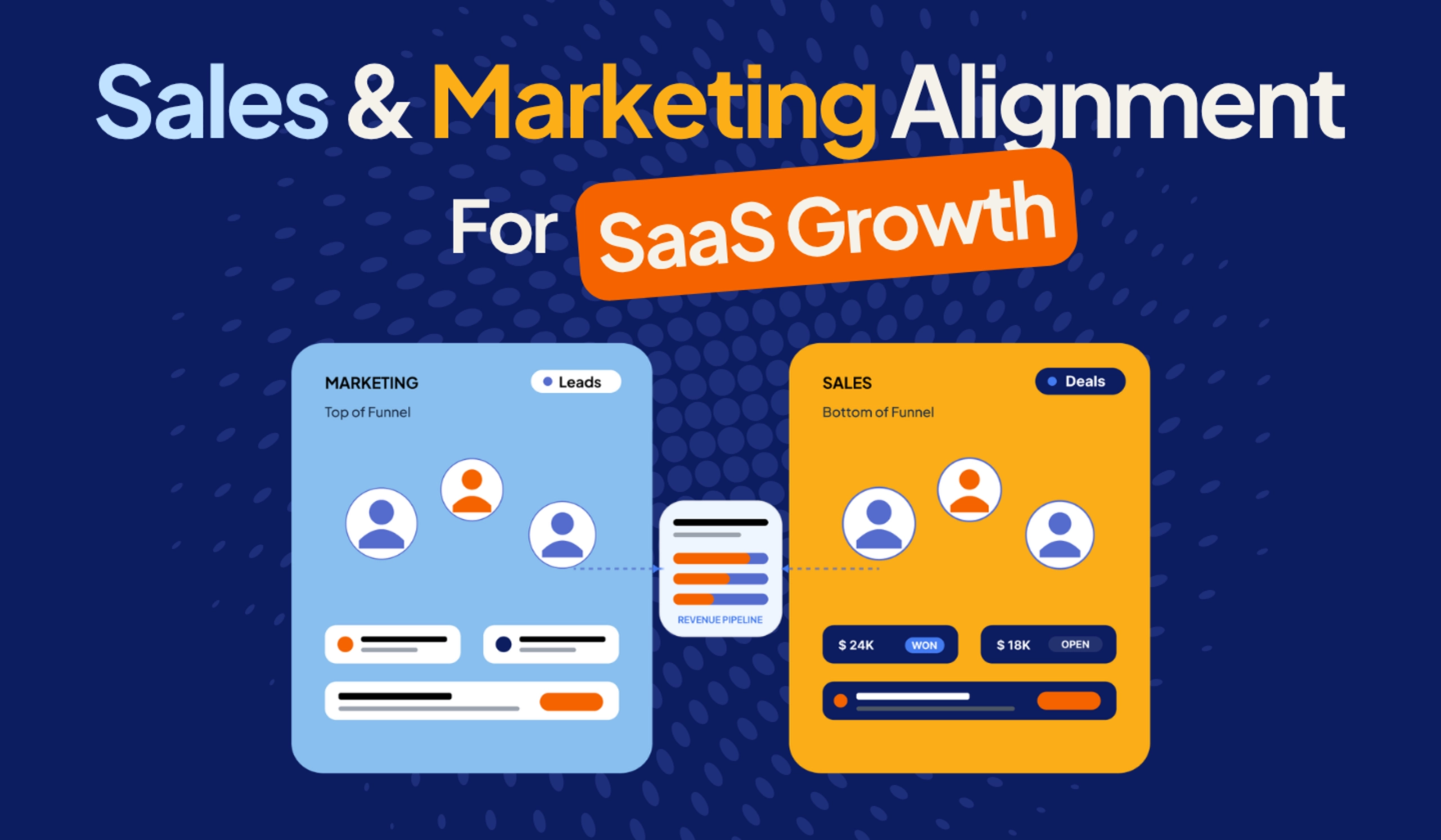
Sales and marketing alignment means both teams agree on the same ICP, qualification standards, messaging, funnel stages, and revenue goals. For SaaS companies, this matters because growth is not built on lead volume alone. It depends on lead quality, qualified pipeline, efficient CAC, stronger MQL-to-SQL conversion, and predictable revenue growth.
What Is Sales and Marketing Alignment?
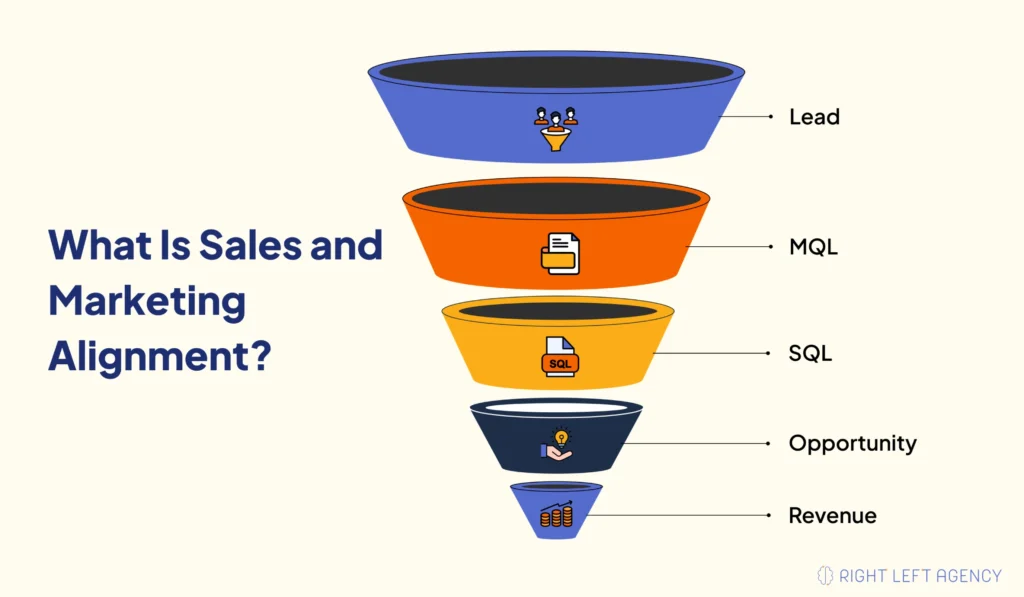
Sales and marketing alignment means both teams work from one shared revenue system instead of chasing separate targets. In SaaS, marketing should not be measured only by how many leads it generates, and sales should not have to spend hours filtering out poor-fit prospects after a campaign goes live. Both teams need the same understanding of who the best buyers are, what makes a lead qualified, how the handoff works, and which numbers actually define success.
Aligned SaaS teams usually share:
- A clear ICP and target account profile
- Shared MQL and SQL definitions
- Consistent messaging across ads, landing pages, emails, and sales calls
- A defined lead handoff process inside the CRM
- Shared reporting around pipeline, CAC, and revenue
- Sales feedback loops that help marketing improve targeting, offers, and campaigns
When these pieces are in place, marketing and sales stop working like two separate departments. They become part of the same growth engine, focused on attracting, qualifying, and converting the right buyers.
Why Sales and Marketing Alignment Matters in SaaS
Alignment matters more in SaaS because SaaS growth depends on recurring revenue, not one-time purchases. Buyers often compare multiple platforms, involve several decision-makers, request demos, test free trials, and think carefully about long-term ROI before they commit.
That makes a qualified pipeline far more important than raw lead volume. Poor targeting can fill the funnel with the wrong prospects. Weak feedback from sales can leave marketing optimizing campaigns around the wrong signals. But when both teams work from the same playbook, the company can reduce waste, improve conversion rates, and make revenue more predictable.
SaaS companies need alignment because of:
- Longer SaaS sales cycles
- Multiple decision-makers and buying committees
- Demo, trial, and product-led conversion paths
- Recurring revenue tied to ARR, retention, and expansion
- Pressure to reduce CAC and improve CAC payback
- Continuous demand for high-quality B2B SaaS pipeline generation
- The need for a consistent buyer journey from first click to sales conversation
Note: Because SaaS revenue depends on long-term customer value, poor-fit leads do more than waste sales time. They can increase CAC, weaken retention potential, and make revenue forecasting less reliable.
What Happens When Sales and Marketing Are Misaligned?
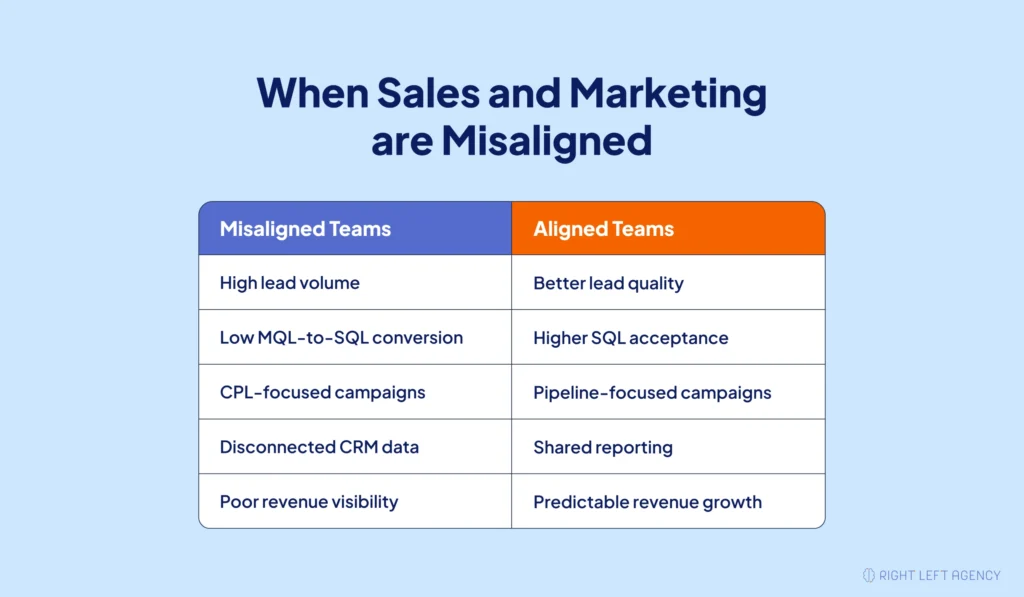
When alignment breaks down, the symptoms show up across the entire SaaS funnel. Lead quality drops, MQL numbers may rise without meaningful SQL growth, paid campaigns spend money on the wrong audience, and CRM reporting becomes too unclear to show which channels are actually creating pipeline and revenue. Here are the most common signs of misalignment and how they affect SaaS pipeline performance.
Poor Lead Quality
Poor SaaS lead quality usually happens when marketing is pushed to generate more leads while sales need better-fit buyers. A campaign may look successful on the surface, but if the leads do not match the ICP, show little buying intent, or lack decision-making power, they are unlikely to become qualified opportunities.
Common causes include:
- Broad targeting that attracts irrelevant accounts
- Weak ICP filters and unclear buyer intent signals
- Leads are not a strong SaaS fit
For example, if a project management SaaS company targets every small business owner, it may generate many leads but few qualified opportunities. A better approach would be to define whether the best-fit customer is a 50–500-employee operations team, a funded startup, or an enterprise department with a clear workflow pain.
Low MQL-to-SQL Conversion
Low MQL-to-SQL conversion often means marketing and sales are using different definitions of a qualified lead. Marketing may treat a webinar signup, ebook download, or newsletter form fill as an MQL, while sales may only accept an SQL when there is a clear account fit, budget potential, urgency, or demo intent.
Without shared qualification criteria, sales follow-up becomes inconsistent, and the funnel becomes difficult to trust. A clear agreement on MQL, SQL, and opportunity definitions helps SaaS teams improve lead conversion and build a more reliable pipeline.
For example, a webinar signup should not automatically become an MQL unless the lead also matches the ICP, shows relevant intent, or comes from a target account.
Wasted Paid Media Budget
Paid media becomes expensive when campaigns are optimized for cheap leads instead of a sales-ready pipeline. A low CPL can look impressive in a dashboard, but it does not help the business if those leads never become SQLs, opportunities, or customers.
Misaligned paid media often creates:
- CPL-focused campaigns instead of pipeline-focused campaigns
- Poor audience targeting across Google Ads, LinkedIn Ads, and Meta Ads
- Landing pages that do not match sales conversations
- No sales feedback loop to improve campaign optimization
For SaaS companies already investing in acquisition, alignment helps reveal where the real issue is hiding: traffic quality, landing page conversion, lead qualification, sales response time, or follow-up quality.
Quick fix: Review paid media performance by SQL rate, opportunity rate, and pipeline value instead of CPL alone. Then use sales feedback to refine targeting, landing page messaging, and qualification criteria.
Unclear Reporting and Attribution
Without shared reporting, it is hard to know which campaigns are actually producing a qualified pipeline and revenue. Marketing may report clicks, impressions, and form fills, while sales focuses on opportunities, win rates, and closed deals.
The problem becomes even bigger when the CRM, analytics tools, and campaign platforms are not connected properly. Tools like HubSpot, Salesforce, and Google Analytics 4 can support better reporting, but only if both teams agree on funnel stages, source tracking, and revenue definitions.
For example, marketing may report that LinkedIn Ads generated 200 leads, but if the CRM does not show how many became SQLs, opportunities, or customers, the team cannot tell whether the campaign actually created revenue.
How Alignment Improves SaaS Growth
Strong alignment helps SaaS companies grow by getting both teams focused on the same buyers, qualification standards, and revenue outcomes. Instead of treating marketing campaigns and sales follow-up as separate activities, the company can build one connected growth system where every channel is judged by pipeline quality and financial impact.
When both teams work from the same playbook, marketing can attract better-fit leads, and sales can follow up with more context. Revenue leaders can also make smarter budget decisions because they can see which channels are driving real opportunities, not just activity.
| Alignment Area | Growth Impact |
|---|---|
| Shared ICP | Attracts better-fit leads |
| Clear MQL/SQL criteria | Improves lead qualification |
| Consistent messaging | Creates a smoother buyer journey |
| Sales feedback loop | Helps marketing improve campaigns |
| Shared reporting | Connects campaigns to pipeline and revenue |
For a broader acquisition plan, SaaS teams can explore SaaS lead generation strategies to connect targeting, content, paid media, and conversion strategy.
Key Areas Where Sales and Marketing Teams Need to Align
A strong alignment strategy should be practical, not theoretical. Both teams need clear agreements that shape targeting, campaign planning, lead handoff, reporting, and revenue decisions. The goal is to remove guesswork from the funnel so everyone understands which buyers matter and how those buyers should move from first touch to closed revenue.
- ICP and target accounts: Both teams should agree on best-fit industries, company sizes, roles, pain points, and buying triggers.
- Lead qualification criteria: Marketing and sales should define what makes a lead ready for follow-up.
- Funnel stage definitions: Everyone should understand the difference between lead, MQL, SQL, opportunity, and customer.
- Messaging and positioning: Ads, landing pages, nurture emails, and sales calls should speak to the same buyer pain points.
- CRM and reporting: Both teams should track the same pipeline and revenue metrics.
- Feedback cadence: Sales should regularly tell marketing which leads convert and which do not.
- Campaign goals: Both teams should agree whether a campaign is meant to generate awareness, demo requests, SQLs, pipeline, or expansion opportunities.
For teams struggling with weak-fit demand, reviewing B2B SaaS lead generation challenges can help identify where qualification and pipeline gaps begin.
Alignment Metrics to Track
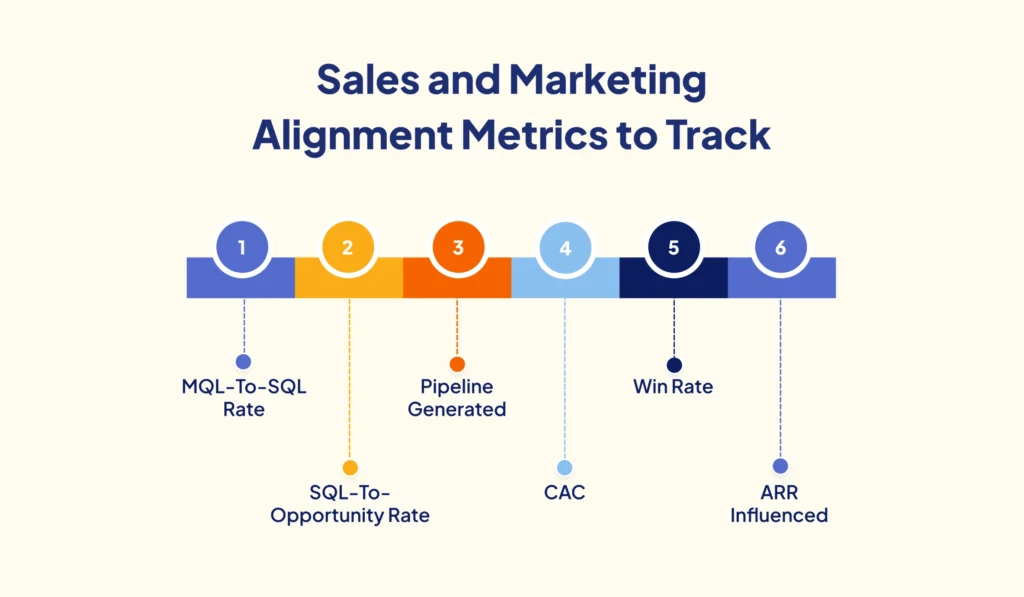
Alignment should be measured with pipeline and revenue metrics, not only marketing activity metrics. Leads, clicks, and impressions can be useful early indicators, but SaaS leaders need to know whether campaigns are creating real buying conversations, qualified opportunities, and efficient customer acquisition.
The best metrics show whether the company is attracting the right buyers, moving them through the funnel, and converting them into revenue at an efficient cost.
| Metric | What It Shows |
|---|---|
| MQL-to-SQL conversion rate | Whether marketing leads are sales-ready |
| SQL-to-opportunity rate | Whether qualified leads create a pipeline |
| Lead response time | How quickly does the sales team follow up |
| CAC | How efficiently the company acquires customers |
| Pipeline generated | Revenue potential from sales and marketing activity |
| Win rate | Whether the team is attracting the right buyers |
These metrics help revenue leaders see whether acquisition spend is creating high-quality opportunities or simply producing more activity. For SaaS companies, CAC, CAC payback, win rate, and pipeline value are much better indicators of healthy growth than lead volume alone.
How to Improve Alignment in SaaS Teams
Before changing campaigns, SaaS teams should review:
- Which channels generate the highest SQL rate
- Which campaigns generate the most pipeline
- Which ICP segments close fastest
- Which lead sources sales rejects most often
- Which landing pages create qualified demo requests
Improving sales and marketing alignment in SaaS starts with shared definitions, shared data, and shared accountability.
- Step 1: Audit where the funnel is breaking. Before changing anything, review which channels produce the highest SQL rate, which lead sources sales rejects most often, and which campaigns generate pipeline versus activity. This tells you whether the problem is targeting, qualification, messaging, or handoff.
- Step 2: Write a shared ICP document that both teams sign off on. Include best-fit industries, company size ranges, buyer roles, core pain points, and explicit disqualification rules. This document should live in the CRM and get reviewed quarterly as the market shifts.
- Step 3: Set MQL and SQL definitions in writing. Specify the exact criteria a lead must meet before it becomes an MQL, and what additional signals move it to SQL. Tie these to lead scoring rules in the CRM, so the process runs consistently, not based on individual judgment calls.
- Step 4: Align campaign messaging to sales conversations. Pull the top three objections sales hear on discovery calls. If those objections are not addressed in ads, landing pages, or nurture emails, realign the messaging before scaling spend.
- Step 5: Document the lead handoff process. Define exactly when a lead transfers to sales, who is notified, what information travels with it, and what the expected response time is. Vague handoffs are where qualified leads go silent.
- Step 6: Build one shared pipeline dashboard. Track MQL-to-SQL rate, SQL-to-opportunity rate, pipeline value by channel, CAC, and win rate — all in one place, so both teams can review together. Separate dashboards create separate realities.
- Step 7: Run a monthly lead quality review. Sales reports back to marketing on which leads converted and which did not. Marketing uses that input to refine targeting, update scoring, and adjust offers. This loop is what keeps alignment from degrading back into silos after the first quarter.
The goal is not to create more meetings. It is to build a cleaner revenue funnel where marketing understands what sales can close, and sales understands which campaigns are creating genuine buyer interest.
How Alignment Supports a Pipeline-Focused Paid Media Strategy
Paid media for SaaS performs better when sales and marketing agree on the audience, offer, lead quality standards, and success metrics. A campaign should not be judged only by CPL; it should be judged by how effectively it creates qualified SQLs, opportunities, pipeline, and revenue.
This matters because different paid channels often attract different types of intent. Google Ads may capture buyers already searching for a solution, while LinkedIn Ads may help reach specific accounts, roles, or buying committees earlier in the journey. Remarketing can bring interested visitors back, but only strong alignment can show whether those interactions are leading to the pipeline.
Alignment improves paid media through:
- Better audience targeting based on the shared ICP
- Stronger landing page messaging tied to sales conversations
- Better lead qualification before sales follow-up
- More useful feedback from sales on lead quality
- Optimization beyond CPL toward CAC, pipeline, and revenue
- Clearer reporting across remarketing, search, and paid social
SaaS teams investing in paid acquisition can also review resources on paid media for SaaS companies or work with a B2B paid search agency that understands pipeline quality, not just lead volume.
Common Alignment Mistakes to Avoid
Bad teams do not cause most alignment problems. They happen because definitions are unclear, tools are disconnected, and different goals are measured by departments. Over time, those gaps make SaaS pipelines harder to predict and more expensive to grow.
Avoid these common mistakes:
- Measuring marketing only by lead volume: This can make campaigns look successful even when they are not creating a pipeline.
- Optimizing only for CPL: Cheap leads can become expensive if they never convert into SQLs or customers.
- Letting sales and marketing define ICP separately: This creates poor-fit campaigns and inconsistent follow-up.
- Ignoring sales feedback: Marketing may keep scaling campaigns that sales already know are producing weak leads.
- Using disconnected CRM data: Teams cannot see which campaigns actually influence revenue.
- Sending every lead through the same follow-up: High-intent demo requests and low-intent content downloads need different treatment.
- Reporting activity instead of pipeline and revenue impact: Clicks, impressions, and lead volume can look positive even when campaigns are not creating qualified opportunities.
Conclusion
Sales and marketing alignment is crucial for SaaS growth because it turns isolated work into one shared revenue system. When SaaS teams agree on ideal customers, qualification criteria, messaging, lead handoff, and reporting, they improve lead quality, build a stronger pipeline, reduce wasted CAC, and make revenue more predictable.
Instead of treating marketing and sales challenges as separate problems, SaaS leaders should use alignment to create a unified acquisition process. As a specialized SaaS marketing agency, Right Left Agency helps SaaS companies build paid media systems focused on a qualified pipeline, not just lead volume.
Pro Tip: For SaaS teams already investing in acquisition but struggling to turn leads into pipeline, the issue is often not traffic volume. It is the alignment between targeting, qualification, and sales follow-up.
Frequently Asked Questions
What is sales and marketing alignment?
Sales and marketing alignment means both teams share the same ICP, qualification criteria, messaging, funnel definitions, and revenue goals. In practice, marketing understands which buyers sales wants to reach, and sales understands how marketing attracts and nurtures those leads. Strong alignment also requires clean CRM data, shared MQL/SQL definitions, and metrics tied to revenue performance.
Why is sales and marketing alignment important in SaaS?
Sales and marketing alignment is important in SaaS because longer sales cycles, multiple stakeholders, and recurring revenue models require better lead quality and pipeline consistency. SaaS companies should not focus only on generating more leads. They need campaigns that target the right accounts, sales follow-up that converts buyer interest, and reporting that connects demand generation to CAC, ARR, and revenue growth.
What happens when sales and marketing are not aligned?
When sales and marketing are not aligned, SaaS companies often face poor lead quality, low MQL-to-SQL conversion, paid media waste, weak attribution, and an unreliable pipeline. Marketing may generate activity while sales struggle to find qualified buyers. Without shared CRM data and funnel definitions, leadership cannot clearly understand which channels generate opportunities and revenue.
How can SaaS companies improve sales and marketing alignment?
SaaS companies can improve sales and marketing alignment by creating a shared ICP, setting clear MQL and SQL definitions, building CRM dashboards, creating sales feedback loops, and focusing on pipeline reporting. Useful best practices also include lead scoring, RevOps support, documented handoff processes, and regular pipeline reviews between marketing and sales leaders.
What metrics measure sales and marketing alignment?
The most important metrics include MQL-to-SQL conversion rate, SQL-to-opportunity rate, average lead response time, CAC, pipeline generated, win rate, and revenue influenced by marketing activity. These metrics show how effectively marketing attracts the right leads and how successfully sales converts them into opportunities and customers. For SaaS teams, pipeline and revenue metrics matter more than lead volume alone.